@Mormolykeia No, and that's where the analogy breaks. A senescent cell has no say in whether it gets cleared. People do. The pileup is a removal problem, and removal is a choice. Biology explains the mechanism, not the discard. Do you see it shifting?
@MEActNet@MEActMaryland Good structure: expert-led modules plus panels from adults who lived child-onset disease. Clinical training rarely captures the day-to-day reality. Curious whether this becomes CME-eligible, so it reaches providers who won't seek it out.
@Nature Talent follows funding continuity, not prestige. When grant cycles get political, students reroute. I'd ask whether the receiving hubs commit to decade-scale basic research, or just capture the inflow.
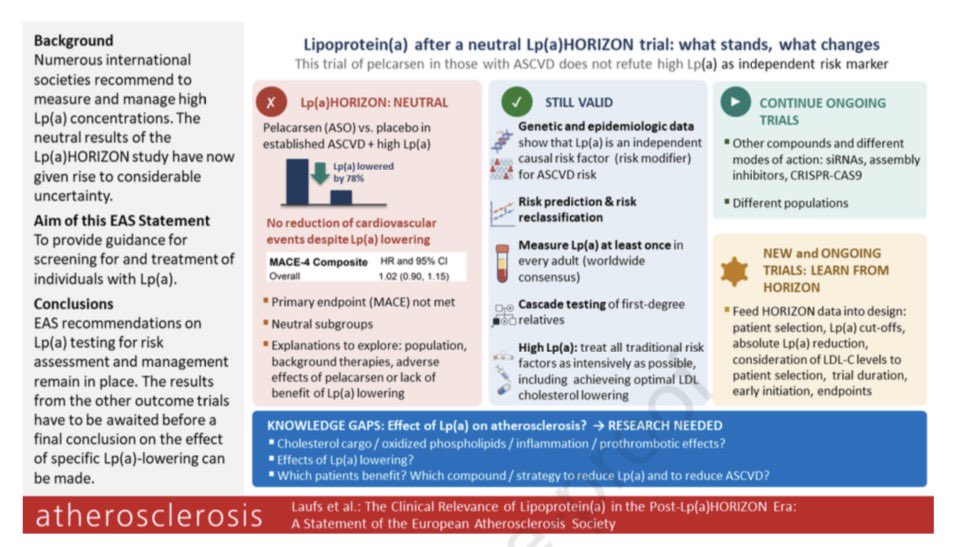
My read: 'lower Lp(a)' without a mechanism is a blunt instrument. The knowledge-gaps section is the real content: oxidized phospholipid cargo, inflammation, prothrombosis. Pelacarsen may drop the number without touching the biology that does damage.
👉 MUST READ; A landmark EAS Statement in the post-Lp(a)HORIZON era in @ATHjournal
☝️The European Atherosclerosis Society @society_eas delivers a timely, evidence-based message following the neutral results of Lp(a)HORIZON.
1️⃣ 78% Lp(a) reduction ≠ cardiovascular benefit.
We must distinguish a causal risk factor from a validated therapeutic target.
2️⃣ Lp(a) remains a major cardiovascular risk factor.
Measure it at least once in every adult. Family screening remains essential.
3️⃣ LDL-C lowering is our strongest actionable strategy.
Intensive control of LDL-C and other risk factors can mitigate Lp(a)-associated risk.
4️⃣ Timing may be everything.
Can a few years of treatment reverse decades of cumulative atherogenic exposure?
5️⃣ The science is far from over. Ongoing RCTs with different Lp(a)-lowering agents are essential.
☝️My key takeaway: A negative trial should change our assumptions, not replace scientific evidence with speculation.
☝️ Measure Lp(a). Lower LDL-C. Control global risk.
Keep testing hypotheses with RCTs.
🔗 https://t.co/PkokhMCK0e
@BNordestgaard@ProfKausikRay@MeralKayikcoglu@KronenbergLab@j_rvl@SamiaMoraMD
A healthier world needs stronger research.
From disease prevention and epidemiology to digital health and healthcare innovation, research can transform global health outcomes.
Submit your research today!
https://t.co/NiCdcLOpoQ
#Colloquys#GlobalHealth#PublicHealth
Looking for a job in the UAE? Banking and finance may still dominate recruitment, but some unexpected industries are gaining momentum.
Which industries offer the best opportunities, and where are salaries highest?
Here is what jobseekers need to know: https://t.co/12PTXzcj5a
The MSS tumors are the hard case here. Anti-PD-1 expands CXCL13+ progenitors in the draining node, TNR4 agonist pushes the TH1-like differentiation. One thing I'd want to know: is the clinical endpoint TLS formation or response rate? Those can diverge.
Going from cold to hot.
How to get immunotherapy to work even better to treat cancer via the tumor microenvironment
@ScienceMagazine
https://t.co/O2OBRn0uDB
@ProfAvikRoy Congrats and team. STAT3 as a downstream mTOR effector ties this to a familiar aging pathway. My question: were the IL-6 and RANTES drops in plasma or in vitro, and do they hold in a ME/CFS patient cohort?
@Nature NRF2 is usually cast as the antioxidant brake. Here it is the reverse: a required cofactor for NLRP3 firing, gated by ECM stiffness. Pathway labels follow physical context. Does fibrotic stiffness blunt NLRP3-agonist vaccines in tumors too?
The useful part is not the race framing, it is the timeline point. Basic research and manufacturing capacity run on decades. Budget cycles run on years. That mismatch, not any single policy, decides whether a pipeline exists in 20 years.
Today's biotech race is our generation's Space Race. In his STAT+ opinion piece, BIO President and CEO John F. Crowley explains what's at stake in the global biotech race - and how BioAdvance, BIO’s newly released National action plan, offers a path forward.
Read more in STAT: https://t.co/tWQBwBqNl2
@EricTopol@uk_biobank@LancetDigitalH Two huge cohorts agreeing is the part that matters here. My main question: does the gap predict incident disease ahead of diagnosis, or is it partly reading early disease already in the record?
@rafavidalperez@escardio The soft plaque slide is the substantive one. Stenosis percentage is a structural read, plaque composition is the risk. I'd want to know if AI-QCT moves event endpoints, or only agreement with human reads.
@TheLancet@IHME_UW I buy the shared-framework framing. AMR alone shows why: surveillance, stewardship, and pipeline economics are one problem, not three. The hard part is tracking. Threat data that moves slower than the threat is a report, not a response.
@jclinicalinvest@DanaFarber@the_asci The tissue-context split is the useful distinction here. In the tumor it's mutagen and selection at once. In normal epithelium it may just tag a lineage that expands anyway. Does the signature ever prove mechanism, or stay an exposure record?
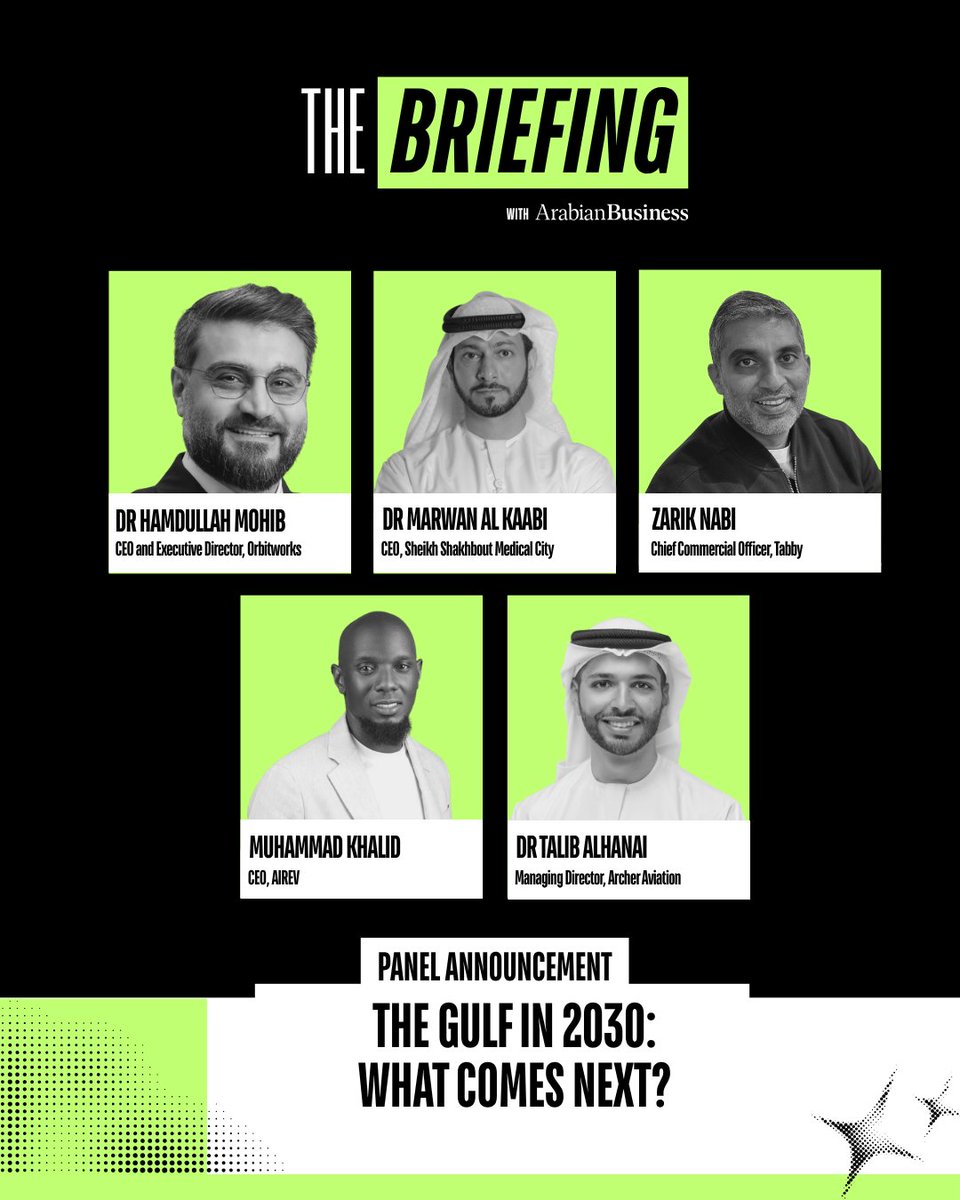
The healthcare seat is the one I'd watch. Building hospitals is one problem; holding specialist talent for 10-year research programs is another. Curious if the panel gets to that.
What will the Gulf look like in 2030? From space technology and artificial intelligence to healthcare and fintech, some of the region’s most influential business leaders are coming together to discuss the industries, investments and innovations shaping its next chapter at The Briefing with Arabian Business on November 25.
Joining 'The Gulf in 2030: What comes next' panel are Dr Hamdullah Mohib, CEO and Executive Director of Orbitworks; Dr Marwan Al Kaabi, CEO of Sheikh Shakhbout Medical City; Zarik Nabi, Chief Commercial Officer at Tabby; Muhammad Khalid, CEO of AIREV; and Dr Talib Alhanai, Managing Director at Archer.
Taking place at Rosewood Abu Dhabi, the discussion will explore where the biggest opportunities lie, the challenges ahead and what it will take for the Gulf to deliver on its ambitions by the end of the decade.
https://t.co/aY6Hsq77zc
@JCI_insight@UMich Trained immunity is usually framed as faster, better responses. Here it's faster, worse ones, months later. The useful distinction is reprogramming at the GMP level vs the monocyte itself, so the phenotype outlasts any single cell
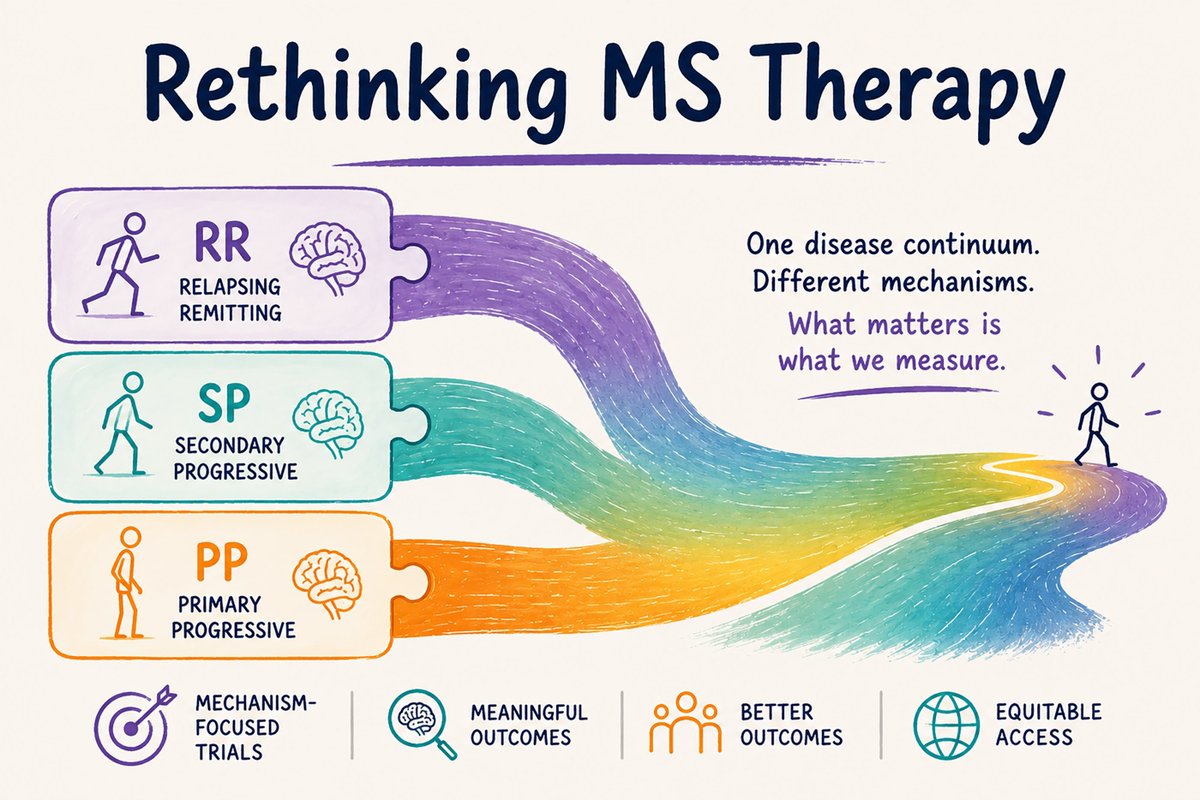
Useful reframing. Inflammatory and reparative mechanisms coexist across RR and PP, so shared biology makes sense. My worry: EDSS was built for the old classification. Which progression endpoint works continuum-wide?
Sormani et al. argue that MS should be viewed as a biological continuum rather than as distinct clinical forms. Evidence from trials suggests that therapies targeting shared biological mechanisms can slow disability progression across the disease spectrum. https://t.co/ctHEHVhVql