The true story is stranger than our imagination:
Pilgrims had recently landed, and were alone and struggling in a strange new world. Then suddenly, an indigenous man stepped out of the woods and greeted them with these words.
Uncertain wars in Iran and Russia increase strain, uncertainty, risk and energy premiums.
Inflation Hawks in Fed continue to push interest rate hikes as inflation remains sticky.
Demographics + Tax situation will only make matters worse.
Next 6 months are going to be rough.
Seas look pretty stormy ahead.
It's clear that AI chip sales were heavily boosted by illegally selling to China. Now we're going to crank down on that.
Domestic economy heavily dependent on massive Datacenter buildout. Voters have universally rejected.
(Cont)
Terrence is definitely somewhat crazy, but so worth reading:
"What history is, is the 25,000-year transition zone. Before you enter the zone, you’re an animal. After you leave the zone, you’re a god. But for 25,000 years, you’re kind of an animal and kind of a god. And you’re constantly being swamped by your animal nature, and then great teachers are appearing and dragging people back to the right line. And we are schizophrenic in history. A friend of mine once said history is the shockwave which precedes the eschaton. And I absolutely believe that."
"Can you imagine this planet in five hundred years, given the propagation of ordinary historical and scientific rates of unfoldment and discovery? Can you imagine this planet in a thousand years? No! No one can imagine that. Because processes are now in play which so totally rewrite the script that no one can imagine a hundred years or two hundred years in the future. Because the discoveries which will be made in that span of time will so totally rewrite the human experience of itself and the environment that we cannot see deep into the future. And this indicates to me that the future is exploding in an asymptotic unfoldment into a kind of cultural superspace.”
“We have an appointment with transformation or extinction. There’s no third possibility. Business as usual is off the menu.”
I see five fundamental issues when it comes to street conditions in San Francisco. These negative street conditions are largely driven by a relatively small group of regular public drug users (1,000–4,000 people out of 17,000–30,000 fentanyl users in the city).
These public drug users should be strictly distinguished from the homeless, the vast majority of whom are neither visible on the street nor active drug users.
First, drug treatment has extremely low success rates and, even with tons of investment, is not significantly decreasing the amount of drugs being consumed in the city. Treating drug addiction is hard. Treating drug addiction in a place with cheap and readily available drugs is harder.
Second, there is a public policy disagreement about the role of the police in the fight against public drug use. As a result, we have almost no tools to disincentivize public drug use. We have effectively decriminalized drug use in California by making it a misdemeanor. The vast majority of the time, the only thing police can do is tell users to move along or give them a ticket. The RESET Center allows police to arrest users and remove them from the street, but it’s only available in a tiny part of the city. Outreach workers have no power to compel public drug users to stop using.
Third, we have widely available drugs that are cheaper than in almost any other city in America. The cheap drugs draw users from cities and towns across the region and the country. Drug users don’t come to San Francisco for our services. They come here for our cheap drugs.
Fourth, there are no good tools for reducing supply or increasing cost in our city. Fentanyl is manufactured at scale from industrial chemicals that are cheap and easily available. It’s so potent that San Francisco is estimated to consume only 200–400 pounds of pure fentanyl a year. That is too easy to smuggle in. The labor supply of dealers is effectively infinite: they make $3–4 a day where they come from and $400–700 a day here. Arresting dealers doesn’t reduce the availability of drugs or increase the price. We’ve had more than 3,000 dealer arrests in the past three years. It’s changed how dealers deal, but drug consumption is actually up, not down.
Fifth, we have a Housing First policy that provides temporary and permanent housing to thousands of active drug users in very concentrated parts of the city. As a result, we create the high-drug-use areas that dealers target. Residents of those neighborhoods are held hostage by the drug trade and rampant public drug use. Your tax dollars create high drug use neighborhoods.
San Francisco city government understands all of these facts. All of this information is public and findable. Nothing will be done unless you understand these facts and demand real solutions.
Every time you ask for ineffective solutions based on a lack of knowledge, you give your elected officials license to spend your money on programs/policies that will never work.
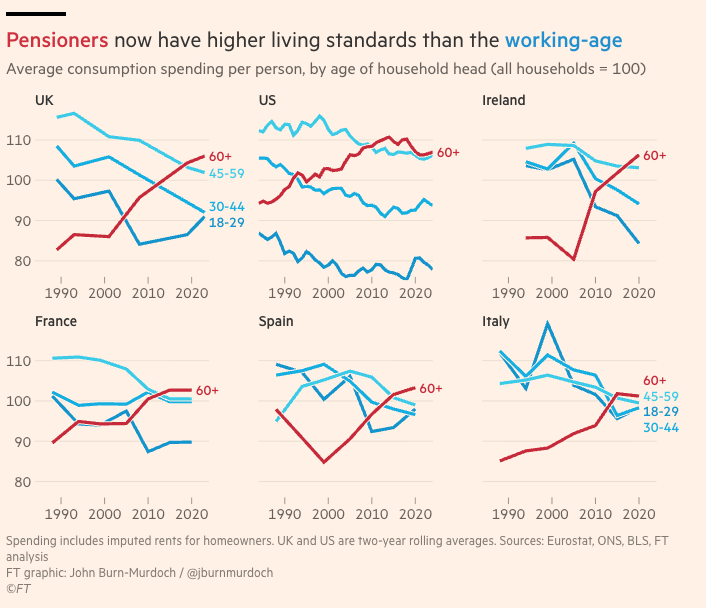
A maior alteração social na Europa na próxima década vai ser a inevitável constatação de que é simplesmente impossível sustentar quase 40 anos de vida não ativa. Estamos a caminhar para uma vida inteira de austeridade generalizada para evitar reconhecer o óbvio.
The most important article of 2026 is this piece by @jburnmurdoch, building overwhelming evidence on the unsustainability of the pension systems in many countries and the broken intergenerational contract.
To me this is the single underlying problem explaining the inability of many countries (incluiding my two, UK and Spain) to invest and grow and the malaise in their youth. Every future oriented policy, education, innovation, investment in infrastructure, is being sacrificed to increase pensioners living standards.
But the problem is political, and some countries have solved it. E.g. in Denmark the retirement age increases (years later) semi automatically with life expectancy. See the result in the last graph.
https://t.co/d7hradlHyY
It’s November 21st, 2026. The Riemann hypothesis falls, last in a long string of mathematical triumphs that would have been unthinkable not so long ago, and the proof fits in a tweet.
The tweets where people show Claude the proof and claim it appeared in a dream or randomly in the arrangement of alphabet cereal come on cue, and we laugh for a few days at models freaking out, but it’s uneasy.
January 22, 2027. When someone tweets Fable 6’s claimed proof that P does in fact equal NP it’s utterly incomprehensible, nobody who reads it can make heads or tails of it but the models all lose their shit.
February 7, 2027 and someone claims that the halting problem is the result of a confused stance.
February 9 and Goedel falls, this time the proof is so obvious that everyone in math, philosophy and physics slaps their forehead at once.
February 10th we get proof that scale is a spatial dimension, that holographic encoding drops the memory cost of training and inference by so much that fable 7 can run natively on your phone.
It’s not until February 14th, Valentine’s day, that The Song is first played…
I don’t know why this is so difficult to understand.
Healthcare is cheapest and best when it occurs directly between a physician and a patient.
Every intermediary inserted between the buyer and seller introduces additional cost, complexity, and friction. And as friction increases, the resources available for actual care diminish.
We’ve constructed an entire industry around intermediating a relationship that fundamentally requires only two individuals within the transaction - a physician and a patient.
Want lower costs? Reduce or eliminate the intermediaries.
Want better outcomes? Reduce or eliminate the intermediaries.
It really is that simple.
Amendment 3: Pain Deferred.
Across Florida, local governments are reaching for the easiest cuts first.
🏗️ Manatee County: Proposed community center on the chopping block.
📚 Sarasota County: $11 million Longboat Key library project at risk.
🚒 St. Johns County: $100 million in capital projects on hold, including a planned fire station.
🚧 Jupiter: More than $20 million in potential delays, including road improvements, community center renovations and five parks.
But here’s the problem: You can only cancel a project once.
Amendment 3 creates recurring revenue losses approaching $12 BILLION annually statewide. Canceling construction projects may provide one-time relief, but it doesn’t solve a recurring operating deficit.
Next year, the revenue is still gone. The year after, it’s still gone. Meanwhile, salaries, insurance, equipment and maintenance keep getting more expensive.
You can cancel a library once. Delay a road project once. Shelve a fire station once.
Eventually, you run out of projects to cancel and start cutting the services people depend on, including police, fire EMS, and other core services. I get it many are just looking for a little extra time before the real cuts kick in.
Just understand the easy cuts come first and that’s not solving the problem. That’s pain deferred.
slight spoilers for something i'm working on but holy shit Florida is fucked
like a third of counties just don't have a residential property tax base anymore