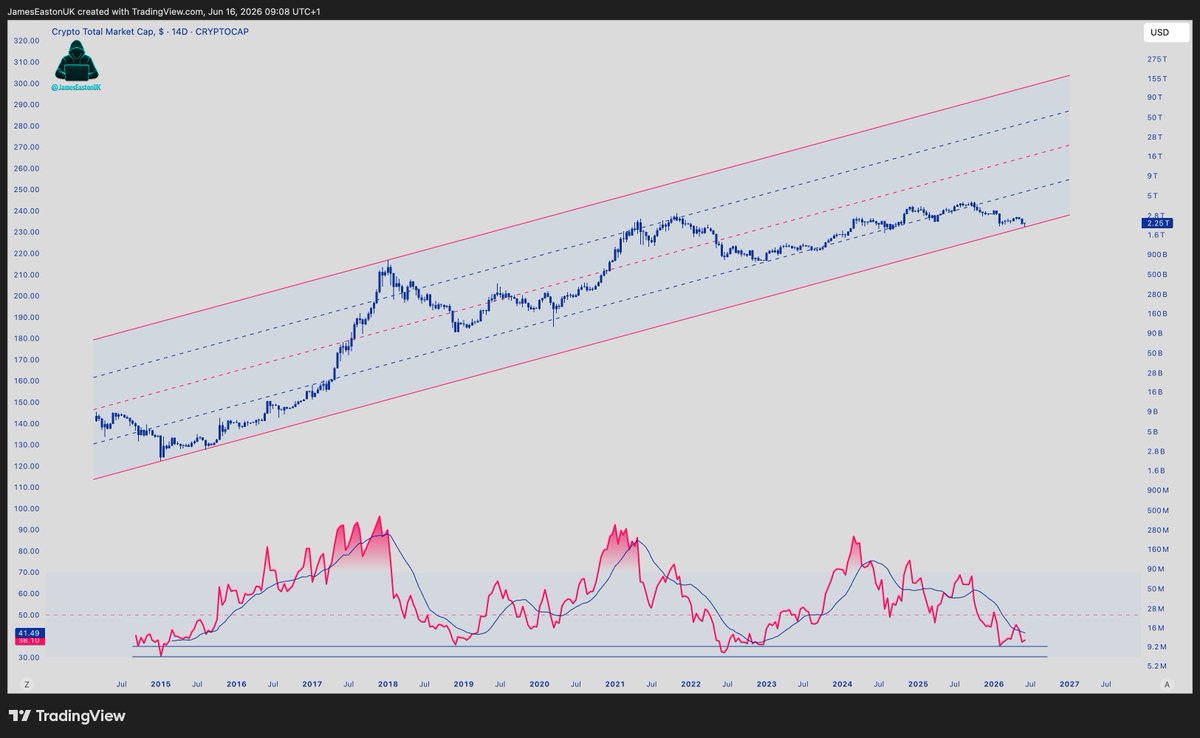
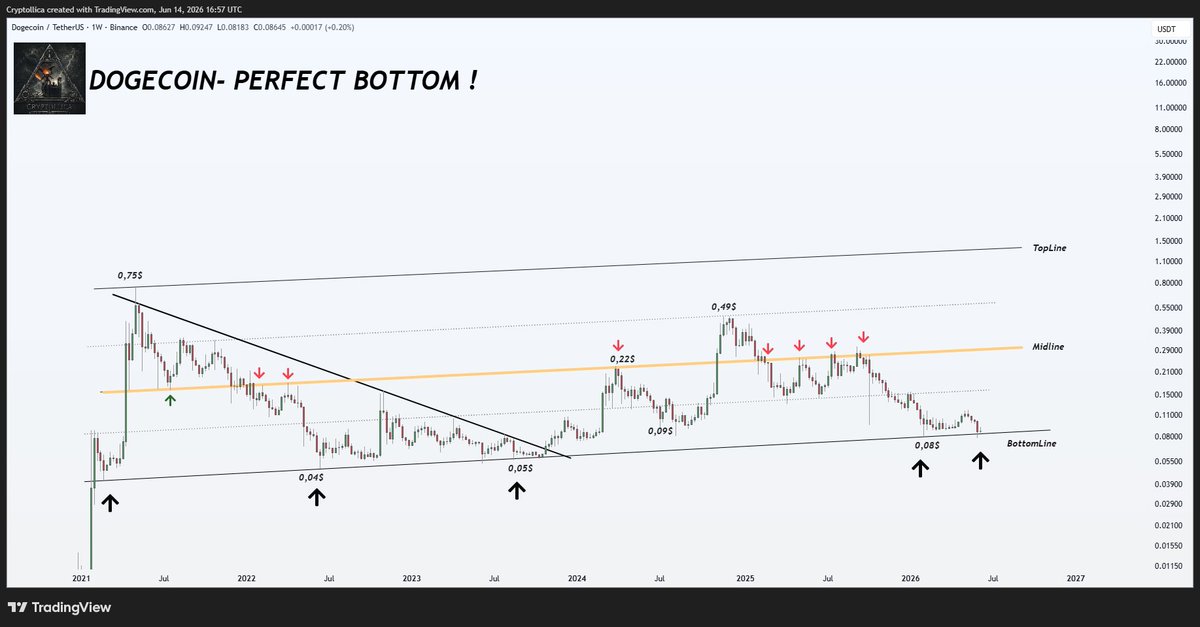
Bitcoin has always been operating in 4 year cycles where it crashes at the end
2014, 2018, 2022, 2026
It's actually great because every 4th year people really get super sad and give up on it (or well that's how it feels like)
There's also surely some sentiment pumping to push the price down so people can buy in cheap again
The next cycle up is 2027-2031
(And it has something to with the halvening which happens every 4 years cutting the reward for miners in half)
"I like to play sports, go to the club, hang out with my friends and drink wine. I'm not sitting here analyzing every report and watching the chart 24/7."
I sat down with Arthur Hayes (@CryptoHayes) founder of @BitMEX, one of the most-read macro voices in crypto and asked him the thing I actually wanted to know: how do you stay this calm in a market this loud?
His answer was the opposite of what most traders preach.
"You have to have a philosophy that fits your lifestyle. I'm not trying to trade the one-minute
candle on 100x leverage. That's not me."
"Every financial crisis, 1873, 1907, 2008, there are those who are liquid and those who are not. If you're liquid, you buy quality assets cheap. That makes your whole career."
"Get 2008 right and you killed it, you could get every single investment after that wrong and still be rich. There are many people like that."
What stuck with me: he's not trying to be right every month. He's trying to be liquid on the one day a decade that actually matters and calm enough the rest of the time to still enjoy his life.
One big call can define a career. The rest is noise.
Full conversation on @new_era_finance.
Are you positioned for the moment that matters, or just busy?
$STRC has a self-repairing mechanism that most people don’t really understand. 🛠️
Below par, Strategy stops issuing new shares via ATM. No new capital is raised at a discount, and no new perpetual dividend obligations are added to the balance sheet. This is the case at both $99.99 or $90.
The self-repairing mechanism then activates automatically - the farther below par, the more powerful it becomes.
Here’s how it works 👇
1⃣ Effective yield increases (higher % return on the same cash dividend). The 11.5% dividend is not paid on the market price of STRC. The dividend is paid on the par value of $100. Think of each unit of STRC as $100 but you can buy it for less sometimes, depending on market conditions. If you buy one share of STRC for $90, the effective yield is 12.78%.
2⃣ Pull-to-par capital gain incentives activate. Strong buy pressure emerges from investors who want the combination of elevated effective yield + capital gains as price moves back toward $100. The higher effective yield feeds the pull-to-par dynamic, which is further supported by the Bitcoin balance sheet continuing to strengthen. Buyers at a discount capture the recovery to par as capital gains.
The system self-corrects without anyone having to “defend” a peg (and again for the people in the back, there is no peg because it's not a stablecoin). STRC and similar instruments (such as SATA) rely on free-market incentives and long-term Bitcoin growth to restore equilibrium.
If liquidation events (like we saw last week) push STRC below par, it simply trades below par. STRC below par does not negatively affect the dividends; it only affects short-term capital that wants to exit immediately. If STRC required active defense, that would actually be a weakness. Structures that cannot bend under stress will break.
Now let's run some numbers to get an idea of the actual incentives for the market. As STRC is a perpetual, we'll go with a one-year time frame for recovery to par. And let's use the $90 IPO price.
Effective yield (what you actually earn in dividends relative to your $90 cost): 11.50/90 = 12.78%
Pull-to-par capital gain: (100-90)/90 = 11.11%
Total return on your $90 investment: (11.5 + 10)/90 = 23.89%
*Note this is a simple sum approximation. As dividends are paid semi-monthly throughout the year, the actual realized return is slightly higher if you factor in the timing of cash flows.
So this ~24% one-year total return profile (yield + cap gains) is exactly what makes buying below par attractive for total-return investors. It turns a temporary discount into a high single-year payoff (or shorter) while the self-repairing mechanism does its work.
To reiterate what I said previously, there's nothing for @saylor and @Strategy to do here. No need to raise the coupon, no need to increase the cash buffer, or anything else. They could do those things of course, but it’s not a necessity.
STRC is working perfectly as designed.
INTERVIEW: @CryptoHayes - The AI Crash That Could Send bitcoin:native to $1M
Arthur thinks the AI trade is sucking the oxygen out of crypto, and the real opportunity may come after the AI bubble cracks.
Inside the episode:
- AI CapEx mania
- Why ethereum:native looks cheap
- Oil as the macro bear case
- “The Fed can’t print Moore’s Law”
- How an AI credit event could send money back into crypto
- Why @HyperliquidX can challenge @binance
- Why the inventor of perps says not to use leverage
---
TIMESTAMPS
0:00 Why Arthur Sold HYPE, NEAR and ZEC
4:26 The AI Trade Starts to Look Crowded
6:25 How Arthur Is Positioned Now
7:15 Crypto’s Strange Market Dispersion
11:09 Oil, Iran and the Fake-Out Risk
14:16 Why the Iran Deal May Not Be Durable
17:29 Can AI Survive Higher Oil?
21:20 The AI Bubble Thesis
26:11 China’s Cheap AI Threat
30:38 The Credit Event Arthur Is Watching
35:51 The 2028 Perfect Storm
39:45 Why AI Is Draining Crypto’s Bull Market
44:28 Arthur on Inventing Perps
48:11 Why Perps Could Eat Wall Street
51:18 Socialized Loss Explained
53:21 Onshore vs Offshore Perps
55:50 Why Hyperliquid Can Flip Binance
56:30 The Perp Inventor Does Not Use Leverage
Druckenmiller and Bessent wanted to bet $3 billion against the Bank of England - Soros said that's not enough and pushed it to $10 billion
they showed how exactly that day unfolded - two traders made $1 billion in one day
two men who trained the current US Treasury Secretary - in one video that nobody has seen
they shorted the British pound until the Bank of England ran out of money defending it - $6 billion gone in one day
then Druckenmiller left - and went 30 years without a single losing year
Bessent and Soros stayed together - 20 years later they crushed the Japanese economy
this documentary will change how you think about risk forever
bookmark & watch today ↓
Next week: Michael Saylor on @new_era_finance.
The most talked-about man in crypto right now, blamed for the correction, questioned over the MicroStrategy sale, defended like a prophet by everyone else.
I sat him down and asked the questions everyone's arguing about on this timeline.
Drops 30-06.
EARLY ACCESS: "The Fed Can't Print Moore's Law" - @CryptoHayes
🟢 Out now for Bankless Premium subscribers
📅 Out on public feeds Monday, June 22
Sign up for early access & the ad-free version now 👇
https://t.co/8Vx1ecpfHO
Imagine that you’re playing a game like bridge, poker, backgammon, or chess and have to make your move, and you have a computer that works with you to assess the circumstances and suggest a move. That’s what playing the investment game is like for me.
I now want to share what the existing characteristics of the market look like to me and what I think should be done in light of them.
As always, I welcome your questions and thoughts.
BEARS ARE SHORTING THE BOTTOM.
THIS TIME IS NOT DIFFERENT.
marked 2018, 2020 (Covid), 2022 and 2026
I remember Every cycle bottom same fear & disbelief..
HODL Bitcoin❗️
Everyone is panicking about the recent sell-off, but if you look at the actual market psychology, this might just be the exact "price panic capitulation" we needed to flush out the weak hands.
In this video, we break down why the mass panic and "Is it over?" text messages are actually a good sign for long-term holders. Plus, we dive into the 3 painful elements that make every bear market hurt:
1️⃣ The sudden downside crash.
2️⃣ Watching your all-time high profits evaporate.
3️⃣ The grueling, interest-killing element of TIME.
Are we finally forming a solid market bottom, or is there more pain ahead? Let me know your thoughts in the comments!
Click the link below to watch this episode! 👀
https://t.co/7r9wtxTEpO
Check out the channel Less Noise, more Signal:
https://t.co/WrgiQUTvyq
Click Like, hit the Bell Button and Follow us for more interviews like this!
#Bitcoin #Crypto #CryptoNews #BearMarket #BitcoinPrice #CryptoTrading #FinancialAnalyst #CryptoInvesting #Shorts
Digital Credit. Digital Money. Digital Equity. Digital Treasury.
My conversation with @ColeMacro at @BTCPrague on the future of capital markets, followed by Q&A on the nuances of Bitcoin-backed securities and corporate finance.
In this episode, I'm joined by @TheMichaelEvery, Global Strategist at Rabobank, for an unflinching analysis of the Hormuz crisis and the fundamental principles pointing toward the Strait’s closure for several more months.
Michael walks through multiple scenarios – a TACO (Trump Always Chickens Out), NATO military action, Chinese intervention behind the scenes – and explains why none of them offer an easy exit.
The conversation expands to explore what this crisis means for the future of global energy trade, the emergence of rival production blocs, the collapse of demand-side macroeconomics, and the surprising potential for a more equitable world to emerge from the chaos.
Watch/listen:
https://t.co/43Sn4M87Hg
Disclaimer:
This episode was recorded Tuesday, June 9th, before the current 'deal' was floated. Given world events, we decided to post this episode immediately as a special release, and deal or not, this conversation is an excellent overview of the issues and stakes of this evolving situation.
Arthur Hayes (@CryptoHayes) sat down with Decrypt to discuss the state of the crypto market, from catalysts that could dispel boredom among retail investors to price targets that fell through last year. In this interview, he offers some wisdom for those feeling the bite of crypto winter, while warning of economic risks tied to AI.
00:29 - What's your timeline for TradFi adopting 24/7 perpetual futures just in order to survive?
04:33 - What's the catalyst we need to snap the market out of boredom?
08:55 - Corporate overspending on AI leading to a subprime crisis, & how BTC will fare
11:24 - What are the biggest risks that Hyperliquid actually faces?
12:40 - How do you feel about the privacy narrative and how is it driving ZCash?
16:28 - What do you see people actually doing from a retail perspective beyond speculation and trading at this point?
19:10 - What’re you saying to people right now who are coming to you with a sense of exasperation in the crypto market?