In loving memory of @izzylawrence11, a friend and a colleague whom I looked up to in this space.
We hope to keep the fire you started burning.
Stay well, we'll see again. 🕊🕊️
Effective Public Goods Funding (PGF) suffers from high evaluation costs.
On average, assessing a round costs 10% of the total funding pool; the actual figure scales upward with the size of the round’s pool. This overhead directly diverts capital away from the participants who need it most.
Our research, proposed for @Artizen Fund Season 6, aims to reclaim these resources by answering three critical questions:
Cost Efficiency: To what extent can LLM evaluators reduce the overhead of human-led processes?
Collective Intelligence: Can we implement the Wisdom of the Crowd theory into this LLM evaluation framework to achieve superior crowd evaluation intelligence?
Accuracy: How do LLM evaluations perform relative to human benchmarks in subjective contexts?
Our goal is simple: minimize the cost of distribution to maximize the impact of the capital.
And we would really appreciate your support for the Artizen Fund by purchasing our research artifact here:
https://t.co/PgUPQhbgrV
Thank you 🙏
@JKim_Tran@_MathAcademy_ I love the fact that you can't take a course without prerequisite knowledge. For every course you want to embark on, they test your prerequisite knowledge and offer lessons to strengthen your foundation. This way, you don't experience learning gaps while taking the course.
@governingweb3 In line with option 2, I recently submitted a research prop to @Artizen season six to see how LLMs might play the evaluator role in PGF rounds.
It's a black box worth exploring.
https://t.co/NRJILc9TOP
@governingweb3 My take is that;
1. Human evaluators have flaws.
2. We need to sufficiently explore AI evaluators and their flaws.
3. The Human+AI option where we combine the strengths of both evaluator types and minimise their flaws will yield more optimal evaluation scenarios.
Not sure who needs to hear this, but we'll be sunsetting v1 of our API at the end of March 2026.
We'll officially launch v2 to the public at that time.
Please reach out if you're currently consuming our v1 API!
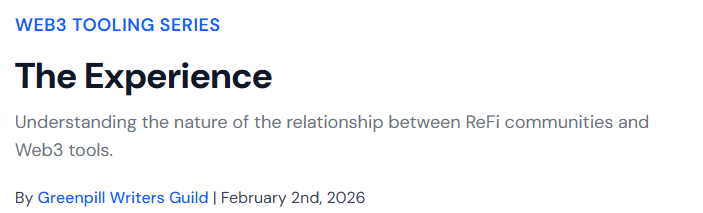
Getting locals to use web3 tools is hard because much can go wrong; funding loss, tooling abandonment, complexity fatigue - you name it.
This article, second in the series, shares how ReFi communities navigate these issues.
Have a delightful read.
https://t.co/jA2yxnfQmx
If you've been wondering what else we've been up to over the past few months, the latest edition of our newsletter explains everything!
https://t.co/zNshAWeqB3
The first article in the series is live.
This piece highlights patterns in the survey — from the ineffectiveness of web3 governance tools for local contexts to the redundancy of impact reporting tools, and more.
Have a good read.
https://t.co/XfBDNJKYrV
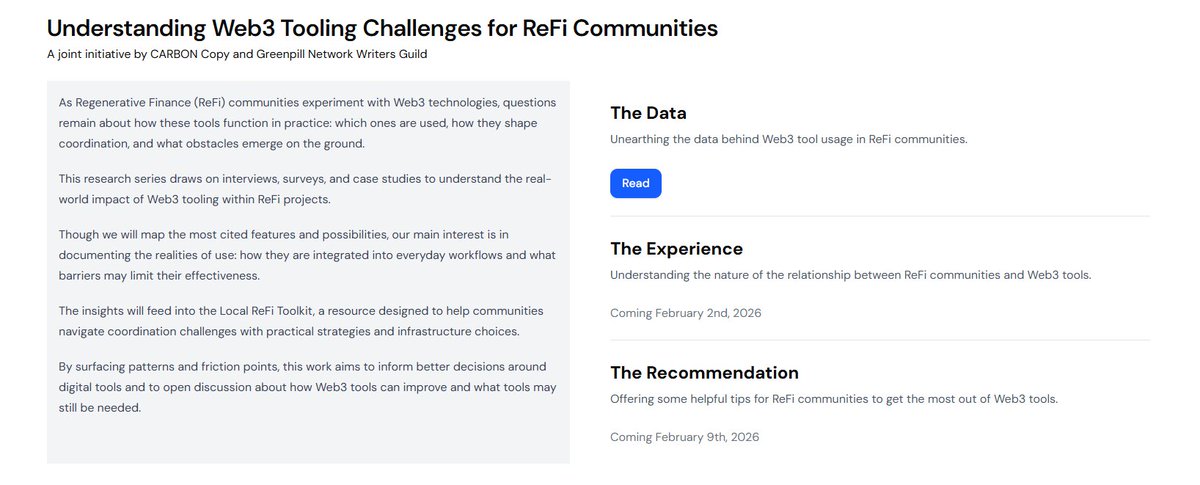
Are web3 tools actually helping ReFi communities or creating more challenges for them?
Last year, we partnered with @CC_ReFi_News to answer this question through surveys and multiple one-on-one interactions with stewards from different communities.
🧵
Earlier this year, we spent 6 weeks researching and building a funding readiness framework to help Web3 ecosystems identify projects that are ready to make the jump to the growth stage.
@TrinityMorphy describes our work in his latest article.
https://t.co/v8Gmhf51tu
We’re seeding $100,000 in matching funds to 8 resilient bioregions combating deforestation.
The Bioregional Reforestation Grants Round, the largest blockchain-native, outcomes-based reforestation grant round yet, is officially open!
Portal link in bio 🧵👇
🚨 MEET THE SPEAKERS
@TrinityMorphy is a visionary tech enthusiast, passionate about innovation. 💪
He’s the Co-founder of CARBON Copy, where bold ideas come to life.
#borderless4#ImpactbyDesign