Why don’t evangelicals build beautiful churches? @jchasedavis offers an answer:
“The real reason is evangelical pragmatism.
For churches today, beauty seems unnecessary at best and a waste of money at worst.
You can almost hear the echoes of Judas: ‘This could have been sold and given to the poor.’”
Link: https://t.co/fEpO8DWK3A
🚨📜Antique Bible Pages Giveaway!
🙋♂️Follow, Like, Retweet/Share to enter! (Comment with which page you would want for an extra entry!)
📝Antique Pages Details:
• Authentic Geneva and KJV pages from 1500’s and 1600’s.
• KJV Pages from last printing of the KJV in King James’ lifetime
• A GIANT 18x11 inch 1680 Red Lined Royal Oxford page that belonged to a royal family.
• “Breeches Bible” page from the 1597 Geneva
Picking 5 Winners on Friday, 3/28.
Sponsored by barzonDESIGN and 316 Antique Bibles. Visit their links below and use the exclusive promo code BARZONDESIGN20 to save 20% on ANY item at 316 Antique Bibles.
(Part 1)
The Tabernacle was all about Jesus! The camp was even arranged like a cross with Jesus at the center.
THE TABERNACLE: A COMPLETE PORTRAIT OF CHRIST
I. THE OUTER COURT - APPROACHING GOD
A. The Gate (Exodus 26:36-37)
1. One entrance only
2. Christ as only way to God (John 14:6)
3. Four colors depicting Christ:
a. Blue - Heavenly origin/divinity
b. Purple - Royal majesty/ kingship
c. Scarlet - Sacrificial death/
atonement
d. Fine Twined Linen - Perfect
righteousness
4. Supported by four pillars - four Gospels presenting Christ
B. The Brass Altar (Exodus 27:1-8)
1. First piece encountered - Cross must come first
2. Made of brass - Divine judgment on sin
3. Four horns - Power of salvation to earth's four corners
4. Dimensions: 5x5x3 cubits
a. Five speaks of grace
b. Three speaks of divine perfection
5. Network of brass - Christ bearing God's fiery judgment
6. Fire never going out - Eternal efficacy of Christ's sacrifice
C. The Laver (Exodus 30:18-21)
1. Made from women's mirrors - Word of God reflects our condition
2. No dimensions given - Christ's unlimited cleansing
3. Position between altar and Holy Place - Sanctification follows justification
4. Daily washing required - Continual cleansing through Word
II. THE HOLY PLACE - FELLOWSHIP WITH GOD
A. The Golden Lampstand (Exodus 25:31-40)
1. Pure beaten gold - Christ's deity tested through suffering
2. Seven branches - Perfect light of Christ
3. Twenty-two bowls shaped like almonds
a. Twenty-two letters in Hebrew alphabet
b. God's Word as light
4. Position: South side shining north
a. Light falling on table of shewbread
b. Christ illuminating Scripture
5. Oil-fed - Holy Spirit empowering Christ's witness
6. Tended morning and evening - Continual testimony
B. The Table of Shewbread (Exodus 25:23-30)
1. Made of wood overlaid with gold - Christ's humanity and deity
2. Twelve loaves in two rows of six
a. Complete Word of God (66 books)
b. Light of lampstand illuminating both Testaments
3. Crown of gold - Christ's kingship
4. Fresh bread weekly - Christ as living bread
5. Dimensions revealing grace (5) and witness (2)
C. The Golden Altar of Incense (Exodus 30:1-10)
1. Position before veil - Christ's intercession
2. Morning and evening incense - Constant prayer
3. Horns covered in blood yearly - Prayer based on atonement
4. Sweet spices - Fragrance of Christ's person
III. THE HOLY OF HOLIES - GOD'S PRESENCE
A. The Veil (Exodus 26:31-33)
1. Same four colors as gate - Christ's person
2. Cherubim embroidered - Guardians of God's holiness
3. Rent at Christ's death - Access to God opened
B. The Ark of the Covenant (Exodus 25:10-22)
1. Wood overlaid with gold - Perfect God-Man
2. Contents picturing Israel’s 3 failures as well as Christ’s perfection:
a. Tables of Law - Israel rejected God’s Law/ Christ keeping God's law
b. Golden pot of manna - Israel loathed God’s provision/ Christ as heaven's bread
c. Aaron's rod - Israel rejected God’s Leader: Christ's resurrection power
When the blood was applied on the ark (coffin) containing Israel’s sin, atonement was made and God met with His people on the basis of the shed blood.
3. Dimensions speaking of witness (2.5 cubits)
C. The Mercy Seat (Exodus 25:17-22)
1. Pure gold - Pure deity
2. Blood sprinkled seven times - Perfect atonement
3. Meeting place with God - Christ our mediator
Happy with the update?
NASB (1995): "the only begotten God"
NASB (2020): "God the only Son" (with Son in italic). Same as ESV, but at least the "Son" is in italic to indicate no Greek word is there in its base text.
The ESV is a hot mess. Assuming they were using the NA27/28: μονογενὴς θεὸς, how did they come up with the reading, "God the only Son"?
LSB returned to the NASB (1995): "the only begotten God"
@Riddle1689 Reckless. Most lay people do not know or understand the issue. There is enough doubt promotion going around when a preacher or teacher says something like “a better translation would be” which is often from what I hear and see.
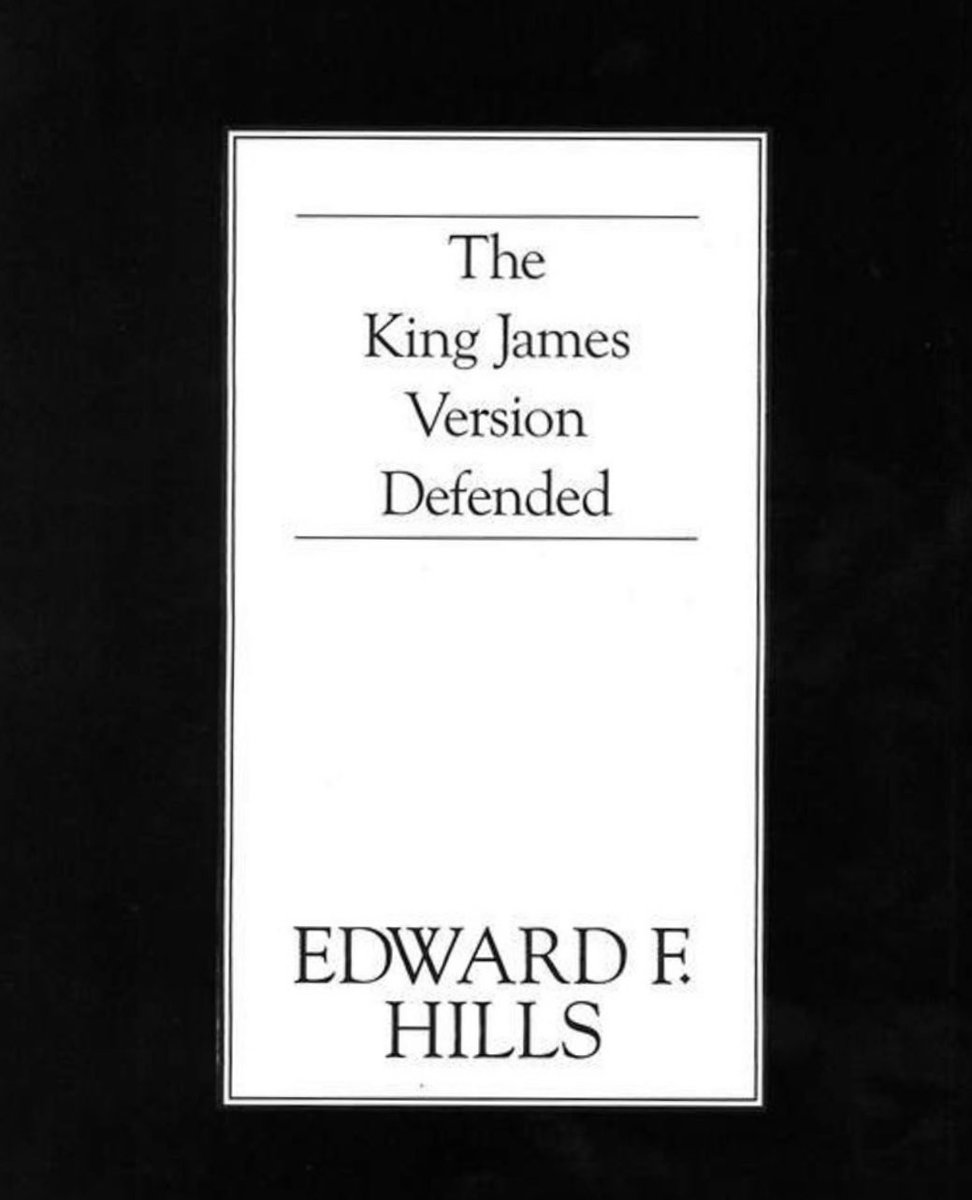
Free PDF book by distinguished text critic scholar, EF Hills
Start with chapter 4 with the biblical text.
“Edward F. Hills (1912-1981) was a respected scholar. He was a distinguished Latin and Phi Beta Kappa graduate of Yale University. He also earned the Th.B. degree from Westminster Theological Seminary and the Th.M. degree from Columbia Theological Seminary. After doing doctoral work at the University of Chicago in New Testament textual criticism, he completed his program at Harvard, earning the Th.D. in this field. In 1956, he published The King James Version Defended: A Christian View of the New Testament Manuscripts. Key chapters include “A Short History of Unbelief,” “A Christian View of the Biblical Text,” “The Facts of New Testament Textual Criticism,” “Dean Burgon and the Traditional New Testament Text,” and “The Textus Receptus and the King James Version.”
https://t.co/Al9efvPILg
Last night during the Refuel service we delved into the reasons behind the continued use of the KJV and explored its enduring significance. Here are a few points highlighted:
1. Textual Reliability: The KJV was translated from established and respected manuscripts (OT Masoretic and NT Textus Receptus.) It was not the product of flawed textual theories that prioritize edited and unreliable Alexandrian manuscripts, potentially undermining the original inerrancy and reliability of the text.
· See Matthew 1:7-8 Metzger writes that Ἀσάφ likely came about because “the evangelist may have derived material for the genealogy, not from the Old Testament directly, but from subsequent genealogical lists, in which the erroneous spelling occurred” Metzger, Bruce M. (1994). A Textual Commentary on the Greek New Testament (4th rev. ed.). London; New York: United Bible Societies, 1-2.
· Origen, the Alexandrian church father in the early third century, said: “…the differences among the manuscripts [of the Gospels] have become great, either through the negligence of some copyists or through the perverse audacity of others; they either neglect to check over what they have transcribed, or, in the process of checking, they lengthen or shorten, as they please.”- Bruce Metzger, The Text of the New Testament: Its Transmission, Corruption, and Restoration, 3rd ed. (1991), pp. 151-152).
· Daniel B. Wallace reports, “Revelation was copied less often than any other book of the NT, and yet Irenaeus admits that it was already corrupted—within just a few decades of the writing of the Apocalypse” https://t.co/BNlyvivjRE
2. Translation Philosophy: The KJV translators used a formal equivalence translation philosophy, aiming to stay as faithful to the original text as possible. This approach is contrasted with dynamic equivalence translations that involve more paraphrasing and private interpretation.
3. Scholastic Excellence: The translation of the KJV was a collaborative effort by a committee of 47 skilled scholars, grouped from prestigious institutions (2 groups went to Cambridge, two groups went to Westminster, and 2 to Oxford.) They were masters in Hebrew and/or Greek, as well as in cognate languages such as Aramaic, Chaldee, Syriac, Arabic, etc. (Translators Revived by Alexander McClure). Elizabethan and Jacobean scholars were trained in grammar schools in their youth – schools where the study of Latin, Greek, Hebrew, and English were emphasized.
· “Some of their adjustments had the Midas touch… In a cumulative way, all the virtues of the various translations which preceded it were gathered up.” – Benson Bobrick, God’s Secretaries: The Making of the King James Bible
· Even Daniel Wallace recognized: “it should be noted that … the KJV frequently has a superior rendering of the Greek perfect over many modern translations. For example, in Ephesians 2:8 the KJV reads “for by grace are ye saved,” while many modern translations (e.g., RSV, NASB) have “for by grace you have been saved.” The perfect periphrastic construction is most likely intensive, however. The KJV translators…seem to have had a better grip on English. They apparently recognized that to translate Eph 2:8 with an English perfect would say nothing about the state resulting from the act of being saved” (Daniel Wallace, Greek Grammar Beyond the Basics, p. 575).
4. Translation Accuracy
The rules set forth by Bancroft underline the accountability, transparency, and collaboration that went into the translation process (see rules 8-15.) It certainly wasn’t a one-man project or publishing company rush job. Over 7000 marginal notes provided clarity rather than ambiguity (Rule 6- “No marginal notes at all to be affixed, but only for the explanation of the Hebrew or Greek Words..”) The KJV stands unmatched in accuracy. https://t.co/LuB5wSp4At
@BlessedBook1611 It's exhausting how instantly everyone is a bible scholar when anything challenges new English Bible flavors or is positive about KJV.
What's disturbing is how wrong or misinformed most comments are. Many fallacies in what is repeated.
At minimum, give sources for comments.
@Protestia Does he feel the need to say something shocking to try to appear educated, even if it is way off and false? I don't know. The church nor world needs another Bible doubt promoter.
@UltraDane This issue is real-time and should be important ta all. It does not matter what a scholar thinks. This comes down to what one's philosophy (or doctrine) is on Bible preservation and translation. One is based in faith, one in materialism. Any "evidence" will be seen through that.












![JoeShakour's tweet photo. Last night during the Refuel service we delved into the reasons behind the continued use of the KJV and explored its enduring significance. Here are a few points highlighted:
1. Textual Reliability: The KJV was translated from established and respected manuscripts (OT Masoretic and NT Textus Receptus.) It was not the product of flawed textual theories that prioritize edited and unreliable Alexandrian manuscripts, potentially undermining the original inerrancy and reliability of the text.
· See Matthew 1:7-8 Metzger writes that Ἀσάφ likely came about because “the evangelist may have derived material for the genealogy, not from the Old Testament directly, but from subsequent genealogical lists, in which the erroneous spelling occurred” Metzger, Bruce M. (1994). A Textual Commentary on the Greek New Testament (4th rev. ed.). London; New York: United Bible Societies, 1-2.
· Origen, the Alexandrian church father in the early third century, said: “…the differences among the manuscripts [of the Gospels] have become great, either through the negligence of some copyists or through the perverse audacity of others; they either neglect to check over what they have transcribed, or, in the process of checking, they lengthen or shorten, as they please.”- Bruce Metzger, The Text of the New Testament: Its Transmission, Corruption, and Restoration, 3rd ed. (1991), pp. 151-152).
· Daniel B. Wallace reports, “Revelation was copied less often than any other book of the NT, and yet Irenaeus admits that it was already corrupted—within just a few decades of the writing of the Apocalypse” https://t.co/BNlyvivjRE
2. Translation Philosophy: The KJV translators used a formal equivalence translation philosophy, aiming to stay as faithful to the original text as possible. This approach is contrasted with dynamic equivalence translations that involve more paraphrasing and private interpretation.
3. Scholastic Excellence: The translation of the KJV was a collaborative effort by a committee of 47 skilled scholars, grouped from prestigious institutions (2 groups went to Cambridge, two groups went to Westminster, and 2 to Oxford.) They were masters in Hebrew and/or Greek, as well as in cognate languages such as Aramaic, Chaldee, Syriac, Arabic, etc. (Translators Revived by Alexander McClure). Elizabethan and Jacobean scholars were trained in grammar schools in their youth – schools where the study of Latin, Greek, Hebrew, and English were emphasized.
· “Some of their adjustments had the Midas touch… In a cumulative way, all the virtues of the various translations which preceded it were gathered up.” – Benson Bobrick, God’s Secretaries: The Making of the King James Bible
· Even Daniel Wallace recognized: “it should be noted that … the KJV frequently has a superior rendering of the Greek perfect over many modern translations. For example, in Ephesians 2:8 the KJV reads “for by grace are ye saved,” while many modern translations (e.g., RSV, NASB) have “for by grace you have been saved.” The perfect periphrastic construction is most likely intensive, however. The KJV translators…seem to have had a better grip on English. They apparently recognized that to translate Eph 2:8 with an English perfect would say nothing about the state resulting from the act of being saved” (Daniel Wallace, Greek Grammar Beyond the Basics, p. 575).
4. Translation Accuracy
The rules set forth by Bancroft underline the accountability, transparency, and collaboration that went into the translation process (see rules 8-15.) It certainly wasn’t a one-man project or publishing company rush job. Over 7000 marginal notes provided clarity rather than ambiguity (Rule 6- “No marginal notes at all to be affixed, but only for the explanation of the Hebrew or Greek Words..”) The KJV stands unmatched in accuracy. https://t.co/LuB5wSp4At](https://pbs.twimg.com/media/F45YDLgXAAACfVx.jpg)


