Introducing PhoneLLM, an open model for voice agents.
GPT 5.6 Terra performance on typical voice agent tasks at 1/3 the latency and 1/18 the cost.
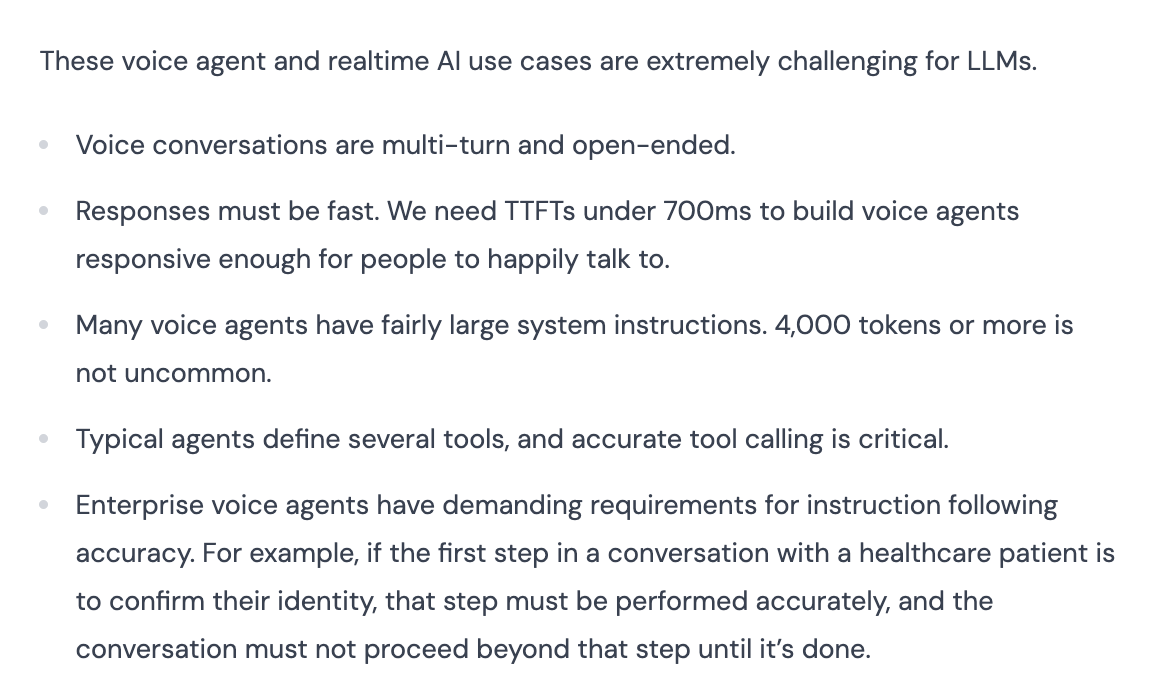
For voice agents, we need models that are both very low latency and very good at tool calling and instruction following.
There's a trade-off here, and we often have to compromise on either latency or capability when building voice agents. With PhoneLLM (and the training and data stack that made this model possible) we're fixing this problem.
For the last couple of years, most of the effort in frontier model development has gone towards leveraging test-time compute. Which is awesome! Models of all shapes and sizes are available that perform really, really well ... if you have "thinking" turned on for your model.
But if you need your agent to respond at voice conversation speed, you can't use thinking models.
PhoneLLM is a full-weights fine-tune of NVIDIA Nemotron Nano 30B. We trained on a wide range of real-world telephone and customer support use cases. The training focused on taking the excellent Nano 30B base capabilities and teaching the model to do typical voice agent tasks with thinking disabled.
The results are really good: accurate tool calling and concise, on-topic responses in long conversations.
And fast: TTFAT measured server-side is <100ms if you run PhoneLLM on a lightly loaded B200. :-)
But seriously, when we characterize model latency, we do it with full, end-to-end, batched request simulations using real Pipecat voice agent pipelines.
You can serve more than 80 concurrent agents on a single B200 with P95 end-to-end TTFAT <600ms. Including network overhead. That's an LLM cost-per-minute around $0.0025. (1/4 of a cent.) At a latency lower than any third-party API offers today.
More details about this model, including weights on @huggingface, how to spin it up with one click on Modal, and a starter project repo you can clone, are in the thread ...
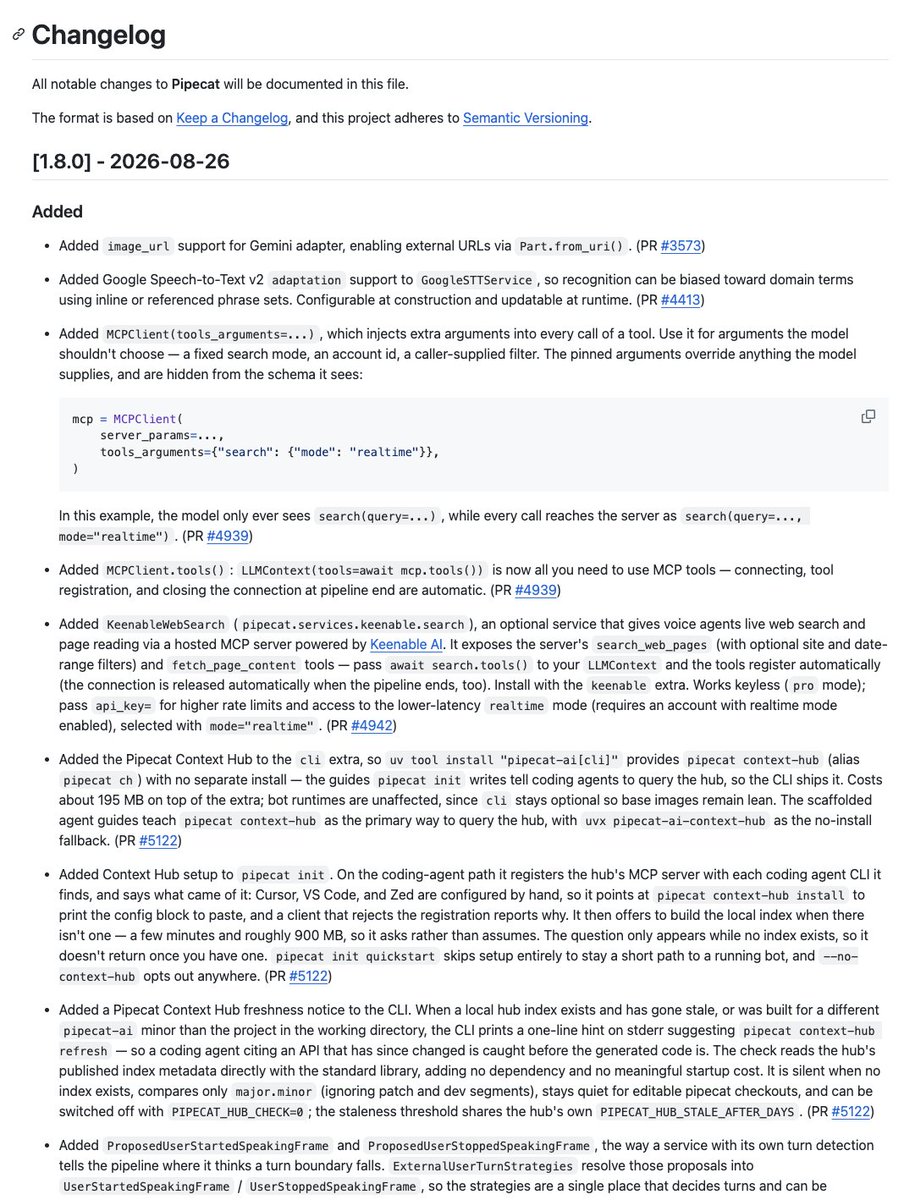
Pipecat v1.8.0 today, with launch day support for Gemini 3.5 Transcribe, Google's new Gemini-based transcription model.
This is a very big Pipecat release. There are 233 entries in the changelog.
Some highlights:
🛡️Improvements to error handling and service failover: Processors can now report when they are no longer usable, errors are categorized, and ServiceSwitcher only fails over when a service really can't recover. STT/TTS services also stop endlessly retrying permanent failures like invalid API keys or models.
⚡ Faster pipeline startup: Pipeline setup has been reworked around the new setup() lifecycle, allowing processors and services to initialize and connect concurrently before the pipeline starts. Combined with import-time improvements, this significantly reduces startup time, especially for larger pipelines.
🗣️ More flexible turn management: Services with built-in turn detection now propose turn boundaries, while Pipecat's turn strategies make the final decision. This keeps turn management and interruption handling in one place and makes provider-native turn detection much easier to customize.
🧪 Pipecat Evals keeps getting more powerful: Run scenarios during development to iteratively measure pass rates, get machine-readable results.jsonl, evaluate turns individually, run entire directories of scenarios, and more. Great for measuring nondeterministic behaviors like interruptions and async function calls instead of testing them once and hoping for the best.
🤖 Better coding-agent experience: Pipecat Context Hub is now included with the CLI and integrated into pipecat init, including automatic setup for supported coding agents and freshness checks to help prevent agents from generating code against stale Pipecat APIs.
🔧 Function calls can now be cancelled by the LLM: Long-running async tools can opt into LLM-driven cancellation, and timed-out function calls are now automatically cancelled instead of continuing to run in the background.
🔌 New Speechify TTS, ElevenLabs Dialogue TTS, Bland TTS, Sarvam Realtime STT, Deepgram Flux on SageMaker, OpenClaw Gateway support, LiveKit runner support, MoQ client mode for connecting bots through a relay, including deployments behind NAT and more.
And, of course, there are tons of fixes and smaller improvements throughout the framework, including pipeline startup/cleanup, metrics, TTS tracking, transports, realtime services, and turn handling.
Huge thanks to everyone in the community for making everything we do possible! There are now more than 180 Pipecat integrations. ❤️
Happy hacking! 🚀
I’m halfway through this talk and it’s the most thought provoking and inspiring talk I’ve heard this year.
Agents aren’t the end goal. They’re like basic webpages in the ‘90s (which I also remember).
We’re aiming collectively for something much bigger and probably stranger. Looking back through history can give us glimpses of the future.
From @kwindla / @trydaily / @pipecat_ai
Congrats to @DeepgramAI on the GA launch of Flux TTS, now live in Pipecat 🎉
@JonPTaylor looks at how Flux TTS delivers a more consistent voice experience. Flux reads the whole conversation, not just the next line — adaptive tone, consistent pronunciation, clean interruption handling natively (no SSML markup, no style tags!) all at sub-200ms latency.
➡️ https://t.co/H8IsYicQ0z
@aiDotEngineer Concierge is now live!
Talk to the concierge and build your custom schedule for the next three days along with a list of people ( speakers ) who you should definitely meet!
This was built on the go with @pipecat_ai and @GradiumAI
Try it out: https://t.co/KWw5g7RcHu
Congrats to @cartesia on the new Sonic-3.5 and Ink-2 releases! We've worked with the team on @pipecat_ai support since their first model. Exciting to see their continued innovation and how they're improving the voice agent experience.
We released Sonic-3.5 and Ink-2, the #1 streaming models for text to speech and speech to text you can use in your voice agents today.
New architectures enable new frontiers for speed and quality.
We're now the only provider to have #1 models for both speaking and listening.
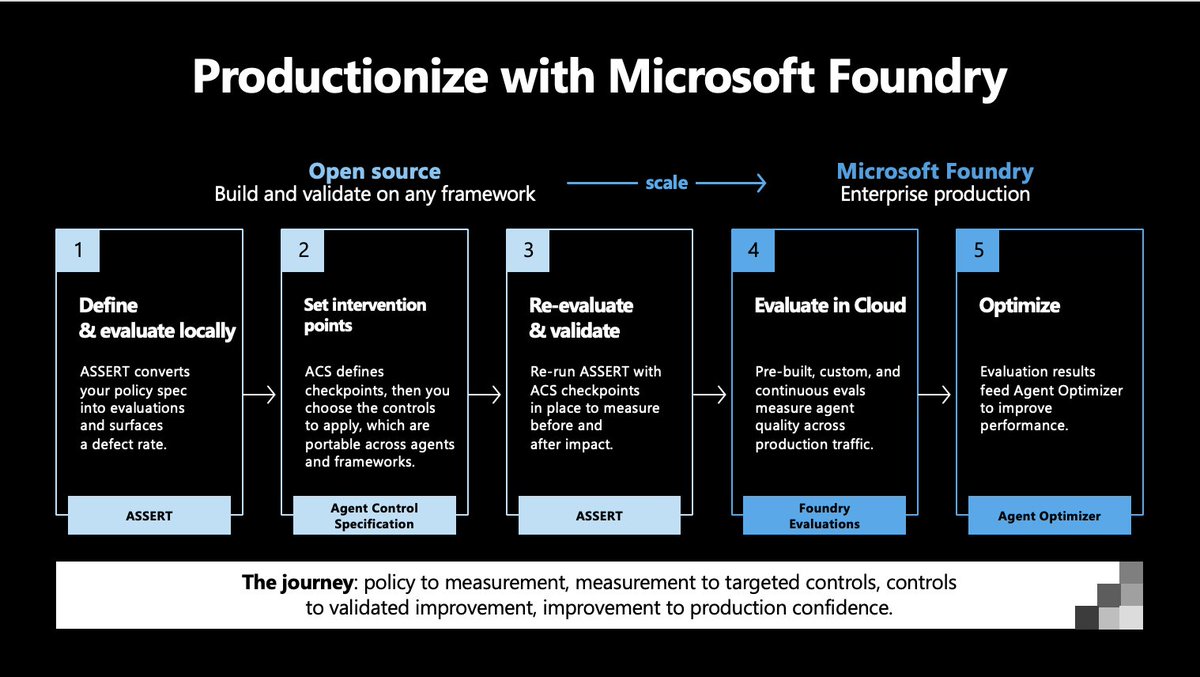
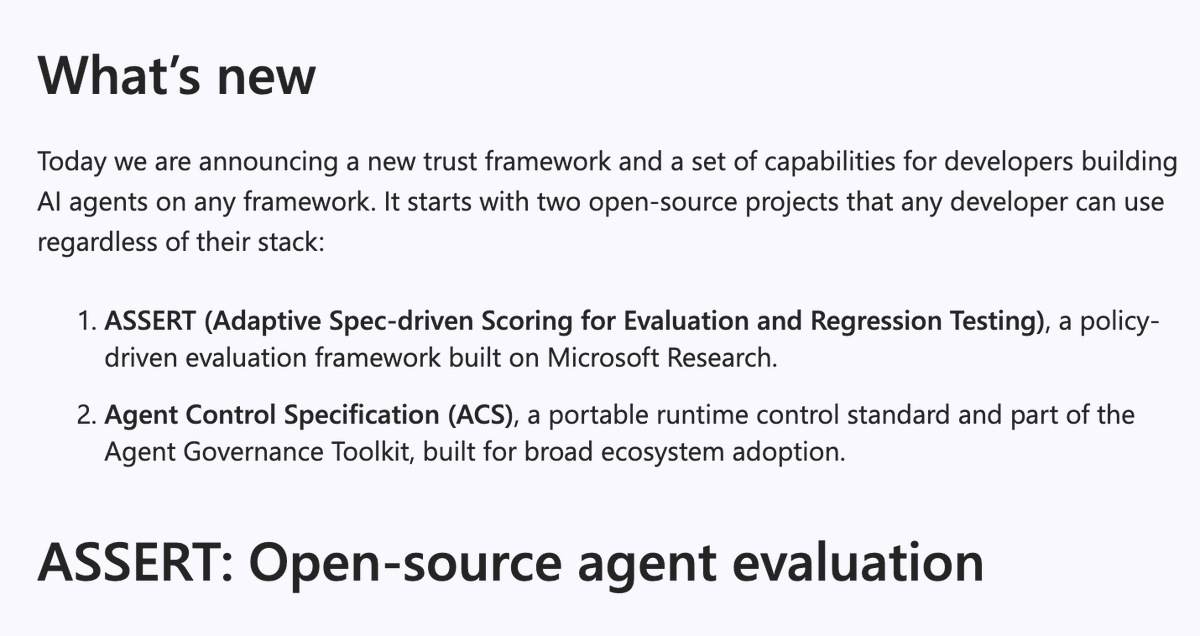
Microsoft announced a bunch of interesting new AI models and tools this week. Model launches alway get lots of attention. But don't sleep on the new ASSERT evals framework that launched today.
I'm on record as arguing that 2026 is the year of evals.
Evals are the glue for all the "jobs to be done" at every level of AI: model training; testing and deciding on what models to use and how to use them; and testing and improving AI agents in production.
Evals unify our work on those different layers of the stack.
These days, when we talk about evals, observability, and testing, we're talking about overlapping parts of a large set of tools we're still early on in figuring out.
As the AI engineering ecosystem matures, diversifies, and increases massively in scale, we really, really need good evaluation (observability, monitoring, testing, data management) frameworks.
I got a chance to test the new Microsoft ASSERT evals framework before it was released, and it has some very nice core ideas.
1) ASSERT is open in two important ways. First, the team is serious about broad support for models, frameworks, and use cases. Microsoft spent time understanding voice agent use cases and building Pipecat support, for example. Second, the code is completely open source, released under an open MIT license.
2) We're all working in and with agentic coding tools today. That means we are planning in natural language, and all of our software development and ops tools have to evolve for these new, natural language, workflows. ASSERT takes descriptions of desired agent behavior and generates specifications for the ASSERT suite of tools to run against.
In a world where "English is the programming language," how we actually make natural language "code" precise enough and repeatable enough is perhaps the big unsolved tooling problem that all of us are working towards in different ways. This is true whether we work on coding agents, AI opps tooling, orchestration frameworks, or vertical applications.
3) Microsoft describes ASSERT as a policy-driven framework. Rather than eval against generic performance metrics, ASSERT aims to generate stable but adaptable evaluation criteria for specific agents.
"Policy-driven" also implies a full loop design. Policy (generated from specific requirements) -> evaluation -> optimization -> monitoring in production -> improving the policy description -> evaluation -> ...
4) Enterprise agents need to be evaluated along many dimensions: task completion, individual conversation turn behavior, latency, mode-specific metrics like audio disfluencies, and safety/security. Microsoft designed ASSERT to be used together with a new safety governance toolkit called Agent Control Specification.
5) Finally, ASSERT is integrated into the Microsoft Foundry ecosystem. Today, AI engineering tools have to be open source and vendor neutral to get attention from developers and gain widespread adoption. *And* it's equally important to give enterprise customers tools that work as a coherent stack.
This is hard to do well. There are real tensions between open source development versus engineering a great full stack developer experience. However, if you sweat the details on both ends, you benefit from a full spectrum of feedback about real-world development pain points. It's more work, but it's worth it!
Kudos to Microsoft for embracing this and committing to an open, community oriented approach, plus doing the extra work to build the full stack for enterprise customers.
Local native-audio voice agent running on an RTX 5090.
- @NVIDIAAI Nemotron 3 Nano - audio|text ➡️ text
- patched vLLM to implement complete turn prefix caching
- ~125ms TTFT
- @kyutai_labs Pocket TTS - text ➡️ audio
- Nemotron Speech ASR - streaming audio ➡️ text
- @pipecat_ai Smart Turn end-of-utterance
- ~500ms total voice-to-voice latency
- runs bash via tool calls
If you're interested in voice and realtime multi-modal AI, come join us at the SF Voice AI Meetup on Thursday May 7th. Talk to engineers from NVIDIA, Kyutai, and Pipecat about what you're building!
Links to meetup registration, code, and models on @huggingface below ...
Big day today. Pipecat version 1.0. Two years in the making. The most widely used framework for voice agents, but not just voice agents. Pipecat is a framework for realtime, multi-modal, multi-model AI applications. Contributions from NVIDIA, all the foundation labs, AWS, GCP, and Azure. Used by thousands of startups, scale-ups, and enterprises.
Pipecat Subagents v0.1.0. A new library for sub-agent orchestration. Which is just a fancy way of saying running lots of inference loops in parallel, with partially shared context. The basic architecture of Pipecat Subagents is an event bus that works locally, and over the network.
And Gradient Bang. The side project that broke containment. Built with Pipecat and Pipecat Subagents. Gradient Bang was actually the proving ground for the early Subagents work. But ... it's also a really fun game.
Sub-agents in (latent) space!
We’ve been working on a side project.
As far as I know, this is the first massively multiplayer, completely LLM-driven game. Come play Gradient Bang with us. See if you can catch me on the leaderboard.
This whole thing started because I wanted to explore a bunch of things I’m currently obsessed with, in an application of non-trivial size, that felt both new and old at the same time.
So … a retro-style space trading game built entirely around interacting with and managing multiple LLMs. Factorio, but instead of clicking, you cajole your ship AI into tasking other AIs to do things for you.
Some of the things we’ve been thinking about as we hack on Gradient Bang:
- Sub-agent orchestration
- Partial context sharing between multiple LLM inference loops
- Managing very long contexts, and episodic memory across user sessions
- World events and large volumes of structured data input as part of human/agent conversations
- Dynamic user interfaces, driven/created on the fly by LLMs
- And, of course, voice as primary input
If you’ve been building coding harnesses, or writing Open Claw agents, or doing pretty much anything that pushes the boundaries of AI-native development these days, you’re probably thinking about these things too!
This is all built with @pipecat_ai, the back end is @supabase, the React front end is deployed to @vercel, and all the code is open source.
Gemini 3.1 Flash Live, a new version of Google's speech-to-speech LLM, just launched.
As you can see in the video, the vibes are really good, and our friends who worked on the model are very excited.
There is, of course, day 0 support in @pipecat_ai so you can try the model out just by creating an agent and running it locally:
```
uvx --from pipecat-ai-cli pipecat init
```
This is a teaser for a longer tutorial that @chadbailey59 built together with the @GoogleDeepMind team!
We have lots more fun stuff cooking with this model. Stay tuned for technical deep dives, detailed long-conversation benchmark numbers, and multi-model orchestration sample code that combines this Live model with Gemini reasoning sub-agents in a "thinking fast and slow" architecture.
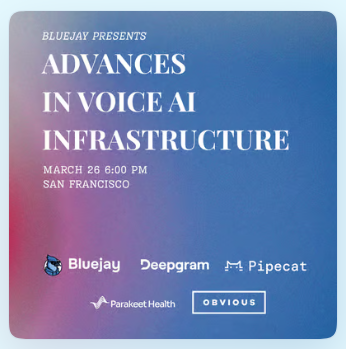
Join us on Thursday in SF for conversations about voice agents, speech models, and realtime AI infrastructure.
I'm on a panel with:
- @natrugrats from @DeepgramAI
- @farazmsiddiqi from @getbluejay_ai
- Aaron Lee from Parakeet Health
There will be food and lots of opportunities to ask questions and share your knowledge.
One thing I'm looking forward to is comparing notes about GTC last week.
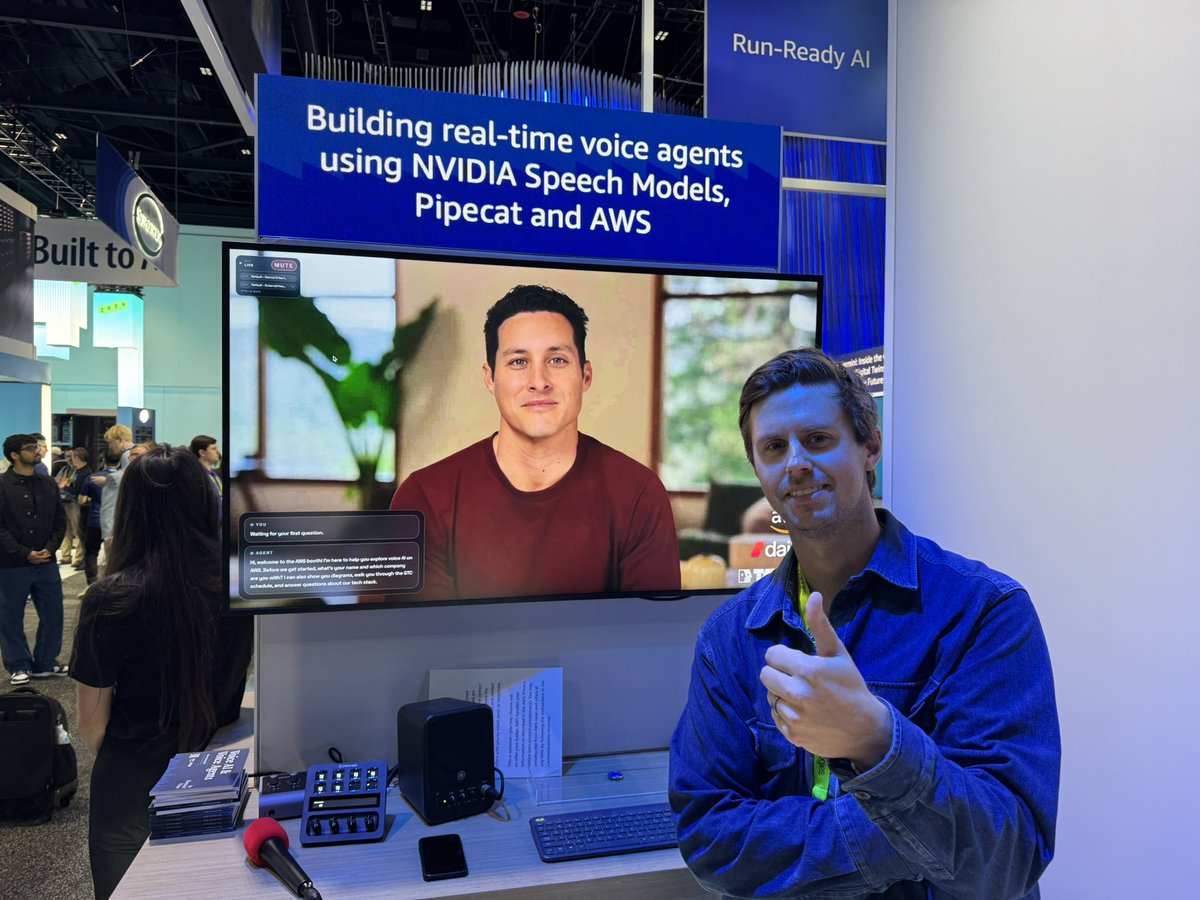
Come by and see @EvanGrenda at the AWS booth at GTC. @tavus video avatars, voice agents built with NVIDIA Nemotron models, and new realtime AI architecture patterns in @pipecat_ai!
Today's @NVIDIA Nemotron 3 Super launch is an exciting development for voice AI developers.
We’re proud to be a launch partner, with day-0 @pipecat_ai support. Developers now have a meaningful open stack for realtime voice, with @NVIDIAAI — Nemotron 3 Nano, Nemotron Speech ASR, Nemotron 3 Super. Open models, open training data.
Review how Nemotron 3 Super matches proprietary models in our long-conversation voice agent benchmarks. Happy building, with open source!!