Introducing gRNAde: our own little "AlphaGo Moment" for RNA design! 🧬🚀
📝: https://t.co/vZCLiPg99O
Unlike proteins, RNA design has long relied on "wisdom of the crowd" (human experts) or the slow crawl of directed evolution — gRNAde changes that! 🧵👇
GRASP: a model for protein complex structure prediction that integrates data from crosslinking, covalent labeling, chemical shift perturbation, and deep mutational scanning experiments. @PKU_CCME@Turnstiles14
https://t.co/n7ejpewLXq
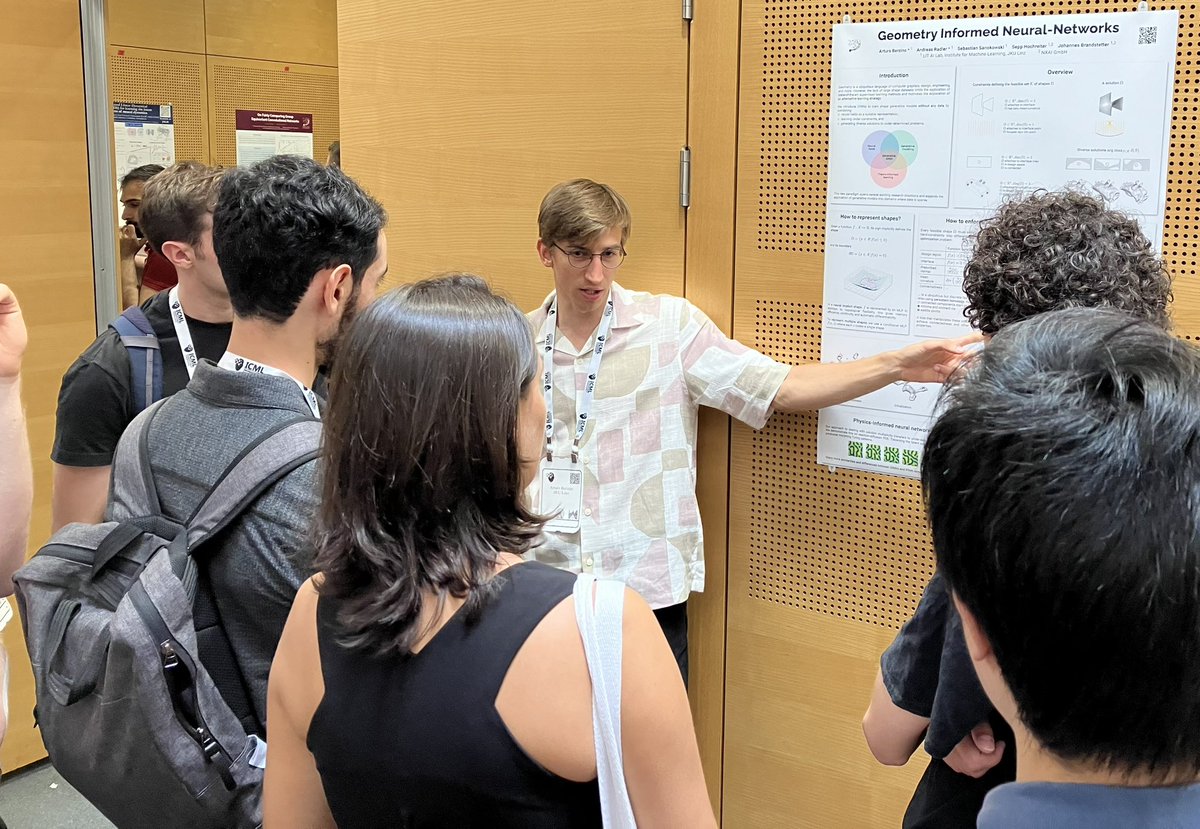
🤹 Excited to share Erwin: A Tree-based Hierarchical Transformer for Large-scale Physical Systems
joint work with @wellingmax and @jwvdm
Core components of Erwin:
- hierarchical organization of data via ball trees
- localized attention for linear complexity
- hardware-efficient multi-scale architecture
preprint: https://t.co/eZo8X1cBLb
code: https://t.co/hjOVFiZeD7
1/N
Integrating Various Experimental Information to Assist Protein Complex Structure Prediction by GRASP
🧬 Meet GRASP, a new AI-driven tool designed to improve protein complex structure prediction by integrating diverse experimental data types like XL-MS, CSP, and DMS, enabling high-throughput and accurate modeling.
1️⃣ Main innovation: GRASP surpasses existing tools by seamlessly incorporating multiple experimental restraints, allowing it to model even the most challenging protein complexes with unprecedented accuracy.
2️⃣ GRASP leverages cross-linking (XL), covalent labeling (CL), and chemical shift perturbation (CSP) data, making it highly effective for predicting complex structures, especially antibody-antigen interactions, where it outperforms AlphaFold 3.
3️⃣ When tested on real-world and simulated datasets, GRASP achieved higher accuracy than popular tools like HADDOCK and ColabDock, particularly excelling in antibody-antigen predictions, achieving up to 63% success rate with minimal restraints.
4️⃣ GRASP also demonstrated its ability to handle large complexes and real-world experimental data. In mitochondrial interaction modeling, GRASP provided structural insights into protein-protein interactions, revealing dynamic, transient complexes at near-cellular conditions.
5️⃣ Flexible & Efficient: Unlike existing models that are time-consuming or limited in size, GRASP integrates experimental data into deep-learning models, reducing errors and boosting prediction quality even with noisy data.
📜Paper: https://t.co/7cp3uO7vf0
And this is why code should always be published with papers... This group made an attempt to reproduce AlphaFold3 and found a number of potential issues in the published pseudo-code. See exciting 🧵 👇
🔍 Curious about how #AI can generate membrane protein structures at specific states? Our recent paper explores a diffusion model to predict the multi-state conformations of #PtypeATPases.
https://t.co/ptlCKSqWEi
Integrated structure prediction of protein–protein docking with experimental restraints using ColabDock | @NatMachIntell
- ColabDock consists of a generation stage for sequence profile optimization with experimental restraints using gradient backpropagation and a prediction stage with AlphaFold2
- Focus on two types of restraints: 1v1 (distance between specific residue pairs) and MvN (sets of residues on the protein surface)
- Use a ranking SVM to select the best conformations from multiple generated structures
Link: https://t.co/UgDPyI3Bjg
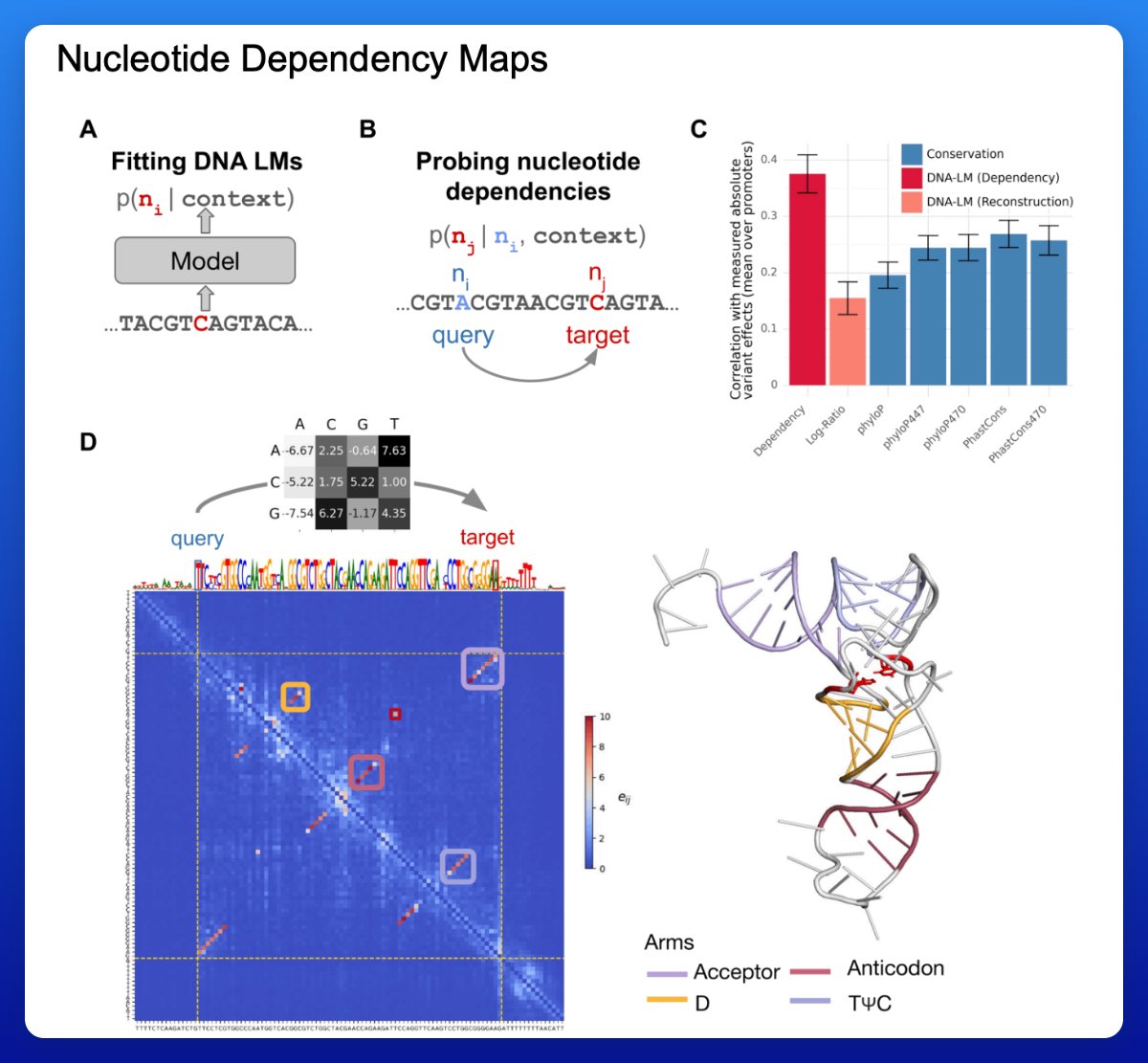
Simply "mutating" (digitally varying the bases) of inputs into DNA language models drops out an enormous number of functional genomic elements.
Heatmaps of the pairwise nucleotide dependencies can clearly show the entire secondary structure of tRNAs (see figure).
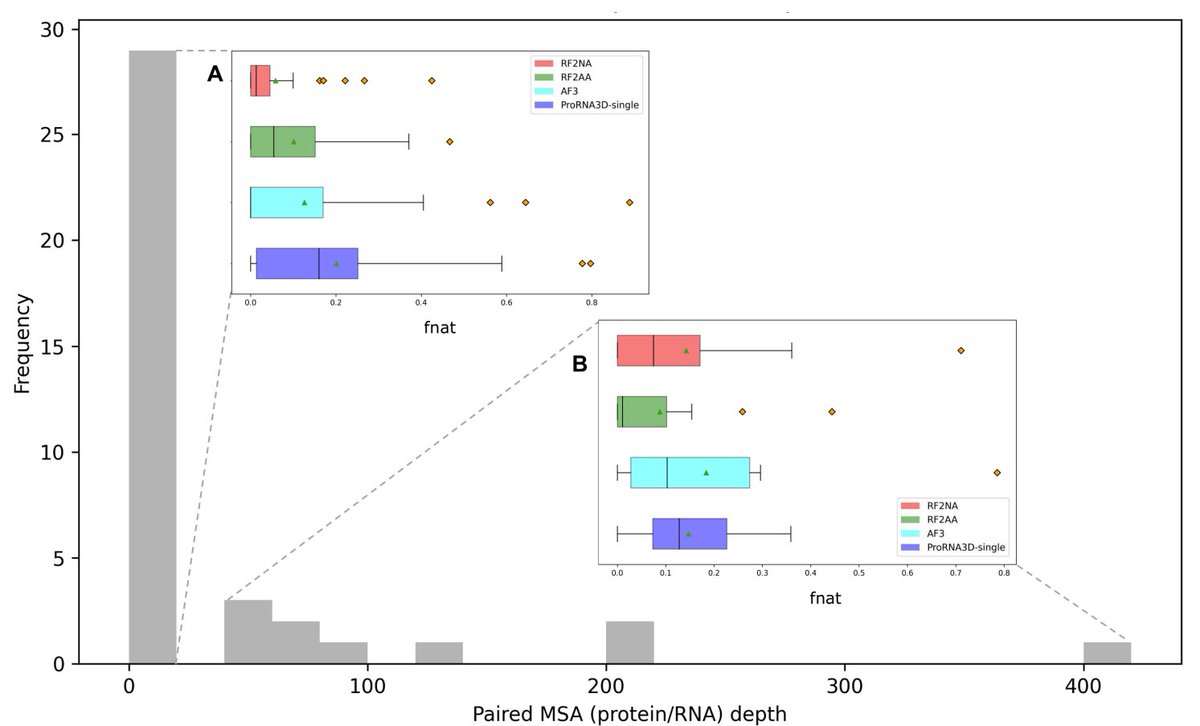
Single-sequence protein-RNA complex structure prediction by geometric attention-enabled pairing of biological language models
- ProRNA3D-single combines ESMFold and E2EFold to predict protein-RNA complex structures
- Use a ResNet-Inception module and a geometric attention module to predict interaction maps
- Apply Rosetta FastRelax to optimize complex structure with intial Protein/RNA structures and predicted interaction map
- Outperform AF3, RFNA, RFAA especially in cases with low paired MSA depth
Preprint: https://t.co/sYisnIRjHM
🔥🔥 Check our latest generative model for antibody design GeoFlow, which can be used for both antigen-antibody complex structure prediction and de novo antibody design
SOTA performance on Ab-Ag complex prediction, comparable to AF3
Try it here: https://t.co/irN7y3A3wC
🚨 NEW state-of-the-art model for unsupervised disentanglement 🚨
[1/n] Tripod melds three complementary methods for disentangled representation learning that each target a separate component of an autoencoder.
Deep learning guided design of dynamic proteins
- Design proteins with conformational changes, focusing on intra-domain reorientation of secondary structural elements
- Use systematic physics-based conformational sampling and Rosetta Design to create a library of alternative protein states differing in local geometries
- Apply AlphaFold2 and ProteinMPNN to identify key residues for state determination and design sequences compatible with multiple states
- Validate designs using MD, NMR and yeast display
Preprint: https://t.co/lORAfmzIV0
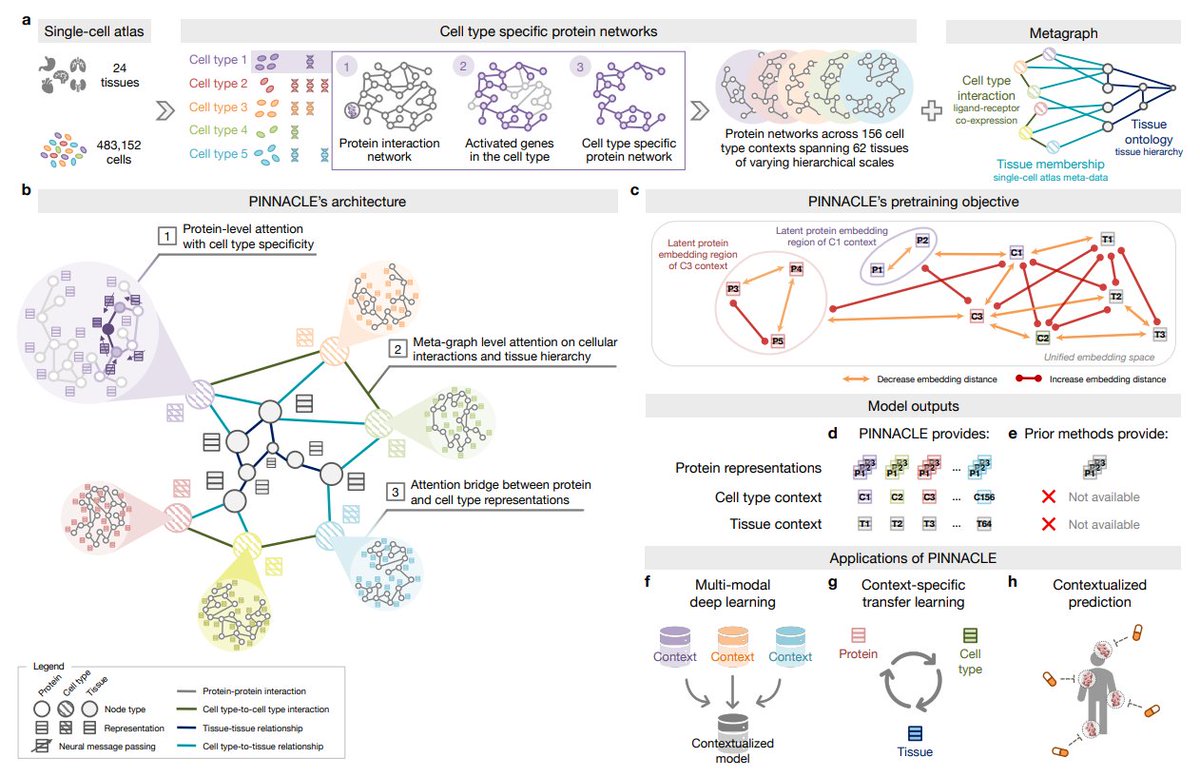
Contextual AI models for single-cell protein biology
- PINNACLE, a geometric deep learning model for generating context-specific protein representations via link prediction and cell type classification pretraining
- Construct context-sensitive protein interaction networks and a metagraph representing cellular interactions and tissue hierarchy
- Customize attention for proteins, cell types, and tissues to ensure accurate unified contextual embedding. Bridgr tissue and cellular embeddings with protein by pooling.
Preprint: https://t.co/0XVPiuBHtt
The Illustrated AlphaFold
https://t.co/i65yxiS03o
Do you want to know how AlphaFold3 works? It has one of the most intimidating transformer-based architectures, so to make it approachable, we made a visual walkthrough inspired by @JayAlammar's Illustrated Transformer!
🧵 (1/7)
Neither cryoEM nor AlphaFold alone is sufficient, you need both! Colleagues from the Löw group @EMBLHamburg and co, resolve one conformational state using cryoEM, model two others with AlphaFold, and use clever biophysics to assign function of a new membrane transporter.





![kylehkhsu's tweet photo. 🚨 NEW state-of-the-art model for unsupervised disentanglement 🚨
[1/n] Tripod melds three complementary methods for disentangled representation learning that each target a separate component of an autoencoder. https://t.co/QqkdLA2y7C](https://pbs.twimg.com/media/GS-7aBuXwAAzCIf.jpg)