New preprint! Are early environments associated with the pace of cortical network development?
In my first postdoc preprint with the @wunder_lab, @BarchDbarch, @rogers_ce, and Chris Smyser, we addressed this question.
🧵
https://t.co/D0Ay6G8ea4 \1
Session 4: Early Network Development is starting now! @MinghuiOuyang presents the developmental connectome, @UTooley links prenatal environment to cortical development, Gondova examines connectivity in preterm infants, and Ayzenberg covers newborn visual organization🧠#FITNG2024
@UTooley showed that the prenatal environment affects brain network development speed in the first 3 years. Early development pace is linked to risk factors and outcomes, with faster development in lower-SES children. #Neuroscience#BrainDevelopment#OHBM2024
Super excited to be in Seoul 🇰🇷 at #ohbm2024 and share our recent work examining the development of intrinsic 🧠 activity in babies 👶, a la @valerieJsydnor & @sattertt . Come on by and see me M/Tu at Poster 1278!
I’ll be talking about my work on prenatal environment & the pace of brain development at @OHBM@OHBM_Trainees during the Tuesday symposium at 12 PM with chairs @StephForkel and @philkuhnke.
Since I'm not able to make it in-person, please connect with me here for Qs! #OHBM2024
@RottenInDenmark Thanks for setting a good example for folks, staying home and testing until you're all the way negative!
- Signed, a scientist with long COVID
Sharing our new study by @keylas3, @SilvaJ_C, Rafael Bayarri Olmos et al (with T. Horvath & @PutrinoLab) showing that a passive transfer of IgG from patients with #longCOVID into mice recapitulates ⬆️ pain and other symptoms 🧵 (1/)
https://t.co/J5I22Y4fnn
Where things stand with Long Covid
By Jason Gale @jwgale in @washingtonpost
A great review of where we stand.
A lot of progress has been made in understanding Long Covid. We need to figure out how to treat it.
https://t.co/GN5i8jvS4c
🚨 #BrainsInBriefs article alert!
#NGG student @kara_mcgaughey writes about recent work from NGG alum @UTooley, who took one of the first looks at brain function during early and middle childhood to study brain connectivity and cognitive development!
https://t.co/cGlE3lBOpG
First preprint out of @Stanford_PMHW! Mood disorders are a leading cause of disability, potentially due to co-occurring cognitive impairments. However, cognitive impairments vary dramatically from person-to-person, even if they share the same diagnosis. https://t.co/ELGTmLjft2
Also be sure to check out all our precision mapping of neonates, with posters from @_JuliaMoser at 2–F-56, @KoiralaSanju1 at 1-F-59, and Alyssa at 1-C-23!
Excited to present work from precision functional mapping of neonates @FIT_NGIn tomorrow, at poster 2-F-60.
Really cool data collected by @ChadMSylvester and Alyssa Labonte — come check it out! #FITNG2023
Ever wondered, how much data you need to construct a reliable individual specific functional brain networks in a newborn infant? Come chat at poster 1-N-100 #Flux2023
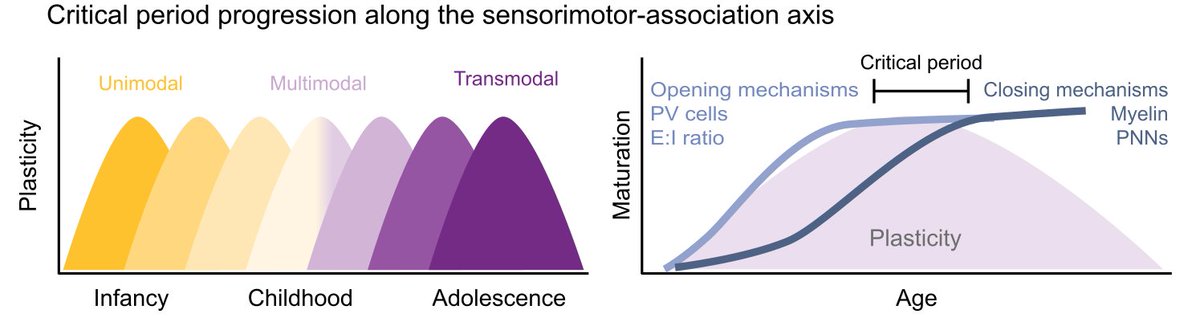
Very happy to announce our new work which proposes a critical period model for the progression of developmental plasticity along the sensorimotor-association axis during youth!
Out now in @TrendsNeuro! 🧵
https://t.co/RSBFMsWHn9
NB: Now hiring postdocs interested in this work!
A big thank you to all the wonderful collaborators on this project: A Latham, J Kenley, D Alexopoulos, @tara_smyser, B Warner, @shimonyjs, J Neil, & J Luby, and support of @WUSTLmed@MIRimaging, and thank you for reading!
Reach out with q's, comments, feedback, etc😊. /16
New preprint! Are early environments associated with the pace of cortical network development?
In my first postdoc preprint with the @wunder_lab, @BarchDbarch, @rogers_ce, and Chris Smyser, we addressed this question.
🧵
https://t.co/D0Ay6G8ea4 \1
Our work highlights the importance of understanding timing and directionality of environmental associations with trajectories of cortical brain development, and emphasizes the first years of life as a target for policies supporting optimal child development. /16