📖 Profesores de universidad alertan: el declive en la lectura está afectando al aprendizaje.
Los estudiantes leen menos, se distraen más y tienen dificultades para procesar textos largos o complejos.
La falta de hábito lector limita la comprensión, el pensamiento crítico y la capacidad de análisis https://t.co/DqcqfJtNsG
El infierno en la tierra de las afganas: de la prohibición de estudiar a la violación legal de niñas. Los talibanes han aprobado desde 2021 alrededor de 140 medidas contra las mujeres mientras la Unión Europea da pasos para legitimar su gobierno https://t.co/1S04hWfkfF
Recent studies have revealed the synchronization of neuromodulators including norepinephrine, serotonin, acetylcholine, dopamine, and histamine during sleep.
A new #ScienceReview explores what potential role the synchronization of these oscillations may play in health. https://t.co/fcDdHm1SDP
Ni Pepa Bueno, ni Gemma Nierga, ni Angels Barceló.., la Cadena SER se queda sin voces de mujeres liderando la programación diaria.
A muchos os dará igual pero a mí me parece un retroceso importante.
El fenómeno este de las trad-wives extreme edition es una de las cosas más interesantes de la sociedad del espectáculo contemporánea porque son cinco serpientes enroscadas, mordiéndose la cola una detrás de otra, simultáneamente, en bucle infinito de ouróboros semióticos.
En la capa más superficial tenemos la apelación a los supuestos valores tradicionales, los de cuando la mujer se quedaba en casa haciendo las cosas de la casa y el marido proveía, un pasado mítico que probablemente nunca existió tal cual pero que funciona estupendamente en vertical a 1080 pixeles.
En la segunda capa estamos ante una manifestación performática evidente, y lo digo porque la inmensa mayoría de estas creadoras de contenido cocinan. Cocinan mucho. Cocinan siempre. Rara vez —casi nunca, diría yo— se graban pasando la aspiradora, fregando el váter, quitando el polvo de los zócalos, limpiando los cristales con vinagre y papel de periódico al modo de la abuela. Eso corresponde a otro tipo de influencers, otro algoritmo, otro público que no es el público de las trad-wives.
En la tercera capa aparece la negación de la riqueza, y aquí la performance se vuelve magníficamente absurda, porque la chica lo hace todo DESDE CERO, y el cero aquí es un cero cósmico, un cero prelapsario. Bate la mantequilla desde cero. Hace el chocolate abriendo el fruto del cacao, fermentando, tostando, moliendo el grano. Muele la harina en un molino de piedra. Todo a mano, sin intervención de máquinas, sin electricidad, sin siglo XX. Y digo que es una negación de la riqueza porque desde siempre, históricamente, transhistóricamente, las personas con dinero —y especialmente las mujeres con dinero— se distinguían precisamente por lo contrario, por no hacer absolutamente nada, por tener manos blancas y ociosas al haber delegado los trabajos domésticos en la servidumbre. La aristócrata no molía, la aristócrata leía novelas francesas.
En la cuarta capa descubrimos que la performance, por su propia naturaleza ontológica, es falsa. Porque puede que sí, que haya hecho todo eso ella sin máquinas, de acuerdo, concedido, pero hay una máquina, la máquina fundamental, la que no se ve y sin embargo lo articula todo, omnipresente: la cámara grabando. Y detrás de la cámara el trípode, el micro de corbata, el aro de luz, el programa de edición de vídeo, el portátil, el router, el servidor, el centro de datos en Oregón refrigerado por tuberías de agua del Columbia.
Y la quinta capa, que es la mejor, es la que niega la primera y la segunda y la tercera en un solo movimiento. Porque estos vídeos terminan acumulando millones de visualizaciones y terminan generando dinero, a veces mucho dinero, a veces cantidades indecentes de dinero, lo cual significa que esta mujer no es un ama de casa, es la proveedora, es ella quien trae el pan —a veces literalmente el pan, moliéndolo—, y a menudo tiene un equipo detrás, y ese equipo suele incluir gente de marketing, agencias de publicidad, asesores fiscales, alguien que le lleva las redes que puede, o no, ser su cuñado, y sí, también personas que limpian la cocina-plató después de cada receta.
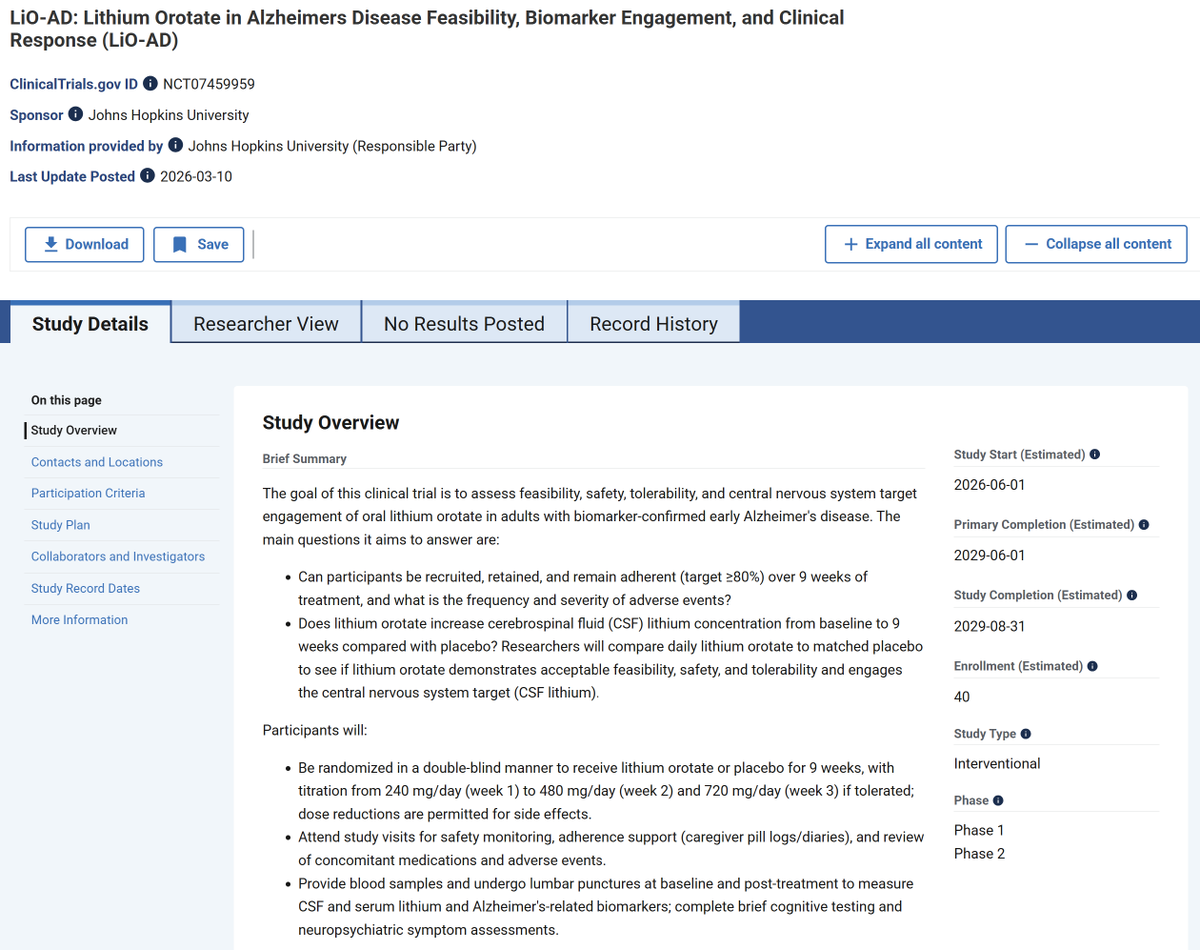
Last year researchers at Harvard found that lithium —specifically lithium orotate — might help prevent or treat Alzheimer's
This has never been tested in a clinical trial before, but the first one's about to start
When Luis García Berlanga's "Welcome Mr. Marshall!" (1953) was screened at Cannes, protest came not from the Spanish Government but from the Americans. The Jury member Edward G. Robinson, who, incidentally, had been one of the victims of Joseph McCarthy's Un-American Activities Committee, protested at the anti-American nature of the film, and tried to prevent it being shown.
The tensions were aggravated when Berlanga and the producers decided to use a promotion stunt at the festival for which they printed a large number of notes resembling one-dollar bills. Instead of George Washington, the picture on one side of the bill was the actor José Isbert and on the other was Lolita Sevilla. When the film was finally screened, only one scene had been cut: a shot of an American flag floating down a stream after the “Yank fever” in the village has subsided. "Welcome, Mr. Marshall" won one of the Special mentions at Cannes.
("Behind the Spanish Lens", Peter Besas, 1985)
P.S: On this day, 73 years ago, "Welcome Mr. Marshall!" (1953) premiered in Madrid, Spain.
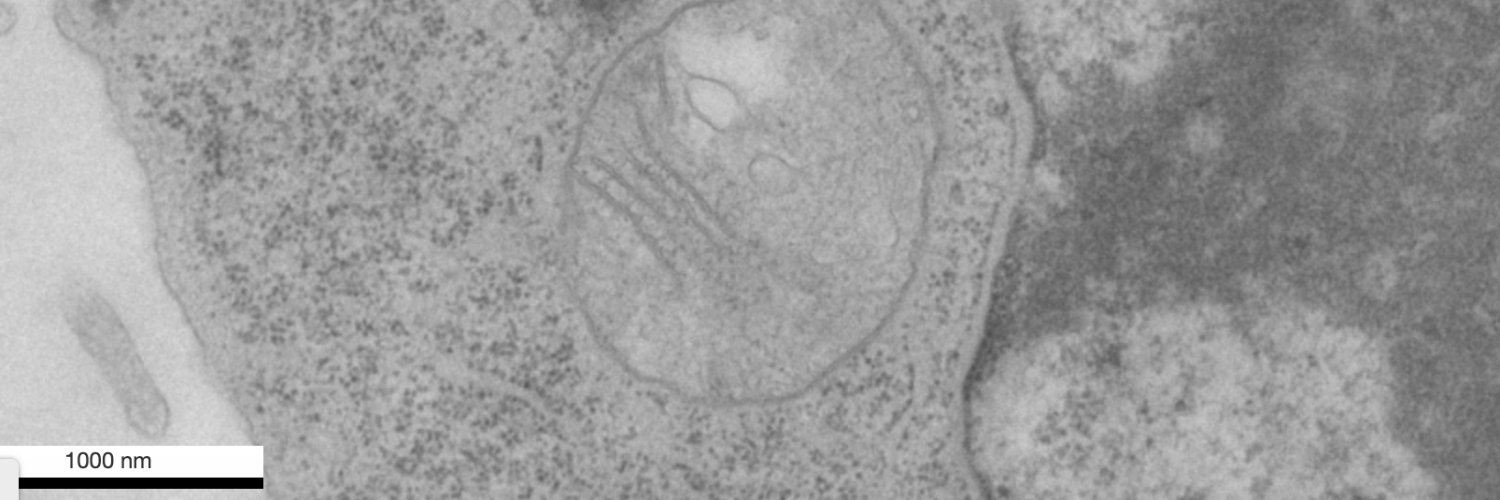
Mechanosensory channels mediate ER Ca2+ transients to trigger assembly of autophagosome initiation sites for degradation of ER subdomains https://t.co/nLCBchgcWA
🚨 p53 is the most mutated gene in cancer… but still NO approved reactivator.
That may finally be changing.
A new wave of mutation-specific p53 reactivation is showing real clinical signal 👇
🧬 Why this matters
~50% cancers harbor TP53 mutations
Tumor suppressors need restoration, not inhibition → historically “undruggable”
💊 The shift: precision reactivation
Old approach ❌ “one-size-fits-all” (APR-246) → weak activity
New approach ✅ mutation-specific targeting
👉 Rezatapopt (PC14586)
Targets Y220C p53 pocket → refolds mutant protein
📊 PYNNACLE trial
• ORR: 19.7% (14/71)
• KRAS WT: 30.4%
• KRAS mutant: 0%
• Grade 3–4 AEs: ~50%, no grade 5
📌 Biology-driven selection = real signal
🧠 Big shift
Not all p53 mutations are equal
→ Structural mutants can be rescued
→ Needs mutation-specific drugs + basket trials
🎯 Takeaway
We are entering:
👉 Targeted therapy for tumor suppressors
👉 Ultra-precise oncology
🔖 Save this: p53 is back
📖 Full paper in comment ⬇️
#OncoTwitter #MedTwitter #PrecisionOncology #TargetedTherapy
@OncoAlert@myesmo@esmo_open@ASCO@NEJM
Every thyroid hormone your body makes is built from iodine and an amino acid called tyrosine. A third nutrient, selenium, is what activates it.
Inside the thyroid, an enzyme called TPO takes iodine from your blood and attaches it to tyrosine residues on a storage protein. Pairs of these iodinated tyrosines then fuse together to form T4. That's the hormone your thyroid primarily releases. But T4 is inactive. It has to be converted to T3 before your body can use it.
That conversion happens mostly outside the thyroid, in the liver and kidneys, and it depends entirely on selenium. The enzymes that do this job (deiodinases) all require selenium at their active site.
Berry et al. identified this in Nature in 1991. Without adequate selenium, T4 gets made but doesn't get activated. Selenium-deficient patients show exactly this pattern: normal T4, low T3.
A few practical notes. Tyrosine is part of the structure, but it's made from dietary protein and is rarely the limiting factor unless someone is severely malnourished. Iodine and selenium are the ones most likely to actually matter. And while low selenium is one reason T4 might not convert to T3, it isn't the only one. Illness, caloric restriction, and chronic inflammation all suppress that same conversion step through different mechanisms.
The takeaway: if you're thinking about thyroid support, iodine alone doesn't cover it. The activation step is just as important as the building step, and that requires selenium.
Endotext Ch.2: Thyroid Hormone Synthesis, 2015.
Berry et al., Nature, 1991.
Di Jeso & Arvan, Endocrine Reviews, 2016.
Os pongo en contexto: mi padre tiene demencia pero aún sale solo a la calle llevando un dispositivo GPS.
Salió esta tarde, a las 20:00 aún no había vuelto. La APP desde la que puedo ver si localización no abre en el móvil. Escribo al servicio técnico pidiendo
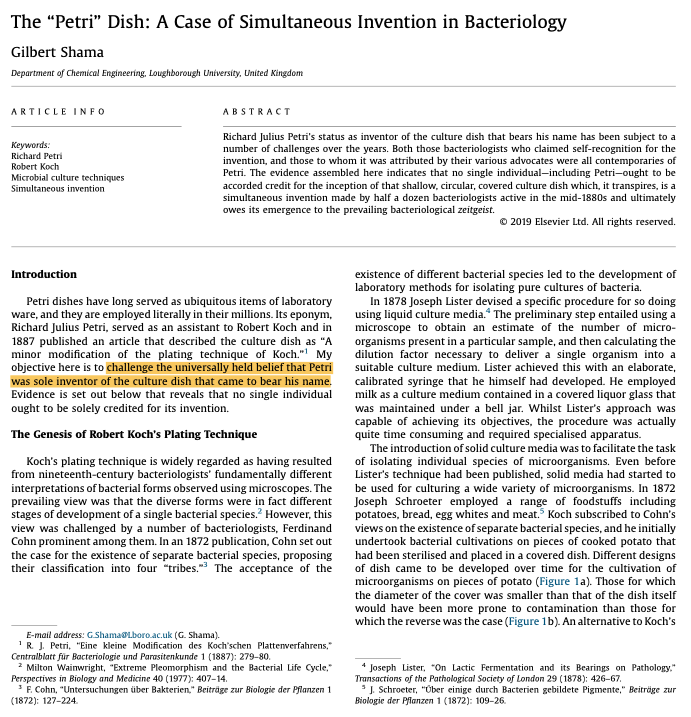
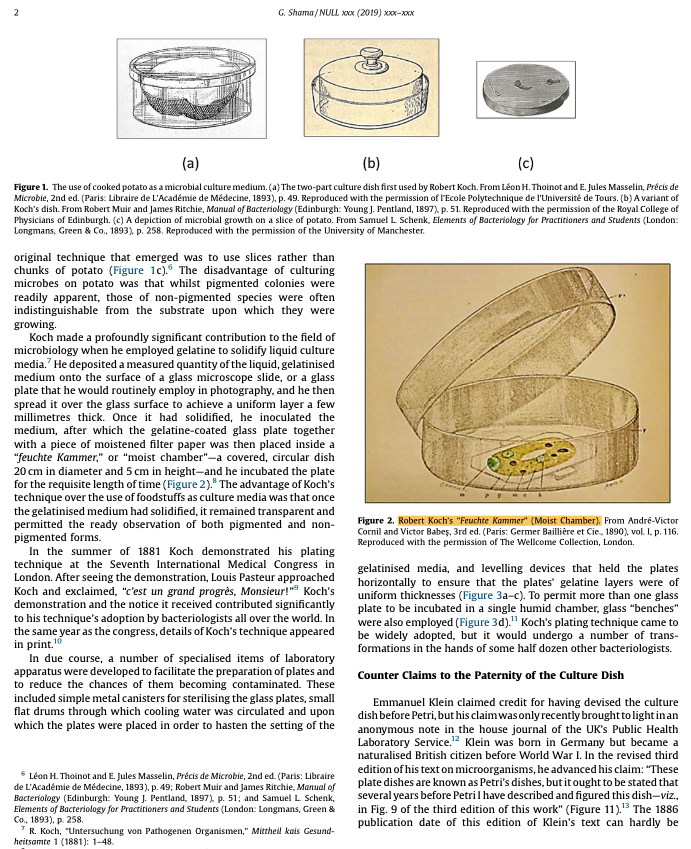
The Petri dish is widely credited to a single person — Richard Julius Petri — but was actually invented by many people, independently, around the same time.
In 1881 (years before Petri’s creation), Robert Koch made a “moist chamber” that looks a lot like the modern Petri dish. The chamber was a circular dish, about 20cm across and 5 cm tall. Koch took a piece of glass, poured gelatine onto it, and then put it into this dish, with a lid, to dry out and harden. Koch then plated bacteria onto that gelatine and looked at them under his microscope.
The main difference between Koch’s “moist chamber” and Petri’s later invention was, simply, that Petri got rid of the glass piece and poured gelatine directly into the dish, and then plated his microbes on top of that. (Petri also worked with Koch for several years before he made the “Petri” dish.)
Petri published an entire article about his little dish, and how to make it, in 1887. As it caught on and spread through microbiology laboratories, however, many other microbiologists claimed that they had actually invented the dish *before* Petri!
Emmanuel Klein, an Austro-Hungarian, claimed that he had described a culture dish before Petri, way back in 1884, but never provided proof for his claims. It seems he got the chronology wrong. Two French scientists, William Nicati & Maximilien Rietsch, also claimed the invention. Nicati and Rietsch poured gelatine into little square jars, akin to pill boxes, and grew cholera microbes on them. And they did so in 1885, at least two years before Petri published his own circular designs. Percy Frankland, in London, also used circular glass plates filled with gelatine to “capture” and study airborne microbes as early as 1886.
It seems that Petri’s name stuck to the plates, then, for two simple reasons: He wrote up and published an article entirely devoted to the designs (which nobody else did), and he was associated with a famous laboratory; Robert Koch's. And this is why, nearly 150 years later, we still call them Petri dishes.
Much more on this will be in the forthcoming @AsimovPress book, “Making the Modern Laboratory."
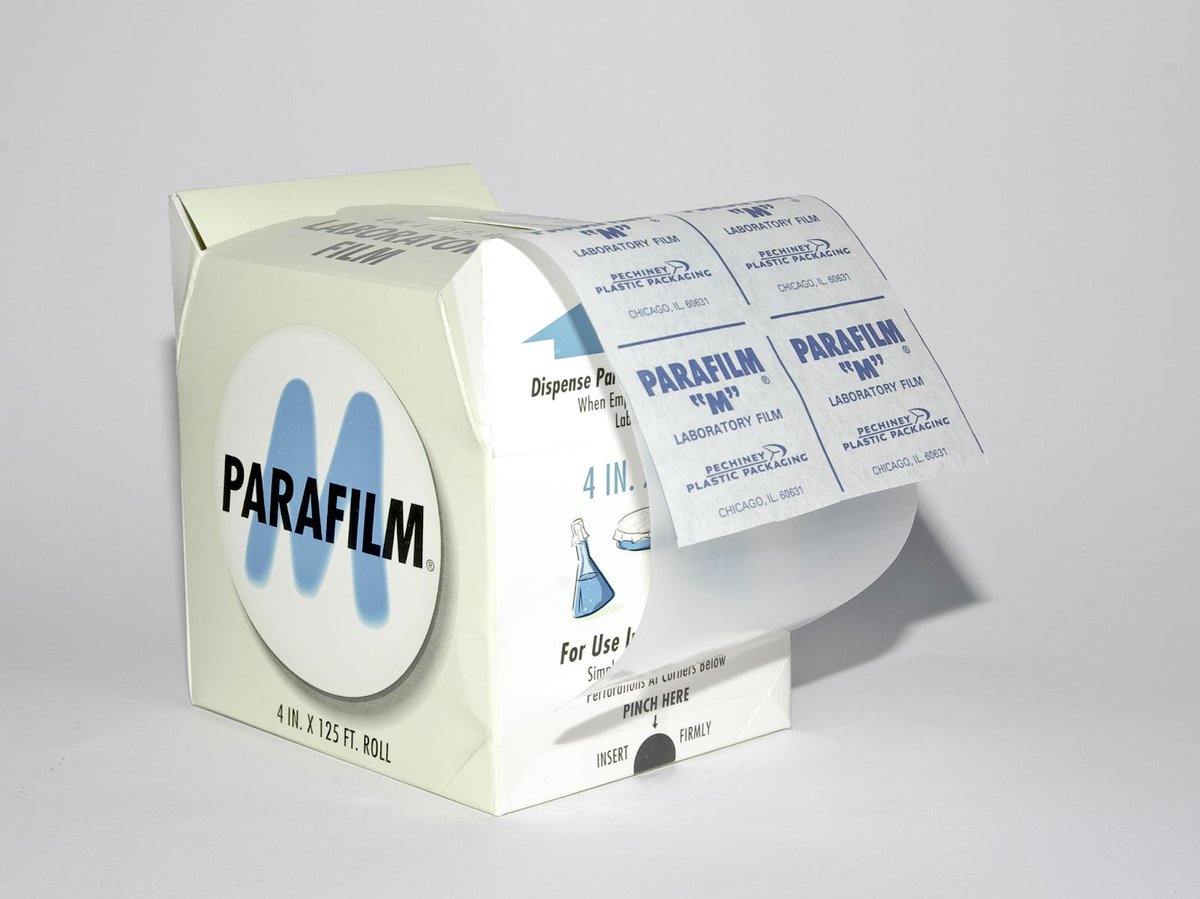
A Brief History of Parafilm (for the upcoming @AsimovPress book, "Making the Modern Laboratory.")
In 1830, a German chemist named Carl Reichenbach (who spent decades of his life extracting various chemicals from tar, for some reason) cooled petroleum and noticed that a thick layer of wax formed on top. He dubbed this wax paraffin, from the Latin for parum and affinis, meaning “very little” and “lacking affinity.”
Paraffin remained quite obscure until 1859, when Edwin L. Drake drilled the first-ever oil well in the small town of Titusville, Pennsylvania. In the decades following, as hundreds of oil wells sprung up across America, paraffin wax became an extremely common byproduct of oil manufacturing. And since it is entirely odorless, this wax was commonly used to make candles.
Paraffin was also used, oddly enough, in some historic physics experiments. In 1932, for example, James Chadwick, the Nobel Prize-winning physicist, used paraffin to discover the neutron. He stuffed chunks of wax inside his neutron detector, and then blasted a beryllium target with radioactive particles. Chadwick detected neutrons after the high-speed particles “dislodged protons from a piece of the wax.”
The word “parafilm” -- that ubiquitous thing that scientists use today to seal flasks, due to its ability to allow gases through while blocking liquids -- was first trademarked by the Marathon Paper Mills company in 1934. The company marketed it as a moisture-proof, self-sealing wrapper. But initially, it was marketed not to scientists but rather to sailors, primarily for map mounting.
Sailors would place a flat layer of parafilm between a map and fabric, and then apply a hot iron for about ten seconds. The parafilm wax would partially melt and join the map to the fabric, making it more resilient to saltwater and harsh ocean winds. Even today, the parafilm recipe is closely guarded. What we know for certain, based on chemical analyses, is that parafilm is made from 56 percent wax and 44 percent polyolefins, and that it has a boiling point above 550 degrees Fahrenheit.
In the 1950s, the Marathon Paper Mills Company sold its Wisconsin plant (and the rights to manufacture parafilm) to the American Can Company, one of the largest military contractors during World War II. Around the same time, advertisements for parafilm began appearing in magazines, including Scientific American. A 1952 advertisement touted parafilm as a “wonder material” for sealing flasks and culture dishes, and also as “airtight,” even though it is permeable to gases.
The rights to manufacture parafilm passed around to various companies until Amcor, one of the world’s largest packaging companies, bought the rights for $5.25 billion in 2019. Today, parafilm is manufactured in a factory located about 40 miles southwest of Green Bay, Wisconsin.
Adapted from an essay I co-wrote with @Meta_Celsus a couple years ago!