𝗦𝗦𝗢 𝘃𝘀 𝗢𝗔𝘂𝘁𝗵 𝘃𝘀 𝗢𝗜𝗗𝗖 𝘃𝘀 𝗦𝗔𝗠𝗟.
Do you know the differences?
𝗦𝗦𝗢 is a user experience, not a protocol. It lets users log in once and access multiple apps without re-authenticating; providing seamless access across tools. It relies on protocols like SAML or OIDC.
𝗢𝗔𝘂𝘁𝗵 is for authorization. It lets apps access user data or services without sharing credentials. It controls what an app can access, not identity.
𝗢𝗜𝗗𝗖 is an authentication layer on top of OAuth 2.0. It verifies user identity and provides user info via ID tokens (usually JWTs). It’s the standard for login + identity in modern apps.
𝗦𝗔𝗠𝗟 is an older, XML-based standard primarily used for enterprise SSO. It’s still widely used in legacy and enterprise systems, though newer applications increasingly adopt OIDC. It’s powerful but more complex than OIDC.
OAuth = access.
OIDC = identity.
SAML = older enterprise SSO.
SSO = the experience.
But getting identity right doesn’t solve the whole access problem.
As more apps and AI agents connect to production data, managing permissions separately in every tool gets harder.
Retool centralizes that with SSO, role-based permissions, and Data Access Enforcement, giving teams shared guardrails underneath the apps and agents they build.
Build with the tools you already use. Run with Retool's enterprise controls.
𝗚𝗿𝗲𝗮𝘁 𝘀𝗵𝗼𝗿𝘁 𝗿𝗲𝗮𝗱 𝗼𝗻 𝗵𝗼𝘄 𝗶𝘁 𝘄𝗼𝗿𝗸𝘀 → https://t.co/NPyc5W8kjn
What else would you add?
——
💾 Save it for later.
🙏 Thanks to @retool for sponsoring this post.
➕ Follow me to improve at system design and AI engineering.
🚀 New in the NestJS docs: Coming from Spring Boot ☕
🫘 Beans, controllers, Bean Validation, Spring Security, Spring Data and Actuator, side by side with their Nest equivalents.
https://t.co/c4eijPfP6W
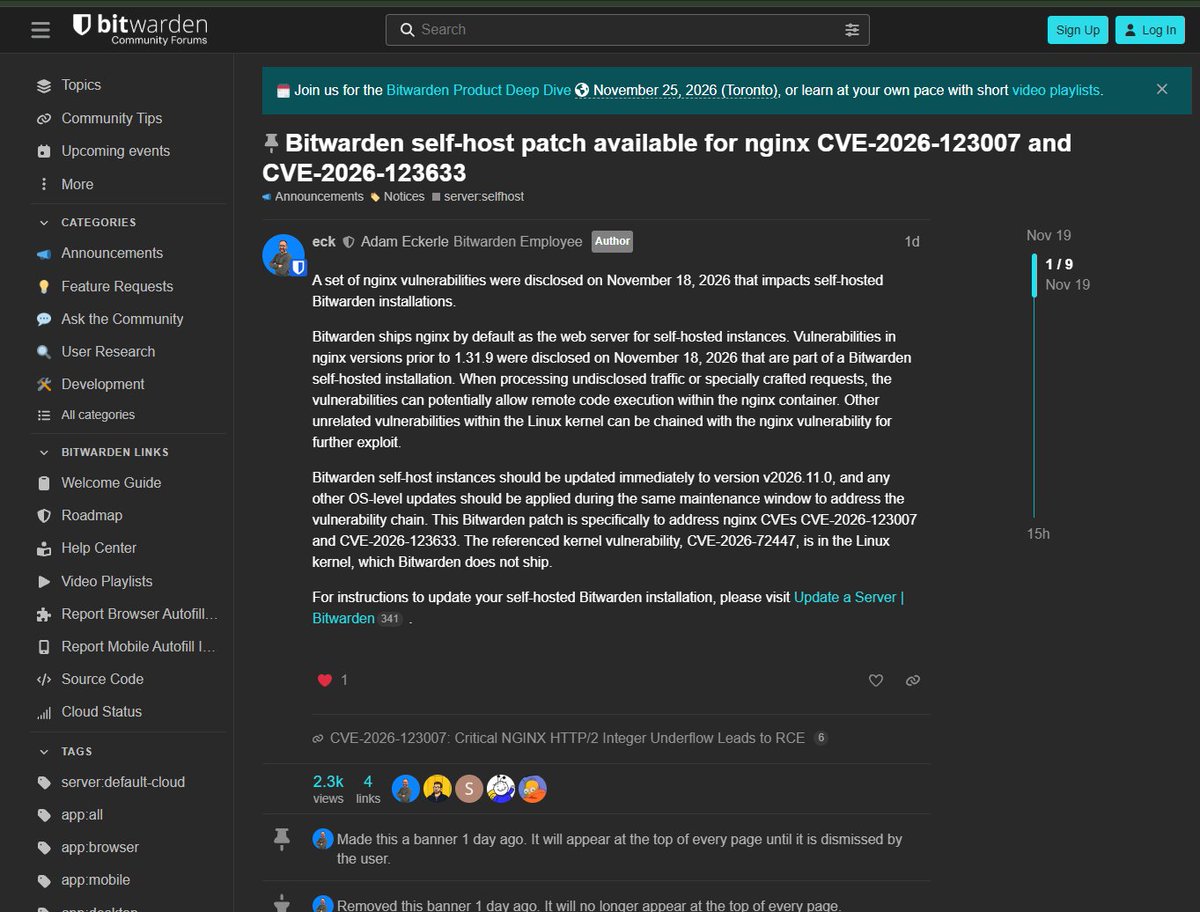
⚠️ Self-hosted Bitwarden servers exposed to potential RCE.
Bitwarden has issued an urgent patch for two NGINX flaws:
• CVE-2026-123007
• CVE-2026-123633
Even some v2026.11.0 installs initially shipped with vulnerable NGINX.
Update now. Verify your NGINX version: https://t.co/VeUDWQ74YD
‼️ NGINX HTTP/2 Flaws Could Allow Memory Corruption and Remote Code Execution on Web Servers
Details: https://t.co/xKxzCTWF7f
Two critical vulnerabilities in NGINX could let remote attackers run code on vulnerable web servers without logging in. The flaws, tracked as CVE-2026-123633 and CVE-2026-123007, were disclosed on November 18, 2026.
Both require NGINX to accept HTTP/2 connections from clients, but the conditions differ. One affects certain reverse proxy setups, while the other can affect a server that does nothing more than serve static files.
The flaws are in NGINX itself, not the websites or APIs behind it. NGINX often handles HTTPS and routes incoming requests to several applications.
#cybersecurityNews #NGINX #Vulnerability
🚨 CRITICAL SECURITY ALERT
BTCPay Server is releasing an emergency update to address five newly discovered nginx vulnerabilities dubbed “NGINX2Root.”
The most severe flaw allows attackers to remotely execute malicious code on vulnerable servers without authentication by exploiting nginx’s HTTP/2 implementation.
When chained with a separate Linux kernel vulnerability, attackers could gain full root access to the host server.
Researchers say the HTTP/2 flaw dates back to 2015, with 98.9% of nginx servers with identifiable versions running releases within the affected range.
The vulnerabilities were discovered by Xint researchers, who demonstrated the attack chain on AWS, Google Cloud, and Azure.
BTCPay Server is urging all administrators to install the emergency update as soon as possible.
🔐 Node.js security updates are now available!
Including the following dependency updates to address public vulnerabilities:
- llhttp on 22.x, 24.x, 26.x
- undici on 24.x, 26.x
- sqlite on 22.x, 24.x
Available for 26.x, 24.x, 22.x Node.js release lines https://t.co/6PdxXwHLE6
Fixes are available for CVE-2026-109518, a High severity vulnerability in APT, the package manager used in Debian, Ubuntu, and derivative Linux distributions. The CVE has a CVSS 4.0 score of 7.7.
Remediation details are available on our blog.
https://t.co/x3q5jIeD4J
😬 La guerra de frameworks acaba de cambiar.
Llevamos años discutiendo si React, Vue o Angular es mejor.
💸 Ahora que la IA escribe código, la pregunta es otra:
¿qué framework cuesta MENOS DINERO en tokens?
https://t.co/FaeZQpLj1J
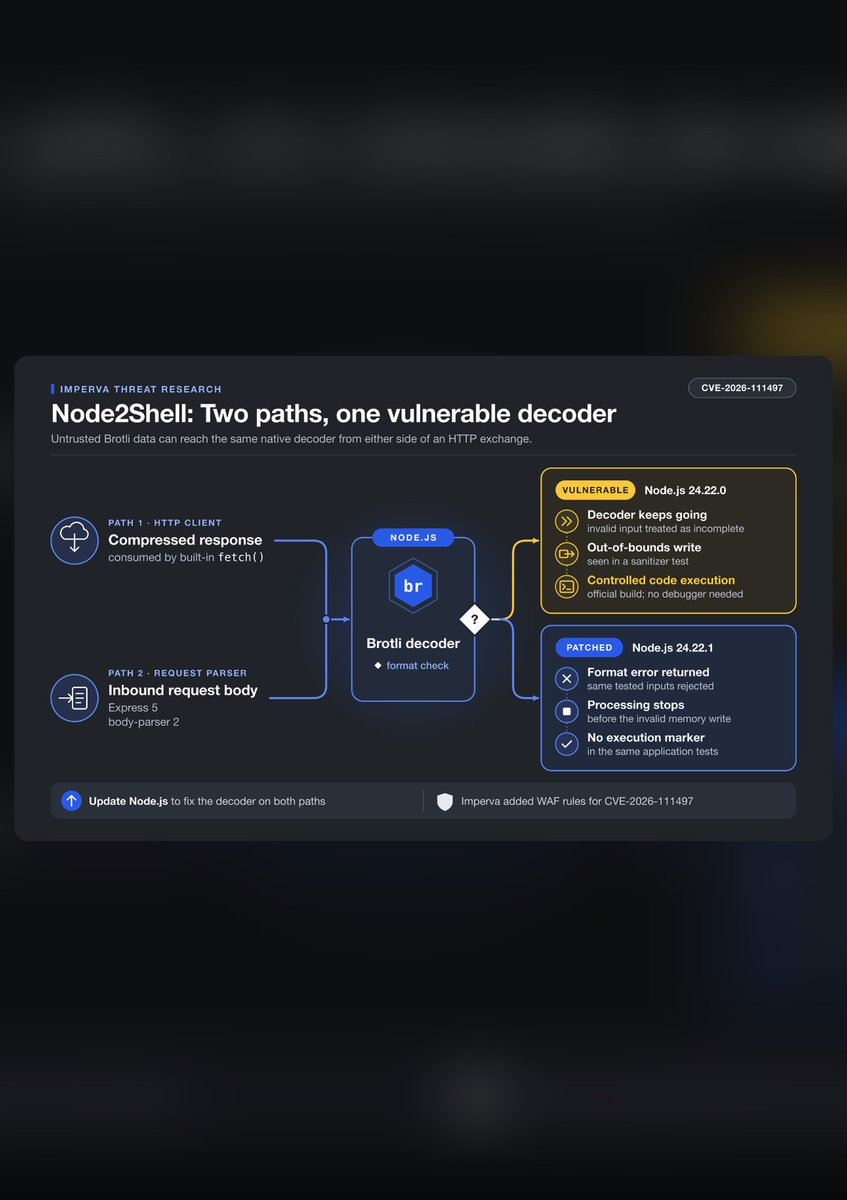
‼️ Alert - Critical Brotli flaw behind #Node2Shell RCE goes far beyond Node.js.
Bun, Python Brotli packages, Envoy, Istio and other widely used software are also affected by the same CVE-2026-111497 memory-corruption vulnerability.
Read full details ↓ https://t.co/Znn8SGEdBu
‼️ After PHP2Shell comes Node2Shell, a critical bug found by OpenAI's Codex Security that can let attackers run code in Node.js apps.
It was successfuly demonstrated on the official Node.js 24.22.0 image.
Node 20, 23 and 25 (all EoL) get no fix.
Liked PHP2Shell? You’re gonna love Node2Shell.
We reproduced CVE-2026-111497 as pre-auth RCE. On a vulnerable Node.js runtime, app.use(express.json()) is enough to expose your server to code execution through a single Brotli request. Patch your systems now!
https://t.co/NLluyUopEi
🚨 UPDATE: A public PoC demonstrates RCE on PHP 8.5.12, even after the October 21 security patches.
The attack is separate from the patched php2shell CVEs and requires specific session configurations and application weaknesses.
Our earlier concerns about PHP session handling remain relevant.
We've updated php2shell-protection with additional hardening guidance.
#php #cybercurity
https://t.co/UAHmYdVr7V
The PHP security team is giving advance notice: Upcoming security release Wed, Oct 21st 2026, 14:00UTC, two critical vulnerabilities, both rated CVSSv4 9.2.
PHP users are encouraged to prepare to update. Earlier release if details become public or active exploit evidence.
ngGlühwein returns on 27 Nov! 🍷
Join us for talks, shared ideas, community connections, and free food + drinks.
📅 Friday, 27 November 2026
📍 @Lean_Coders, Vienna
🎟️ Save your spot and a mug of Glühwein: https://t.co/cXS8DfgFNE
#Angular#ViennaTech#AngularAustria#Devs