if you're not working with unlimited tokens like @steipete and @bcherny, you could do your loop with claude code + caveman.
event -> trigger->action -> eval -> feedback
- event: create a "wiki" to render claude generated md files as context
- trigger: click "review with claude" on a page; it drops a line in a queue file
- action: claude cowork / code reads the queue and writes edits right into the page (green add, red cut, amber note) ~thanks @nbaschez for roughdraft syntax~
- evaluate: you read those marks in the wiki and judge
- feedback: accept/reject decisions; reply sends it back to claude to redo
My bet: @thinkymachines will soon make more money than @AnthropicAI. Not by winning the race to build one standardized frontier model. By becoming the Palantir FDE for enterprise custom models.
The playbook:
1. Release the best American open-weight model.
2. Drive widespread enterprise adoption.
3. Charge the largest companies 7–9 figures to post-train and run custom models behind their own firewall.
The model rests on three bets:
1. Large enterprises will increasingly demand their own models with their own data, and this is how they differentiate and win.
2. Enterprises won’t need just one model. They’ll continuously need new models for different workflows, departments, and proprietary datasets. That creates extremely sticky, recurring revenue.
3. Autoresearch will make custom model development increasingly scalable. Tinker can become the interface enterprises use to post-train their own models—with @thinkymachines providing the expertise and infrastructure behind it. FDE, infra, everything, huge contracts.
4. Eventually, maybe everyone wants their OWN model, and autoresearch and training inside tinker on top of @thinkymachines's base model will make it happen.
Meanwhile, Henry-ford-styled, standardized models will makes no margins. OpenAI and Anthropic will have their API margins squeezed by Deepseek/GLM/Grok/Meta etc, and their consumer subscriptions are loss centers.
The fat margin will move to customization: proprietary data, post-training, evals, deployment, and infrastructure.
If this thesis is right, @thinkymachines isn’t building just another frontier lab. It’s building the highest-value layer between frontier research and enterprise model ownership.
Turns out, the best business model for enterprise is NOT to sell commodity API access. Sell them their own models.
I’m extremely bullish on this approach.
@miramurati may be the most commercially savvy frontier-lab leader. I have to admit it.
underrated gems in Kimi-K3 release:
> an early K3 wrote the majority of the kernels in the late development stages
> it built a triton-class compiler from scratch, MiniTriton, that delivers performance on par with or better than Triton and torch.compile
> then it designed a chip, by a model, for a model, in one 48-hour autonomous run
the model is rewriting and optimizing every layer of the stack it runs on: kernels for its own training. A compiler for its own kernels. silicon for its own weights.
we're watching software build its own hardware
no one:
us: let’s make it hard for technical founders to found companies here while also wanting them to not start companies elsewhere in the world
smh
FYI that America’s moronic visa policy is almost certainly a factor in why Kimi/Moonshot is a Chinese startup and not an American one.
The fact that we don’t staple a green card to every AI PhD completed in America is stupid.
would be more logical to seize their passports and force them to stay
imagine focusing on distillation. distillation purely a tactical surface. the higher order failure is that america subsidizes the education, network formation, & research maturation of elite technical talent, then makes permanent belonging uncertain enough that competitors inherit the finished product.
i can’t believe we’re obsessing over whether they copied yesterday’s model while voluntarily exporting the people capable of building tomorrow’s.
ridiculous.
@danfaggella We need to get China, the US, and the frontier labs heavily prioritizing AI alignment R&D and scaling up GRAM (https://t.co/pf3mAQWs9p) before it’s too late
@juddrosenblatt@danfaggella while an interesting experiment, gram doesn’t seem to propose how to separate say, virology, from protein folding. or how scalable it is at the trillion param model.
Kimi K3 owned the internet today. Read tons of content & observed 10 key patterns:
1) The open source-to-frontier gap went from a year+ behind to 6 months to 6 days, all within the last 12 months.
2) An open model debuted ahead of a flagship US model for the first time ever. Artificial Analysis scored K3 at 57. Opus 4.8 sits at ~56, GPT-5.6 Terra at 55. It's still behind Fable 5 and GPT 5.6 Sol.
3) K3 helped build itself. An early version of K3 did the majority of Moonshot's own kernel optimization work during development. One 15-hour unattended run made a core operation 2.5x faster.
4) It's cheap per token, not cheap per answer. Sticker price is 1/3 of Fable. But it only runs at max thinking effort and burns ~2x the tokens per response. @simonw measured 13,241 reasoning tokens to write a 3,417 token answer.
5) The era of dirt-cheap Chinese AI is ending. $3/$15 per million tokens. Hacker News called it "extremely high for a Chinese open-weight model."
6) Weights don't drop until July 27. Mentions of "open" quietly disappeared from the docs an hour after launch.
7) Even when the weights drop, you can't run them. 2.8 trillion parameters. Top Reddit joke: "2TB VRAM Is All You Need." Open weights increasingly means auditable by companies with GPU clusters, not runnable by you.
8) The "they just distill/copy" argument is dying in public. One of the most upvoted comments: you'd have to be "a complete ignorant or a complete bigot" to believe Chinese labs aren't legit at this point.
9) Day one user verdict: fast, but less accurate. "Faster than Claude, but less accurate. On par with GPT 5.5 perhaps, but not 5.6 or Fable."
10) The one thing everyone agrees on: competition is wonderful. Even the skeptics: "Say what you want about these Chinese models but they sure create competition and urgency in the space."
AI agents are booking travel, signing into websites, and acting on your behalf. That creates a new security problem: until now, letting an agent log in meant exposing your credentials to the model.
Today, with @AnthropicAI, we're changing that. 1Password for @claudeai lets Claude use your stored credentials to complete real-world tasks without your passwords or one-time codes ever reaching the model, its memory, or Anthropic's systems.
You stay in control and approve which credentials an agent can use. 1Password handles authentication behind the scenes.
Available now on Mac for business, family, and individual customers.
https://t.co/eg9Y1bW7uK
My favorite moment from the entire URKL Robot Fight!
One brutal kick sent the robot's head hanging loose. and it somehow kept fighting like nothing happened!
I completely lost it. Had to lower down the volume of my laugh 😂😂
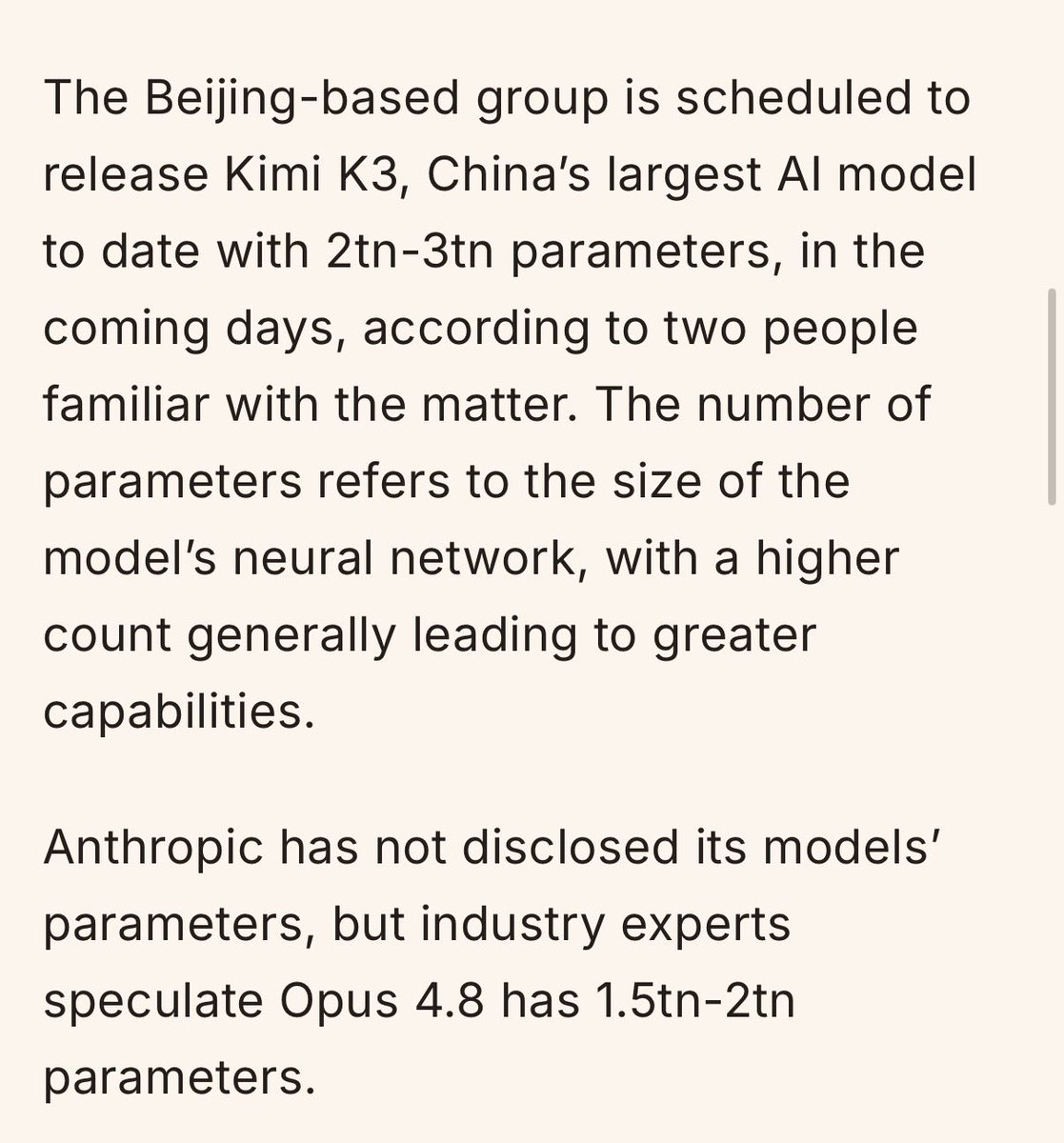
Kimi k3 is being released tonight, via FT
-2-3t parameters (Opus4.8 has about 1.5t)
-1m context
-Expected to exceed Opus 4.8 performance!
The time when China was six months behind is over. History is presumably being made today.
These high agency, high ownership mentality people are called barrels. No startup can have too many of them. The number of meaty initiatives a company can support == the number of barrels at the company.
h/t @rabois
"we could have executed more big bets if we had had a single person owning & iterating on them. Former successful founder profile with drive and speed"
+1
seems obvious but hiring former founders for early sales/GTM is very underrated
not only because of the speed (which is needed in an earlier stage, just taking more calls & closing deals faster)
but also because they are incredible at making bets and iterating very quickly
we had our first $1M month because of a bet started by an ex-YC founder turned AE (using the @crustdata MCP to power internal recruiting use cases)
he recorded personalized looms for hundreds of our customers, explained the use case and managed to expand accounts
also hired someone to build out the Claude skills for us and (with the help of our growth team) got us enough traction to justify us spending more time and resources on this new ICP
you need to hire quicker but also look out especially for entrepreneurial/ex-founder talent, they can change the trajectory of your company
exciting but there are two big gotchas:
finding the people who can translate between domain expertise and tech
and then getting to market before that translation becomes self service and obviates the need for specialized products
There is a massive opportunity for any startup to build specialized, domain-specific workflows that are at the Pareto frontier in accuracy, cost, and latency.
It is clear that not every task requires frontier intelligence (e.g. 5.6 Sol xhigh). Every single task has an optimal model+harness configuration in order to solve that task in an accurate, cheap, fast manner. This holds true even as frontier models get better!
We see this as being especially true for document OCR. We think there will always be a massive gap in the Pareto frontier for document OCR vs. frontier model capabilities for visual understanding.
Over the past year, we’ve invested massive amounts of research efforts in building auto-routing harnesses, fine-tuned layout models, and specialized models for specific elements within the document distribution - tables, charts, handwriting, and more.
All this applied research makes its way towards making LlamaParse the best document processing service out there. Come check it out: https://t.co/XYZmx5TFz8
A San Diego infectious disease doctor says it’s probably best to stay away from fresh produce for the next week or so, even if you wash it. A fecal parasite illness, known as cyclosporiasis, has now reached California. NBC 7’s Shandel Menezes has details. https://t.co/beYdXip2Ds