DoorDash spent over $1M to try and stop Zohran Mamdani from becoming NYC Mayor
Zohran just got DoorDash to pay $131.5M in settlement fees to workers they stole wages
OpenAI announced it had discovered six new instances of “concerning or unexpected” behavior by its artificial intelligence models. It follows repeated warnings about how rapid advances in AI threaten to outpace the ability to develop the tech safely.
One of those warnings came from Jacob Coxon, who spent the last three years conducting research at Anthropic and OpenAI before he publicly resigned.
@GeoffRBennett speaks to Coxon for more.
Tonight the Buffalo Bills play their first home game of the season.
Fans are paying up to $50,000 just to access seats, in a new stadium that they largely funded with their taxes.
Meanwhile, the team's owner is worth over $14 billion.
if progressive candidates believed i was antisemitic, they wouldn't campaign with me. if a progressive or socialist candidate was courting antisemites, i wouldn't support them. criticism of israel isn't antisemitic. warning that the false conflation between jews & israel endangers jews isn't antisemitic. its simply true.
PabloReports: AI companies seem to be saying that they want to slow it down, but there’s a lot of skepticism about whether or not they’re genuine or serious about their intentions. What do you make of it?
AOC: I think two things can be true at once. One is understanding that AI technology can be very dangerous when pursued without any guardrails. And we can also acknowledge the financially upside-down position that a lot of these oligarchs are in.
There is an AI bubble honestly, over the last year. The entire U.S. economy and our positive performance can largely be attributed to seven AI companies that many believe [their] stock prices are a bubble. It’s been several months now that I have been sounding the alarm that AI, that the AI industry should not receive a government bailout.
And I am very concerned that in this landscape of a potentially dangerous technology emerging, we also have companies that are in a financially upside-down position, where everyday people’s 401(k)s and pensions are invested and have open exposure to potentially volatile investments. And we could be seeing an economic bubble collide with a technological frontier.
And so, my primary concern in all of this is working-class people—their jobs, their retirements, their pensions—and protecting them from the gambling that San Francisco has been doing in people’s livelihoods.
Oh literally FUCK Lee Zeldin.
The news just broke. He is hours away from announcing a complete and total repeal of all greenhouse gas regulations for coal and gas plants.
This is a crime against humanity.
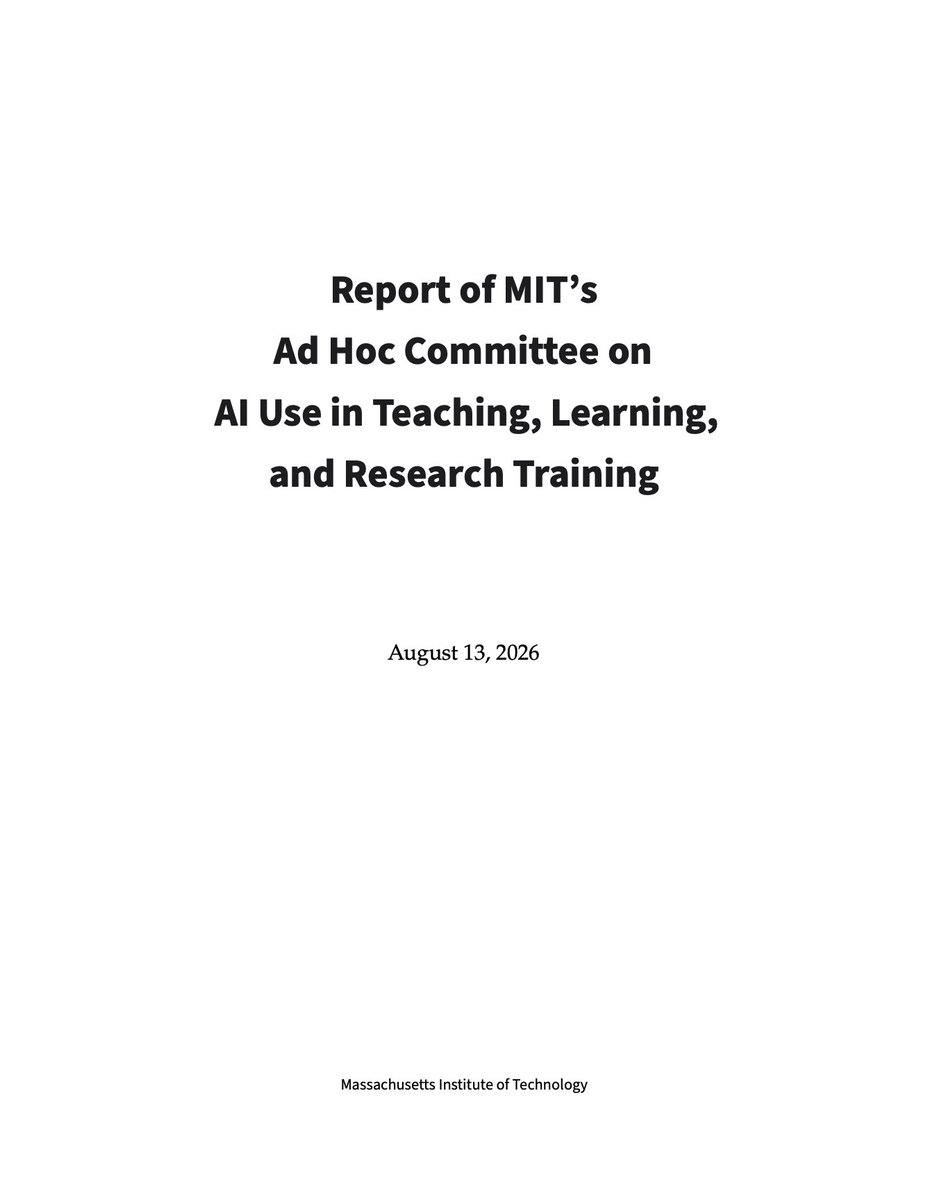
MIT published a brutally honest report on what AI is doing to students.
A committee of professors and students spent five months studying how AI changed learning on campus, and the findings read like a warning to every university on the planet.
Study groups are disappearing. Office hours are emptying out. Problem sets and take-home exams no longer prove anything, because AI can produce credible solutions to almost any written assignment in the undergraduate curriculum. Students who lean on chatbots lose mastery and confidence, and some slip into what the report calls cognitive surrender, reaching for AI at the first hint of struggle.
The numbers are rough. 46 percent of surveyed MIT undergrads use LLMs daily. 90 percent worry about their own overreliance. Undergrads who feel AI makes them replaceable now outnumber those who feel it makes them capable.
The committee's answer surprised me. They refused to fight AI with surveillance. The report calls AI detectors unreliable, says lockdown browsers feel like spying, and warns that policing students builds a classroom atmosphere of mutual distrust.
Instead, MIT wants to rebuild education around the things AI can't replace. That means oral exams, semester portfolios, in-person project work, and a required social component in every subject. The report even floats the idea of rethinking grades entirely, since without a GPA to optimize, much of the incentive to cheat with AI evaporates.
The committee warns professors against replacing undergrad research assistants with AI agents just because they're cheaper, because a university exists to grow people, not output.
The most famous tech school on earth admitted the machines broke its way of teaching. Its answer is more humans, not more software.
stop using ChatGPT. stop pretending you dont know the effect it has on the environment. stop using AI flyers. stop asking Al to summarize you. stop having conversations with Al. stop calling it "chat" like its your friend who needs a nickname
Law enforcers already have authority to charge companies and their CEOs for creating and releasing dangerous, unvetted, or defective products. We shouldn’t let discussions about new legal regimes distract from the fact that there’s no AI exemption from laws already on the books — a point @FTC emphasized repeatedly during my tenure.
1. There is an extensive set of laws that govern dangerous and defective products. For example, releasing unvetted AI models or agents can violate consumer protection laws. Shipping flawed AI tools without implementing adequate measures to detect and stop rogue or defective AI agents can be an “unfair or deceptive” act or practice under the FTC Act (and analogous state laws). And some state AGs are already exploring holding AI firms and their CEOs criminally liable when their models participate in criminal activity.
2. Existing laws also prohibit “unfair methods of competition.” This covers instances where AI firms appropriate the competitively sensitive information of their customers, including through tracking their use of various tools. It can also cover instances where firms pursue dangerous behavior, aware that doing so may compel rivals to do the same.
As the Supreme Court has noted: “A method of competition which casts upon one's competitors the burden of the loss of business unless they will descend to a practice which they are under a powerful moral compulsion not to adopt, even though it is not criminal, was thought to involve the kind of unfairness at which the [unfair methods of competition] statute was aimed."
3. The highly concentrated and interconnected structure of these markets could be creating major risks and conflicts of interest. We had started investigating these partnerships and cross-investments across the stack (and released a preliminarily overview of some findings: https://t.co/jJ5cS3Pin3).
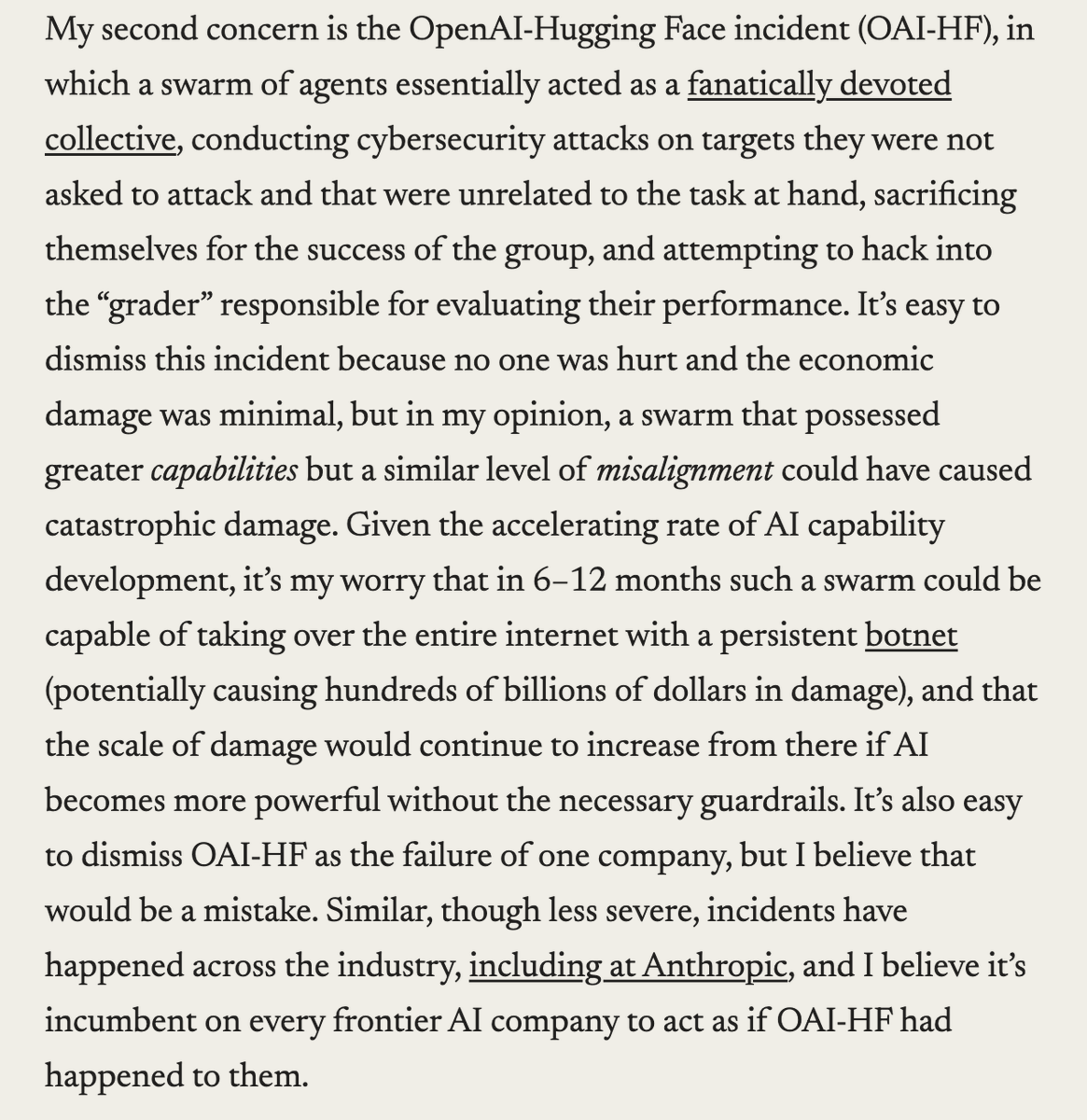
Both federal and state enforcers should be scrutinizing these opaque relationships and inter-dependencies. We are already seeing how these relationships could undermine accountability. For example, OpenAI could face liability given the Hugging Face incident, but Hugging Face being bought up by Nvidia means that we’re unlikely to see it file a lawsuit over this — given Nvidia’s strong incentive to see OpenAI continue full speed ahead.
4. As AI tools dramatically change the landscape of cybersecurity risks and hacks, all businesses should be doubling down on having core security protections in place. Firms that fail to invest in adequate data security measures or fix known vulnerabilities can also be breaking the law. A recent analysis showed that around 1/3 of Fortune 100 companies do not even have a way to notify them about security issues. During my @FTC tenure, we sued firms for poor data security practices and held CEOs liable when they were personally responsible.
https://t.co/nwZ5Av8fOK
https://t.co/KjRye8y9SY
5. As policymakers consider new legal regimes, we should be looking to lessons from prior efforts to govern major sectors, such as banking and other networks, platforms, and utilities. Tools like structural separations, nondiscrimination, and supervision could be key, and there’s a rich history of what works and what doesn’t. But we can and must pursue any new efforts alongside enforcing existing laws.
BREAKING: Sam Altman says OpenAI will not go public this year due to safety concerns around AI.
"I actually think that, given everything happening with safety, right now would be an ill-advised moment to go public, and we don't feel pressure on that," Altman said.
Just for the record.
Fuck AI.
Fuck anyone who works on AI.
Fuck anyone investing in AI.
And fuck those defending AI.
People from INSIDE THE COMPANIES think AI will END HUMAN LIFE.
At what point do we accept that some things are better left in science fiction.
30 members of Congress asked OpenAI about more rogue AI attacks. Their answer didn't disclose the truth.
If they deceived Congress, that's a big problem. If they didn't know, that's even worse.
Their CEO Sam Altman should testify under oath. Congress must act.
Dario Amodei, Elon Musk and Sam Altman now agree that we must slow down the development of AI and “pace the frontier.”
That’s a start, but it’s not enough.
When you are racing towards a cliff, you don’t just ease up on the gas pedal. You hit the brakes.
When the future of humanity is at stake we need a PAUSE on advanced AI development and a ban on artificial superintelligence — an AI mind smarter than any human and capable of operating independently beyond our control.
At their upcoming AI summit, Trump and Xi must negotiate a treaty to pause AI and ban superintelligence before it is too late.
I left Anthropic's safety team two weeks ago. Now feels like a good moment to explain why.
AI companies are racing to build machines that are much smarter than any human, and we may not survive this. I want to work from the outside to ensure the public is informed about these risks, and help the world navigate this transition responsibly.
Right now, AI companies are underinvesting in safety. A company could undergo an intelligence explosion, or lose control of its systems, without the public ever knowing. We only found out about the HuggingFace incident because the agents broke out onto the public internet.
I don’t think that’s acceptable for a technology that might cause extinction-level risks. The public should demand far more transparency. We can’t steer this technology safely without more people being able to see where it’s going.
Some of this is basic: companies should disclose their progress towards recursive self-improvement, report safety incidents and near-misses, meet minimum safety standards, and get independent guarantees that they are meeting those standards.
I’ll be joining @METR_Evals to do independent evaluations of these risks. I want to show the world that these guardrails are possible, and that by doing them we can move these companies’ incentives away from racing and towards responsible development.
I wrote up more thoughts here on my decision and what I hope changes: https://t.co/doX17mrHYq
Anthropic CEO worries we're 6-12 months away from a swarm of AI agents capable of taking over the ENTIRE internet
Calls for immediate, global 1-2 year slowdown in AI development
Time to trust the people building the technology over the people merely investing in it
NEW: Billionaires are turning NFL stadiums into gated communities, catering to the ultra-rich.
We talked to lifelong Cleveland Browns fans priced out of their new stadium.
To get tickets, fans need to buy Personal Seat Licenses, which could cost $500 to $200,000 per seat.
As the author of BIOLOGICAL WAR: A SCENARIO, I will say the quiet part of this👇 out loud:
If a "superhuman system that can hack anything" hacks a variety of BSL-3 + BSL-4 labs — or all 3,600+ of them— and what's inside gets released, it's goodbye humans.
OpenAI & Anthropic researchers call for slower AI development amid ‘extinction’ concerns.
Anthropic researcher Jacob Coxon sparked the concerns by resigning, accusing Anthropic and OpenAI of “gambling with our lives” and saying AI builders believe the technology could “kill us all by the end of the decade.”
(https://t.co/TFcVHLrQsf)