PhD candidate at Monash BDI, study in Glucagon signalling in metabolic control (supervised by Dr Adam Rose, the head of Nutrient Metabolism and Signalling lab)
Excited to see my main PhD project finally published! We discovered a novel glucagon signaling node, SEC22B, and its S137 phosphorylation, which plays a key role in glycogen, lipid, and amino acid metabolism. Huge thanks to my supervisors and collaborators!
Excited to share our latest discovery that the vesicle trafficking protein SEC22B is a key actor in #glucagon signalling the the #liver to control #metabolism. https://t.co/vqWZMf5vFI
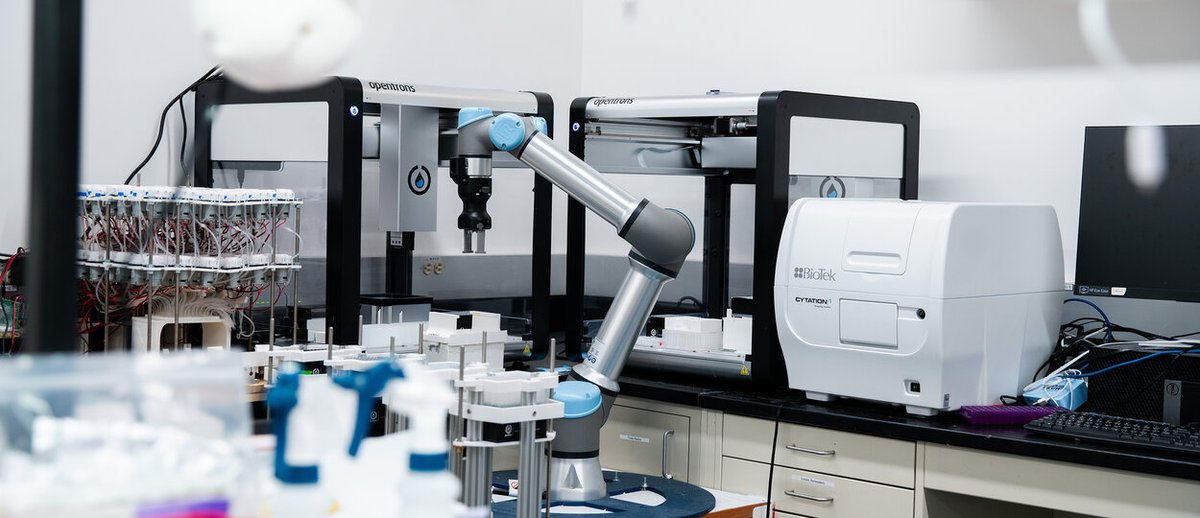
LUMI-lab is out today in @CellCellPress! 🚀We built a self-driving lab that closes the loop between an AI foundation model + robotics to accelerate lipid nanoparticle (LNP) discovery for mRNA delivery. Free access to the manuscript: https://t.co/HTAaQPrvSe
Code available on GitHub: https://t.co/OgLJ4OamGa
Check the video here: https://t.co/t3sffZw53i
LUMI-lab (Large-scale Unsupervised Modeling followed by Iterative experiments) is a self-driving laboratory that tightly closes the loop between an AI foundation model and automated robotics to accelerate LNP discovery for mRNA delivery.
To tackle data scarcity in emerging mRNA delivery domains, we pretrained the model on 28M+ molecular structures, then iteratively improved it with closed-loop experimental data. This is the kind of workflow we believe can meaningfully expand the accessible chemical space for next-generation RNA medicines.
In this work, across ten active-learning cycles, LUMI-lab synthesized and evaluated 1,700+ new LNPs and unexpectedly identified a new design feature for efficient delivery: brominated lipid tails. These brominated-tail ionizable lipids delivered mRNA into human lung cells more efficiently than approved benchmarks, despite representing only a small fraction of the initial chemical space explored.
Huge thanks to our team @YueXu1995, @HAOTIANCUI1, Kuan Pang, Reagan Li, and collaborator @BoWang87 at @UofT and @PMResearch_UHN, and to @acceleration_c@CIHR_IRSC@NSERC_CRSNG@InnovationCA@GSK for supporting this platform.
#mRNA #LNP #AI #SelfDrivingLab @bradwouters@EricTopol@elonmusk
Excited to share our new study out in @NatureCellBio! Led by postdoc @MikeLangePhD, we identify the first #LipidDroplet lipid quality control pathway: LD-localized FSP1 protects stored lipids from oxidative damage and prevents LD-initiated #ferroptosis.
https://t.co/QBM8e07IlC
Here the authors further support the link between #leptin signaling and tissue #fibrosis demonstrating that a leptin-neutralizing antibody may be a promising therapeutic approach for reducing fibrosis in the kidney, liver, lung, heart, and blood vessels https://t.co/dKSwbRKMxp
A new @CellCellPress Research, led by scientists in the labs of Weizmann’s. Prof. @AyeletErez & @MDAndersonNews’s Prof. Xiling Shen, reveals that blocking the brain-liver communication pathway may prevent deadly weight loss in cancer patients >> https://t.co/KJuDCD6MGf
🧵1/8 We’re excited to announce our new @CellReports paper, “Intramuscular adipose tissue restricts functional muscle recovery,” where we defined the functional impact of IMAT on muscle regeneration. https://t.co/OJtL8FfGK6
GLP-1R/GCGR dual agonism in mice provides multimodal efficacy to decrease hepatic steatosis and consequently improve insulin sensitivity, in concert with recovery of endogenous β-cell function and reduced insulin demand #diabetes@natcomms https://t.co/Qagg9H4bIx
Tachykinin is a food responsive gut hormone highlighting how EEC-derived nutrient-specific satiety signals and gut hormones in regulating food choice, sleep and lifespan @NatMetabolism
https://t.co/fhmxk1yGcv
New research from @WeillCornell has uncovered a surprising culprit underlying cardiovascular diseases in obesity and diabetes – not the presence of certain fats, but their suppression.
https://t.co/DDk9qWrGpS
GLP-1 agonists have transformed life for many people with type 2 diabetes and obesity. The 2025 Breakthrough Prize honors Daniel Drucker, Joel Habener, Jens Juul Holst, Lotte Bjerre Knudsen and Svetlana Mojsov for seminal contributions to GLP-1’s discovery, characterization and development into effective drugs. See them honored at the Breakthrough Prize ceremony April 12 at 3pm EDT: https://t.co/XyEkTjOrvT
A broad impact of human gut commensal bacteria on GPCR-targeted drug structures and activities through diverse #microbiota-mediated biotransformations @NatureChemistry https://t.co/OAprgpUmd6
If you're using AAVs to develop a gene therapy or to study gene function in skeletal muscle, then this may be of interest to you. In our latest work, we show that AAVs commonly used to deliver transgenes to muscle fibers also target mononuclear cells:
https://t.co/XHVtO8ouFw
🚀 We just launched the brand-new #KinaseLibrary website, directly connected to the recently released Python package! Explore kinase-substrate relationships, run enrichment analyses, and visualize phosphoproteomics data—no coding required!
https://t.co/uPmrvbq5fs
@KinaseLibrary