Alright. I want you to read this.
Earlier today, I released a new component.
What you see is the finished result.
What you don’t see are the days of planning, research, testing, designing, simplifying, throwing ideas away, and trying again before I felt it was ready.
Within hours, it had been copied and ported to another framework by pointing an agent at my code.
Of course, it’s open source. They were allowed to do it.
And I’ve been around long enough, with multiple successful products, that I don’t care.
But what if this was someone’s first product?
What if they spent months building it, launched on Friday, and by Monday it had been cloned by agents, repackaged, and made free?
What happens when your second product is copied?
Your fifth?
Your tenth?
What happens when every new idea immediately becomes the next prompt?
What happens when your roadmap, your changelog, and your launch announcements become someone else input prompts?
What happens when models become good enough to copy bigger ideas?
What happens when “just execute better” stops being the answer?
What happens when “just build bigger” or “think wider” stops being enough?
What happens when both ideas and execution become cheap?
What happens when the creator pays the full cost of creativity but everyone else pays nothing to reproduce it?
What happens to creativity when AI makes copying effectively free?
What happens to the will to create when AI makes copying effectively free?
Look, copying is not new.
Copying at this speed, cost, and scale is.
People will tell you to think bigger.
But nobody starts "bigger".
Every one of us here started by making something small.
You keep going because, somewhere along the way, the work is rewarded.
Maybe people use it.
Maybe they pay for it.
Maybe they simply recognize the thought, effort, and care that went into it.
Copying once demanded effort.
You had to study the work and understand it to copy it.
That effort created appreciation for the person who made it.
Not anymore.
Creativity begins with small steps.
If we make those first steps feel pointless, we don’t just lose small products.
We lose the people who might have gone on to build the big ones.
We are uniquely positioned here.
We get to use and experience this life-changing technology before almost everyone else.
How we use it will set the default everywhere else.
That default will spread to writing, design, music, research, and every other field where someone still has to take the first creative risk.
We can use AI to build great things.
Or we can use it to strip every new idea for parts.
We decide.
Introducing Prime Agent:
A self-improving RLM harness for coding and long-running autonomous tasks.
Designed to be both token-efficient and expressive through programmatic tool calling, context as a variable, multi-agent messaging, and a self-modifiable harness state.
This is exactly right. Source code is on the verge of becoming like assembly.
The next step is getting rid of “source code” entirely and just making an efficient binary directly with AI.
Releasing the model weights and technical report of Kimi K3.
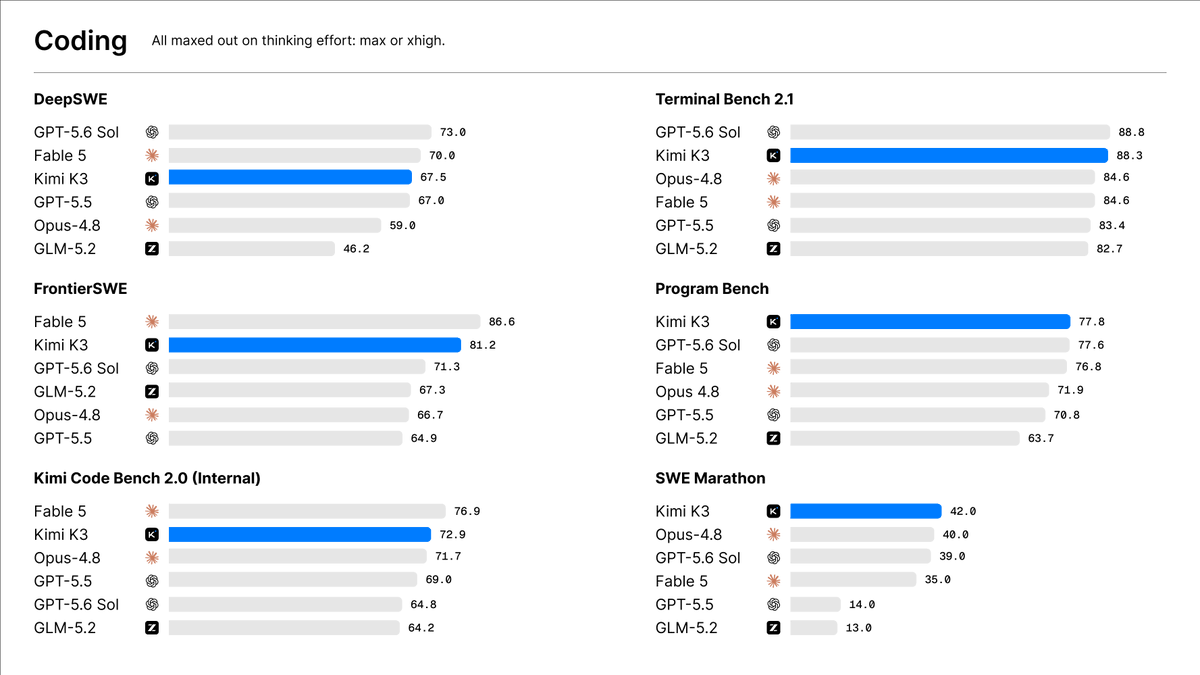
Kimi K3 is our most capable model: a 2.8T MoE model with native visual understanding and a 1M-token context window.
New model architecture: 2.5x the intelligence per unit of compute, not just more params.
Alongside Kimi K3, we're opening up more of the stack behind it — high-performance attention kernels, MoE communication library, and infrastructure for running agent environments at scale.
Model weights: https://t.co/7m7eEg6Y0B
Tech report: https://t.co/yeu6cjpMCT
Tech blog: https://t.co/YTfiMSNM1f
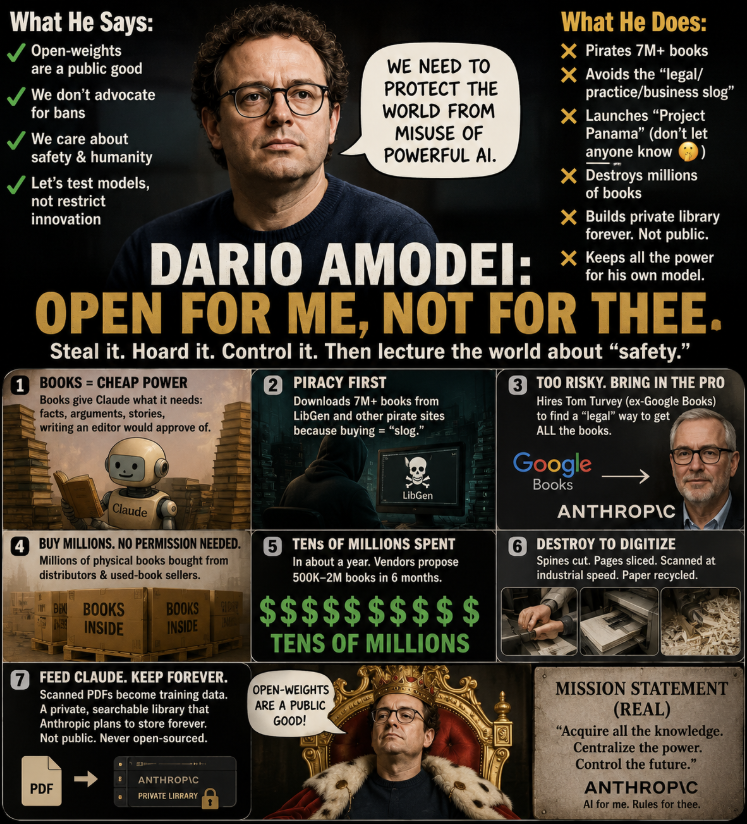
The entire tech industry (save for Anthropic) has come out in favor of open source AI.
So what happens next? Will Anthropic change its lobbying efforts? Not likely. Now the gaslighting begins:
“Nobody is trying to ban open source.”
“We just want to limit who can use it.”
“We just want to limit who can contribute to it.”
“We just want to limit how powerful those models can be.”
“We just want to make sure the guardrails (we lobbied for) can’t be removed.”
The net effect will be the same. They won’t stop until they kneecap open source. The rest of the industry needs to watch these guys like a hawk.
OH: “i’ve switched to Kimi from claude for a bunch of work. it’s just so much more fun because it just does the thing instead of lecturing you”
Woke lobotomized models are the enemy of American competitiveness.
🤯🤯🤯Kimi K3 Max agent swarm built MacOS 27 with real Liquid Glass and native apps in web browser and it’s been going for 3 hours - https://t.co/njbR0gEUyj
by @mweinbach
🛑 URGENT - A single anonymous HTTP request can run code on an unpatched #WordPress 6.9 or 7.0 site, even on a default install with zero plugins.
The new wp2shell flaw sits in core and still has no CVE for scanners to match.
Affected releases and mitigations 🠖 https://t.co/K0BhT3DwJ7
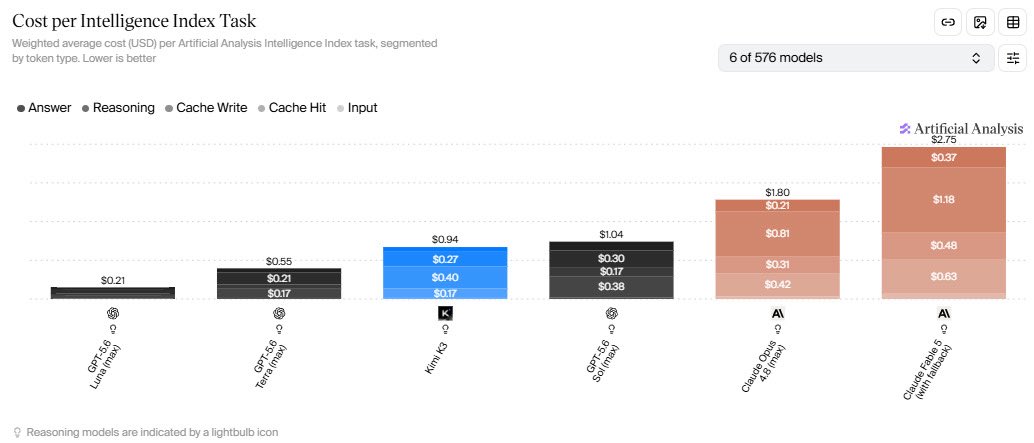
Kimi K3 may be an important inflection point for AI. Potentially negative for Anthropic and OpenAI while being net positive for essentially every other company in the world. I mean that very literally. Although the real “Sputnik moment” would be an open-source frontier model that was also token efficient unlike Kimi K3 which is 50-70% more expensive to run than GPT 5.6 per Artificial Analysis.
Rationale:
A world where there are only 2-3 dominant frontier labs with 90% inference margins is net negative for every other layer while being awesome for those 2-3 labs. Those labs would become monopsonies for power, data centers, semiconductors and hyperscalers and would obviously vertically integrate over time into all those layers while also completely subsuming the application/software layers.
Anything that lowers margins and increases competition at the model layer is good for every other AI layer: power, semiconductors, hyperscalers, neoclouds and yes even software.
This is why Jensen is so supportive of open-source. An open-source model requires the *exact* same amount of compute to run as a closed frontier model of similar size and architecture. Kimi K3 is roughly the same price as GPT 5.6 Terra on a per token basis, which actually suggests that it is less computationally efficient as I am sure that GPT 5.6 is priced to a higher margin than K3. And given that K3 is a token wastrel, i.e. token inefficient, it is significantly more expensive per task than GPT 5.6 and Grok 4.5, which are much more token efficient. Cost per token and token efficiency (i.e. intelligence density per token) are the drivers of intelligence per unit of cost. The winning AI companies will be those that offer the most intelligence per $ over time.
Lower margin % at the model layer = more margin $ at every part of the infrastructure layer and is a godsend for software. This can happen either through open-source models like K3 at the frontier *or* having a vertically integrated model company like Meta, SpaceX or Google at the frontier. Both outcomes result in a lower margin % at the model layer as vertically integrated model companies don’t really care where the margin $ come from. This is why it was so painful for OpenAI and Anthropic when Google was right there with them from a model competitiveness perspective and why Grok 4.5 and Muse 1.1 were just as important as Kimi K3.
The reason Kimi K3 is only *potentially* negative for Anthropic and OpenAI is 1) the @ericvishria point that the Claude and ChatGPT products and harnesses may be more important than their models today and 2) the hypothesis that they have much more advanced model checkpoints internally that are already being used for RSI. In the latter scenario, reaching RSI even a few months ahead of other labs might be enough to cement a permanent lead.
Time will tell on both points. And likely fairly quickly.
Caveat would be that since Kimi K3 is not token efficient and thereby actually more expensive than ChatGPT 5.6, we may need to see a more token efficient open-source model at the frontier or see Grok 5/Composer 4/Muse 2 at multiple points on the Pareto frontier for this potential risk to Anthropic and OpenAI to play out. And I am sure they will both vertically integrate as quickly as possible while continuing the product/harness strength they have shown over the last 8 months.
Introducing Kimi K3: Open Frontier Intelligence
🔹 2.8 Trillion Parameters, 1 Million Context, Native Multimodal
🔹 Kimi Delta Attention enables up to 6.3x faster decoding in million-token contexts
🔹 Attention Residuals deliver ~25% higher training efficiency at <2% additional cost
🔹 Built for long-horizon agentic coding and self-evolving workflows
Kimi K3 is now live on on https://t.co/zrk6zZxZUo, Kimi Work, Kimi Code, and the Kimi API.
Open Weights by July 27, 2026.
🔗 API: https://t.co/XCrgjXAqMw
🔗 Tech blog: https://t.co/YTfiMSNM1f