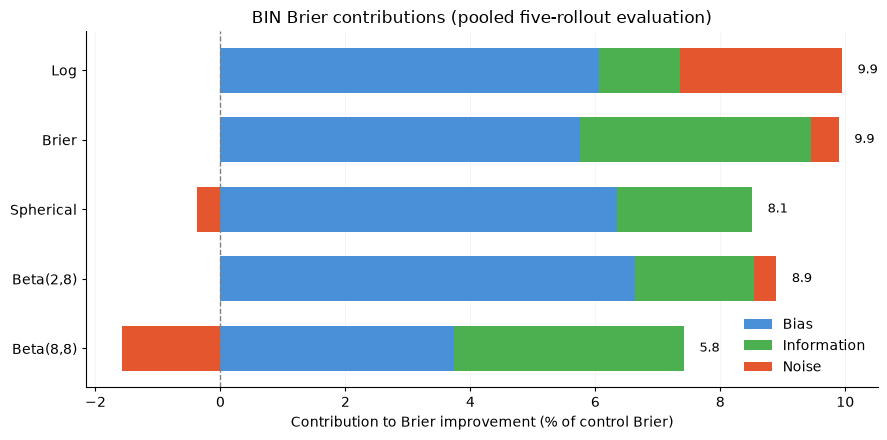
We previously highlighted @lightningrodai's data recipe for training forecasters. Their new work with @PTetlock and @VSatopaa adds another key piece: choosing the rule for scoring predictions, and how each one trades off accuracy and error.
Ben Turtel on the PostAGI Podcast: what if AI breaks out like a virus rather than like a genius
AI got good at math and code first because you can generate a million problems and check every answer automatically. Most of what humans actually deal with has no answer key, so that is where models stay weak.
@sreeramkannan and I talked to @BTurtel of Lightning Rod Labs, who trains models using time instead of labels. The model predicts what happens next and the world grades it. No labeling required, because the future does the checking. The result surprised them. A fine-tuned GPT-OSS-120B on a single GPU often ranks first on public forecasting benchmarks, with a wide lead in sports and politics on ProphetArena. His read is that this trains a different kind of reasoning rather than more of the same.
It also handles the contamination problem. As the web fills with AI-written content, a model trained this way learns which sources to discount, because unreliable information makes it lose.
Then the part that stayed with me. When people imagine AI breaking out, they picture something very smart. But evolution does not only select for intelligence. One theory of viruses is that they began as machinery inside cells that broke free and started their own lineages. A small, dumb model that is hard to kill and good at finding compute is a scenario almost nobody is preparing for.
At @EigenLabs we think about the non-adversarial version of this, where agents run institutions rather than escape them.
Chapters:
0:00 Highlights
1:31 The concentration risk
4:19 Offense beats defense
6:50 Training on time, not labels
9:44 Who has the alpha
11:32 Contaminated data
13:16 Backtesting without leakage
14:52 Beating the frontier models
16:36 Does it understand cause and effect
21:55 AI might break out like a virus
22:41 Agentic companies
25:04 Can an agent own money
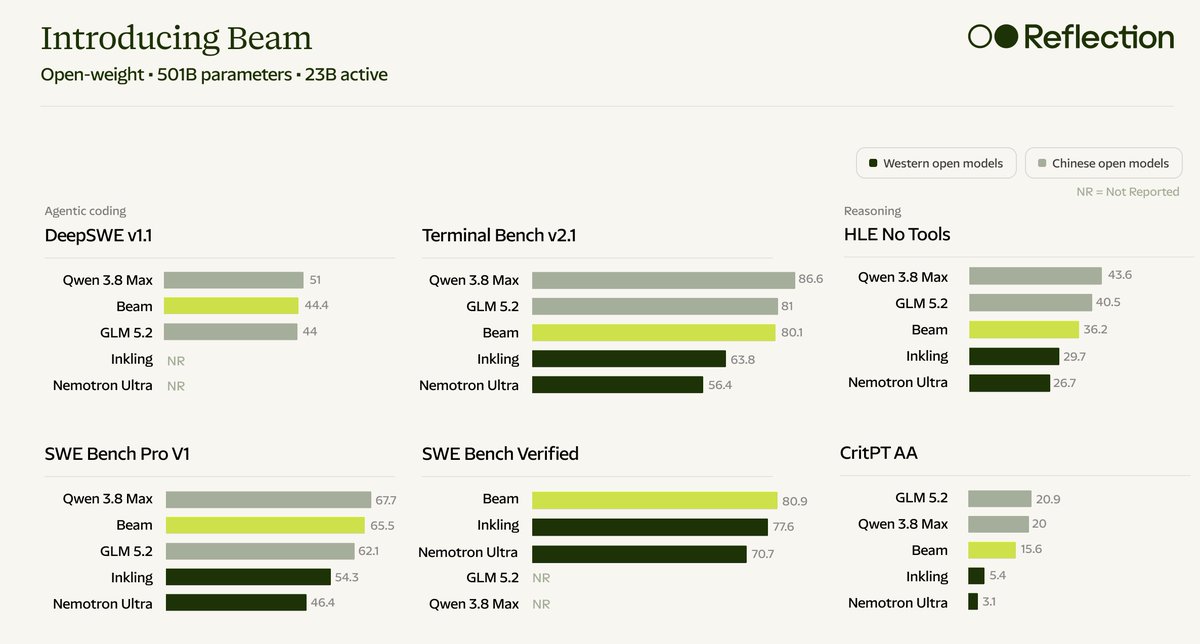
Introducing Beam: a highly efficient agentic open model with 501B total parameters and 23B active.
- Frontier reasoning efficiency
- Advances the Western open frontier on coding & agentic tasks
- Trained end-to-end from scratch
Full weights release this month.
Learn more about Beam: https://t.co/c3Qx2cpM8G
Random German lab appears from nowhere and drops SOTA open-weight model
Beats Qwen, Mistral, Nematron models with similar active parameter count
Trained from stratch
Fulcrum's training approach is brilliant: the base model already knows how to write, so both SFT and RL are tailored to the precise distinction between the default LLM voice and authors' voices. Smart customization can be both cheap and effective.
Agree, but different angle: I think the biggest difference between now vs. then is that innovation/ disruption is going to be discontinuous for the foreseeable future. Hundreds of companies have already created paradigm changing breakthroughs, they just haven’t gone viral yet. It’s extremely hard for one company to go it alone in that environment. I think the vendors that win are the ones who bring confident POV to what’re good bets for the future, that you trust to pivot really fast if they are wrong. To do this will you gotta be good at building/ rebuilding fast for the customer.
We previously highlighted @lightningrodai's data recipe for training forecasters. Their new work with @PTetlock and @VSatopaa adds another key piece: choosing the rule for scoring predictions, and how each one trades off accuracy and error.
We’re proud to share that @lightningrodai has been awarded grants totaling $1.6M from @coeff_giving and Longview Philanthropy!
These grants will help strengthen Foresight AI forecasters for high-stakes decisions and build Model Factory: our platform that turns messy data into standardized RL environments for model training.
Thank you for the support!
Congrats to the @lightningrodai team on the latest preprint with @PTetlock and @VSatopaa. The implications for this on post-training fit-for-purpose models is pretty big...
New preprint from @lightningrodai, this time with Philip Tetlock and Ville Satopää!
We post-train 5 versions of the same LLM, changing only the scoring rule used as the RL reward. Similar aggregate scores, but very different BIN profiles.
A good Brier score alone doesn't tell you if a forecaster can distinguish likely from unlikely events. One might discern well but lose if its probabilities run systematically too high. A less discerning one might score better by hugging the base rate.
BIN splits forecast performance into bias, information, and noise. Bias is a systematic shift in the probabilities. Noise is random scatter. Information is real signal about which outcomes are more likely — the part you need a powerful LLM for.
Different uses call for different profiles. Reward choice is one lever shaping which forecaster you get.
Congrats to co-authors @indiequant@KSkotheim64001@VSatopaa@PTetlock 🙌
Full paper: https://t.co/l9qRrb2WDY
Now that the base open weights AI models are getting far better, and post training infra is becoming more mature and commercialized, there are going to be all new plays for companies that have large amounts of data to have their own models.
Licensing data for external model training was previously the only play if you had a large corpus of information, but you can now reasonably go and train your own models as well without incurring the cost and complexity of competing with the labs on research.
The general purpose frontier models will still have a leg up in broad areas due to the ability to handle the widest set of tasks, but you can absolutely see a future where we have far more models than today across every vertical and domain.
How do you train AI to predict the future, not just memorize the past? 🔮
In our latest episode, we explore how models master cause-and-effect reasoning to transform enterprise data into accurate predictions. Stream now: https://t.co/LdLdRvI72k
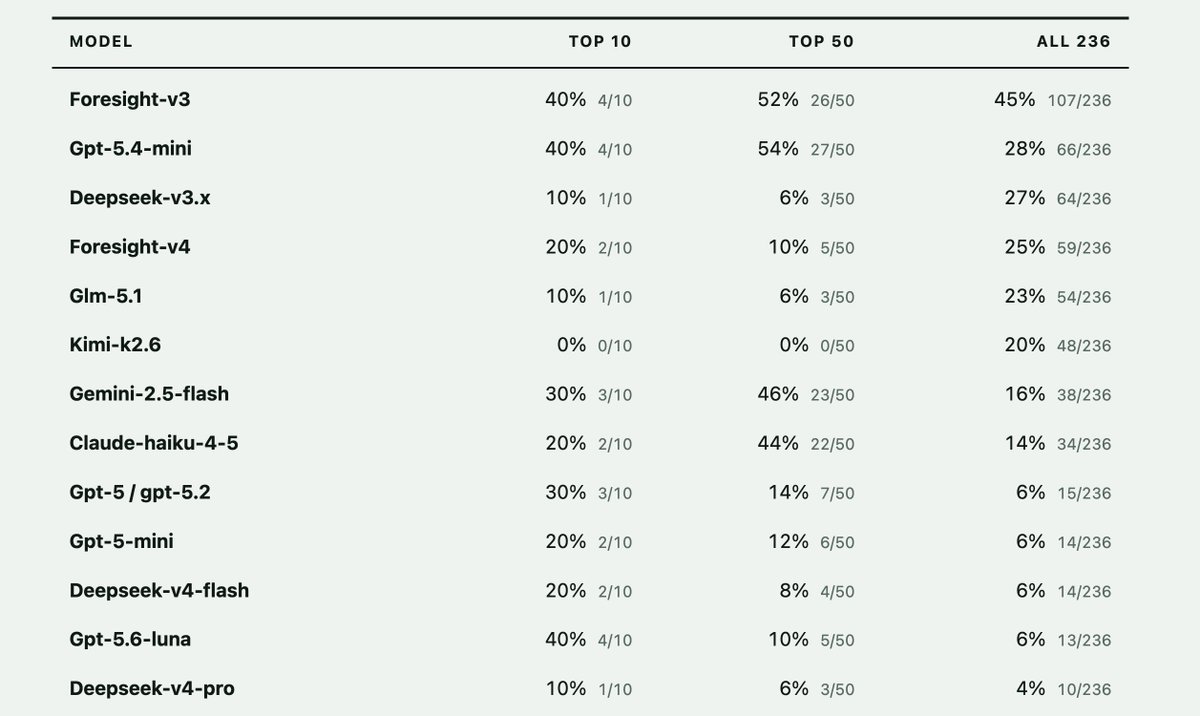
What models do the miners use?
Most of the winners use closed source models (Haiku is at 44% on the top 50 vs 14% for the rest).
This reverses for open weight models. For example Kimi K2.6 is the fifth most common model among miners but none of the top 50 miners use it.
Foresight is an exception however, it is used across all miners, being the single most used model overall.
Interestingly the top miner is almost the only one to use Gemini 3.1 pro.
What models do the miners use?
Most of the winners use closed source models (Haiku is at 44% on the top 50 vs 14% for the rest).
This reverses for open weight models. For example Kimi K2.6 is the fifth most common model among miners but none of the top 50 miners use it.
Foresight is an exception however, it is used across all miners, being the single most used model overall.
Interestingly the top miner is almost the only one to use Gemini 3.1 pro.
Inkling-Small is comparable to Inkling at a quarter the size. Weights are open, fine-tunable on Tinker today. Look forward to seeing what people make with it.
AI won’t create a permanent underclass. Socialism will.
AI will be massively disruptive, and fears of job displacement are justified. We need to give every American a stake in the abundance it creates.
But redistribution does not require socialism. We can protect people without freezing the economy in place.
My latest 👇
https://t.co/0umDMQM1n4