I’m not an AI doomer, but my firsthand experience dating back to 2020 is that the researchers expressing concerns are sincere.
The closer they are to the research, the more worried they seem to be.
@pachabelcanon When you are in the "flow", when you do your best work, we lose ourselves in the work, "I" does not exist. I did not do the work, the work instantiated/took physical form through me.
i genuinely have no desire to be rich so i can buy a rolex or a Lamborghini.
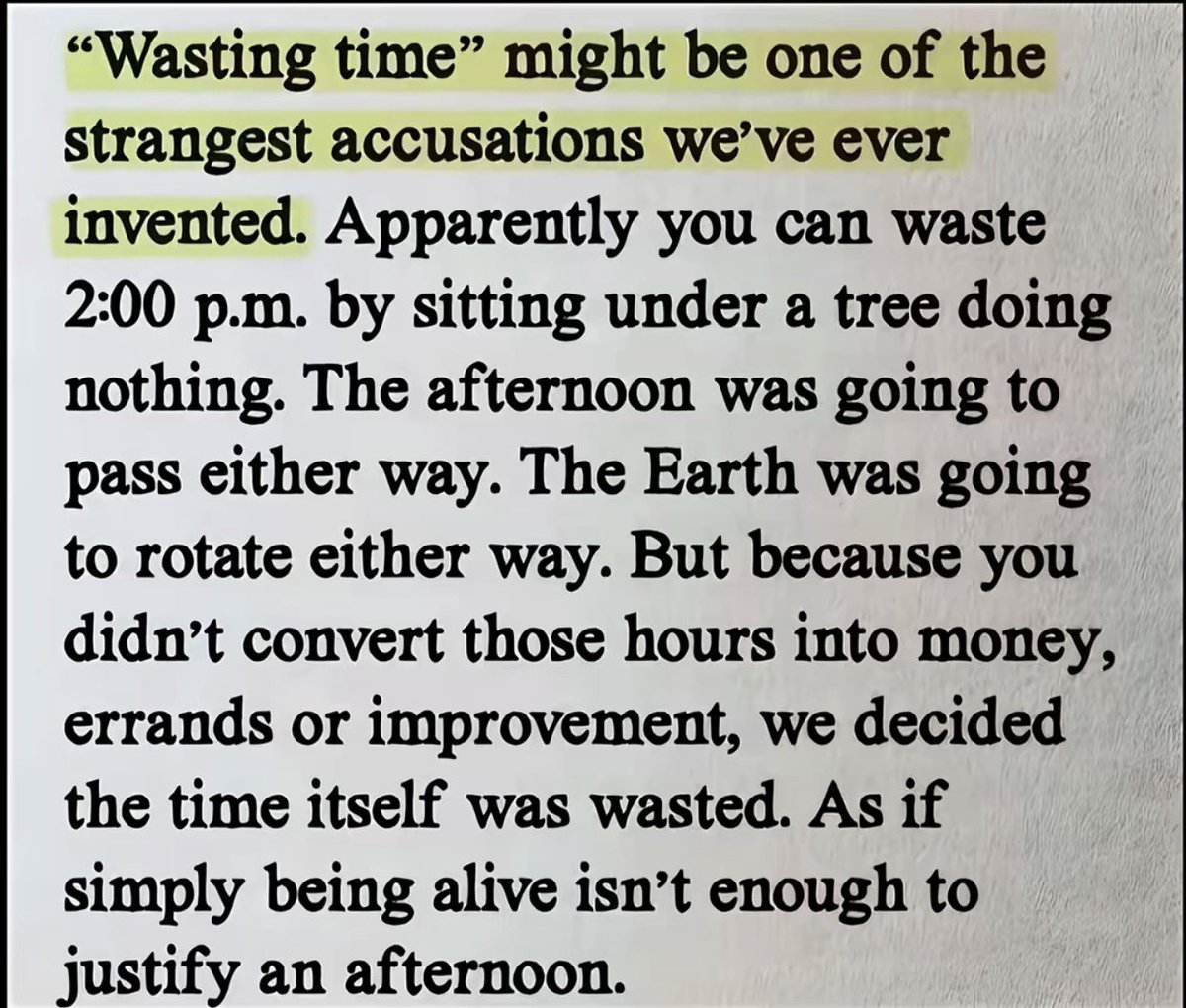
i want to be rich so i can control my time and go to the gym at 3pm on a monday.
sit at a cafe and relax for an hour on a rainy afternoon.
so i can cook meals at home with fresh ingredients.
spend on my family and friends without worrying about a budget.
that's my idea of a rich life, not the fake consumerist idea shoved down my throat.
Btw, this is the only mathematician who has solved one of the seven Millennium Prize Problems.
he rejected both the Fields Medal and the $1M prize:
> be Grigori Perelman
> Russian mathematician
> 16 years old
> go to International Math Olympiad
> score 42/42
> years later…
> there’s a geometry problem called the Poincaré conjecture
> been unsolved since 1904
> generations of mathematicians fail to solve it
> Clay Institute puts a $1M prize on it
> wrestle with the problem for years
> 2002
> casually upload the solution to arXiv
> don’t even care about submitting it to a journal
> mathematicians spend years checking the solution
“fuck
he actually solved it”
> 2006
> offered the Fields Medal
> most prestigious prize in math
> refuse it
> 2010
> offered the $1,000,000 Millennium Prize
> refuse that too
“EVERYBODY UNDERSTOOD THAT IF THE PROOF IS CORRECT THEN NO OTHER RECOGNITION IS NEEDED”
Terence Tao just posted this really insightful thread which seems to have been written in reaction to the Navier Stokes announcement. Please give it a read. https://t.co/SiuLLyp8jQ
We’re sharing a solution to the Navier-Stokes Millennium Prize Problem, one of the deepest problems at the frontier of mathematics.
The proof was produced by a group of agents, using an OpenAI next-generation model significantly more capable than GPT-6 Astra.
The problem concerns whether the description of smooth three-dimensional fluid motion modeled by the Navier-Stokes equations can break down. It has remained unresolved for roughly 90 years.
@nntaleb@bryan_johnson bro, i think your criticism is that he is a grifter, however, I don't think there is anything wrong with believing that death can effectively be solved (for ex by reaching aging escape velocity)