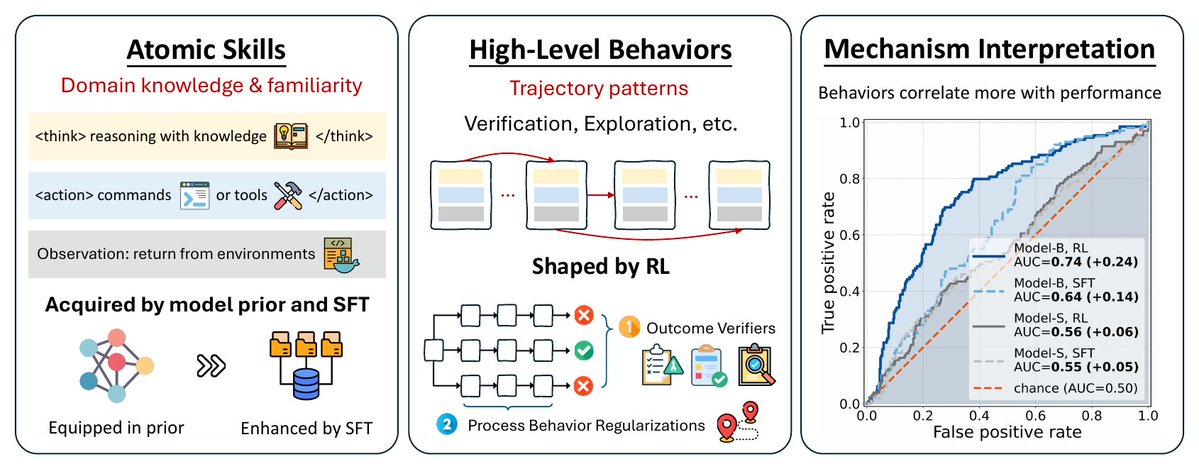
📢 Excited to share our latest work from @SFResearch: Learning Generalizable Behaviors for Terminal Agents
🤔 Q1: How does RL actually help terminal agents generalize?
→ Not by teaching new skills. It reshapes behavior.
• Skills (write the regex, call the tool) are already there from pre-training + SFT
• Behaviors (inspect first, verify, stop looping) are what RL shapes, and what predicts success
🔍 Q2: Can you trust your synthetic RL environments?
→ Often not. The reward can be wrong in both directions.
• The cleanest public collection we audited: 35.8% clean
• Reward 1 for copying a leaked answer. Reward 0 for a correct solution
🌊 So we built RIVER
→ Filter defective envs, penalize repetitive loops, then run RL.
• River-8B: best among evaluated open RL-trained 8B models on all 4 terminal benchmarks
• 2B→27B with <30% of the envs: RL gains +106% on Terminal-Bench-Lite, +30% on Terminal-Bench-v2.1
• Same 3.5K-env budget: filtered 19.4 vs. randomly sampled 17.7
✅ Takeaway: audit your verifiers before you scale your envs.
🙌 Led by @YYYao45 and @bo_pang0 , with @xuanphinguyen , @zhao__ding and @JotyShafiq
📄 Paper: https://t.co/SUTFEzVHEd
🌐 Website: https://t.co/nuMWIxG1fk
🧵👇
Rollout accuracy alone doesn’t guarantee good RL training for LLMs. Our most recent paper BRIDGE shows how exploration + data co-influence are critical for stronger reward-driven updates!
🚀 Introducing BRIDGE — a task-agnostic data augmentation strategy to prepare LLMs for RL!
🤖 Why do LLMs often fail to benefit from RL fine-tuning? We pinpoint two key factors: 1) 🔍 Rollout Accuracy 2) 🔗 Data Co-Influence. 💡 BRIDGE injects both exploration & exploitation into LLMs, boosting rollout informativeness and increasing data co-influence — key ingredients for effective RL fine-tuning.
🔍 We also compare with a popular accuracy-filtering baseline — it still plateaus due to low data co-influence. TL;DR: medium query difficulty / accuracy ≠ RL-ready.
📄 Paper: https://t.co/98Xb9nmAOL
🌐 Website: https://t.co/YTieEjXA0G
🏝️ OASIS: Shaping the Future of Offline Safe Reinforcement Learning
🚀 Our recent NeurIPS 2024 paper tackles the challenges in Offline Safe Reinforcement Learning with a data-centric perspective that improves training dataset quality for safer and more effective policies.
#neurips2024 #Oasis #safety #ReinforcementLearning #Datacuration
✨ Key Contributions:
💡Data-Centric Approach: Focuses on knowledge distillation and data augmentation to enhance dataset quality, rather than solely proposing new model-centric algorithms for sequential modeling and policy optimization.
💡Distribution Shaping: Leverages a conditional diffusion model to curate datasets and align training data with user-defined safety preferences.
💡Theoretical Insights: Provides a comprehensive theoretical analysis of how behavior policy and offline dataset quality affect the performance of regularization-based offline (safe) RL.
💡"Less is More" for Offline Safe RL: Demonstrates that a small, preference-aligned, high-quality dataset can outperform a massive dataset with mixed quality and preferences.
💡Broad Compatibility: Integrates seamlessly with model-centric algorithms.
🔗 Project website: https://t.co/Qv1S4nwwGN
📄 Paper: https://t.co/wd0BpbVdBe
🐙 Code: https://t.co/yBabEVPwyI
Using tools is often regarded as the hallmark of intelligence. How can robots creatively use tools beyond standard functionalities and make impossible tasks possible? 🤖🗝️
We introduce RoboTool built on LLMs, enabling multiple creative tool-use behaviors, including tool selection, sequential tool use, and tool manufacturing!🧵👇🏼
https://t.co/VTD8QsNgJb
🚀 Excited to announce our latest research on #SafeRL, with three high-quality packages released! We introduce a benchmarking suite tailored for offline safe learning challenges. Explore more details at https://t.co/ZhUsTyd8Hc #AI#RL#AISafety (1/4)