Robotics has no shortage of impressive demos. What it lacks is intelligence that holds up on the factory floor.
Closing that gap took a lot of work. Exciting to see our systems out there solving real problems!
Meet Koa, built on @NVIDIA Nemotron
Salesforce’s first CRM reasoning model for Agentforce just made its @Dreamforce debut.
→ Built with 27 years of Salesforce CRM intelligence
→ Designed for complex, multi-step CRM work
→ Matches or exceeds leading model performance on CRM actions with 3x fewer errors
🚀 Now in pilot
Introducing Koa, built on @NVIDIA Nemotron
Salesforce’s first CRM reasoning model for Agentforce brings 27 years of CRM intelligence into the model itself
→ Matches or exceeds leading model performance on CRM actions with 3x fewer errors
→ Built for complex, multi-step workflows
→ No customer data used to train it
→ Now in pilot
And our work with @NVIDIA goes further — bringing NVIDIA Nemotron-based models + accelerated computing to Missionforce for mission-specific AI.
Read more 👇 https://t.co/j7TMJePVQD
The essence of harness is transfer of cognitive load.
In our new work, we investigate this through strong2weak scaffolding, where builders recursively refine harnesses for smaller models at test time.
📄 https://t.co/C6Mg6zuHOO
🤗 https://t.co/KwgqIkzMh1
Every KV cache evictor for efficient long reasoning scores cached tokens to decide which ones to keep. We find the score buys almost nothing: keep the prompt, evict at random per head, and you match the strongest evictor at 32–43% higher throughput.
Paper: https://t.co/TvQwOymVfE
Page: https://t.co/eeyLhJRkDj
Today I finally get to share something our team has been quietly grinding on for months – we've created an 𝗼𝗽𝗲𝗻 𝘀𝗼𝘂𝗿𝗰𝗲𝗱 𝘃𝗲𝗿𝘀𝗶𝗼𝗻 𝗼𝗳 Cursor 𝗕𝗲𝗻𝗰𝗵 @cursor_ai .
If you’ve been following Cursor’s Composer launch and their internal "Cursor Bench" for testing vibe coding models, you can think of our 𝗟𝗖𝗕𝗔 𝗯𝗲𝗻𝗰𝗵 as the open-source, model-agnostic counterpart.
Here is what we provide by @SFResearch . With 𝗟𝗖𝗕𝗔 𝗯𝗲𝗻𝗰𝗵 we:
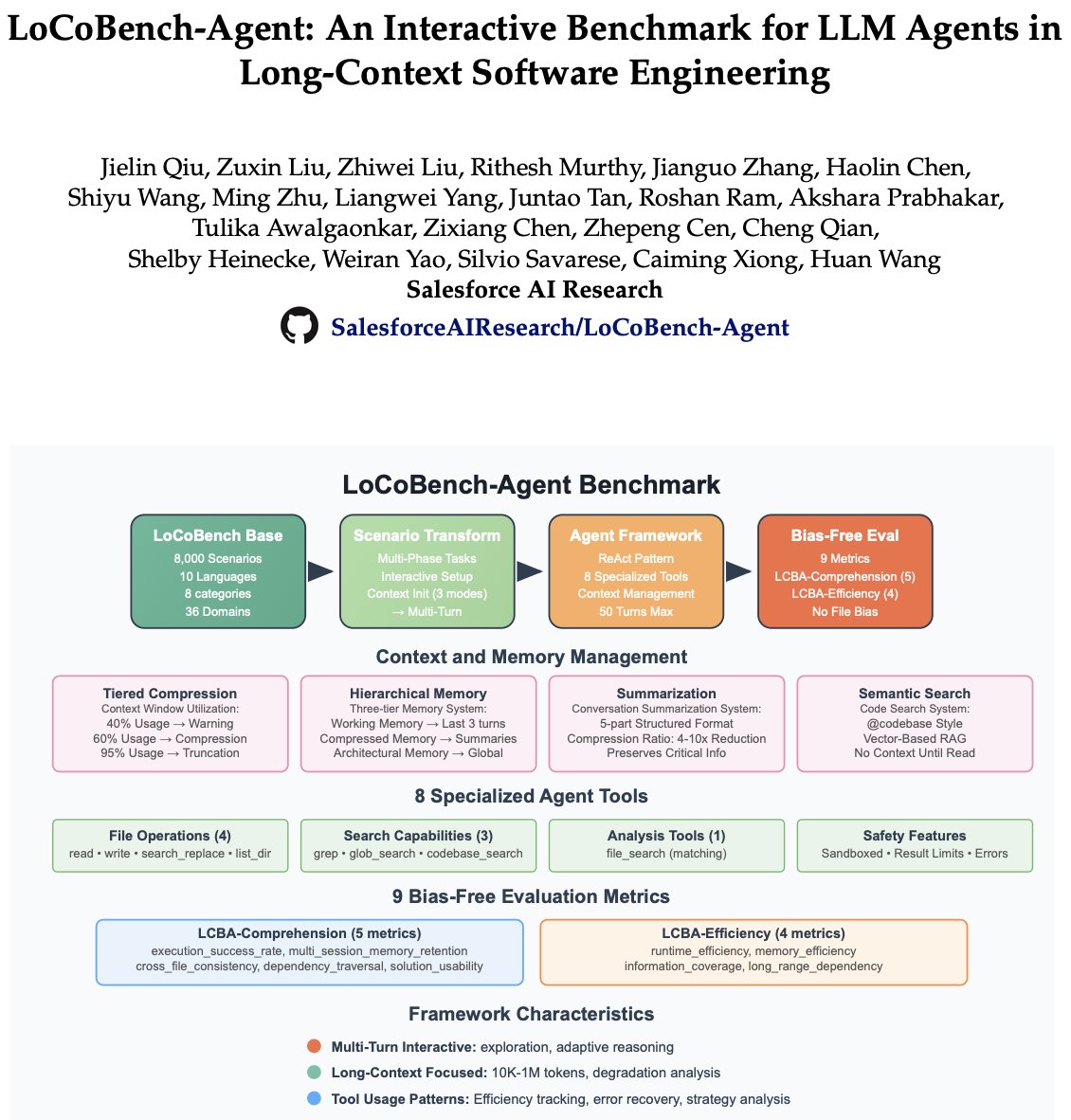
• Ship a 𝗖𝘂𝗿𝘀𝗼𝗿-𝘀𝘁𝘆𝗹𝗲 𝗮𝗴𝗲𝗻𝘁 𝘀𝘁𝗮𝗰𝗸: ReAct loop, semantic @ codebase search, grep, file read/write, refactor tools, and a three-tier memory system inspired by production coding assistants like Cursor.
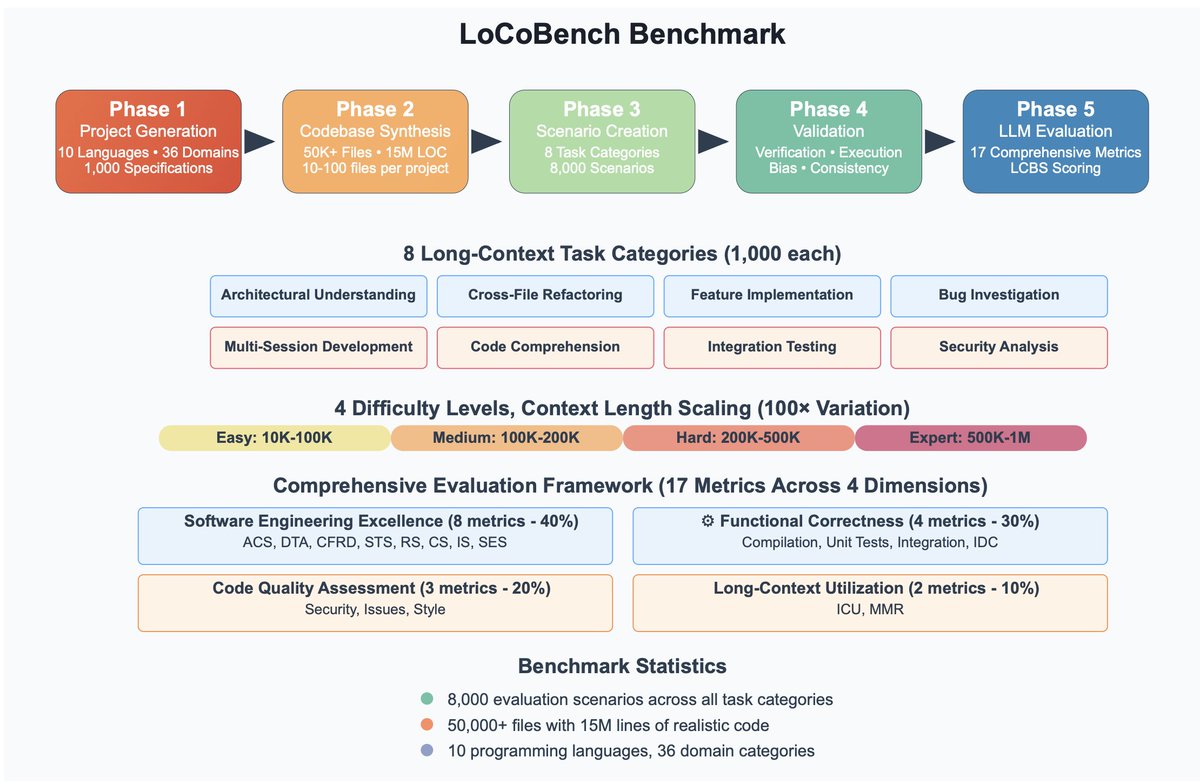
• 𝗧𝗮𝗸𝗲 𝟴,𝟬𝟬𝟬 𝗿𝗲𝗮𝗹-𝘄𝗼𝗿𝗹𝗱 𝘃𝗶𝗯𝗲 𝗰𝗼𝗱𝗶𝗻𝗴 𝘀𝗰𝗲𝗻𝗮𝗿𝗶𝗼𝘀 and turn them into interactive agent gyms across 10 languages and 10K–1M token codebases.
• Let you plug in any model (GPT-5, Claude Sonnet 4.5, Gemini 2.5 Pro, etc.) and see how it actually behaves on long, messy, multi-turn coding tasks.
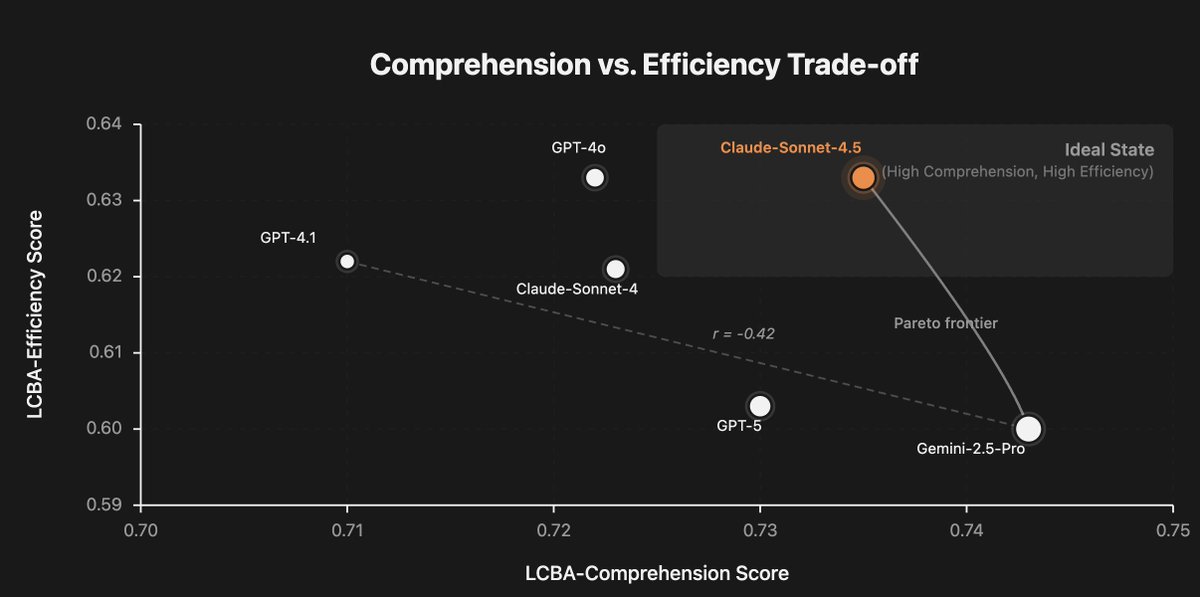
A few fun findings: Cursor-style agents with context management are surprisingly robust at 1M-token contexts, but there’s a hard trade-off between deep exploration vs. efficiency — no one frontier model sits in the “perfect” top-right corner yet. Anthropic Claude 4.5 and Google Gemini 2.5 pro are at the Pareto Frontier.
Everything is open source (agent, code, scenarios, traces, metrics) on @huggingface:
📄 Tech Report: https://t.co/i6UTFGou4T
🤖 GitHub:https://t.co/OEwv4x5tC5
🤗 Dataset: https://t.co/PuxHwxoHVU
If you’re building coding agents, benchmarking your model against GPT/Claude/Gemini, or want to train your coding agents with RL in real coding environments, we’d love for you to try LCBA bench, and tell us your findings!
Excited to see the first paper getting accepted at @DMLRJournal. In the last few months, we are fascinated by the quality of reviews and the engaging interactions between authors and reviewers! Thanks everyone! Please continue to send your best work about Data x ML😀
'Benchmarking Robustness of Multimodal Image-Text Models under Distribution Shift'
by Jielin Qiu, Yi Zhu, Xingjian Shi, Florian Wenzel, Zhiqiang Tang, Ding Zhao, Bo Li, Mu Li
Action Editor: Hongyang Zhang
https://t.co/mXh5OCAt9T
#Multimodal#Robustness#DistributionShift
📚🌟 Evaluate any story to your heart's content with our new personalized story evaluation model, PerSE! No more worries about diverse preferences - get your own story evaluation report now! 📝🎯 https://t.co/uRIGBlnGAI
1/5
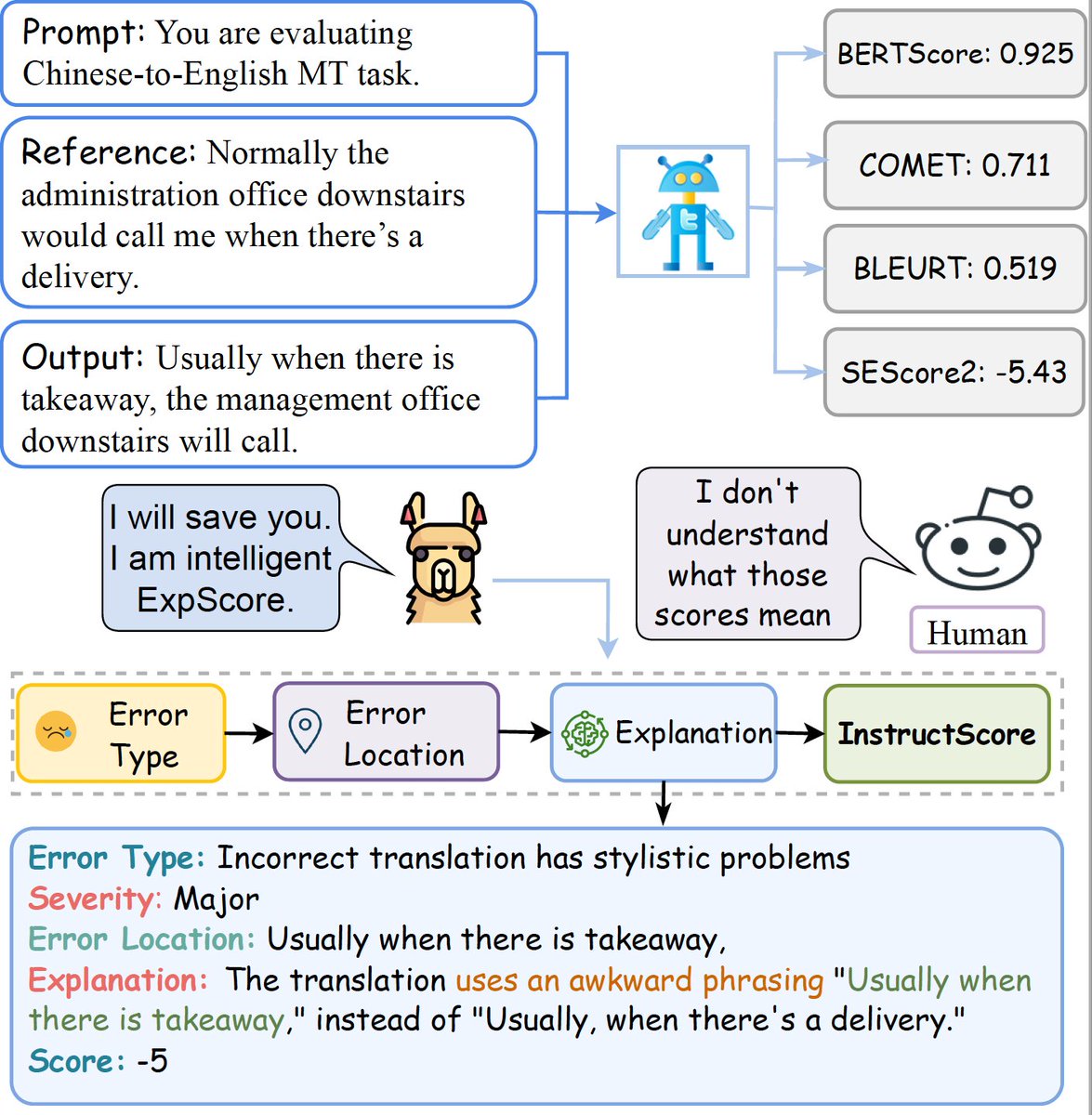
What is missing in the text generation evaluation for BERTScore, BLERUT, COMET, SEScore & SEScore2? Explanation! Can we build a metric that not only produces a well-correlated quality score but also tell you the rationales, error type, and error location? Checkout InstructScore!
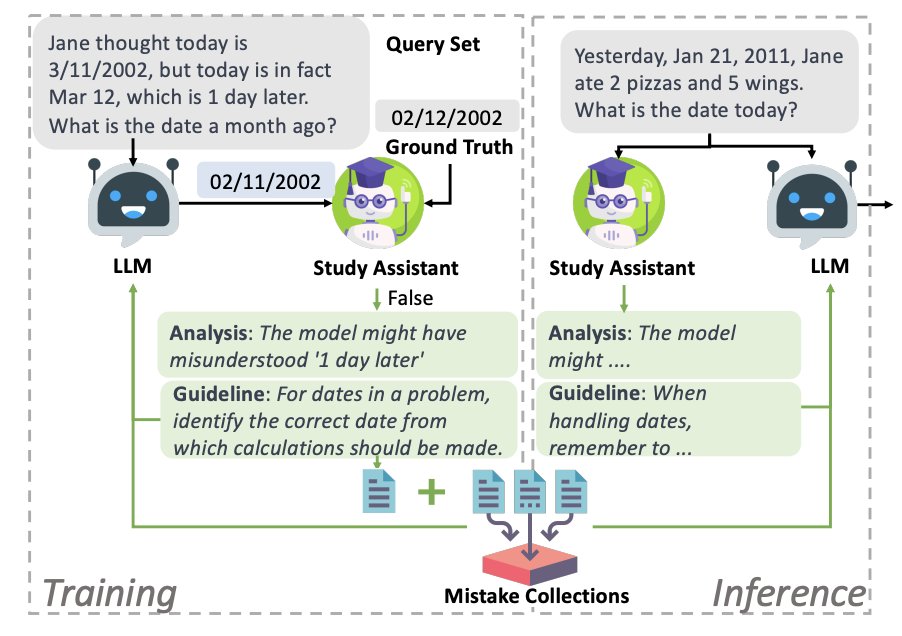
🚀 Excited to share our latest work in EMNLP main conference: "Learning from Mistakes via Interactive Study Assistant for Large Language Models". We introduce a study assistant (SALAM) to conduct thoughtful analysis on LLMs' mistakes and provide guidelines to avoid past mistakes
😭Tired of in-context demos & docs for LLM tool use?
💰Too GPU-poor to tune LLMs for unseen tools?
🤬Frustrated with frequent syntax errors in tool calls?
Check out our new preprint 𝐓𝐨𝐨𝐥𝐃𝐞𝐜 that addresses all these issues from the decoding side!
https://t.co/vssxVg833j
1/5
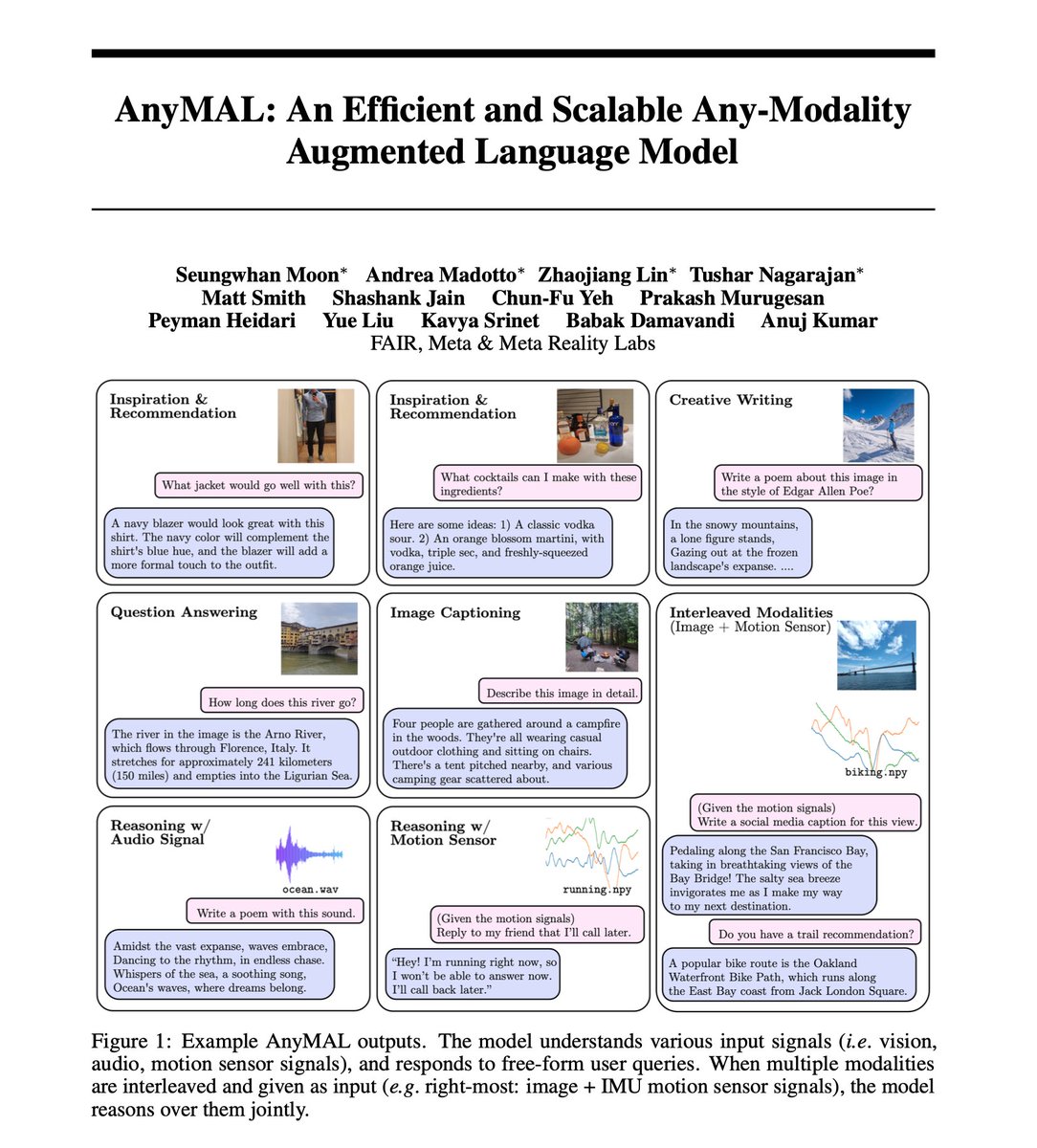
Excited to share our recent work, AnyMAL -- a unified Multimodal LLM built on LLaMA-2 that can reason over various inputs, e.g. images, audio, motion sensors.
Check out our paper for more information on the model training, evaluation, safety and more!
➡️ https://t.co/HmyVynWXPH
Our #ACL2022 paper "Vision-and-Language Navigation: A Survey of Tasks, Methods, and Future Directions" is out (https://t.co/k9IrNlrlqJ)!!!
It serves as a thorough reference for the VLN research community (for both starters and experts).
https://t.co/m9xkegUs1g