Dozens of Orthodox Christians Reportedly Killed in Fresh Violence in Ethiopia’s Arsi Zone
At least 37 Orthodox Christian civilians have reportedly been killed in a new wave of violence in Ethiopia’s Arsi Zone of the Oromia region, according to church sources, raising fresh concerns over security and communal tensions in the area.
The attacks allegedly occurred in Tefa Kebele of Aleko Teleta District and began on the eve of Ethiopia’s general election, according to reports received by the Ethiopian Orthodox Church. Church officials say several other residents remain unaccounted for, raising fears that the death toll could increase.
The violence reportedly targeted multiple communities and religious sites. Among the most significant incidents was the destruction of St. Gabriel Church, a century-old Orthodox church that was reportedly burned to the ground. A letter sent by local church authorities to the Ethiopian Orthodox Patriarchate confirmed the destruction of the church and detailed the scale of the attacks.
According to church officials, more than 280 households were displaced after armed assailants attacked villages, burned homes, and forced residents to flee. Church authorities described the events as a large-scale assault that caused extensive human and material losses.
The attacks were also reported in several neighboring localities, including Zedibu, Erecha Michael, Sunte Mariam, Bogdo Abo, Lencho Ada, Jiso, and Dire kebeles. Residents and church representatives said homes, livestock, and other property were looted or destroyed during the violence.
In a separate incident, a facility used by Holy Saviour Church for religious activities and guest accommodation in Kore Kuftele was reportedly damaged.
Church sources said the attacks continued on election day and criticized what they described as a delayed security response from local authorities. However, government officials have not publicly commented on the latest allegations.
Abune Elsae, Archbishop of the Arsi and Somali Jigjiga dioceses, confirmed that attacks had taken place and submitted a report to the Patriarchate listing victims and documenting damage caused during the violence.
The latest incident follows a series of deadly attacks reported in parts of Arsi and other areas of Oromia in recent years. Church leaders and community representatives have repeatedly raised concerns over the security situation and called for stronger measures to protect civilians and religious institutions.
In March 2026, church sources reported that more than 30 Orthodox Christians were killed in a separate attack in Arsi, while hundreds of residents were displaced.
Federal and regional authorities have previously stated that security operations have significantly weakened armed groups operating in Oromia and rejected accusations that attacks are being carried out on the basis of religion or ethnicity.
The latest reports are likely to intensify calls for an independent investigation into recurring violence in the region and renewed efforts to ensure accountability for attacks against civilians.
#Ethiopia: More than 40 Orthodox Christians have reportedly been massacred, and centuries-old churches have been burned by Oromo Islamist militants, who are alleged to be supported by the Abiy Ahmed regime, in the East Arsi Zone of Ethiopia’s Oromia Region since May 31, 2026.
Ethiopians will be offered no real choice in their elections next week. Register for free to discover why the world should pay attention to the country’s uncompromising prime minister https://t.co/eu55N8oTk2
Ballots were cast like this by cadres across Ethiopia last night. I hope the African Union team was at such scenes to observe the process. They were filling the ballot box on the even the election before the polls opened.
Ethiopia’s 1 June “election” is a coronation, not a vote. With two-thirds of the population excluded and no legitimate opposition, Abiy Ahmed’s “victory” is already written.
The price: five more years of war, repression and economic ruin— and a fragile Ethiopia and Horn of Africa pushed closer to the edge.
The international community has watched Ethiopia’s tragedy in silence for eight years. It must not now legitimize this charade. Recognition would embolden the regime — and implicate the world in what follows.@antonioguterres@ymahmoudali@SecRubio@EU_Commission@SenateForeign@HouseForeign@amnesty@hrw@DicarloRosemary@TheEconomist@AJEnglish@BBCWorld@washingtonpost@afnm_official@OLF_OLA
#Ethiopia #HornOfAfrica #ShamElection
Ethiopia’s June 1 “election” is a sham — and the AU just sent the perfect man to rubber-stamp it: Uhuru Kenyatta.
A man whose own 2017 election “victory”was annulled by Kenya’s Supreme Court for fraudulent ballot manipulation, whose 2013 win by a laughable 4,099 votes out of 12.3 million cast triggered a fraud petition, who faced ICC charges for mobilising ethnic militia violence after a disputed poll. That’s Abiy Ahmed’s chosen validator. That’s the AU’s idea of an honest broker. And what exactly is Kenyatta “observing”? An election where Amhara is under military siege, Oromia is in a civil war, and Tigray is constitutionally locked out — three regions comprising well over two-thirds of Ethiopia’s population and political life. Scholars call it plainly: “a symbolic exercise to confer legitimacy on the incumbent.” No genuine opposition. No free campaigning. Constituencies cancelled. The AU — which blessed Malawi’s 2019 vote as “free and fair” before courts voided it for mass rigging — will do what it always does: smile, sign, and fly home.
This isn’t an election. It’s a coronation with sham polling stations.@ymahmoudali@antonioguterres@TheEconomist@AJEnglish@TheAfricaReport@SecRubio@SenateForeign@BBCAfrica@hrw@amnesty@martinplaut@EU_Commission@alexanderdecroo@DicarloRosemary
#EthiopiaElection2026 #ElectionWithoutElectors #AUAccountability #AbiyMustGo
Increasingly, Ethiopians of all stripes resent the prime minister for amassing too much power. That will not stop him from being re-elected https://t.co/ADciExaLeL
The American Ethiopian Public Affairs Committee (AEPAC) Commentary on the U.S.–Ethiopia Bilateral Structured Dialogue and Regional Stability in the Horn of Africa
• The United States and Ethiopia have formally launched a U.S.–Ethiopia Bilateral Structured Dialogue (BSD), creating an institutional framework for continued engagement on regional stability, security cooperation, and economic relations.
• Publicly available reporting linked to the U.S. State Department confirms discussions between Secretary of State Marco Rubio and Ethiopian Foreign Minister Gedion Timotheos on regional peace, security cooperation, and expanded commercial engagement.
• AEPAC’s mission remains the advancement of strong, constructive, and mutually beneficial U.S.–Ethiopia relations grounded in long-term peace, democratic governance, the rule of law, economic cooperation, and regional stability. We welcome diplomatic efforts that seek to reduce tensions and create sustainable frameworks for engagement in the Horn of Africa.
• AEPAC hopes the BSD incorporates lessons learned from past policy shortcomings in the region. Over several years, both domestic and international policy failures contributed to the expansion of ethnic polarization, weakened national cohesion, erosion of institutional trust, and growing instability across Ethiopia and neighboring countries.
• Ethiopia’s future stability cannot depend on deepening ethnic political fragmentation. Sustainable peace requires inclusive national dialogue, equal citizenship, accountable institutions, adherence to the rule of law, economic opportunity, and respect for fundamental rights and freedoms for all Ethiopians.
• The Horn of Africa remains highly volatile, with ongoing war in the Amhara region, instability in the Oromia, Southern Ethiopia, and Tigray regions, the continuing war in Sudan, and broader Red Sea security dynamics all threatening regional peace, stability, and humanitarian conditions. The BSD’s long-term value will depend on whether it evolves into a meaningful platform for accountability, conflict de-escalation, humanitarian access, respect for the rule of law, and responsible diplomacy.
• AEPAC also notes growing concerns surrounding preparations for national elections reportedly being structured for June of this year while major regions remain under conflict, political opposition faces significant restrictions, and fundamental questions surrounding political inclusiveness, institutional independence, and electoral credibility remain unresolved. Reports from human rights organizations and independent observers continue to raise concerns regarding the imprisonment of opposition leaders, elected officials including parliamentarians, journalists, civil society voices, and other political detainees, further deepening concerns regarding political openness and democratic participation. Recent reported attacks targeting associates connected to Teddy Afro and broader concerns regarding pressure on artistic and cultural expression further intensify fears about shrinking civic space. Credible democratic processes require broad public trust, political openness, respect for free expression, adherence to the rule of law, and conditions free from fear, intimidation, and coercion. A process perceived as excluding meaningful political participation risks becoming a mockery of democracy rather than a pathway toward national reconciliation, institutional legitimacy, and long-term stability. Such concerns cannot be ignored within the broader BSD framework.
• AEPAC strongly encourages the U.S. Congress to pass H.Res. 937 as a responsible and balanced complementary measure reinforcing accountability, human rights, democratic principles, the rule of law, and long-term regional stability alongside broader diplomatic engagement efforts.
A BSD structured to advance security cooperation, regional stability, and economic opportunity can only succeed within the context of a stable, inclusive, and peaceful Ethiopia — not in a political vacuum. Getting the policy framework right today is essential not only to correcting years of past policy shortcomings, but also to creating the foundation for long-term peace, democratic legitimacy, responsible governance, and sustainable regional success in the Horn of Africa.
@WhiteHouse@StateDept@USEmbassyAddis@UAEthio@UNOSAPG@VP@realDonaldTrump@TheIRD, @StateDRL, @AsstSecStateAF, @richghazal,
@markdtooley, @OrthodoxyNews, @MikeHammerUSA, @USEmbassyAddis@indefchristians,@RepJohnJames,
@housegop, @Repsarajacobs,
@YoungKimCA, @RepJimBaird, @CongressmanKean,
@RepMillsPress, @RepGaramendi,
@jakejsullivan, @IMFNews,
@SecRubio , @StateDept, @JusticeOfficeUS,
@WorldBank, @WorldBankAfrica,
@StateIRF, @USCIRF, @IrfSecretariat, @Sean_ADFIntl,@michaelgwaltz,@RepMarkWalker,@RepRileyMoore,@TomColeOk04,@HouseAppropsGOP
Ethiopia’s prime minister says the next election will be the most open and democratic in the country’s history. In reality it will be a sham. Discover the full story: register to read for free https://t.co/tuiCbgfPOU
Teddy Afro's Private Studio Raided by Armed Men in Federal Police Uniforms: Confiscated Equipment Puts the Artist's Intellectual Property at Risk
The ongoing pressure and harassment directed at the legendary Ethiopian singer Tewodros Kassahun, widely known as Teddy Afro, have escalated to a dangerously unlawful level. Eyewitnesses and close sources have confirmed that armed individuals wearing Federal Police uniforms and driving Federal Police vehicles forcibly broke into the singer's private studio and office located in the CMC area.
A Nighttime Raid and Assault
This illegal and forceful intrusion reportedly occurred yesterday, around 9:00 PM local time. Reports indicate that the armed men severely beat the building's security guard to force their way into the premises. By completely bypassing standard legal procedures and the requirement for a court-issued search warrant, this violent nighttime raid on a private citizen's workspace has raised serious alarms regarding the integrity of the country's justice system and the overall safety of its citizens.
Severe Threat to Unreleased Intellectual Property
Beyond the physical violence and property damage, the most critical aspect of this incident lies in the contents of the studio and the specific items taken. This space serves as Teddy Afro's primary office and highly confidential creative sanctuary where he produces his work, stores unreleased music and lyrics, and archives his new concepts. The studio houses numerous highly valuable intellectual properties. According to newly confirmed information, the intruders confiscated two laptops, speakers, music production equipment, and various other studio accessories. Because these seized laptops and production tools contain the artist's unreleased works and private creative files, the threat posed to his intellectual property is now of grave concern.
Targeted Intimidation Campaign
Legal experts and arts commentators are refusing to treat this incident as a routine robbery or standard police search. Following the recent arrest of Teddy Afro's deputy manager and close friend, Mr. Yusuf Yassin, who remains detained without any formal charges, this attack on the heart of the artist's creative space is being strongly condemned. Analysts describe it as a systematic, deliberate campaign of intimidation aimed at obstructing his artistic output, seizing his unreleased projects, and inflicting severe psychological pressure on the singer. Public demands are rapidly mounting for the government and relevant Federal Police officials to provide an immediate and transparent explanation regarding this violent act committed under the guise of law enforcement and the severe endangerment of the beloved artist's intellectual property.
SHOCKING: 100’s of thousands of Ethiopian Christians gather in an unapologetic explosion of faith.
While the godless West dies in atheism, Ethiopia rises as an UNSTOPPABLE force for Christianity.
🚨From the moment they set foot in #Ethiopia, #Oromos have built their future by tearing others down, using unimaginable cruelty and large-scale destruction. What we are seeing now is simply the continuation of that same mentality. This is happening right now in the #Amhara region as we speak.
Ethiopia: Video footage circulating on social media that shows government forces searching Amhara farmers’ grain warehouses and making the grain unusable has sparked wave of public outrage
My recent interview in @EthioReporter Magazine on all things Horn of Africa related. One of my favorite publications from my time as Ambo in Addis. For those unhappy with my answers-my goal is not to make everyone happy but to tell it the way I see it.
https://t.co/J8UtyjBOFI
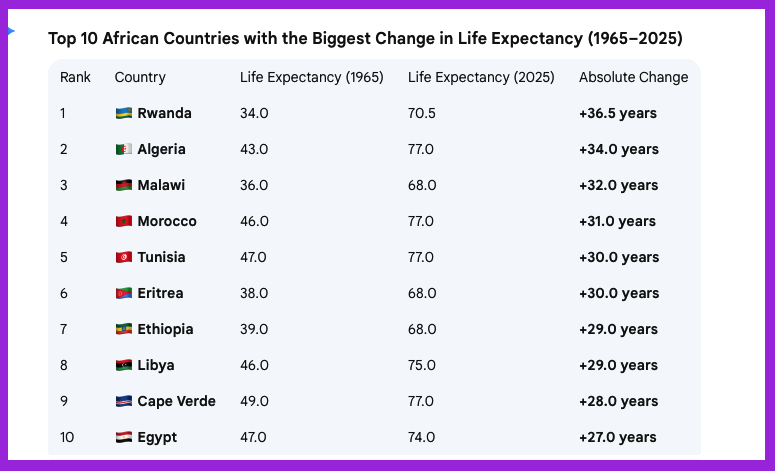
The African continent has seen some of the world's most dramatic health transformations. Despite vast differences in geography and wealth, these top 10 African nations with the highest increases in life expectancy share a "social health" model and “prevention first” strategy. They all prioritised things like universal vaccine coverage and access to clean water over high-tech specialised health – at least in the initial stages.
Rwanda, which is leading this shift is Rwanda, saw a dramatic drop in life after the 1994 Genocide against the Tutsi. Its leap is attributed to the country's universal health insurance system—which covers over 90% of the population—and a sharp reduction in child mortality.
Algeria and Malawi follow, driven by massive public health investments and successful infectious disease control.
-Sources: Visual Capitalist, UN World Population Prospects (2024/2026 Revisions), and World Bank Data.
The world is celebrating Christmas, but in Ethiopia, the same silent horrific massacres of ethnic Amharas has continued unabated. Worse they are trying to gaslight the people into settling for everlasting suffering by derailing their only way out to their survival.
It is truly sad!
End #AmharaGenocide
#ForwardFano