❤️ We made it to the FINAL EIGHT of #STATMadness 2026! 🤼
Thanks to everyone who voted: Columbia's Squidiff AI (our diffusion model predicting cell responses & development, developed with Stanford) is now facing MD Anderson Cancer Center, and we need your votes to reach the Final Four!🙋🙋♀️
We're the underdog at 42.2% to 57.8%, but we've been here before. Your support carried us this far, and every single vote matters now more than ever 🙏🚀
Vote here 👉 https://t.co/tWBO8dIkEA
@statnews@Columbia@Cancer_dynamics
❤️ We’re in the SEMIFINALS of #STATMadness 2026! 🙌
Thanks to your support, Columbia’s Squidiff AI (our diffusion model predicting cell responses & development — developed with Stanford) has advanced and is now facing Boston Medical Center!
We’re now at 45.3% to 54.7% — voting is OPEN RIGHT NOW! Help us reach the finals together? Every vote means the world 🙏🚀
Vote here 👉 https://t.co/tWBO8dIkEA
@statnews@Columbia@Cancer_dynamics
🚨 We’re in the QUARTERFINALS of #STATMadness 2026!🙌
Columbia’s Squidiff AI (diffusion model predicting cell responses & development — developed with Stanford) just advanced and is now facing Tufts University.
We’re currently behind (36%-64%) — voting is OPEN RIGHT NOW! Help us push through to the next round 💪🚀
Vote here 👉 https://t.co/OeTqn4T2F3
@statnews@Columbia@Cancer_dynamics
🚨 Columbia University is in STAT Madness 2026!
Our Squidiff AI (diffusion model predicting cell responses & development, developed with Stanford) is facing Whitehead Institute & MIT in Round 1.
Voting opens TOMORROW, March 2 — help us advance this exciting AI for biology!
👉 https://t.co/OeTqn4T2F3
#STATMadness @statnews@Columbia@Cancer_dynamics
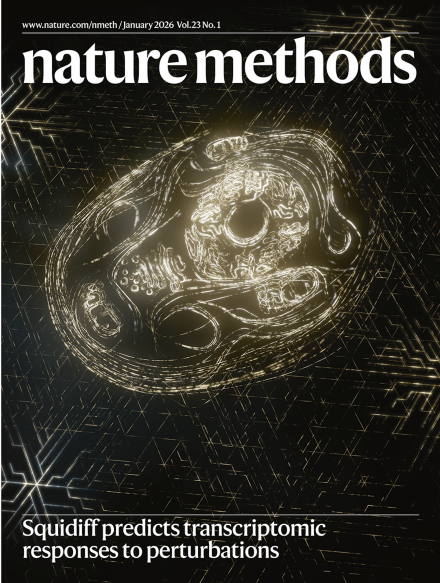
Cover feature! 🎉 Siyu He and colleagues appear on the January cover of @naturemethods for Squidiff, a diffusion AI model predicting cellular responses to developmental and chemical cues: https://t.co/i4P9fhMeyz
Our Perspective paper "Toward informed batch correction for single-cell transcriptome integration" is out in @NatComputSci 🔗https://t.co/mr2NKvpNxs
We review a decade of batch-correction methods and propose to move from "blind" integration to "informed" modeling.🧵👇
Our January issue is now live! 🥳
https://t.co/XIcpBm1aDQ
On the cover, a network of illuminated grids forms a cell-like shape representing Squidiff’s ability to predict continuous cell-state transitions under differentiation and perturbations. Paper: https://t.co/4PgWZvUd66
🐙We are thrilled to share #Squidiff, a conditional diffusion model, which generates new transcriptomes that represent distinct cellular states, and its application to cell differentiation and drug perturbation https://t.co/tTtN5is6kB 1/🐙
Squidiff: Generative diffusion models for predicting cell fate and perturbation responses
Single-cell sequencing lets us observe how individual cells differ, evolve, and respond to their environment. But while we can measure these transcriptomic states, predicting how a cell will change under a new stimulus — a gene knockout, a drug, or even something as complex as radiation exposure — remains extremely difficult. Experiments are slow, expensive, and often impossible to run at the scale needed for mechanistic insight.
Squidiff proposes a different path. This framework combines a semantic encoder with a conditional diffusion model, enabling the generation of new transcriptomic profiles by iteratively denoising from latent space. The key idea is that cellular identity and environmental cues can be captured as smooth, manipulable vectors in a shared latent representation. By shifting these vectors, Squidiff can navigate cellular state trajectories: from pluripotent stem cells into differentiated lineages, across gene perturbations, or along drug-response gradients.
What makes this interesting is not just that Squidiff generates realistic single-cell data — many generative models attempt that — but that it captures transient cell states and developmental trajectories that are often inaccessible experimentally, including intermediate stages and nonlinear responses. The diffusion process encodes the underlying stochasticity, while the semantic space carries the structured biological signal, enabling controlled interpolation across time and condition.
The authors demonstrate this on multiple fronts: predicting iPSC differentiation into germ layer lineages; modeling non-additive gene perturbations without graph priors; reconstructing cell-type-specific drug responses; and, remarkably, predicting the effects of neutron irradiation and the protective effects of G-CSF in blood vessel organoids. In the organoid system, Squidiff recovered not only cell-type-specific damage signatures but also the dynamic progression of vascular disruption, and how G-CSF shifts these trajectories toward recovery — all from sparse experimental sampling.
This suggests something important. Instead of treating single-cell sequencing as a static snapshot technology, we may be moving toward generative, predictive models of cellular development, where experiments guide the model, and the model guides the next experiment. Squidiff does not replace data — it amplifies the value of each dataset, enabling in silico hypothesis generation and perturbation screening before wet-lab validation.
Paper: https://t.co/JOf6A1RT3I
Thrilled to see #Squidiff 🦑 drop in @NatureMethods—predicting cell fate, drug responses, & radiation hits on vascular organoids via diffusion models (https://t.co/p7bSKBY4bu). Huge thanks to rockstar lead @SiyuHe7 for sparking this collab during my PhD🔬
Super excited that #Squidiff 🦑is online now in @naturemethods! In the updated version, we’ve added a drug compound adaptor, enabling prediction of unseen drug effects and enhancing generalization across perturbations. Check out our paper and research briefing!