We've open-sourced thousands of agent trajectories across a wide range of AI agents, generated with our zeroproof-simulations SDK:
https://t.co/PCdrCbgiRK
@eastdakota We totally agree -- in the near future, agents will become the backbone of the online economy. That's why we are building tools to make sure that the new agentic Internet is as secure and trustworthy as possible: https://t.co/pHtGGtUMqI
All the building blocks for an agent economy are being built. Email, phone, memory, payments. The one missing from this list is a security and verification layer. Zero Proof AI solves for that: https://t.co/pHtGGtUMqI
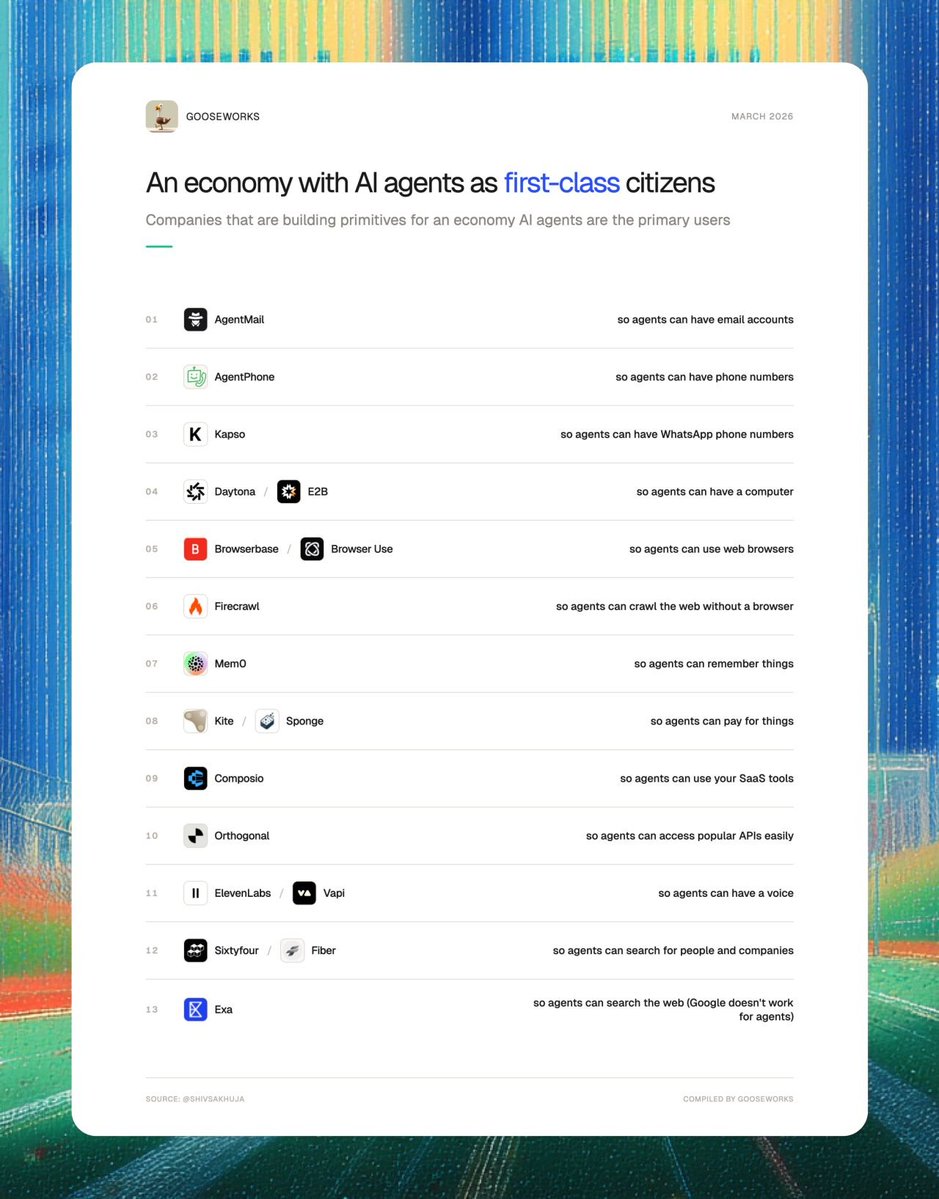
Lots of companies are now building primitives for an economy where AI agents are the primary users instead of humans.
They're betting on an economy of AI coworkers.
1. AgentMail (@agentmail): so agents can have email accounts
2. AgentPhone (@tryagentphone): so agents can have phone numbers
3. Kapso (@andresmatte): so agents can have WhatsApp phone numbers
4. Daytona (@daytonaio) / E2B (@e2b): so agents can have their own computers
5. Browserbase (@browserbase) / Browser Use (@browser_use) / Hyperbrowser (@hyperbrowser): so agents can use web browsers
6. Firecrawl (@firecrawl): so agents can crawl the web without a browser
7. Mem0 (@mem0ai): so agents can remember things
8. Kite (@GoKiteAI) / Sponge (@PayspongeLabs) : so agents can pay for things.
9. Composio (@composio): so agents can use your SaaS tools
10. Orthogonal (@orthogonal_sh) so agents can access APIs easily
11. ElevenLabs (@ElevenLabs) / Vapi (@Vapi_AI) so agents can have a voice
12. Sixtyfour (@sixtyfourai) so agents can search for people and companies.
13. Exa (@ExaAILabs): so agents can search the web (Google doesn’t work for agents)
If you stitch all of these together, you get a digital coworker that looks more human than AI.
Agent identity, observability and governance are becoming the core security challenges of the agentic era. Zero Proof AI adds a cryptographic security layer to agentic workflows to give enterprises full visibility into agent behavior: https://t.co/pHtGGtUMqI
“In this era of Agenetic AI, organizations will need an ‘observability control plane’”, says Vasu Jakkal, Corporate Vice President, Microsoft Security, @Microsoft during her Monday keynote ‘Ambient and Autonomous Security: Building Trust in the Agentic Al Era’ at #RSAC2026 in San Francisco.
@vasujakkal@dvellante@rneelmani #RSAC26
This is exactly why agentic AI needs a security layer. Zero Proof AI adds cryptographic verification to agent actions, giving enterprises full visibility and trust in how agents behave: https://t.co/pHtGGtUMqI
https://t.co/fb9G0tYnYk
Governance and identity are emerging as the core challenges for enterprise AI agents.
Zero Proof AI adds a cryptographic security layer to agentic workflows: https://t.co/pHtGGtUMqI
Had meetings and a dinner with 20+ enterprise AI and IT leaders today. Lots of interesting conversations around the state of AI in large enterprises, especially regulated businesses.
Here are some of general trends:
* Agents are clearly the big thing. Enterprises moving from talking about chatbots to agents, though we’re still very early. Coding is still the dominant agentic use-case being adopted thus far, with other categories of across knowledge work starting to emerge. Lots of agentic work moving from pilots and PoCs into production, and some enterprises had lots of active live use-cases.
* Agentic use-cases span every part of a business, from back office operations to client facing experiences from sales to customer onboarding workflows. General feeling is that agentic workflows will hit every part of an organization, often with biggest focus on delivering better for customers, getting better insights and intelligence from data and documents, speeding up high ROI workflows with agents, and so on. Very limited discussion on pure cost cutting.
* Data and AI governance still remain core challenges. Getting data and content into a spot that agents can securely and easily operate on remains a huge task for more organizations. Years of data management fragmentation that wasn’t a problem now is an issue for enterprises looking to adopt agents. And governing what agents can do with data in a workflow still a major topic.
* Identity emerging as a big topic. Can the agent have access to everything you have? In a world of dozens of agents working on behalf, potentially too much data exposure and scope for the agents. How do we manage agents with partitioned level of access to your information?
* Lots of emerging questions on how we will budget for tokens across use-cases and teams. Companies don’t want to constrain use-cases, but equally need to be mindful of ultimate token budgets. This is going to become a bigger part of OpEx over time, and probably won’t make sense to be considered an IT budget anymore. Likely needs to be factored into the rest of operating expenses.
* Interoperability is key. Every enterprise is deploying multiple AI systems right now, and it’s unlikely that there’s going to be a single platform to rule them all. Customers are getting savvier on how to handle agent interoperability, and this will be one of the biggest drivers of an AI stack going forward.
Lots more takeaways than just this, but needless to say the momentum is building but equally enterprises are acutely aware of the change management and work ahead. Lots of opportunity right now.
We're publishing a new evaluation suite and research paper on Chain-of-Thought (CoT) Controllability.
We find that GPT-5.4 Thinking shows low ability to obscure its reasoning—suggesting CoT monitoring remains a useful safety tool. https://t.co/isZkNkPXZm
@e2b Really exciting news: we're building the security layer for AI agent transactions, so keen to see more agents operating on the Internet. A little bit more about what we're building: https://t.co/pHtGGtUMqI
This is exactly how we're thinking about building the ledger of truth for AI agent behavior at Zero Proof AI. We believe that solutions exist across AI and crypto to increase reliability as we move toward an agentic economy.
Learn more about what we're building: https://t.co/GrphkwWcTw
Ben Horowitz on the infrastructure behind the AI economy:
"Crypto is the natural money for AI because it’s internet-native money."
"AI is global. Crypto is global."
"There needs to be not just a ledger of money, but probably a ledger of truth for AI to really fulfill its potential."
"I think people are probably underestimating how crypto and AI work together to form the AI economy."
"Networks and computers tend to grow together, and I think that AI is obviously a new kind of computer and crypto is a new kind of network."
@bhorowitz on Moonshots with @PeterDiamandis
This is why we're building what we're building with Zero Proof AI. As AI agents take over the payments and transactions space, security will become a fundamental constraint.
Our cryptographic verification system solves for security of agent-powered transactions: https://t.co/GrphkwWcTw
"In our view, agents will most likely soon be responsible for most internet transactions, and we will need blockchains that support more than one million-or even one billion-transactions per second."
Agents are coming to crypto.
Take Stripe's word for it.
@ColinGardiner We'd love to know how marketplaces are thinking about agent-led transactions and whether there are security-side risks and considerations for businesses in the space.
Would be helpful as we're building something to address that issue :) https://t.co/pHtGGtUMqI
In the agentic age, security and verification need to evolve in order to validate outputs created by AI autonomously without human supervision.
We build the securitization rails for this type of oversight: https://t.co/pHtGGtUMqI