There's too much happening right now, so here's just a bunch of links
GPT-4 + Medprompt -> SOTA MMLU
https://t.co/Jkp96izfec
Mixtral 8x7B @ MLX nice and clean
https://t.co/75StzY5AHe
Beyond Human Data: Scaling Self-Training for Problem-Solving with Language Models
https://t.co/gOCWjfY7ec
Phi-2 (2.7B), the smallest most impressive model
https://t.co/Fps8tI5QVi
LLM360: Towards Fully Transparent Open-Source LLMs
https://t.co/l6E16GfdIN
Honorable mentions
https://t.co/7GQqiCGHRH
https://t.co/3GZrYPp9KP
https://t.co/Su8iiDksMZ
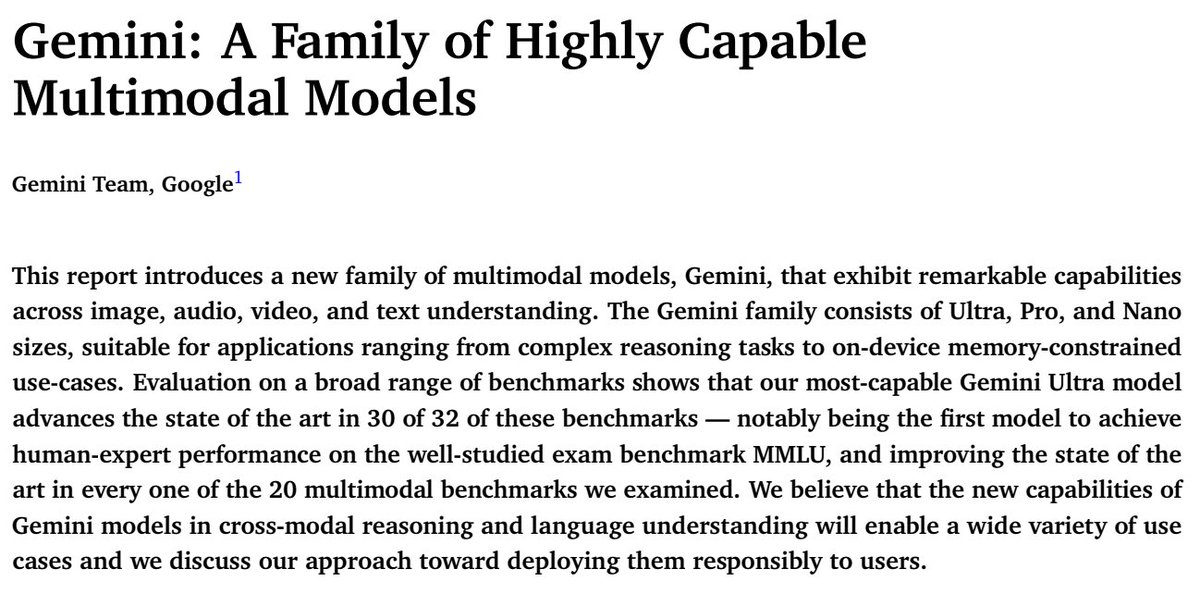
I’m very excited to share our work on Gemini today! Gemini is a family of multimodal models that demonstrate really strong capabilities across the image, audio, video, and text domains. Our most-capable model, Gemini Ultra, advances the state of the art in 30 of 32 benchmarks, including 10 of 12 popular text and reasoning benchmarks, 9 of 9 image understanding benchmarks, 6 of 6 video understanding benchmarks, and 5 of 5 speech recognition and speech translation benchmarks. Gemini Ultra is the first model to achieve human-expert performance on MMLU across 57 subjects with a score above 90%. It also achieves a new state-of-the-art score of 62.4% on the new MMMU multimodal reasoning benchmark, outperforming the previous best model by more than 5 percentage points.
Gemini was built by an awesome team of people from @GoogleDeepMind, @GoogleResearch, and elsewhere at @Google, and is one of the largest science and engineering efforts we’ve ever undertaken. As one of the two overall technical leads of the Gemini effort, along with my colleague @OriolVinyalsML, I am incredibly proud of the whole team, and we’re so excited to be sharing our work with you today!
There’s quite a lot of different material about Gemini available, starting with:
Main blog post: https://t.co/NzSycJl7aE
60-page technical report authored by th Gemini Team: https://t.co/CEdMRyYSLo
In this thread, I’ll walk you through some of the highlights.
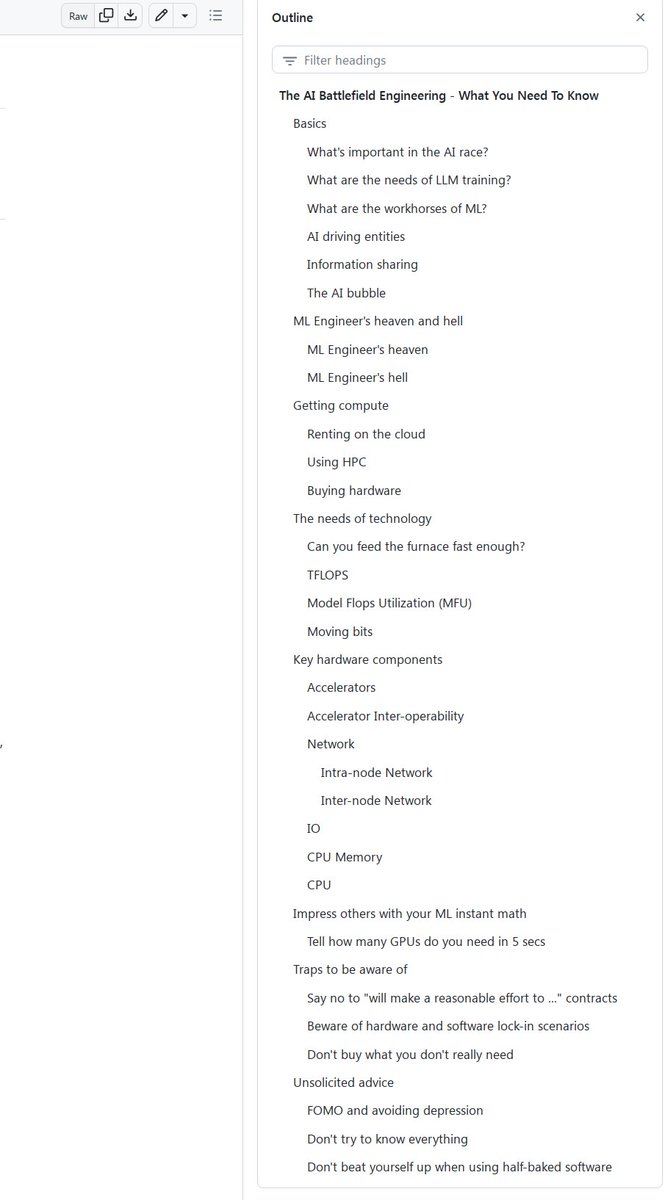
This is the first pass on the new chapter for ML Engineering:
The AI Battlefield Engineering - What You Need To Know
https://t.co/6BqzG2PEDb
This a WIP and your feedback for improvement is always welcome.
This is how I use AI (ChatGPT) to improve my academic research.
"AI Prompt Templates" supercharge any task from PDF annotations to writing a paper.
Step by step tutorial with powerful prompts for researchers:
👇
@hubermanlab Great information! At the start of the video it was mentioned "many people out there think they have a deviated septum ... little bit later we'll talk about how to repair a deviated septum ...", was this part covered? It seems I might have missed it. Thank you! @hubermanlab
A project to keep an eye on: https://t.co/wvyriUffEP
The goal: A truly open ChatGPT like assistant, and beyond, currently targeting a ~24GB-memory-to-run model. You can help right now with the RLHF stage: https://t.co/3RzhRLZXAK
Excited to announce our Deep Learning Tuning Playbook, a writeup of tips & tricks we employ when designing DL experiments. We use these techniques to deploy numerous large-scale model improvements and hope formalizing them helps the community do the same! https://t.co/vDhSwZyHJm
Python 3.11 is out! 🎉
This is one of the most exciting releases in a while, including significant speed upgrades and better error messages.
Here's what's new:
I probably should have written this years ago, but here are some MLOps principles I think every ML platform (codebase, data management platform) should have: 1/n
If you don't remember retweeting this, it means that you have leaked your Twitter Access Token in a public GitHub repository. Not the best practice, right?
For details, read our latest article: https://t.co/6WBC6DRNDS
#InfoSec#CyberSecurity#GitHub
Today with @emblebi, we're launching the #AlphaFold Protein Structure Database, which offers the most complete and accurate picture of the human proteome, doubling humanity’s accumulated knowledge of high-accuracy human protein structures - for free: https://t.co/vtBGmTkKhy 1/
I wrote a piece of code that, given an input and output tensor sizes and a depth, computes all the sequences of kernel sizes / strides that do it!
No padding. I hate paddings.
https://t.co/2m2JdMiCKR
@PyTorch
Gradient descent in differentiable games rotates around solutions instead of converging. For instance, in GANs. We solve this with a simple trick: complex momentum damps the oscillations.
https://t.co/6ql2bqSX21
With @jonLorraine9@davidjesusacu@PaulVicol
Excited to share a new #SIGGRAPH2021 paper with @markgillesie81 and Boris Springborn that is a pretty big breakthrough in mesh parameterization: https://t.co/M0EZGuIGfL
In short: no matter how awful your mesh is, we compute beautiful high-quality texture coordinates.
(1/n)
As @NeurIPSConf#NeurIPS2021 deadline approaches, I've consolidated some technical writing tips.
Succinct answers to each of the questions,
Voila, you have a crisp Introduction!
Expand on prior work, intuition/tech details, & expts for the rest ensuring the why is always clear
TPU VM is out of alpha!
Cloud TPU VMs run on the TPU host machine and offer significantly better performance and usability when working with TPUs (e.g. you can store data directly at TPU VMs).
https://t.co/fZW2Pv69nT