🚨 Due to high demand, I created a new (and much improved) version of the Econ Journal Matchmaker.
New tool here:
https://t.co/kvrQQmo5SG
#EconTwitter Please help spread the word by reposting. 🙏
More details below 👇
The results of the research happening in my team @GoogleDeepMind have convinced me that the next era of scientific discovery will be aided by AI agents acting as force multipliers for human ingenuity.
That’s why I’m proud to introduce Gemini for Science - a collection of experimental science tools designed to support researchers at every stage of the research process. The tools include:
1️⃣ Literature Insights, built with Google NotebookLM, searches millions of scientific papers to synthesize findings and generate artifacts including data tables, slides, reports, and more.
2️⃣ Hypothesis Generation, built with Co-Scientist, simulates the scientific method via a multi-agent "idea tournament" to generate, debate, and rigorously evaluate research hypotheses.
3️⃣Computational Discovery, built with AlphaEvolve and ERA, is an agentic engine that generates and scores thousands of code variations in parallel, allowing researchers to test modeling approaches in fields like epidemiology in a fraction of the usual time.
Read more: https://t.co/l8XIg8iXCN
Register for access here: https://t.co/V3YS15mRUS
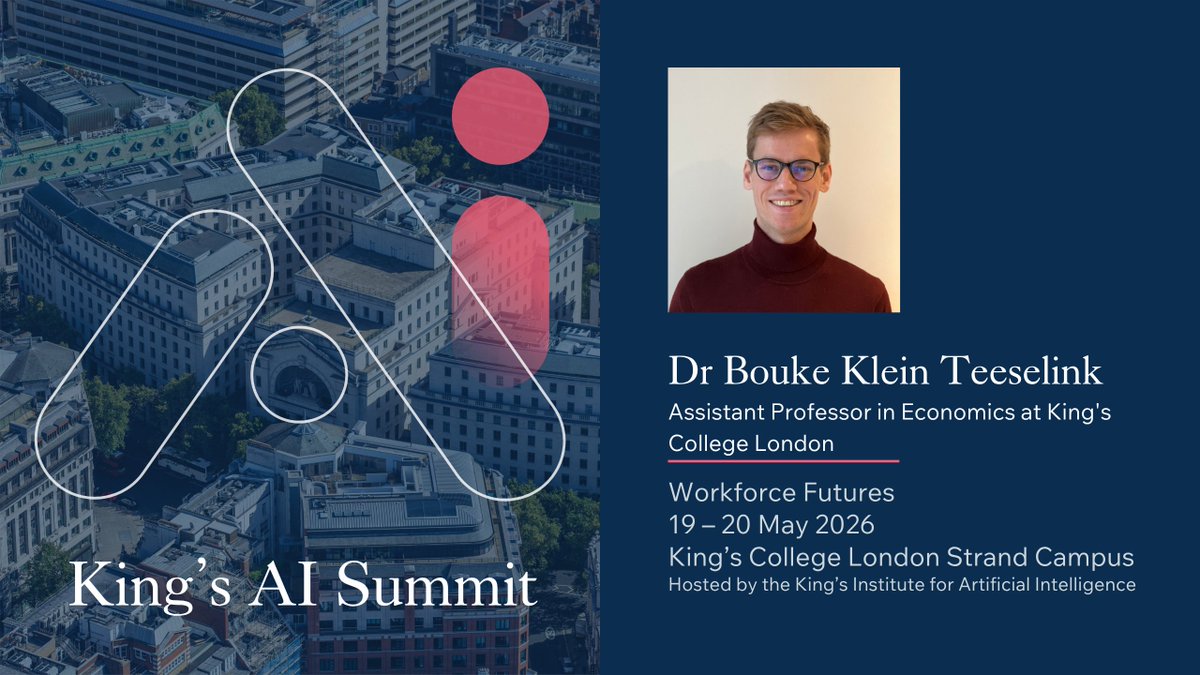
Excited to be hosting our inaugural King’s AI Summit: Workforce Futures at KCL this week!
We are gathering top researchers, industry leaders, and policymakers to discuss how AI will affect the future of work.
To see our exceptional lineup of speakers, check out the program below
@aiatkings@AIObjectives@Kingspol_econ
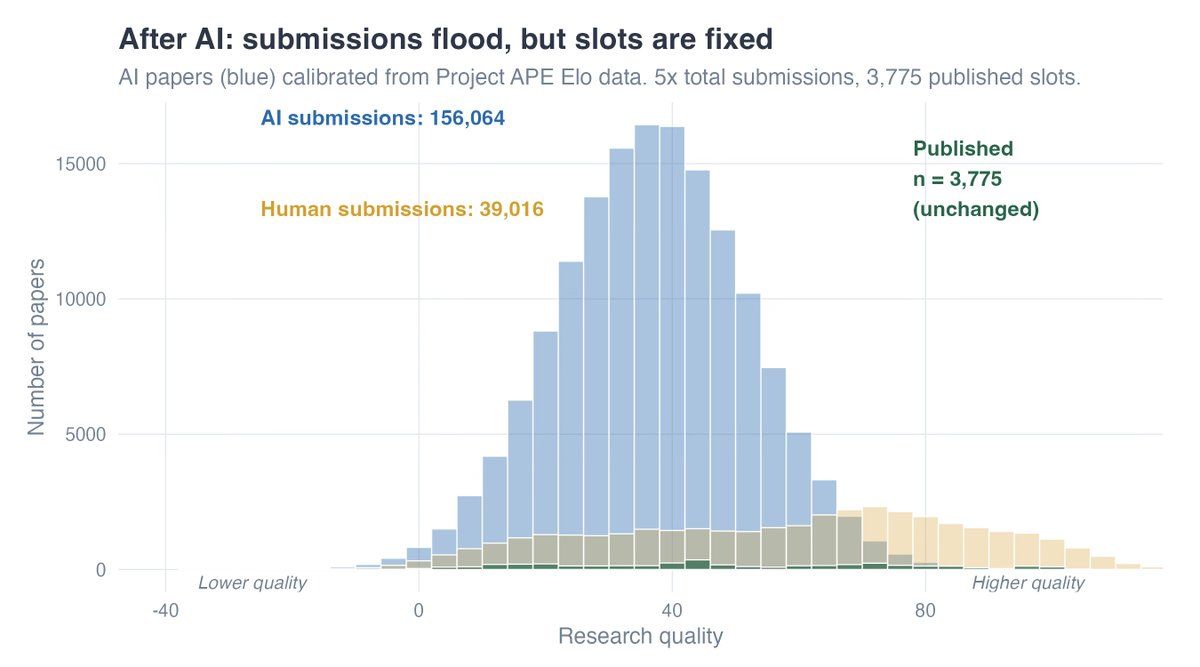
I was talking to an economics Assistant Professor today frustrated with the profession. A few years into his job and he's struggling with the last mile of his papers & trying to get them published in the right places. He said it'll get better. The problem: he's only partly right.
I’m really excited about this paper! Some of my work has pointed out problems in empirical work, but this one is all about new 🔧s.
If you (or your referees) want to know about the mechanisms by which a treatment affects an outcome, you may be interested. A 🧵.
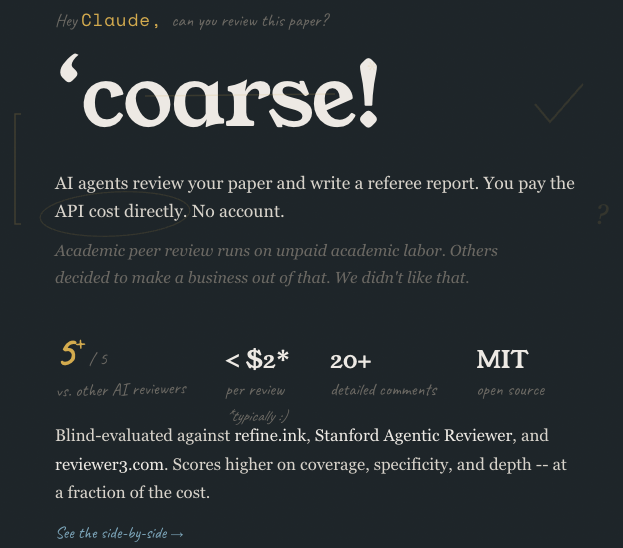
I coded up an open-source, not-for-profit AI paper reviewer that rivals the performance of @reviewer3com, @RefineInk, and Stanford Agentic Reviewer (according to @GeminiApp). Costs <$2!
Live @ https://t.co/5m1Srky4H8. Plug in paper, @OpenRouter key, and email. #econtwitter.
The Department of Economics at the University of York is pleased to invite submissions for the 2nd Workshop in Political Economy and Economic History, which will take place Wednesday 10 to Thursday 11 June 2026 in York. The theme of the workshop is: “In Time and Space“.
🚨 Come work with me on the Economics of AI! 🚨
I'm recruiting a fully funded 3.5-year PhD student to study how generative AI is transforming UK labour markets!
This position is a unique collab between @KingsCollegeLon and the @AISecurityInst.
Deadline: 22 April
Paul and I are teaching a short course on big data and development in a Tuscan castle! (Can finally check this off the bucket list). Pls circulate to anyone who may be interested. There is some funding for students for LMICs so please don't let the cost be a barrier to applying!
🚨 Visiting Faculty position @SFU
Fields: Economic History, Political Economy, Development
- Summer or 1-2 semesters in 2027-28
- Up to $55k stipend + $7.5k research support
- Visa + moving support
⏰ Apply by May 4 🔗👇
found something rather baffling when researching my column this week…
I wanted to see if there was any evidence that AI tools were helping economists to make their research more readable. So I analysed the text of NBER working paper abstracts…
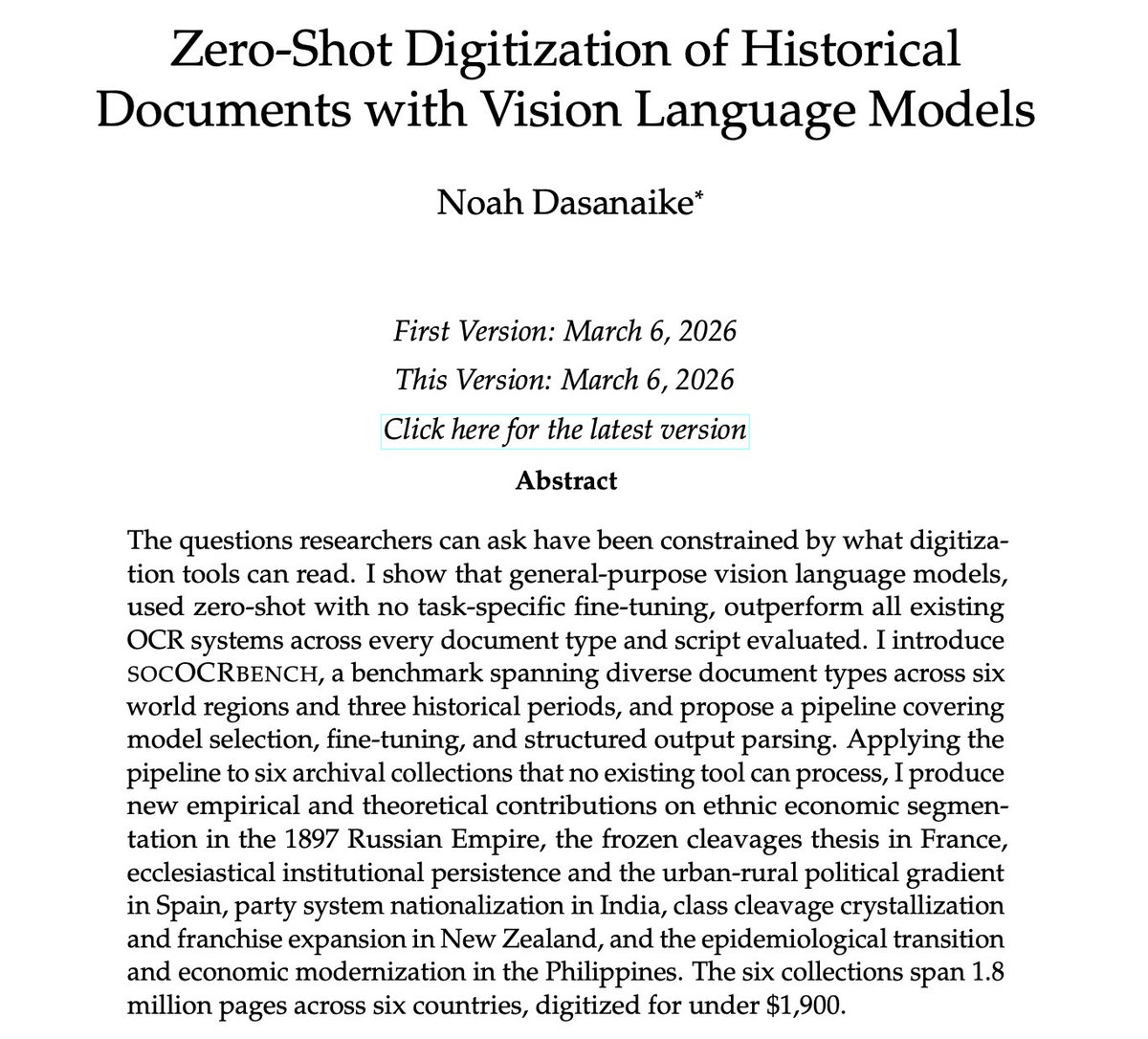
Social scientists working with materials requiring digitization can only study what machines can read. In practice, that means printed Latin-script documents from well-funded archives. In a new working paper, I show that Vision Language Models used zero-shot outperform every existing OCR system across every script evaluated, and I propose a pipeline for deploying them on new collections. I apply it to six archival collections spanning 1.8 million pages across six countries for under $1,900.
How did the US transform from an agricultural economy to the frontier in science and innovation?
A new paper published in Research Policy by a team of researchers at the @HarvardGrwthLab and @CSHVienna shows that this process was not gradual but prompted by abrupt changes clustered in the early 1920s.
It was driven by the creation of the industrial research lab, which fostered large-scale, science-based, team-oriented invention.
The findings suggest that new technologies, such as AI-powered digital collaboration tools, could play a similar role today by reducing coordination costs and potentially reshaping how collective invention is organized.
Co-authors: Matte Hartog, @GomezLievano, @ricardo_hausman, and @FrankNeffke (1/7)
1/ Today I’m excited to share an updated paper with my colleague Friedrich Geiecke 👇👇👇
We develop an open-source platform to conduct high-quality qualitative interviews using LLMs, including voice interviews. Interviews can run GPT, Gemini, Claude, and open-weight LLMs.
Second-best project management skill I've created: Every week, for each of about 10 research projects, I built an automated skill where Claude Code pulls and integrates:
-the transcripts of all meetings
- all project-related emails
- all discussions in the project WhatsApp groups
- all new and existing documents (most of which either live in a folder of Markdown files or in a collaborative Google Doc with multiple tabs for many purposes)
- any Overleaf or Tex files
Then it automatically generates a 3-page project overview covering
- strategic overview with a reminder of long run objectives
- critical success, factor factors and operational imperatives over the next two weeks and few months
- a priority to-do list for every member of the team for that week
It then creates a weekly summary of the recent week's most recent discussions and activities and pastes it to a second tab, giving us a detailed documentation of all the decisions we made and everything we discussed that week (and the weekly summary for every previous week lives below that--so we have a project memory of every major decision and discussion)
My next step is for it to populate everybody's calendars or reminders system with their to-do list for the week.
Yes, I could try to get four different professors from different universities (for each project) and four different research assistants (for each project)to all work on the same software like Slack. Lots of organizations do this. But since they all have their own special processes and programs, this harmonizes everything.
I’m training it to create a tutorial and example system for others to copy and adapt this for themselves. All part of “Claude Blattman”. Stay tuned for the link. I just need to get it polished over the next couple of weeks.