Partner @RadicalVCFund, AI columnist @Forbes. "the machine does not isolate man from the great problems of nature but plunges him more deeply into them."
10 (bold) predictions for AI in 2026:
1⃣ Anthropic will go public. OpenAI will not. 📈
2⃣ Details of SSI’s research and technology will leak to the public. The big labs will make meaningful adjustments to their research roadmaps as a result. 🤫
I’m coming around to @ylecun’s JEPA …
When you study quantum mechanics deeply enough, you realize that living systems have holographic computing substrates called microtubules … which form long-range coherent networks … and those are holographic!
JEPA is very hologram-esque:
— predicts in embedding space, not pixels (holograms encode interference, not images)
— masked prediction = whole-in-part (any fragment constrains the whole)
— relational, not absolute (meaning = predictability between parts)
— EBM framing = learned holographic associative memory (cf. Plate HRRs, Kanerva SDM)
This is it.
Everything learned spending millions on longevity.
From: Your Immortal Unc and Auntie.
To: Our Immortal nieces and nephews.
0. Sleep is the world's most powerful drug.
1. Be in your bed for 8 hours
2. Same bedtime every night, any time before midnight
3. Don’t eat right before bed
4. Calm foods for dinner
5. No screens 1 hour before bed
6. Avoid added sugar (be aware it’s in everything)
7. Avoid all things in an American convenience store
8. Avoid fried foods
9. Shoes off at the door
10. Eat whole foods, particularly veggies fruits nuts legumes berries
11. Walk a little after meals or air squats
12. Get your heart rate high routinely
13. Lift heavy things
14. Stretch daily
15. Water pik, floss, brush, tongue scrape, morning and night
16. Make an effort to drink water
17. Get sunlight when you wake up (UV is low)
18. Protect skin in midday sun
19. Stand up straight
20. See at least one friend once a week
21. Avoid plastic where you can (in all things)
22. Circulate air in rooms
23. When stressed, breathe, learn to calm your body
24. Go to the dentist
25. Avoid sitting for long times
26. Protect your hearing, the world is too loud
27. Alcohol is bad for you
28. Finish coffee before noon
29. Avoid bright lights after sunset
30. If obese, look into a GLP
31. Sleep in a cold room
32. Texting while driving is dangerous
33. Turn off all notifications
34. Limit social media use
35. Don’t smoke anything
36. If you struggle to sleep, read a physical book before bed
37. 1 hour before bed have a calm wind down routine: bath, read, light walk, listen to music
38. The body is a clock and loves routine. Have a daily morning and evening schedule.
39. Avoid long distance travel where you can
40. Baby steps first: incorporate new things slowly
41. Do less… most things don’t work.
Bonus points if you get your blood checked.
Start here, it will change your life.
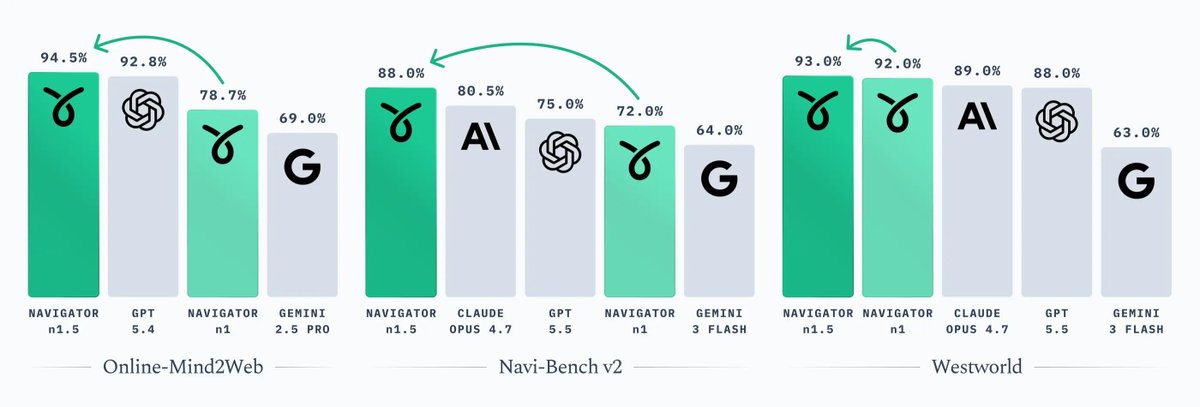
𝐈𝐧𝐭𝐫𝐨𝐝𝐮𝐜𝐢𝐧𝐠 𝐍𝐚𝐯𝐢𝐠𝐚𝐭𝐨𝐫 𝐧𝟏.𝟓
The most capable computer-use model for the web.
Pareto-domination: accuracy, latency, cost
• SoTA across all benchmarks
• +5-10% over GPT 5.5, Opus 4.7, n1
• +25% over Gemini
• 2x faster, significantly cheaper
Expanded action space
• UI actions (like n1)
+ JavaScript generation & execution
New work with @AlecRad and @DavidDuvenaud:
Have you ever dreamed of talking to someone from the past? Introducing talkie, a 13B model trained only on pre-1931 text.
Vintage models should help us to understand how LMs generalize (e.g., can we teach talkie to code?). Thread:
Excited to launch a new podcast dedicated to conversations on the future of neurotech, computing, intelligence, and more.
First guest: @maxhodak_ founder & CEO of @ScienceCorp_, which is building PRIMA, a retinal prosthetic that’s restoring meaningful vision for patients with blindness caused by age-related macular degeneration.
Science is also developing a biohybrid brain implant that grows living neurons directly onto a silicon chip, then interfaces that system with the cortex. The possibility space here is vast and new. Imagine growing new areas of the brain.
Sections
00:00 What counts as neurotech?
01:45 History of brain-computer interfaces and the smartphone dividend
07:25 PRIMA - How Science is restoring vision in blind patients
10:10 Why stimulating bipolar cells works when the optic nerve doesn't
30:30 Are we bottlenecked by biology or engineering?
32:40 Expanding the brain's bandwidth beyond 10 bits per second
37:00 Can we add new areas to the brain?
37:46 Biohybrid BCIs: neurons growing on a chip
39:20 What could neural augmentation look like?
01:13:20 How Science drives Fast R&D
01:44:00 How founders learn and level up
This is the kind of discussion I’m excited to explore on this podcast. Enjoy!
Full Episode 1 here and in links below.
A couple of months ago, we released a preprint of one of my favourite papers I’ve ever written. It lies at the intersection of representation learning and neuroscience. I have now written a blog post about it.
Preprint: https://t.co/vtDeBzvjsq
Blog post: https://t.co/d5rPZHoGaC
Near the top of @vsiv's (almost annoyingly) long list superhuman abilities, is how smoothly he can enlist people to a very big mission. That cause is turning data centers intro flexible assets, unlocking capacity and affordability right right when the world is desperate for both.
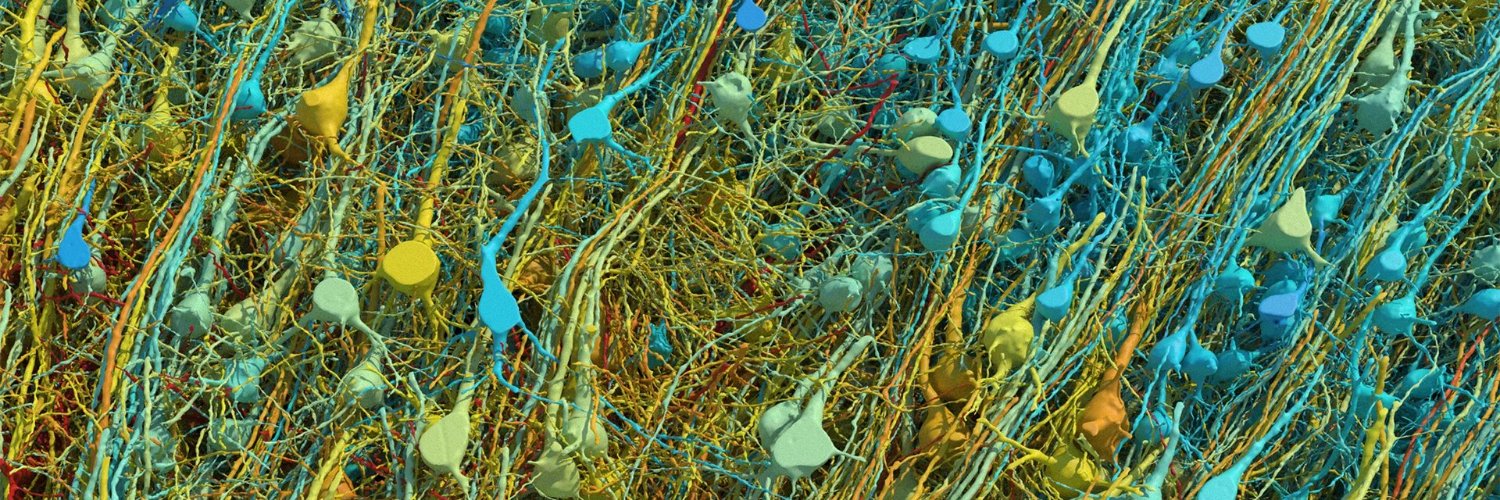
The human brain: 2% body mass, but consumes 20% of its energy. Cortical neurons fire 0.16 times per second. BUT they are capable of firing at 40 or more. A 250-fold gap. If more than a few percent of neurons fired at high rates simultaneously, the brain would literally overheat. So less than 1% fire at any given moment. Frontier AI models have the same two constraints: sparse activation and thermal limits. Mixtral activated 27.6% of its parameters per token. DeepSeek-V2 activated 8.9%. DeepSeek-V3 has 671 billion parameters and activates 37 billion of them. That's 5.5%. NVIDIA hit the same wall. The GB200 generates 120 kilowatts per rack. Air couldn't cool it. They switched to liquid and unlocked 30% more compute. Now, what would happen if we could cool our brains? Neurons that fire faster produce measurably higher IQ scores, but three things stop us: heat dissipation, oxygen delivery, and ion channel reset time. There's already a device that achieved a 3°C brain temperature drop in 30 minutes by running chilled saline through the nasal cavity. So the first human IQ-overclock device might look less like Neuralink and more like a beer helmet with tubes running up your nose.
We don't have a compute problem… We have an architecture problem.
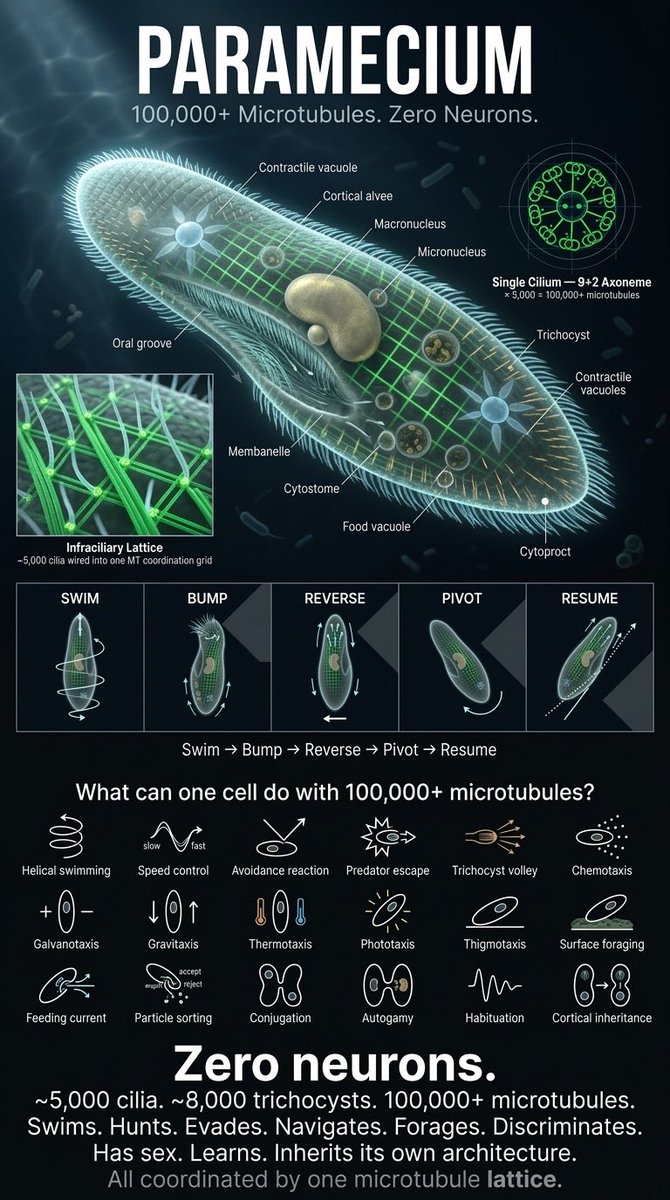
Paramecium Caudatum are single-celled organisms roughly the width of a human hair.
They have no brain, no neurons, no synapses, and no central nervous system of any kind.
But what they do have is ~100,000 microtubules…
With that substrate alone, they can:
→ Swim in controlled helical trajectories
→ Modulate speed continuously
→ Execute graded avoidance reactions (reverse, pivot, resume)
→ Escape predators with emergency burst reversals
→ Fire localized volleys of 8,000 trichocyst harpoons
→ Navigate toward food via chemotaxis
→ Orient in electric fields (galvanotaxis)
→ Orient to gravity (gravitaxis)
→ Sense and navigate thermal gradients
→ Sense and navigate toward light
→ Detect and follow surfaces (thigmotaxis)
→ Forage biofilms
→ Generate feeding currents and sort particles at the cytostome
→ Engage in reciprocal sex with mating-type recognition, nuclear exchange, and complete genomic reconstruction
→ Self-fertilize when no partner is available (autogamy)
→ Habituate to repeated stimuli (primitive learning)
→ Inherit cortical MT architecture epigenetically independent of the genome
17 distinct behaviors. One lattice. Zero neurons.
The coordination layer is the infraciliary lattice — a microtubule-based grid connecting all 5,000 ciliary basal bodies into a single cell-wide network.
Every cilium is a terminal node on a microtubule mesh that coordinates metachronal waves across the entire cell surface — thousands of appendages
phase-locked into coherent motion by a substrate that predates the nervous system by a billion years.
The neuron didn't invent computation. It inherited microtubules.
The "decoupling of information and energy" is a major point of divergence between biological and artificial computers.
Brains are efficient, modern AI isn't. And energy consumption is the biggest bottleneck in scaling AI (you can't hallucinate electrons into existence).
To address this we need an "energy-aware theory of computation." And this new preprint is an attempt to address this.
[1/11] 🧵
Financial AI is here.
Wall Street, meet the future of institutional intelligence.
See how Oak Hill Advisors, LionTree, @NewYorkLife, @MetLife, & @HSFKramer are already putting it to work.




![hadivafaii's tweet photo. The "decoupling of information and energy" is a major point of divergence between biological and artificial computers.
Brains are efficient, modern AI isn't. And energy consumption is the biggest bottleneck in scaling AI (you can't hallucinate electrons into existence).
To address this we need an "energy-aware theory of computation." And this new preprint is an attempt to address this.
[1/11] 🧵](https://pbs.twimg.com/media/HDjbQSLbEAUitKA.png)





