Our latest work about the landscape of somatic mutations in human small intestine epithelium and APOBEC mutagenesis is online @NatureGenet and it’s open access!
https://t.co/arbB1H0wZ4
🚨 We’re #hiring a Staff Scientist to drive innovative computational workflows for large-scale, multi-omics data in human microbiome research @LawleyLab@sangerinstitute
📅 Closing date: 27th April 2025
📢 Please share & apply!
https://t.co/RFTeEqru47
The stomach is an organ unique in its function, environment and exposures. How does this affect the mutations that normal cells in the stomach acquire? What does this reveal about the origins of stomach cancer? These questions and more in our Nature paper:
https://t.co/n7vcJq0ApW
We trained a genomic language model on all observed evolution, which we are calling Evo 2.
The model achieves an unprecedented breadth in capabilities, enabling prediction and design tasks from molecular to genome scale and across all three domains of life.
I’ve opened two more positions in my lab for both junior and senior RAs—no PhD required. 🌟 Spread the word!
🔬 Dry Lab: https://t.co/TzzT3RC4JZ
💧 Wet Lab: https://t.co/7lFPlgCGIY
Thanks for sharing!
Very happy and excited to announce that I'll be starting my own research group at @emblebi! The group will focus on lineage tracing, somatic evolution and the origins of cancer. Interested in doing a postdoc in the group or know someone who is? Please reach out!
Peter Campbell leaves the Sanger Institute at the end of the year to become Quotient's CSO. A mentor and one of my favourite scientists. His foundational, profound and creative contributions to cancer genomics and somatic evolution have truly shaped those fields. [1/7]
🚨𝐇𝐞 𝐋𝐚𝐛 job opportunity @UCSF 🚨:
I'm hiring TWO postdocs - an experimentalist and a computational biologist. Join us to use cutting-edge single-cell and spatial technologies to unravel the mysteries of human tissues.
https://t.co/QJqxMmrxGi
Very excited to share our latest preprint on somatic mutations in the normal stomach. We found many surprises, incl. hypermutant glands, recurrent somatic trisomies and a unique landscape of driver mutations. Thread below! https://t.co/AcSeFdu53c
Excited to share iStar, which was just published in @NatureBiotech By leveraging high-resolution histology image information, iStar can increase the spatial resolution of sequencing-based ST platform such as Visium @10xGenomics to near single-cell level. https://t.co/I19tzGkPaL
It’s my great pleasure to be able to contribute to this wonderful collaborative project published on @CancerCell , in which we investigated the genomic alternations in early and late-stage precancerous lesions of esophageal squamous cell carcinomas.
https://t.co/kJXdJP6mRw
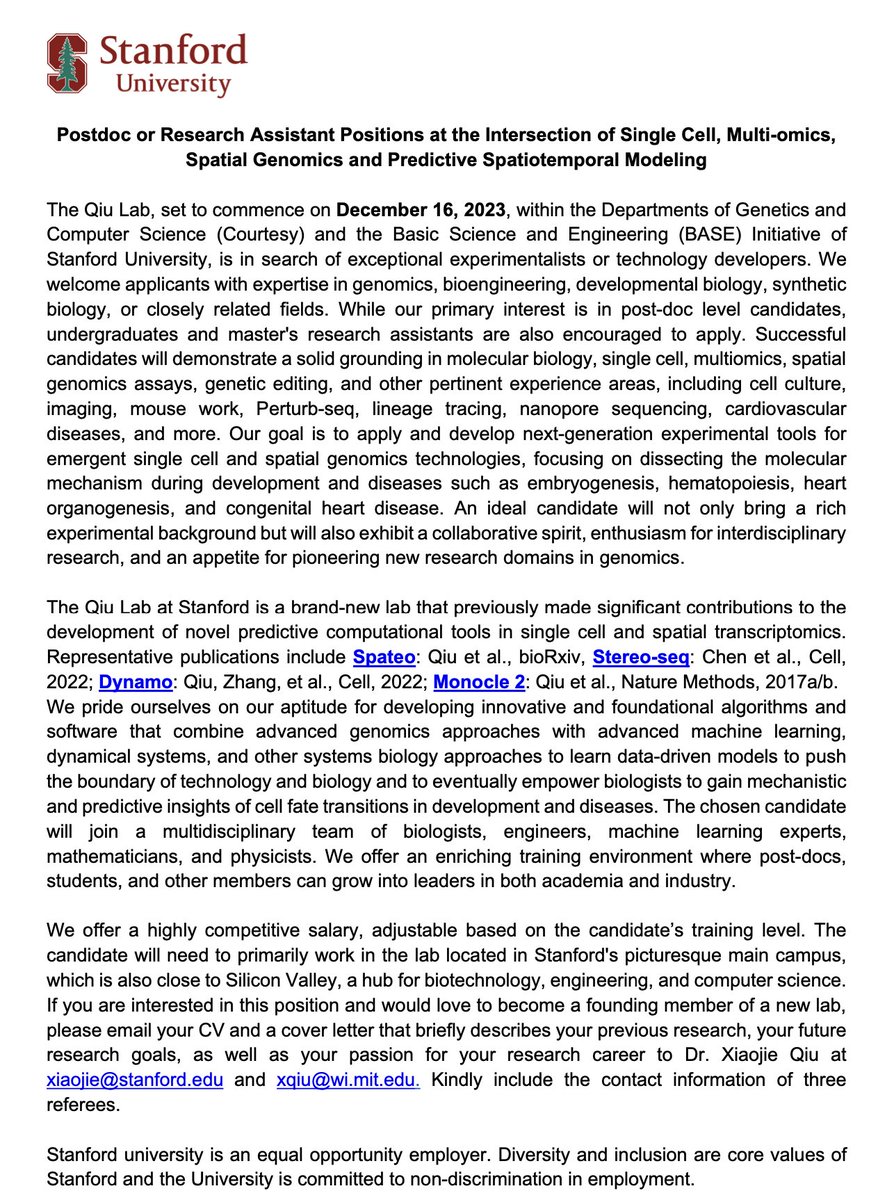
🔬My sc/spatial genomics lab (Launch at #Stanford on Dec. 16) is seeking experimental RAs & post-docs in genomics & dev bio. Come to work with me and a vibrant team of sys biologists, ML experts, etc. to push the boundaries of gene regulation of development & disease. #HiringNow
excited to announce our new paper in @CellCellPress on ARC-well by @KaileWang@TapsiKS, on a new single cell DNA-seq nanowell method that we applied to study DCIS and recurrences, revealing an evolutionary bottleneck during progression @MDAndersonNews https://t.co/WPJHpPERZW
Very excited to see our study on a case of ALL to AML switch after CAR-T treatment out in @NatureCancer! Using deep genome sequencing, we show the cancer switched cell types to escape therapy.
@broadinstitute@sangerinstitute@getz_lab
Thread below 🧵
https://t.co/LGUtJmZ7O2
Two exciting method papers in @NatureGenet by Olivier Delaneau and team reporting
* A new tool (GLIMPSE2) to impute genetic variants accurately from low-coverage sequencing data
* A new tool (SHAPEIT5) to phase rare variants to identify compound heterozygotes
My favourite is the identification of the compound heterozygotes in the UK Biobank. Identifying human knockouts is one of the main goals of large-scale sequencing efforts. The knowledge that humans can lead a normal life without a particular gene is precious for drug development as it informs that it is safe to inhibit that drug (https://t.co/mClMBLb3ci).
A human is considered a "knockout" when carrying a loss of function variant (pLOF) in both copies (maternal and paternal) of a gene. It can be the same variant that knocks out both gene copies (homozygous) or different variants (compound heterozygous). Identifying homozygotes is straightforward but identifying compound hets is tricky as we need to confirm that the two pLOFs are sitting on independent haplotypes, which requires accurate phasing.
Here the authors found that 0.22% of the UK Biobank participants are compound hets for at least one gene. The authors have provided a table--a valuable resource for drug companies--of 549 genes for which at least one compound het is found in the UK Biobank, thus adding to the repertoire of genes that humans can live without.
On a side note, there is a related paper from deCODE published recently (https://t.co/i7SAGgWGW9). Will post a separate thread on that soon.
Congrats Olivier (my new colleague) and team on these great papers.
Didn’t know about this episode. Must watch it. The whole human genome sequence would require way more pages. From start to end it would fill a whole shelve with 30 books, see https://t.co/vQrFKXyukY