The part that doesn't fit in a launch thread is the decade before it. AI4Bharat, IndicTrans2, building tokenizers and datasets for Indian languages when it wasn't the headline. The 14 drops in 14 days are the visible part. The years at IIT Madras getting unreasonably good at something specific are why 15 people could pull off what most labs won't even attempt.
No, the white collar jobs are not going away in 18 months!
I was furious with the populist-baiting language (in line with @DarioAmodei 's and @sama's also preferred apocalyptic usage) that Microsoft's @mustafasuleyman used in his FT interview, threatening everyone's jobs: “White-collar work, where you’re sitting down at a computer, either being a lawyer or an accountant or a project manager or a marketing person — most of those tasks will be fully automated by an AI within the next 12 to 18 months.”
Not only do I not see the point of this backlash inducing language, I also believe it shows no understanding of the way the labour market and organizations actually works and what people do all day. (My book on this with Jin Li and Yanhui Wu will be out soon.).
Don't get me wrong: I believe AI is a huge deal, and will radically change the world. But many white collar jobs are Messy jobs, as our book (and the post linked below) will explain: automating the automatable tasks within them is not near to automating the job.
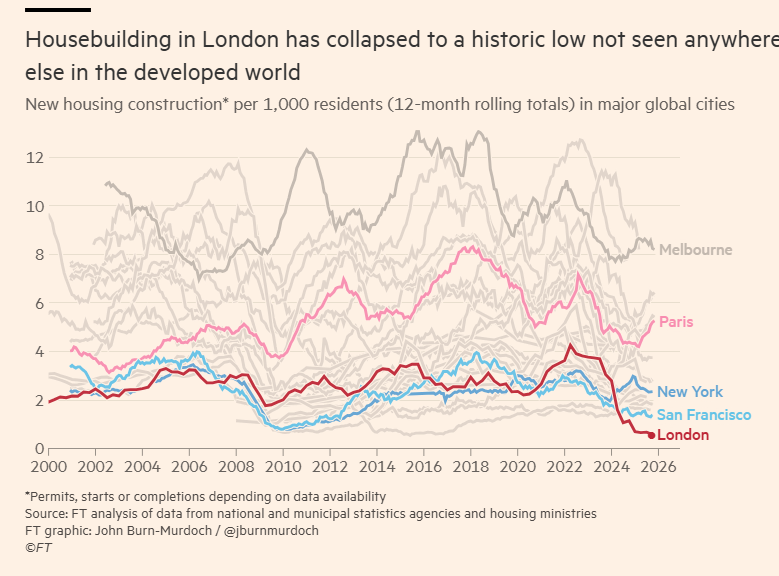
Let me make the point with the attached @jburnmurdoch graph on London.
London needs 88,000 new homes per year. In the first nine months of 2025, just 3,248 private homes started construction. Twenty-three of London's thirty-three boroughs recorded zero new housing starts in the first quarter of 2025. Planning permissions have fallen to their lowest level since records began in 2006. Construction of new rental homes fell by 80 percent in a single year. All this is after Starmer declared his government wants to "build, baby, build."
Does anyone think AI will fix this?
All the technology to design a building exists, and existed pre-AI. The bottleneck in London housing is human. What stops homes from being built in London are environmental and land use regulations and neighbors that weponize them.
AI can draft the review, but that is a trivial bit. It cannot convince the environmental group to drop its lawsuit or persuade politicians or negotiate with the neighbors.
These obstacles employ people. Suleyman and Amodei imagine that project managers spend their days doing Gantt charts, call their job "sitting down at a computer" and dream of automating them. But the job of the planning guys is not to fill in forms, but to negotiate and coordinate developers, residents, environmental groups, heritage bodies, and elected politicians who all have incompatible interests.
At other levels and in other jobs the same is true- radiologists spend only 1/3 of their time reading scans (see this great piece https://t.co/CQoK77OqxQ). Their job was supposed to be gone in 2017; in fact, the demand for radiologists is booming (employment and wages are sharply up). Many consultants try to elicit the tacit, local, knowledge of what is actually going on in a firm in order to make a recommendation. Yes, if you spend your day just doing PPTs, you will be replaced. But how many people do just that?
Organisations/managers resolve conflicts and deal with exceptions. Making a decision stick requires authority: being a person who can be blamed, sued, or fired. The manager resolves disputes about the rules, not just within them. Think of your last renovation in your house. The contractor trying to to get the guy installing the windows and the guys from the floor to show up and do a good job, a mess right? No algorithm does that.
AI will make white-collar workers more productive. Some single-task, automatable roles will shrink (doing taxes is an expert system, drafting contracts too), many tasks will be automated. Also, the disruption of career ladders is a real concern. But "most tasks fully automated in 18 months" is not a prediction. It is marketing, designed to sell enterprise subscriptions and justify capital expenditure.
The real world is messy. The mess is not a bug. It is what happens when human beings with competing interests try to get things done together.
For more on "Messy Jobs", here is my New Years post: https://t.co/vMjQUY8aTI. A book out soon.
Evolving eight categories of Indian Vegetarians -
1 - Pure Vegetarian (Pure vegetarian)
2 - Can eat egg but not chicken (Eggetarian)
3 - Can eat cake (which has egg) but not Omelette or boiled egg (Cakeytarian)
4 - Can eat the gravy but not pieces (Gravyetarian)
5 - Can only eat non-veg outside the house, not inside (Restrictarian)
6 - Eat non veg only while drinking. When not drinking they are vegetarian (Boozytarian)
7 - Eat non veg only when forced by someone to do so (Forcitarian)
8 - Pure Vegetarians on Tuesday, Thursd ay & Saturday. Can eat anything on Monday, Wednesday, Friday & Sunday (calendartarian)
#SundayFun
😂😂
Untimely passing of a rich person’s son is so tragic that the Prime Minister immediately tweets about it.
15 people including toddlers died in Indore water contamination not so long ago, there was no tweet or statement of even a mere condolence put out by this man.
Now judge your value.
Zoho’s business would be first to be competed away by people building their own custom software built by people using @Replit@emergentlabs and @Taskade
Why pay $30/seat/month for over bundled SaaS when soon even nontech ops ppl can vibe-code a custom solution in a weekend?
After this:
1. Can't use whatsapp/telegram on tablets without SIM
2. Can't use whatsapp/telegram on companion device
3. Will get logged out of desktop apps after every six hours. Irritating.
4. Can't use whatsapp/telegram on international SIM when traveling abroad
5. Businesses can't use WhatsApp for business which has automation and API based access
6. Someone moving out of India wanting to keep whatsapp contacts and messages can't change number because account is locked to SIM
This is largely based on my reading and responses I've received. Will think of more.
Dave: "Masa Son, welcome to the show. What's going on?"
Masa: "Dave, I sold my entire NVIDIA position."
Dave: "How much?"
Masa: "All 32.1 million shares. $5.8 billion."
Dave: "And why did you do that?"
Masa: "To go all-in on AI."
Dave: "You sold your NVIDIA stock... to invest in AI."
Masa: "Yes."
Dave: "NVIDIA makes the chips that run AI."
Masa: "Correct."
Dave: "So you sold the shovels to buy lottery tickets."
Masa: "I prefer to call them 'high-conviction bets.'"
Dave: "Got it. And this is your second time selling NVIDIA completely."
Masa: "That's right."
Dave: "In 2019, you sold $4 billion worth."
Masa: "Yes."
Dave: "Which would be worth $150 billion today."
Masa: "I'm aware."
Dave: "So you already missed out on $146 billion from the first sale."
Masa: "When you say it like that—"
Dave: "And now you're doing it again. To put $30 billion into OpenAI."
Masa: "And a $1 trillion AI manufacturing hub in Arizona."
Dave: "Right. Because WeWork worked out so well."
Masa: "That was a stain on my life, Dave."
Dave: "Cost you $11.5 billion in equity losses. Plus another $2.2 billion in debt."
Masa: "Adam and I fell in love."
Dave: "You fell in love with a guy who wanted to trademark the word 'We.'"
Masa: "He had vision."
Dave: "And before that, you lost $70 billion in the dot-com crash. The largest personal loss in history."
Masa: "But then I made it back with Alibaba."
Dave: "After a six-minute meeting."
Masa: "Jack Ma is very persuasive."
Dave: "So your entire investment strategy is falling in love during short meetings and then losing generational wealth."
Masa: "I believe in the singularity."
Dave: "Right. So just to recap: you've lost $70 billion, missed out on another $146 billion, burned $13.7 billion on WeWork, and now you're selling NVIDIA at what might be the worst possible time to bet it all on Sam Altman."
Masa: "Sometimes you have to push all your chips to the center of the table."
Dave: "You've done that four times and lost three of them."
Masa: "But that one Alibaba win though."
Dave: "Okay. Thanks for calling in."
I've been recommending @telegram_org since a decade now, way before Covid when it blew up in India. But lately, it's just been bad - images & videos fail to download, video calls are less reliable than WA. Is it related to the shift in focus towards profitable features? @durov
Every company has a set of beliefs, written in its philosophy and practice. A guide that makes them different.
This is who Frappe is: open source, with an open culture that makes us “Open by Default.”
Watch the documentary here 🎬 - https://t.co/f6EansyvGt