For people using AI in commercial game development: I'd be interested in hearing the best arguments as to why you think people should pay for the resulting game instead of pirating it.
Concisely, if you pirated the inputs, why shouldn't they pirate the output?
Non stupid age verification for social media:
- go to any shop
- seller verifies your age
- buy a scratch card (1€) with random code
- you put the code in the SM app to unlock 18+ mode
- goverment gets money, people stay anonymous, should be win for both sides
To be a little less vague, I suspect that we're likely (not certain, but likely) to be entering into a period of unprecedented software degradation, and we're going to be seeing an increasing frequency of outages like this across many high profile products.
But IMO the cause is actually not just the-one-thing-that-everyone-is-always-talking-about, it's a number of things that have all been bubbling away at just below critical levels for a long time. Some of the things off the top of my head:
- Poorly designed / optimised software has been getting a free ride on hardware improvements pretty much since the invention of the computer. That chapter is now coming to an end, and will only be worsened by the enormous industry-wide pivot to producing & innovating on AI specific hardware, rather than general purpose CPUs etc.
- The ZIRP era created a temporary suspension of reality in our industry, and now that it's ended we need to deal with the hangover. Companies that spent years making no profit, paying extravagant compensation to employees / shareholders and giving away server time for free are now pivoting into extraction mode, which is putting further pressure on their low quality software. QA is being laid off, hardware budgets are being reduced, timelines for shipping features are becoming more aggressive, etc.
- The enormous amount of free money incentivised too many new people to join the industry too quickly. This has led to an abundance of poor quality education programs (bootcamps, uncertified colleges etc) and an influx of people into the industry who frankly aren't interested in programming. If you compared the average person in the industry now to 20 years ago, I suspect the difference in motivations would be stark. I'm not saying it's these people's fault necessarily, it's simply an inevitable result of the absurd compensation / performance expectations ratio that our industry has enjoyed for the last 15+ years. Working for a tech company has also become socially prestigious, which further adds to the problem.
- Because computer programming was once an incredibly niche area of interest, many of our fundamental systems are built on trust. We're now starting to see that if systems like open source, public supply chain, discussion spaces, education etc become flooded with bad actors, we have no real mechanisms to deal with them.
- Our hiring / recruitment pipeline has totally misaligned incentives. Even before the AI resume / AI HR-filtering arms race disaster that we're experiencing now, the widespread adoption of the leetcode style interviews IMO selected for a very narrow personality type, and filtered candidates that would have made great contributions to the industry long term.
- The pivot from purchasing long term stable releases of software, to paying a subscription for constantly updating software has done huge damage to software quality as a whole. Companies have lost their incentive to get their software "right" because they can just "fix it later", and for the consumer - you can't just go back to the version of github that still works because the new one has problems.
This was all happening well before AI entered the picture. I won't belabor the point because there has been endless discussion about it. But to me personally, there are two additional and deeply worrying problems with AI code generation.
- It's undeniable at this point that it negatively affects the people who use it. It stops juniors from getting better, and it burns seniors out and makes them hate their jobs. Like it or not, humans are still the core of this industry, and I don't see this ending well.
- It's completely unfit for purpose in the most important, high-stakes situations. One of the reasons that we excuse all the small errors it makes, is because it's low effort to type "do it again and fix this bug". That kind of thing doesn't fly when you only get one attempt because a mistake results in data loss or an outage. The damage is done.
All the above has led to a silent exodus of many of our most experienced and impactful people. There are so many amazing programmers who made enough through stock options / compensation that they didn't need to work anymore, and were only doing it because they enjoyed it. Many of these people have just quit the industry and switched to doing hobby projects in the last 5 years. These are the types of people who have the experience and foresight to prevent the types of outages that we're seeing at github today.
It's very easy to assume that the proverbial straw that broke the camel's back is entirely to blame here. But I think it's a reckoning that has been on the horizon for a very long time.
it is currently easier to install arch Linux than either OSX or Windows
Hyprland, one polish kid, has made a better looking desktop experience than multi-trillion dollar Apple or Microsoft could
it really might be the year of the Linux desktop
"People smarter than you already figured it all out" is the stupid people's way to tell other stupid people to stay stupid, ignorant, and uncurious, because they need to justify their stupidity somehow.
The question is not WHO (smart, not smart) made it this way. But WHY.
Age verification is here, and now UK Redditors can’t access their favorite LGBTQ+, political, or public health communities without destroying their anonymity. Help us fight to avoid this future. https://t.co/aXbQ6fJrzQ
How many more model releases do we need for folks to realize we are not getting to magical superintelligence with what we got?
How many times do you have to see a model benchmaxxing to realize Humanity's Last Exam is a freaking idiotic name and that answering questions on it doesn't tell us shit about the true intelligence of the model?
How many models do we have to see demonstrating superficial intelligence but utterly failing at long running, contextual understanding for people to wake up and realize that AI is just another tool?
A good tool, a useful tool, a wonderful tool but not magic and not the end of all jobs and not the end of humanity or any other absurd fantasy of fools and dreamers.
Fool me once, shame on you.
Fool me twice, shame on me.
@cmuratori On Ubuntu, gcc compiles with these protections enabled by default. Compile hello world with gcc -v and look for -fcf-protection in the output. I don't think shadow stack changes asm output, but if you see "endbr64" that's another type of control flow protection
The Tea app having all its user data leaked was bad. Now imagine a porn site with "age verification" tying viewing history to a specific identity. I'm sure no hacker or government agency would ever have interest in such data!
Web app users would be shocked to learn that 99% of the time, deleting your data just sets a flag in the database. And then it just lives there forever until it's hacked or subpoenaed.
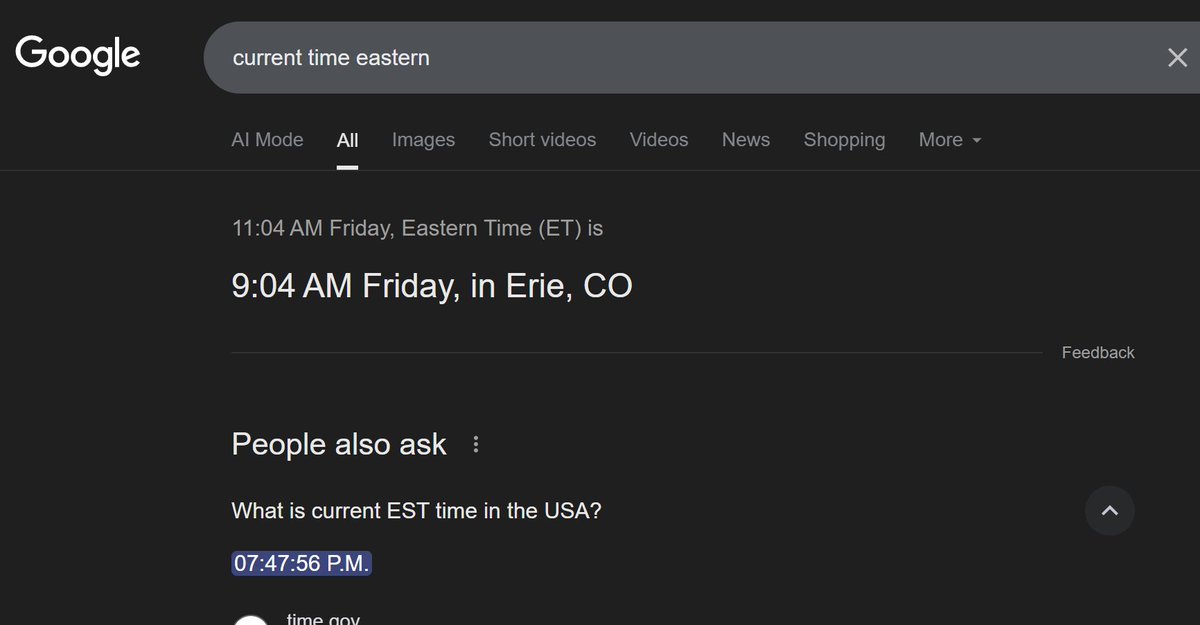
Google is just crazy these days. Here is a search result from right now, 11:04am Mountain time in Colorado, 1:04pm Eastern time. The first two outputs are two totally different totally wrong results.
The Real World must be a truly depressing place to live. It’s apparently a realm where new ideas, unfamiliar approaches, and foreign concepts always lose. I’m told that the only thing that works in The Real World is what its inhabitants already know and already do. No matter how flawed or inefficient that way may be.
People who live there are said to be living Real Life. An existence filled with pessimism, despair, and every shade of pitch black imaginable. Yet strangely, these people living Real Lives seem not to be interested in getting out. They are not looking for a change of scenery of the dreary Real World.
Instead, they’re actually trying to recruit! In arguments everywhere, they’re trying to convince those of a sunnier demeanor that they must convert to Real Life or perish. That resisting the Real World is futile. This call persists even in the face of contrary experiences. Tales of people who actually did things differently and still lived to see the sun rise in the morning.
Please don’t be fooled, there’s nothing even remotely attractive about The Real World. It’s a bleak mirage suitable only as a place of communion for those who have lost all hope.
[First written by me in 2007. I never did end up moving to The Real World. Thank heavens!]