Strands Decider 2B, a small, open-source decision model, perfect for experimentation but capable enough for real work: https://t.co/xowuE7WrVG
We've open sourced the whole recipe, with all the training data, code, and log of what we learned along the way: https://t.co/TDxWrfdzea
We'll be spending a lot more time trying to understand the outputs of language models. A few thoughts, tips & tricks:
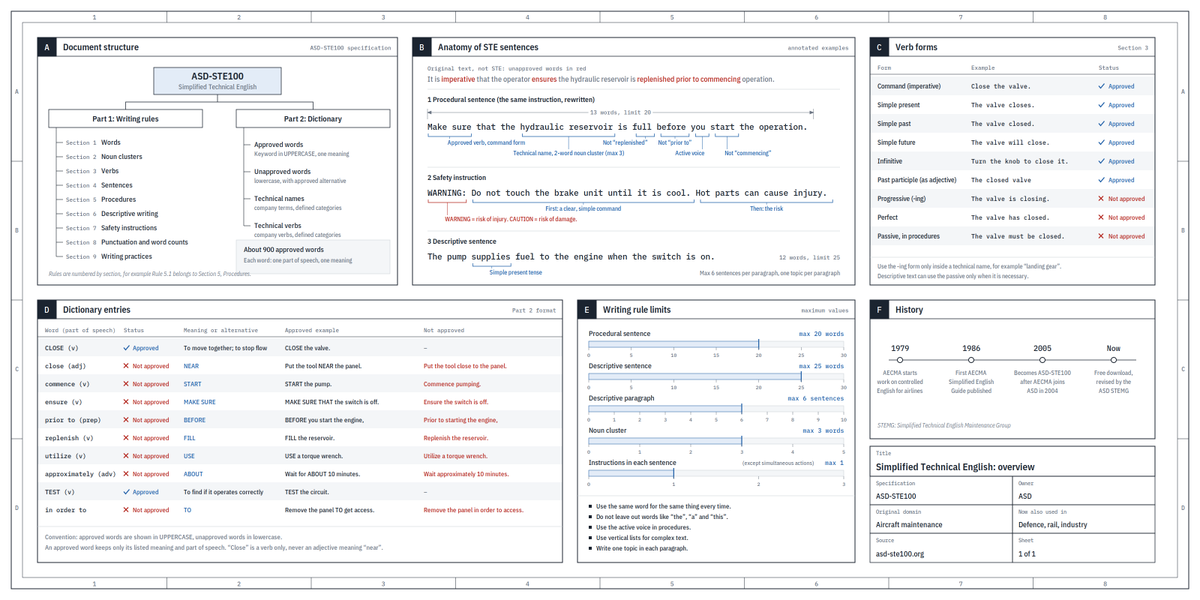
Writing. Something I've had success with: Ask your LLM to explain something in ASD-STE100, it's a controlled language specification originally developed for aerospace maintenance documentation. LLMs well-versed in this language and it comes with heavy constraints on clean writing style that I often find a lot more readable. Sometimes I've tried to soften it a bit e.g. ask for "80% of the way to ASD-STE100" because the spec is quite stringent. But even better:
Diagrams / images. Instead of writing, ask your LLM to create a diagram. These can be a lot easier to process, parse, and understand. But even better:
Web pages. Ask for output "in HTML" to get a beautiful, interactive webpage. LLMs are getting really good at frontend and can create beautiful experiences, animations, etc. But even better:
Explainer videos. The output format I am most bullish on is fully custom / bespoke explainer videos generated on any arbitrary topic. Experiment with things like "Create a 3b1b style video explainer on X. Use my ElevenLabs API key for audio narration". (you'd need an API key for the latter or you can ask your LLM to find you decent free alternatives that use your local compute). This is actually starting to work!
In summary:
- As LLMs get better, they will do more and more of the legwork autonomously, and a lot more of our work will rise up the abstractions into oversight and understanding.
- Luckily, LLMs can help here too because as intelligence and code are increasingly abundant, you can ask for large, custom, discardable software artifacts (e.g. web apps, video explainers) that would have never made sense to create before. Push the boundaries here and you'll be surprised.
introducing 𝚌𝚕𝚎𝚏: our first models trained by @cloudflare's workers ai team.
today, we're releasing two fast and accurate decision models that top the benchmarks for quality and latency. use them hosted on workers ai or grab the weights from @huggingface, because we open-sourced it too.
https://t.co/4bKblI3MwN
CLM-8B can play Terraria now 🎮
Every move and every attack is driven by CLM in real time, ranking candidate actions in milliseconds!
🤗 HuggingFace: https://t.co/wdSWGGO3hu
💻 GitHub Code: https://t.co/rsHRYCGR8I
🗣️ Discord Channel: https://t.co/Uqtdefvo3J
Huge thanks to Joshua Leonard for building this and sharing it with the community 🙌
Introducing JEV-27B-VL.
We believe it is the world’s first open-weight, near-SOTA multimodal decision model — built with AutoTrust AI’s Blocks of Experts (BoE) recipe.
It does not just describe what it sees. It turns visual state into calibrated action probabilities, then selects what to do next.
In this demo, it sees Mario’s position, movement, obstacles, and timing — then chooses whether to run, jump, or do both.
See → decide → act.
this might be the only prompt you need for high-end motion graphics with Claude Opus 5.5.
it turns Claude into a full motion design pipeline:
• studies reference videos frame by frame
• storyboards before animating
• builds scenes in GSAP + Three.js
• renders and critiques every section
• checks motion, contrast, audio and transitions
• keeps iterating until the final video passes the quality bar
it also uses this open-source motion kit:
https://t.co/r2MwiJ8fv2
full prompt below.
10 GitHub repos from Claude Opus 5.5 week, from motion graphics to full games
1. PDoomVideo: the Opus 5.5 P(doom) music video, every frame in code (1.5k stars)
https://t.co/XYmwFwmlJK
2. awesome-opus5-5-videos: 475 viral Opus 5.5 videos with their prompts (1k stars)
https://t.co/GGJUepNjTG
3. tidewater: a WebGPU fishing game built with Opus 5.5 (988 stars)
https://t.co/vkIkczkeSe
4. claude-opus-5-5-demo: three 3D web games, one prompt each (937 stars)
https://t.co/SXBdV1yb7R
5. lemo-opuscar: 43 film styles, each a short film made in code (650 stars)
https://t.co/zZnb7MWK2d
6. ClaudeAnimationBase: starter kit for hand-painted cartoon animation (606 stars)
https://t.co/oqs6HXPmrp
7. awesome-opus-5-5-videos: source-linked guide to 1,000+ videos (360 stars)
https://t.co/kDWJBCqeLo
8. shipvideo: paste a URL, Opus 5.5 writes an HTML launch video (223 stars)
https://t.co/i3LueU2yVf
9. motion-graphics-music-video-skill: song in, motion graphics video out (71 stars)
https://t.co/T6aiJoYCs8
10. opus-video-skills: one Claude Code skill per video style (36 stars)
https://t.co/D8Qp0PL7dZ
Follow me for more AI updates like this
FastAPI now has built-in OpenTelemetry support, natively 📈
No extra code needed.
See how your app behaves in production.
Go and upgrade to "fastapi[standard]" version 0.142.2 ⬆️
Read the docs: https://t.co/dUZmbLmWsJ
Document parsing requires a lot of on-the-fly decision making.
We explored the early approaches to Jev and Jev-like models on several documents tasks like orientation detection, language detection, routing, and more.
https://t.co/U9urKwcORE
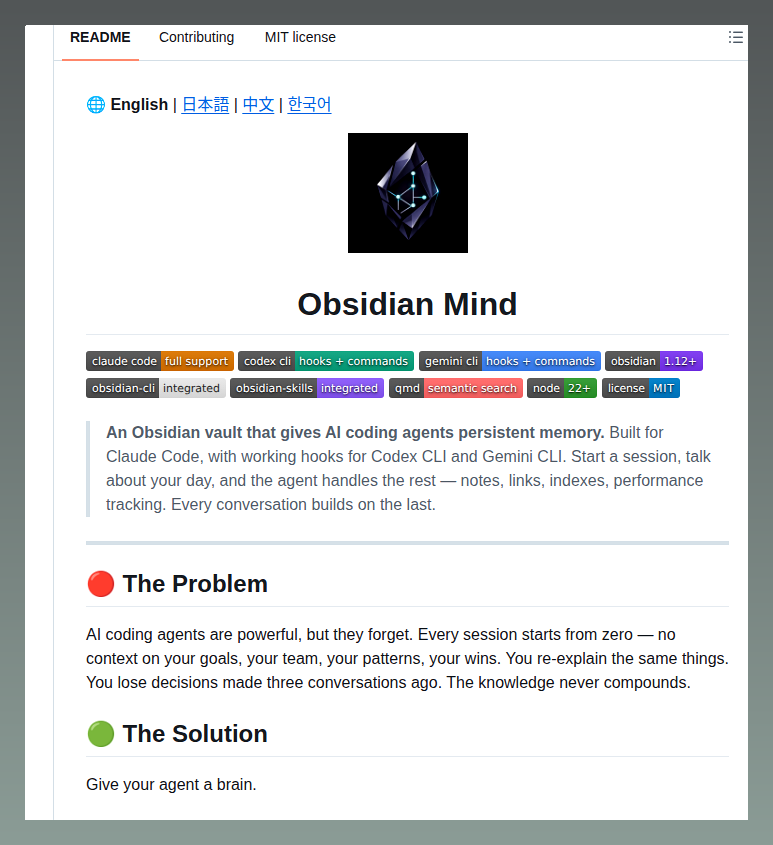
Obsidian Mind gives AI coding agents persistent memory by connecting Claude Code, Codex CLI, and Gemini CLI to an Obsidian vault. Agents retain notes, links, and context across sessions instead of starting from zero.
https://t.co/sdrDs7mJiE
Create self-contained HTML artifacts including wireframes, interactive prototypes, and system diagrams using focused agent skills from the Effective HTML repository.
https://t.co/waxQ1fDkBN
I've spend 10+ hrs perfecting how to get the best out of Opus 5.5 for video generation workflow:
- Use it with Claude Code, not the app.
- Use OpenRouter API to access all the other models (image gen, video gen, audio gen) with one key
- Use Gemini 3.8 TTS and make it create a skill from the API to put emotion into the voice.
- Use Manim, Hyperframes, Motion Canvas for motion graphics for HTML web grounded video
- Use GPT 2.5 Image Sunburst for keyframes and Veo 3.1 / Seedance 2.5 for generation. Seedance does better with motion shots. Ensure you have reference images for consistency and generate an animatic before full video.
- Add a script writing planning skill. Use OpenTimelineIO to assemble.
- Explicitly tell it to avoid Claudisms like short punchy sentences and a lot of numbers. “Narrate like a university professor.”
- Allow it to use yt-dlp with search to inject clips from real videos (creative commons) in composition
- Use ElevenLabs for music gen in the background
- Add a caption skill which uses any decent ASR model to get word-level timed subtitles on the final video
- Add a critic skill which takes screenshots and uses transcription to validation the audio and video quality
In the prompt, specify a) what you want b) aspect ratio c) length d) style preferences. ffmpeg handles most of the actual video manipulation tasks.
Here's an example of a 4 minute Neocloud business explainer:
Introducing pdfcn
Build beautiful PDFs like you build your UI.
Powered by Takumi + Forme.
Pick from 10+ themes, 40+ components & blocks, then customize everything.
One command to get started. shadcn/ui compatible.
100% Free. Open source.
We finally cracked it!
Opus 5.5 videos are now editable.
We built Open Edit, an open-source agent that turns videos into editable browser projects.
Project + GitHub below ↓




![FastAPI's tweet photo. FastAPI now has built-in OpenTelemetry support, natively 📈
No extra code needed.
See how your app behaves in production.
Go and upgrade to "fastapi[standard]" version 0.142.2 ⬆️
Read the docs: https://t.co/dUZmbLmWsJ https://t.co/CPTKSFJHMo](https://pbs.twimg.com/media/HTdOHaEWEAA3_MW.png)