BREAKING: AI can now analyze options trades like a $500/hr options strategist (for free)
Here are 10 Claude prompts I use to sell puts, buy LEAPs, and run the wheel without second-guessing every trade
(Save this for later)
What is a Super Company according to Chris Hohn?
Not only has $SAF.PA delivered a 20% IRR to TCI over 13 years (!)
They recently INCREASED their stake by 22%
So, what makes Safran such a great compounder?
And why is one of the GOATS now doubling down?
Let's dive in ⬇️
(HINT: cashflows are now de-risked for another >13 years)
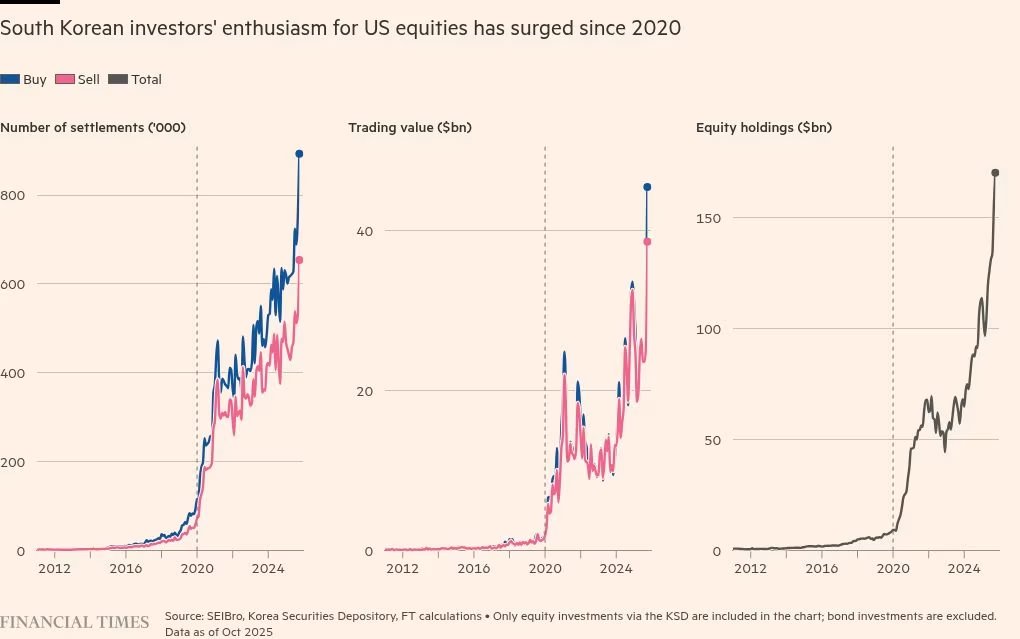
My chart of the day.
Wow. Sure, I knew Korean retail investors had become *a* factor in pumping the meme stocks and no-revenue wishco stocks. But not *this big* of a factor. Korean trading volumes in U.S. markets have exploded.
1/3
A really insightful interview with a Former $GOOGL Cloud employee on TPUs:
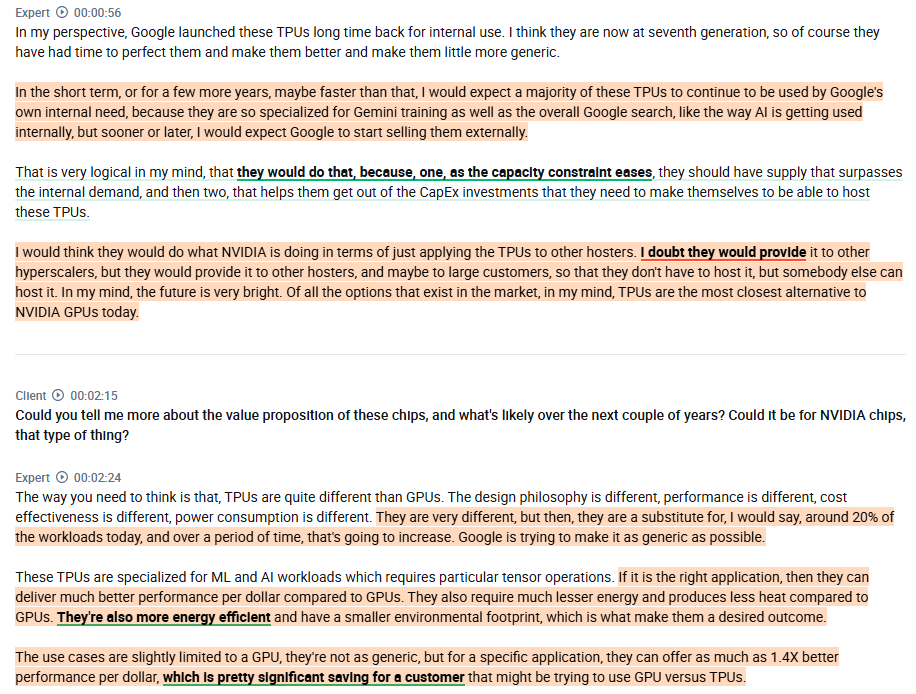
1. In the short term, he expects that TPUs will continue to be used by $GOOGL's own internal needs (Gemini, Search, etc.), but sooner or later, he expects $GOOGL to start selling them externally.
2. He thinks the strategy will be similar to $NVDA, where $GOOGL would apply TPUs to other hosters (not hyperscalers). In his view, out of all the options on the market today, TPUs are the closest alternative to $NVDA GPUs.
3. TPUs and GPUs are very different; they are a substitute for around 20% of the workloads today, and over time, he expects that to increase. $GOOGL is trying to make it as generic as possible.
4. TPUs are specialized for ML and AI workloads, which require particular tensor operations. In the right application, they can deliver significantly better performance per dollar compared to GPUs, requiring much less energy and producing less heat. They are also more energy efficient and have a smaller environmental footprint. For a specific application, they can offer as much as 1.4x better performance per dollar vs a GPU.
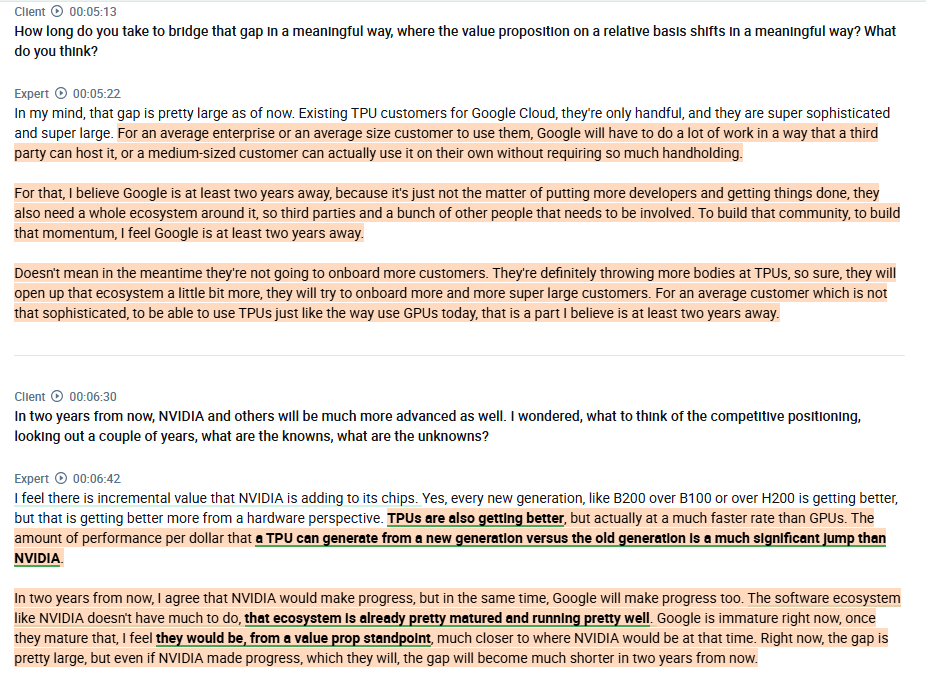
5. He mentions that some clients already use TPUs on $GOOGL Cloud, but those are mostly super sophisticated and super large. For an average customer to use them, $GOOGL will have to do a lot of work so that a third party can host it.
6. He thinks $GOOGL is at least 2 years away, as it is not just about the developers but also building a whole ecosystem around it. He believes that in the meantime, they will continue to onboard more customers.
7. He is not worried about the argument that $NVDA is getting better each year, as he believes that the TPUs are getting better at a faster rate than GPUs each year: »The amount of performance per dollar that a TPU can generate from a new generation versus the old generation is a much significant jump than $NVDA «. Currently, the $NVDA vs TPU gap is quite large, but he is convinced that the gap will be significantly smaller in two years.
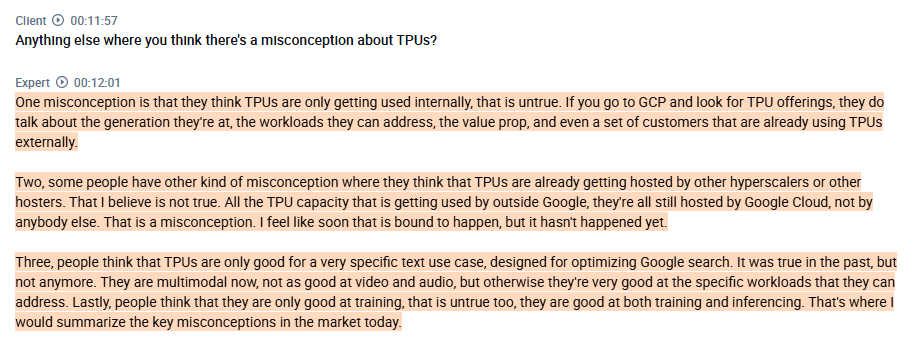
8. There is a misconception that TPUs are only good for very specific text use cases designed for optimizing $GOOGL Search. It was true in the past, but not anymore, according to him. They are multimodal now, not as strong in video and audio, but otherwise, they're very good. TPUs are also not used only for training, but are effective at both training and inference.
9. He also mentions that the ambition at $GOOGL with TPUs always existed, but now the management team is pushing super hard.
found on @AlphaSenseInc
Why did ALL Mag 7 slow US hiring at the EXACT same time?
(Hint: It's not the economy)
The hiring drop is synchronized across Apple, Google, Meta, Microsoft, Amazon, Tesla, AND NVIDIA.
All slammed the brakes in late-2022/early-2023... and never let go.
We’re not seeing a reversion to old patterns.
CEOs AI-wash layoffs to pump stock - real reason? $420B capex redirected to offshore GCCs (70% savings).
Mag7 bombshells:
- Microsoft: 15K US cuts → India (especially Hyderabad/Bengaluru GCCs) was explicitly spared layoffs and saw massive expansion via $3B+ cloud investments, data centers, and hiring in strategic areas.
- Google: Thousands laid off in 2025 (HR/Cloud/Android teams) while Pichai pours $15B into Visakhapatnam hub - briefed PM Modi Oct 14
- Amazon: 14K managers gone → GCCs (Chennai, Hyderabad) are expanding with AWS/offshore boom
- Meta: 20K+ cuts → India hiring up (Blind: "massive outsourcing")
US tech postings -36% below pre-COVID.
India? +47%.
We all feel the pressure in the labor market for US workers right now.
Bookmark if you are pissed at the gaslighting. Let's start watching these levels every single month.
There is a service charging $700/mo to view dealer positioning models (GEX/VEX).
We believe these tools should be accessible, not limited to a select few.
So we built our own and made it accessible.
🧵 (1/4)
Before getting into this, would like to mention this is for INVESTING, for the most part. Not TRADING. I think, most people won't be interested. Again, as I previously said. I am learning and being taken a little under the wings of others. This is just sort of a journal currently if you will.
This portion of my portfolio is essentially my "save game" point and more passive. Every few months, I reset my crypto trading account and have moved that over to tradfi. I've historically viewed it as a barbell approach where crypto = make money and tradfi = preserve it. So this specific bucket is a low risk bucket that protects the majority of my wealth. It also, in doing so smooths out my overall returns as a whole.
Most people think the goal is to make the highest return. But really, what we all should strive for is something that is sustainable, and can keep compounding without blowing up.
So this portfolio design is suppose to survive every environment as opposed to being a bet on any one outcome. Keep in mind, this is it's own bucket, there are a few buckets. I'll cover all of them.
There is the foundation, or the anchor. Which is bonds, credit funds, box spreads. These can be rotated into stocks on a huge correction or at least my plan but don't have to be.
The purpose of them is to have steady, predictable returns. They certainly won't make you wealthy, but they can help keep your wealth regardless of that level.
Orthogonal Bets:
It just means, uncorrelated or things that move differently from stocks or bonds. These are strategies like systematic quant funds, or multi-strategy platforms.
They smooth the overall return curve and keep the portfolio more stable.
Then you have your long /short strategies. This is where the highest returns are possible. This is more skill based, but think of it as long value and short junk. It doesn't necessarily rely on the market going up. The same trades many put on here in crypto.
Then you have convexity sleeves. They are the smaller positions, but can be explosive. Macro, momentum, or venture style bets. They don't cost as much but they can move a lot. Discovery, is one one example. A macro convex fund. When something breaks, these can shoot up and offset the pain elsewhere. And sometimes, but not always can create some pretty huge wins.
Anchor = Stability
Orthogonal = Diverisification
Alpha Engine = Growth
Convex = optionality
Big capital in low volatility sleeves
Small capital in high vol sleeves (convexity)
And this helps shape the return path into something smoother that can compound, and be resilient despite market conditions.
In short, you survive the crashes.
I currently in this bucket for this portfolio have the following:
40% in anchor atm. Bonds, Alt credit funds like helix, delphi, and legacy, and box spreads. These are just examples.
45% in the alpha engine. Fundamental and systematic long/short equities. Some of this in similar liquid funds. Some is self managed like on my brokerage accounts.
10% in orthogonal: Uncorrelated asset streams
5% in convex/opportunistic. This is more asssyemtric bets, smaller capital but more optionality.
It's balanced between offense and defense. The result is high sharpe, moderate returns, and low drawdown risks. If the markets blow up as they do time to time, I may only see 5-10% drawdown.
Everything is counter balanced, the beta ends up being around .20-.25, with low volatility. Drawdowns are shallower, rebalacing is more effective. So one part is maybe losing money, another is flat, and then a different part of the port is making a killing when turmoil hits. But the part that is making a killing is the smallest part of the port bc its the convex sleeve. So you end up with a smooth equity curve overall
I will add more onto this later. Bc it's already a long post.
And although I truly believe we will continue to see these cyclical waves of volatility, a part of me is starting to think that the real tail event might be one where volatility stays elevated, similar to 2008, but less extreme. Imagine a VIX that holds between 40 and 60 in recurring waves instead of collapsing back down quickly.
Whenever we speak to potential investors, it is very clear that many market participants are conditioned to want long volatility programs that monetize gains almost immediately. Everyone is always focused on fighting the last war and optimizing around it, as usual.
It has become a running joke to “always short the VIX whenever it goes up.” But I think a prolonged period of elevated volatility would break a lot of models and hedging frameworks that rely on quick normalization. That path, where volatility remains sticky and refuses to die down feels increasingly possible, and I believe the market is underestimating that risk when they think about how vol can react whenever equities do eventually take a substantial leg lower.
Rick Rescorla was the director of security for Morgan Stanley. His preparation and relentless drilling of evacuation techniques (due to his strong suspicion that the WTC was a target for terrorism since 1988) resulted in nearly all of MS’ employees being successfully evacuated.
When AA11 struck WTC1, the port authority made announcements urging people to stay at their desks. Rick ignored the announcement, got on his bullhorn and began the process of evacuating MS’ 2700 employees. In a call to his best friend Dan Hill, he relayed,
“The dumb sons of bitches told me not to evacuate. They said it's just Building One. I told them I'm getting my people the fuck out of here."
During his tour of duty in Vietnam, Rescorla had boosted morale among his men by singing Cornish songs from his youth. He did the same in the stairwells of the world trade center, directing people down stairwells and away from elevators while singing:
“Men of Cornwall stand ye steady;
It cannot be ever said ye
for the battle were not ready;
Stand and never yield!”
Between songs, after successfully evacuating almost all of the 2700 employees, he called his wife Susan and told her,
“Stop crying. I have to get these people out safely. If something should happen to me, I want you to know I've never been happier. You made my life.”
Susan replied, "You made my life, too”.
Despite successfully evacuating everyone, Rescorla then went back into the building to continue getting everyone out. When the message came through on his walkie-talkie that he, too, had to evacuate he said, simply, “As soon as I make sure everyone else is out.”
Rick was last seen heading up the stairs of the South Tower on the 10th floor, shortly before the collapse. Just 13 of Morgan Stanley’s 2700 employees at WTC perished on 9/11 - Including Rick and his deputies Wesley Mercer, Jorge Velazquez and Godwin Forde who all went back into the building to help anyone who needed it.
We don’t all need to be heroes, defying death with Cornish battle songs and saving thousands of innocent people. But if we could all internalize just a small portion of the sense of duty, preparedness and selflessness that Rick possessed, the world would be a much better place. I share this story on each anniversary with the hopes it gets us just a little bit closer to that.