mHC and AttnRes demonstrate that richer depth mixing improves model performance at scale. Is there a unifying perspective? 🤔
Meet our Depth Memory framework: each layer reads from a set of streams to form its input, then writes back its output.
Linear Depth Memory (LDM) equips models with a matrix-valued memory.
Confident ≠ correct. But vanilla sampled OPD gives high-confidence tokens tiny gradients—even when they’re wrong.
In our analysis, 72% of sampled tokens are high-confidence, yet receive just 2.4% of the gradient mass. Valuable teacher signals go underused. These high-confidence tokens can be the very mistakes that send the model down the wrong reasoning path.
📖 https://t.co/mBYIOqNVKH
😆 Just saw our ISO-Merger used for RL expert merging in K2-Horizon on 375B MoE scale! Cool work 🚀
No extra data or expensive on-policy distillation stage —just merge in minutes :)
Sometimes, just understanding RL optimization better --> much simpler methods. 👀
If interested, can check out our previous work here https://t.co/xzXf6V8ukO ; maybe more RL thoughts to share when I have time, lol
(1/9) Quantizing recurrent language models is easier than you think!
Hybrids compete at scale (e.g. Qwen, Kimi, Nemotron). Yet the PTQ stack has largely been tailored to softmax attention. 🤔
In this work, we reveal that recurrent models can be easier to quantize.
Functional invariances are the basis of many transformer quantization methods.
Turns out there are way more for linear recurrences, like Mamba-2 and KDA!
Check out our new paper, LinQuant👇
We've spent years learning how to quantize attention. But what about the linear recurrences (e.g. Mamba-2, GDN and KDA) replacing it?
It turns out we can rewrite their computation to reduce quantization error, while preserving the full-precision function. 🤯
Introducing LinQuant: a framework for low-precision recurrent prefill. 🧵 (1/7)
🚨 New paper!
What if LLMs could reason like we do when solving Sudoku: keep a few candidates per cell and iteratively narrow them down?
Introducing Binary Discrete Diffusion for language and reasoning tasks: it denoises sets of candidate tokens using binary representations! 🧵
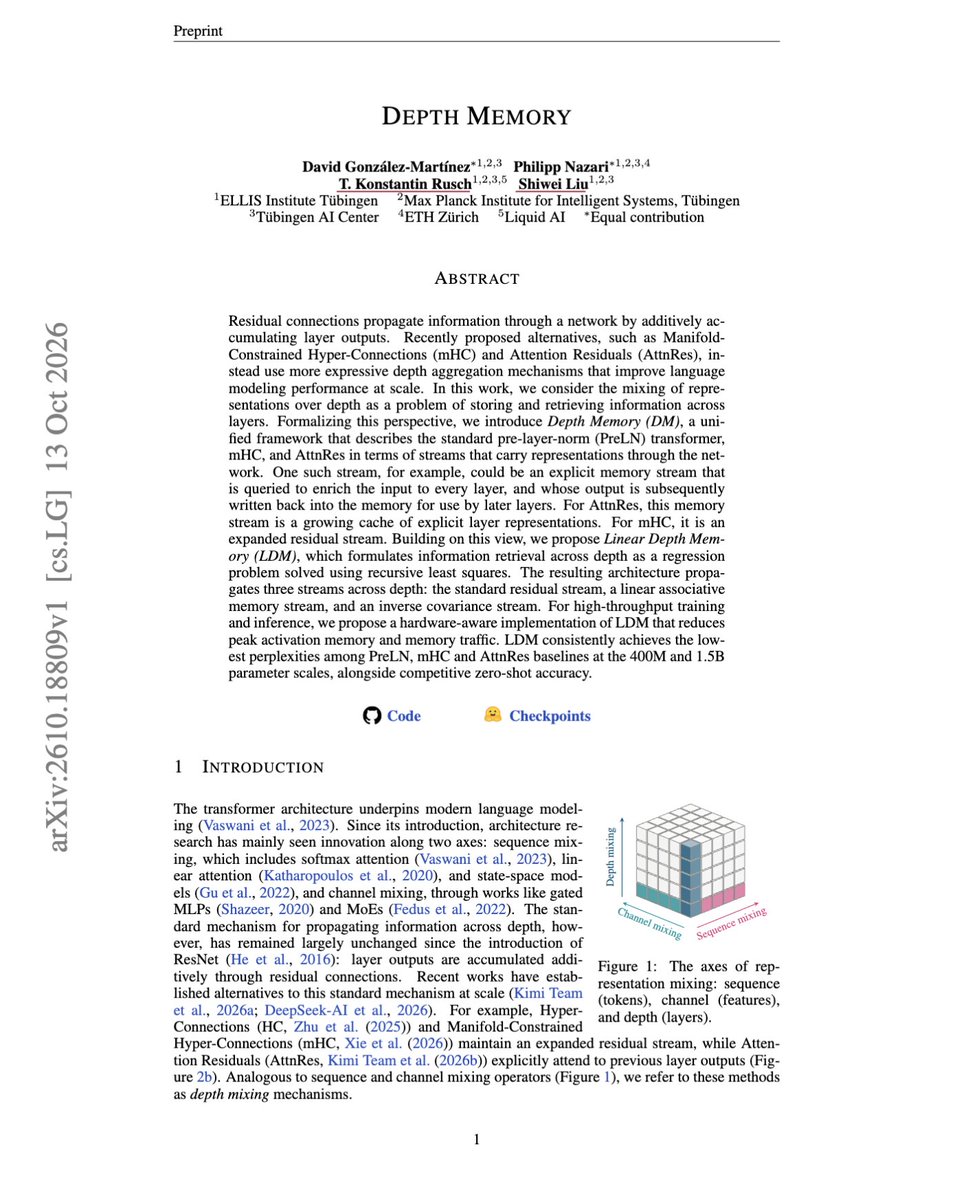
What if information passing between Transformer layers were treated as memory reads and writes? "Depth Memory" proposes LDM, a fixed-size memory updated via recursive least squares, and reports lower perplexity than PreLN, mHC and AttnRes at 400M and 1.5B scale (authors' experiments).
https://t.co/sXdvZr6zsR
This next paper is a bit quirky, but here goes:
Introspection is hard to study in both humans and LLMs. But, we do have internal senses that are verifiable, like proprioception (the sense of where your arm is right now).
What would proprioception look like in language models?
As a digital analogue to the sense of position, a model could verbalize which expert activated in a certain layer for any previous token.
It turns out that LLMs can learn a range of such proprioception skills where they understand and report on their internals. We can calibrate and score these reports, and evaluate whether training for proprioception changes model behaviors.
mHC and AttnRes demonstrate that richer depth mixing improves model performance at scale. Is there a unifying perspective? 🤔
Meet our Depth Memory framework: each layer reads from a set of streams to form its input, then writes back its output.
Linear Depth Memory (LDM) equips models with a matrix-valued memory.
Great summary of our paper, Depth Memory!
We
1. introduce a framework for existing depth mixing methods and
2. propose a new depth mixer that outperforms AttnRes and mHC.
Check it out! 🚀 @_davidgonmar@tk_rusch@Shiwei_Liu66
"Depth Memory"
Attention Residuals stores earlier Transformer layer outputs for retrieval but this memory grows with depth.
Linear Depth Memory (LDM) maintains a fixed-size memory across layers, using recursive least squares to store and retrieve earlier layer information alongside the standard residual stream.
On 400M and 1.5B models, LDM achieves lower perplexity than standard residuals, mHC, and AttnRes, while maintaining competitive zero-shot accuracy and comparable throughput with optimized kernels.
https://t.co/BqotZ9dqWK
mHC and AttnRes demonstrate that richer depth mixing improves model performance at scale. Is there a unifying perspective? 🤔
Meet our Depth Memory framework: each layer reads from a set of streams to form its input, then writes back its output.
Linear Depth Memory (LDM) equips models with a matrix-valued memory.
In general, overhead numbers are not comparable across codebases or settings. If your baseline (PreLN) is already very optimized (e.g. with torch.compile), adding other stuff (e.g. AttnRes) on top might add more overhead than for a less-optimized baseline. For larger runs, we suspect it might also be easier to hide additional overhead. For our runs, we used the FLA kernels without modifications (beyond some mods around the kernels so that torch.compile works well for AttnRes without graph breaks) but did not try anything else. For most of our settings AttnRes has less than 12% overhead (see our Appendix for the full set). We also released our code, so you can try other implementations :)
mHC and AttnRes demonstrate that richer depth mixing improves model performance at scale. Is there a unifying perspective? 🤔
Meet our Depth Memory framework: each layer reads from a set of streams to form its input, then writes back its output.
Linear Depth Memory (LDM) equips models with a matrix-valued memory.
Thanks for your comment! Depth memory is indeed related to DDL, which we cite. However, we want to highlight some key differences beyond using RLS instead of the delta rule.
In DDL, the value dimension D_v is small (e.g. 4), while the key dimension is large. Reading from DDL's matrix-valued stream means contracting along the value dimension (which you call "compressing"), yielding a D_k-dimensional vector. Writing to the stream then follows the standard Delta Rule. Moreover, DDL's writes values are produced from the compressed stream.
The most important distinction is that LDM treats the memory itself as a separate stream while retaining the standard residual stream. The latter determines where to write (keys) and where to read from (queries). Importantly, to read from the memory, we contract along the key dimension, as in the sequence mixing analogous. Additionally, we write layer outputs into the memory instead of producing them from the stream.
In any case, DDL is very interesting work!!
Can reasoning finish while latent states keep moving?
Happy to share Quotient Recurrent Reasoner (QRR)!
We let symmetry-generated rotations persist while task-relevant dynamics converge faster in quotient space, reaching 97.9% on Sudoku-Extreme with 78% fewer loops than FPRM.
@ethantsliu Thanks for the interesting questions! In practice, LDM adds very little FLOPs, and the FLOP differences between the recurrences are negligible. Regarding memory size, deeper models might benefit from larger memories, but we haven't explored that yet.