Just wired up Qwen3.6-27B with MTP on llama.cpp. One flag (--spec-type draft-mtp), ~1.5-2x throughput, identical outputs. Local inference keeps eating the moat.
@mitchellh LoC and deploys per day aren’t useless metrics, not for model providers because they push you to consume more. Maybe there will be a day where we aim to create most token efficient code and delay change as far as possible.
@viljararakas Doesn't stop the ever steeping retirement curve and eventual collapse of pension system. Pretty sure this will be snugged under the rug in the next election cycle.
@dhh I never understood the license issue on the code generation. At the end of the day it's token generated code converted to the most efficient machine code via compiler and fed as instruction set to CPU. What is left there to copyright?
@Talvitp@viljararakas 2,5 miljardit? Alusta endast... Enne kui Malthuse maailmavaadet jagad, tasub meeles pidada, et kogu maailma rahvastik mahub New Yorgi Central Parki ära, kui kokku pakkida nagu kilud karbis. Meid on tegelikult vähe ja see saab suureks probleemiks.
@karpathy All what was left to do was to delegate feedback to agents. Getting this to work on the scale of massive models is going to be operational challenge but I think in a year we will get there.
So many startups think their engineers are "cracked" but have no idea what that really means.
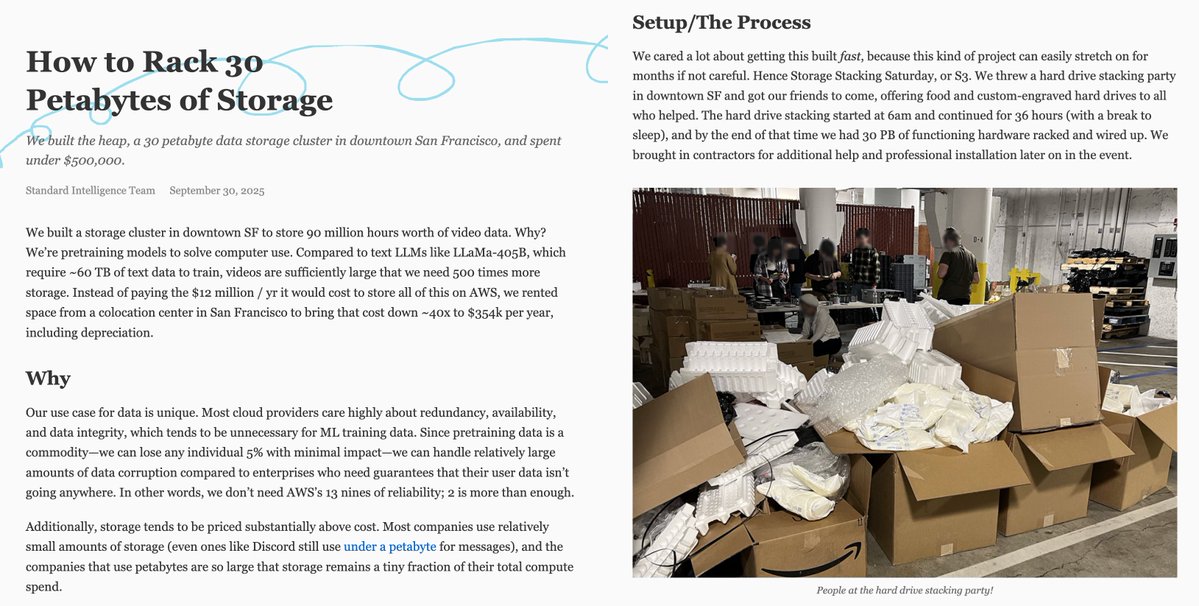
This team of 5 19yr olds built a 30 petabyte storage cluster in SF for ~$500k to get a 40x cheaper AWS S3 as a side quest to store 90M hours of video.
Now, that's cracked.
Accidentally stumbled across some insane Gem5 stuff. Turns out the Chinese have just been pushing the SotA in hardware simulation without telling anyone.
@matteopelleg I am sure that within 3 years, any new iPhone will run local LLM that is twice "smarter" than Opus 4.6. New architecture, separate chips for LLM, and battery improvements will definitely allow it.
@taurialas BHF võlakoormust, võlakirju ning portfooliot vaadates tekib arusaam, et BHF strateegia on tänaseks olnud "teeme kõik, mida EfTEN teeb aga vastupidi!".
256 Tb/s data rates over 200 km distance have been demonstrated on single mode fiber optic, which works out to 32 GB of data in flight, “stored” in the fiber, with 32 TB/s bandwidth. Neural network inference and training can have deterministic weight reference patterns, so it is amusing to consider a system with no DRAM, and weights continuously streamed into an L2 cache by a recycling fiber loop. The modern equivalent of the ancient mercury echo tube memories. You would need to pipeline a bunch of them to implement modern trillion parameter models, but fiber transmission may have a better growth trajectory than DRAM does today, so it might someday become viable.
Much more practically, you should be able to gang cheap flash memory together to provide almost any read bandwidth you require, as long as it is done a page at a time and pipelined well ahead. That should be viable for inference serving today if flash and accelerator vendors could agree on a high speed interface.
@Brad_Setser@ExanteData ECB just has to add a 10% risk weight to US Treasuries in Solvency II. EU insurers would be forced to dump US debt instantly. Trump is only influencable through treasury markets.
@NatRothschild1@Simon_Nixon Entering the defense market is much easier in the US than in Europe. Europe struggles with market fragmentation, political interference, and resistance to innovation. Consequently, Europe is lagging behind the rest of the world in critical defense capabilities.
@NatRothschild1@Simon_Nixon Europe values its security, but the defense sector suffers from underfunding and high entry barriers compared to the US. Procurement is often driven by politics rather than the free market. Policymakers must urgently address these issues.
Evolve at the hyperscale!
Work co-led with Mattie Fellows and Juan Agustin Duque.
Made possible by #Isambard and AIRR
🌐 Website: https://t.co/JLluUPmuWc
📝 Paper: https://t.co/JonCoelVIT
💻 Code: https://t.co/moyzZfEg9s
🥚NanoEgg : https://t.co/LLmgnnm6eU (train in int 😉)