Tether's Q2 2024 attestation is out.
Another great quarter.
A short summary as of 30 June 2024:
* $1.3 billion in net operating profit.
* $520 million increase in Tether's Group own equity, bringing it to a total of $11.9 billion.
* $5.33 billion in excess reserves
* more than $97.5 billion in U.S. Treasuries (direct + indirect exposure), ~$7 billion increase from the previous quarter, a new all-time high. This achievement brings Tether’s exposure to treasuries above Germany, the United Arab Emirates, and Australia. While China and other countries have been recent net sellers of U.S. Treasuries, Tether positioned itself at 18th in the rankings of countries owning U.S. debt
* ~80k #bitcoin owned by Tether's Group
A Once-In-One-Hundred-Year Opportunity.
Tether's primary goal has always been to create the most solid, stable and resilient stablecoin. Our attestation data shows our company's commitment to this endeavor. Tether's management, in fact, decided to keep $5.33 billion in Excess Reserves as part of the stablecoin reserves (on top of the 100% reserves that are backing all issued tokens) to further protect USDt's global user base, accounting for hundreds of millions of people globally, with deep concentration in emerging markets and developing countries. Many of the USDt users live in countries with very high inflation, where the local national currency is devaluing against the U.S. dollar very quickly. To protect their savings and their families, they are looking for a digital dollar they can trust and hold directly.
That's USDt.
The $5.33 billion could have been distributed as dividends to the shareholders.
They weren't.
Tether's management and shareholders believe in building fair access to financial services especially for those people that have been forgotten by the traditional banking industry, simply because they are not profitable enough as customers. In many countries people live on less than $10 per day. They don't have the luck of having 2 bank accounts, 2 credit/debit cards and other payment / savings methods like good parts of the populations living in richer countries. Providing a solution to start saving money and preserving wealth through a digital wallet is a groundbreaking improvement for billions of people.
For this reason, keeping a significant part of our profits in the company is our way to support our users and thank them for the trust they place in us every single day.
Tether also announced recently how, outside of stablecoin reserves, the Group has accrued an investment portfolio of ~$6.56 billion.
This capital is not managed as a classic VC fund. Tether invests only in companies and technologies that are aligned with our fundamental company mission: disintermediate, build for independence, build for resiliency, build for the future, build for the apocalypse.
Two of the biggest investments recently announced:
* Artificial Intelligence: primarily in Northern Data Group @NorthernDataGrp . Being AI probably the most future shaping technology of the next 100 years, with Northern Data we aim to build fair access to AI infrastructure
* Biotech: primarily in Blackrock Neurotech @BlackrockNeuro_ . Tether acquired the majority stake in BRNT to support the development of a brain-computer interface that can help millions of people around the world afflicted with paralysis, lost function and neurological disorders that prevent them from walking, seeing, hearing, feeling, or talking. We also see a future where this technology will fill the gap between humans and machines, paving the way for human evolution
Finally, we realize that our company grew and reached new, almost unimaginable, levels. It’s truly humbling to find ourselves in the position to build everything our imagination could dream. That’s why, for us, Tether is a Once-In-One-Hundred-Year Opportunity.
And being a private company allows us to focus on the things that truly matter.
Thanks for your continued support ❤️
For more information about Tether’s mission please visit https://t.co/hTI0TNYGVR
*** amounts are in USD equivalent
5) MORE TREASURY DUMPING BY CHINA
Next, did you know that China (the single largest foreign buyer of US Treasuries) has been dumping[5] US paper at an accelerating clip?
This is a bit technical, but China is an “outside investor” in the US kind of like a new venture capitalist investing in your tech company is an outside investor. Even by buying just 5% of your equity (or in this case, debt), they set the price for everyone else. And show that there’s robust outside demand, by people who don't have to buy.
But now that outside demand is crashing:
6) MORE GOLD BUYING BY BRICS
But isn’t the dollar a store of value? What are other countries saving in if not US Treasuries? Well, China is a bellwether for much of the non-US world. And those countries have begun stacking historical quantities of gold[6], even as Western countries have been selling gold. Take a look:
7) MORE DEDOLLARIZATION THAN EVER
OK, what about the dollar as medium of exchange? Well, China — which is the #1 trade partner of most countries in the world now[7a], in case you didn’t know — has just flipped[7b] to majority CNY for cross-border FX deals.
8) LESS SANCTION EFFICACY THAN EVER
OK, but can’t the dollar still be used as a sanctions weapon? Don’t countries need access to the US financial system? Actually, no. All the sanctions on Russia actually ended up hurting Europe more than Russia. Europe needed Russia’s oil and gas, but Russia had other customers. So according to the World Bank[8] (not a Russian source!), Russia just flipped Japan to become the #4 global economy in GDP-by-PPP.
Two more graphs below, and then all the references. 👇
The Rise of Solana RWAs & stablecoins
An ecosystem analysis by @davewardonline
Alongside the recent ETFs surge, stablecoins and real-world assets (RWAs) have been the strongest paths to real-world adoption and augmenting existing financial systems with onchain economies.
Larry Fink’s mission of tokenizing the world leads as one of the most discussed memes of this cycle, a vision he’s followed up within $BUIDL, @Blackrock’s tokenized onchain fund. Stablecoins also remain central to discussions due to protocols like @ethena, Stripe's reentry via USDC payments, and new EU regulations like MiCA.
Although Ethereum and Tron are stablecoin hubs, Solana has notably risen here this cycle, with daily volumes exceeding $100 billion during peaks. RWA activity is also increasing on the network, with @OndoFinance's USDY as DeFi collateral, @maplefinance's @jito partnership, and @librecap's launch.
This article will dive into all these developments to understand the momentum Solana’s achieved in becoming one of the chains with the most real-world applications.
Stablecoins on Solana
Stablecoins on Solana have shown strength and continued expansion this cycle, highlighting the network’s robustness and appeal to stable issuers.
Today, Circle's USDC dominates the stablecoin arena on Solana, accounting for ~70% of the chain's total stablecoin supply, despite only holding ~30% on Ethereum.
As of this week, USDC's volume is ~19:1 compared to USDT (who comes in second on the chain), despite USDT's $114B total market cap and $31.5B daily volume on Ethereum, surpassing the top 20 ERC tokens combined. USDC's dominance on Solana stems from @circle and the @Solana Foundation’s strategies to incentivize developers and promote trading platform integration.
For instance, developer grants from platforms like @solendprotocol and @superteam in USDC have attracted more developers to Solana. Circle's Cross Chain Transfer Protocol (CCTP) launch on Solana has also boosted USDC's usability and liquidity. Additionally, Circle’s Web3 Services simplify smart contract development, meeting developer demand and fostering USDC's integration. All in all, these efforts aim to unify DeFi and establish USDC as Solana's leading stablecoin.
In third place at ~$240M circulating supply is @Paypal’s $PYUSD, which now accounts for ~11% of the total stablecoin supply on Solana after launching less than two months ago.
DeFi protocols like @KaminoFinance bolstered this growth by offering significant supply-side yields for PYUSD starting July 1st. Starting at 30%, these yields have lowered to 23%, though borrowing APY stands at 0.22%, compared to USDC’s 21% and USDT’s 16.5%, making PYUSD an attractive DeFi tool. Within a week of July 1st, PYUSD’s supply increased 88%, with 38% funneling into Kamino.
Outside of just stablecoin issuers, major financial platforms like @stripe and @Shopify integrating with Solana opens up new opportunities for developers and businesses to use the network to build trusted platforms that service everyday needs and connect Solana to mainstream finance.
Here, projects like @sphere_labs, @uselulo, @Decaf_so, and @helio_pay are already in development, simplifying crypto transactions and leveraging stablecoins such as USDC for everyday financial services like offramping to local currencies, facilitating crypto payments for e-commerce, and high-yield savings.
Overall, the stablecoin momentum seen on Solana looks primed to expand the offerings of existing financial systems with efficient, onchain solutions.
RWAs on Solana
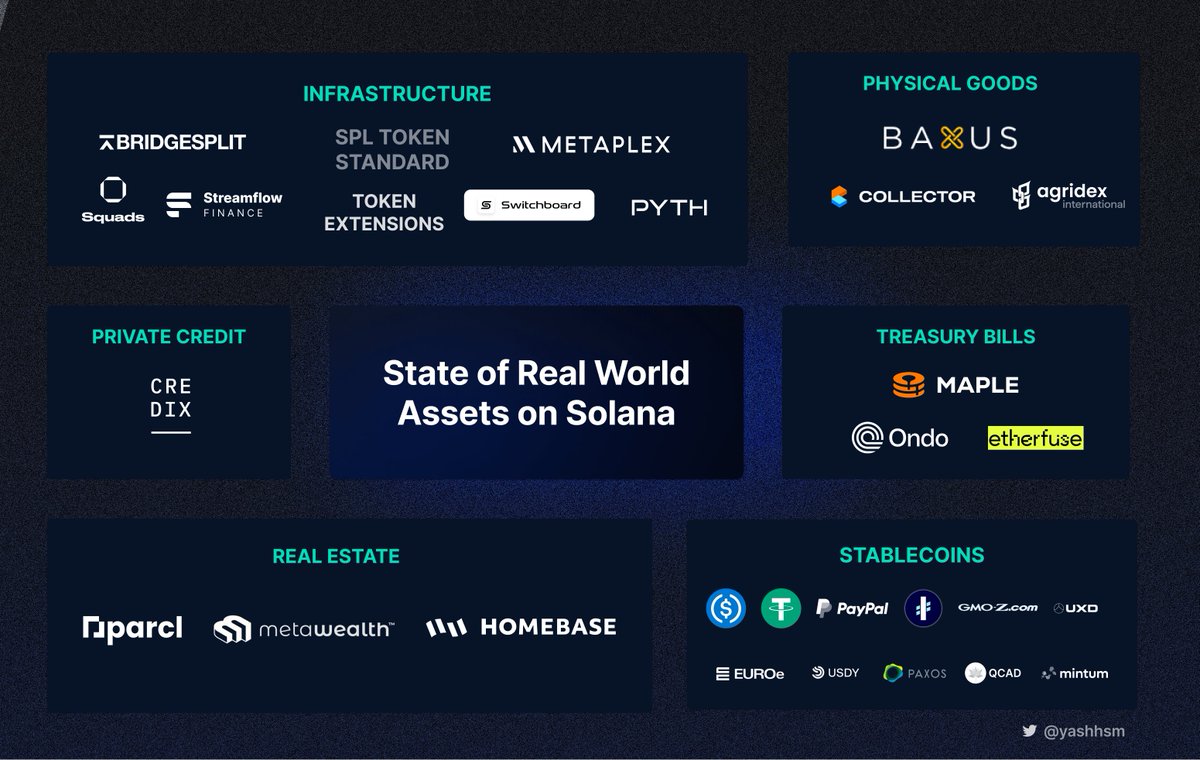
Although quieter than Ethereum's RWA growth, Solana's integration of real-world assets is building a fertile ecosystem beyond tokenized treasuries.
Deployed on Solana in December 2023, Ondo Finance’s flagship tokenized treasury product, USDY, currently boasts a $42M market cap, which is relatively small compared to other leading stablecoins, which it is frequently categorized as. Despite its size, USDY has seen interesting developments, like integration into perps DEX @DriftProtocol as collateral.
This partnership and those to come add utility to tokenized real-world assets beyond lending and borrowing, improving capital efficiency for traders.
Some of the other most interesting RWA projects in the Solana ecosystem today include Maple and Parcl.
Maple, a marketplace for whitelisted companies to borrow from onchain liquidity pools, redeployed on Solana last year, offering yield avenues for stablecoins and altcoins through overcollateralized loan markets. Beyond this, Maple partnered with Jito for their new retail-focused lending product, Syrup. This partnership will provide flexible financing for borrowers using JitoSOL, unlocking yield sources for lenders and enhancing risk management with JitoSOL's liquidity.
@Parcl is a real estate perps DEX that allows users to invest in and trade—long or short with up to 10x leverage—specific geographical markets like Boston, Chicago, or Miami. This protocol aims to be used for directional investment and hedging strategies, democratizing access to a traditionally opaque asset class. Parcl is expanding into forex, too, with upcoming markets for the British Pound (GBP) and the Euro (EUR).
This is just the beginning of Solana’s RWA expansion, which will continue to be fueled by the recently announced Libre Fund and the upcoming launches of Jupiter’s GUM Alliance and elmnts’s exchange.
Libre Fund
Libre, a joint venture between Brevan Howard’s WebN Group and Nomura’s Laser Digital, is rolling out a suite of tokenized funds on Solana like the Hamilton Lane SCOPE fund, known for its higher yields, and the Brevan Howard Master Fund, which specializes in global macro trading strategies. With nearly $20M in TVL pre-launch, Libre's initiative intends to introduce secondary trading services for its funds later this year.
Jupiter’s GUM Alliance
@JupiterExchange's Grand Unified Markets (GUM) initiative, in partnership with the Solana Foundation and market makers like @wintermute_t and @DWFLabs, intends to create a "single atomic market" on Jupiter for all assets from forex and stocks to RWAs like credit, T-bills, and real estate and, of course, crypto.
The initiative aims to onboard tokenized assets efficiently by ensuring deep liquidity and addressing the common chicken-and-egg problem in tokenization, where issuers hesitate to tokenize assets without liquidity, and liquidity remains low until more assets are tokenized.
elmnts
@elmnts_ is an upcoming market for tokenized essential energy resources like mineral rights in the oil and gas sectors, an industry that is expected to generate over $800 billion in 2024. This approach increases transparency, access, and liquidity, addressing issues in the current market like high transaction costs and low liquidity.
To do this, the company acquires mineral rights through auctions, private sales, and networks, with specialists tracking active leasing areas and understanding the oil and gas market. This market simplifies the investment process, reduces costs, and allows more investors to participate with lower fees and minimums.
Zooming out
With significant stablecoin growth and a rising stable of RWA offerings, Solana has established a strong base for expanding real-world markets with onchain economies.
Through new and upcoming initiatives like Libre's tokenized funds, Jupiter’s GUM Alliance, and elmnts's market for essential energy resources, Solana continues to not only embed itself deeper into the RWA market but also offer a wider swath of access than most other chains to real-world assets onchain.
Indeed, @Coingecko's recent report shows that the top 2 narratives of Q2 2024 were memecoins (of course) and RWAs. If Solana captures the attention around RWAs as it has memecoins, it could attract institutional capital to the chain and solidify its place at the very top of this cycle's trends.
As existing financial systems merge with our decentralized ones, Solana’s role in facilitating the tokenization of traditional assets will continue to expand, reinforcing its status as a chain capable of feeding all appetites, whether from retail or institutions.
RWA people
please stop calling them RWAs
this framing is value destructive. you are telling the people who are not in crypto that you do not live in the real world, and that you want the real world to come to bizarro crypto world
Solana's new scheduler is going live this week, with all validators recommended to upgrade to 1.18.15 in the next few days
But what does this mean for users?
I've been running 1.18.15 for two weeks and watching the blocks packed. Here's how I think it changes things:
@crispheaney This is why VCs should understand the tech and thus be able to understand founders relationship and understanding of the tech. First principles > mimesis
Great discussion today in the Solana Foundation Validator discussion on SIMD 96 Full Priority Fees to Validators (https://t.co/3yVMB5KRzG). If you're a validator operator, make sure to get involved in the Solana forum: https://t.co/0sVowh4sBg
Yes #RWA will go down as yet another failed meaningless catch-all generated by the crypto world.
We already have assets with names. When they are represented onchain, they are tokenized.
These are Security Tokens
Can we all agree that RWA = things like USD, AAPL, TSLA, etc on chain. basically, financial assets
And things like whiskey, watches, wine, etc are not RWA. they are physical collectibles
using the same vocabulary to describe financial assets and physical assets is going to lead to a lot of poor logic


![balajis's tweet photo. 5) MORE TREASURY DUMPING BY CHINA
Next, did you know that China (the single largest foreign buyer of US Treasuries) has been dumping[5] US paper at an accelerating clip?
This is a bit technical, but China is an “outside investor” in the US kind of like a new venture capitalist investing in your tech company is an outside investor. Even by buying just 5% of your equity (or in this case, debt), they set the price for everyone else. And show that there’s robust outside demand, by people who don't have to buy.
But now that outside demand is crashing:
6) MORE GOLD BUYING BY BRICS
But isn’t the dollar a store of value? What are other countries saving in if not US Treasuries? Well, China is a bellwether for much of the non-US world. And those countries have begun stacking historical quantities of gold[6], even as Western countries have been selling gold. Take a look:
7) MORE DEDOLLARIZATION THAN EVER
OK, what about the dollar as medium of exchange? Well, China — which is the #1 trade partner of most countries in the world now[7a], in case you didn’t know — has just flipped[7b] to majority CNY for cross-border FX deals.
8) LESS SANCTION EFFICACY THAN EVER
OK, but can’t the dollar still be used as a sanctions weapon? Don’t countries need access to the US financial system? Actually, no. All the sanctions on Russia actually ended up hurting Europe more than Russia. Europe needed Russia’s oil and gas, but Russia had other customers. So according to the World Bank[8] (not a Russian source!), Russia just flipped Japan to become the #4 global economy in GDP-by-PPP.
Two more graphs below, and then all the references. 👇](https://pbs.twimg.com/media/GTICr1bakAAGk3a.jpg)
![balajis's tweet photo. 5) MORE TREASURY DUMPING BY CHINA
Next, did you know that China (the single largest foreign buyer of US Treasuries) has been dumping[5] US paper at an accelerating clip?
This is a bit technical, but China is an “outside investor” in the US kind of like a new venture capitalist investing in your tech company is an outside investor. Even by buying just 5% of your equity (or in this case, debt), they set the price for everyone else. And show that there’s robust outside demand, by people who don't have to buy.
But now that outside demand is crashing:
6) MORE GOLD BUYING BY BRICS
But isn’t the dollar a store of value? What are other countries saving in if not US Treasuries? Well, China is a bellwether for much of the non-US world. And those countries have begun stacking historical quantities of gold[6], even as Western countries have been selling gold. Take a look:
7) MORE DEDOLLARIZATION THAN EVER
OK, what about the dollar as medium of exchange? Well, China — which is the #1 trade partner of most countries in the world now[7a], in case you didn’t know — has just flipped[7b] to majority CNY for cross-border FX deals.
8) LESS SANCTION EFFICACY THAN EVER
OK, but can’t the dollar still be used as a sanctions weapon? Don’t countries need access to the US financial system? Actually, no. All the sanctions on Russia actually ended up hurting Europe more than Russia. Europe needed Russia’s oil and gas, but Russia had other customers. So according to the World Bank[8] (not a Russian source!), Russia just flipped Japan to become the #4 global economy in GDP-by-PPP.
Two more graphs below, and then all the references. 👇](https://pbs.twimg.com/media/GTICpOJacAAW8QA.jpg)
![balajis's tweet photo. 5) MORE TREASURY DUMPING BY CHINA
Next, did you know that China (the single largest foreign buyer of US Treasuries) has been dumping[5] US paper at an accelerating clip?
This is a bit technical, but China is an “outside investor” in the US kind of like a new venture capitalist investing in your tech company is an outside investor. Even by buying just 5% of your equity (or in this case, debt), they set the price for everyone else. And show that there’s robust outside demand, by people who don't have to buy.
But now that outside demand is crashing:
6) MORE GOLD BUYING BY BRICS
But isn’t the dollar a store of value? What are other countries saving in if not US Treasuries? Well, China is a bellwether for much of the non-US world. And those countries have begun stacking historical quantities of gold[6], even as Western countries have been selling gold. Take a look:
7) MORE DEDOLLARIZATION THAN EVER
OK, what about the dollar as medium of exchange? Well, China — which is the #1 trade partner of most countries in the world now[7a], in case you didn’t know — has just flipped[7b] to majority CNY for cross-border FX deals.
8) LESS SANCTION EFFICACY THAN EVER
OK, but can’t the dollar still be used as a sanctions weapon? Don’t countries need access to the US financial system? Actually, no. All the sanctions on Russia actually ended up hurting Europe more than Russia. Europe needed Russia’s oil and gas, but Russia had other customers. So according to the World Bank[8] (not a Russian source!), Russia just flipped Japan to become the #4 global economy in GDP-by-PPP.
Two more graphs below, and then all the references. 👇](https://pbs.twimg.com/media/GTICmjmbUAAZGit.jpg)





![balajis's tweet photo. 5) MORE TREASURY DUMPING BY CHINA
Next, did you know that China (the single largest foreign buyer of US Treasuries) has been dumping[5] US paper at an accelerating clip?
This is a bit technical, but China is an “outside investor” in the US kind of like a new venture capitalist investing in your tech company is an outside investor. Even by buying just 5% of your equity (or in this case, debt), they set the price for everyone else. And show that there’s robust outside demand, by people who don't have to buy.
But now that outside demand is crashing:
6) MORE GOLD BUYING BY BRICS
But isn’t the dollar a store of value? What are other countries saving in if not US Treasuries? Well, China is a bellwether for much of the non-US world. And those countries have begun stacking historical quantities of gold[6], even as Western countries have been selling gold. Take a look:
7) MORE DEDOLLARIZATION THAN EVER
OK, what about the dollar as medium of exchange? Well, China — which is the #1 trade partner of most countries in the world now[7a], in case you didn’t know — has just flipped[7b] to majority CNY for cross-border FX deals.
8) LESS SANCTION EFFICACY THAN EVER
OK, but can’t the dollar still be used as a sanctions weapon? Don’t countries need access to the US financial system? Actually, no. All the sanctions on Russia actually ended up hurting Europe more than Russia. Europe needed Russia’s oil and gas, but Russia had other customers. So according to the World Bank[8] (not a Russian source!), Russia just flipped Japan to become the #4 global economy in GDP-by-PPP.
Two more graphs below, and then all the references. 👇](https://pbs.twimg.com/media/GTICu6SbsAAAkjE.jpg)