Get good at using AI agents asap.
Because soon, @bot will make you money trading, build your brand, do your accounting, automate your errands.
And you? You’ll do whatever you damn want.
This is the way.
Part 3, the final part of our recap of NICE’s event on looped language models。 Is looping along depth the same as CoT? Do expressiveness proofs still matter? How should loops be combined with MoE? And what about extrapolation, ACT and parallel decoding? https://t.co/fJQzIMh6GH
Not long ago, AI was a tool you used.
Now, it's becoming a teammate that thinks, plans, and acts on its own.
This shift is being driven by a new wave: Agentic AI.
These systems don’t just respond — they take initiative, make decisions, and get things done.
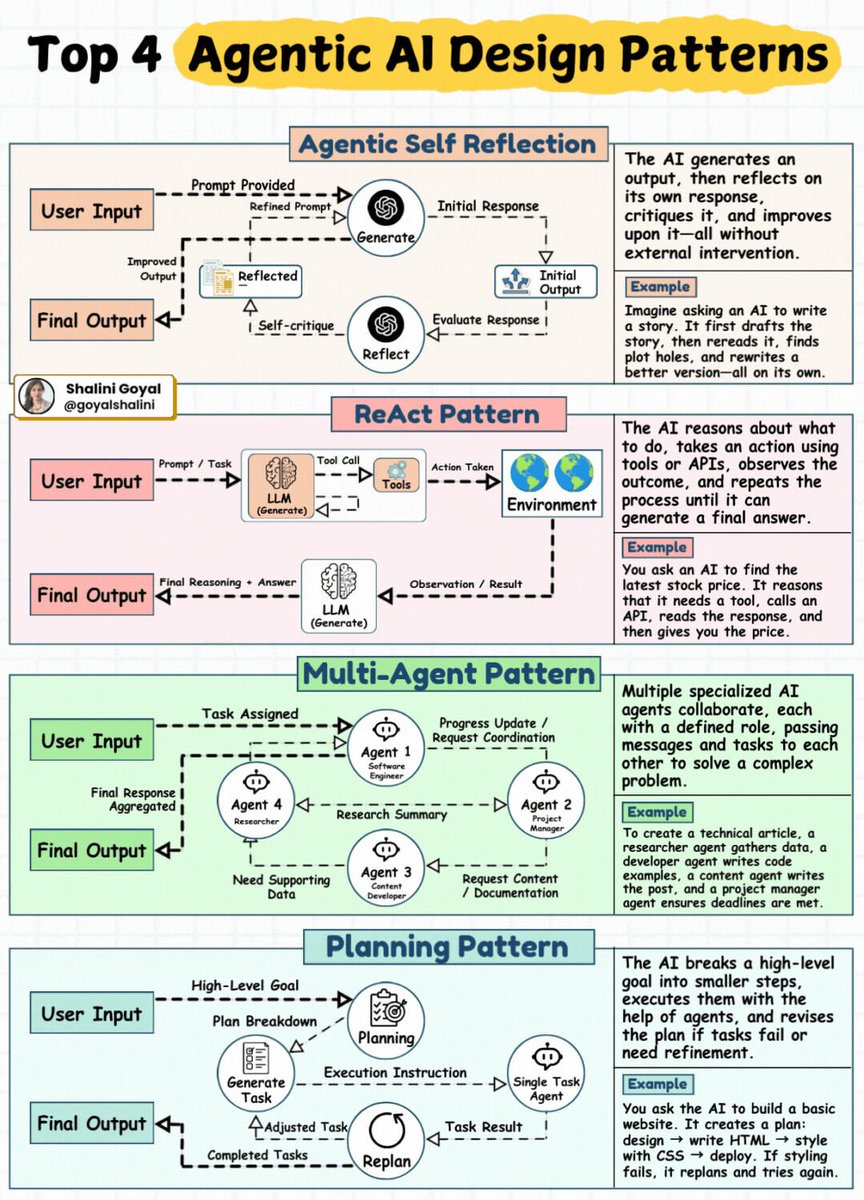
Here’s a breakdown of the 4 most powerful Agentic AI design patterns each unlocking a unique approach to intelligent decision-making and task execution.
Here’s what each pattern brings to the table:
1. Agentic Self-Reflection
The AI critiques and improves its own output through self-reflection. It generates a response, evaluates it, and revises — all autonomously.
2. ReAct Pattern
Combines reasoning and acting in loops. The AI uses tools, observes results, and iterates on its response until the final answer is accurate.
3. Multi-Agent Pattern
Involves multiple agents with specialized roles. They communicate, delegate, and aggregate results to solve complex tasks together.
4. Planning Pattern
The AI breaks a goal into smaller tasks, executes them with agents, and replans dynamically if something fails or needs adjustment.
📌 Save this as your go-to reference for building smarter, more autonomous AI agents using proven architecture patterns.
WATCH: @Google Cloud, which reported $24.768 billion in Q2 revenue, is teaming up with @LayerZero_Core on Zero chain to explore how AI agents can autonomously execute micropayments.
The initiative highlights the growing intersection of artificial intelligence, blockchain infrastructure, and automated transactions. Zero’s advisory board also features prominent figures such as ARK Invest founder Cathie Wood and ICE’s Michael Blaugrund.
This collaboration could help advance the development of AI-driven payments and expand the role of blockchain in the emerging agent economy.
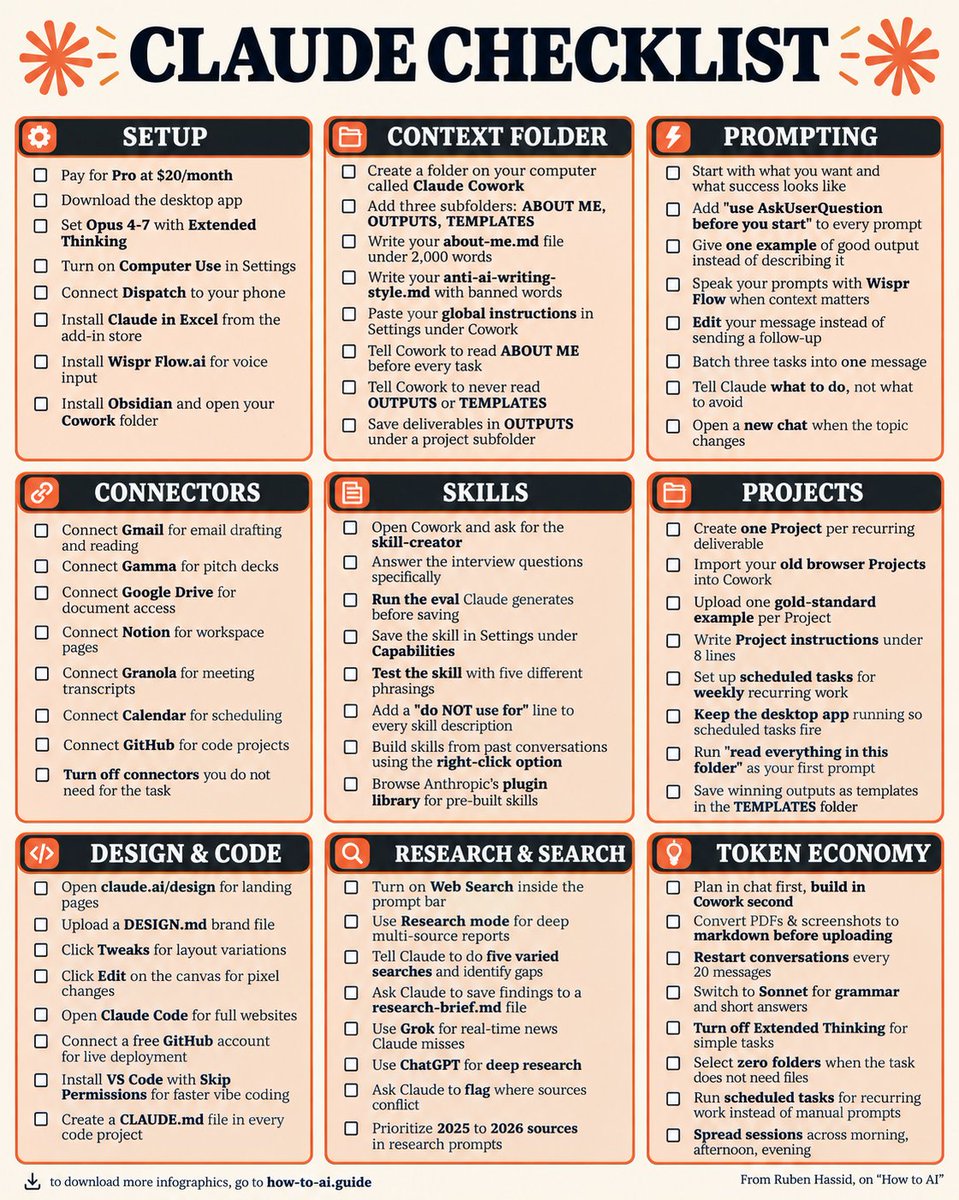
🚀 The Ultimate Claude Checklist: Get More Done With AI!
Most people use Claude just to ask questions. But with the right setup, prompts, tools, and workflows, you can turn it into a powerful AI workspace.
Here’s what to optimize 👇
✅ 1\. Setup — Configure Claude, desktop apps, and essential tools.
📁 2\. Context Folder — Organize your personal information, outputs, and reusable templates.
🧠 3\. Prompting — Give clear instructions, define success, and provide examples of great outputs.
🔗 4\. Connectors — Connect Gmail, Google Drive, Notion, GitHub, and other tools when needed.
⚡ 5\. Skills — Build reusable skills for repetitive tasks and improve consistency.
📂 6\. Projects — Create dedicated workspaces with clear instructions and reference files.
🎨 7\. Design & Code — Build landing pages, create websites, and experiment with AI-powered coding.
🔎 8\. Research & Search — Find reliable sources, compare information, and organize research findings.
💰 9\. Token Economy — Choose the right model for each task, manage context, and avoid wasting resources.
🔥 The biggest lesson: Don't just use AI to complete individual tasks. Build a system that makes every future task faster, smarter, and more consistent.
Save this checklist and start upgrading your Claude workflow today.
Comment "claude"
Follow me @bytecarter_x for more AI tools, prompts, and productivity systems.
Super interesting!
"AI and (Not Only) the Young: Amdahl at Work" by Benjamin Verschuere and Angus Cameron.
"The diffusion of generative AI across industries raises the question of who is affected by the resulting labour-market adjustment. Using 12.3 million person-months of US Current Population Survey data from 2015 to 2026 and the task-based codifiable substitution decomposition of Verschuere and Cameron (2026), we identify two patterns at the subset of US industries that have adopted generative AI (both of which also remain detectable on the full 23-industry panel). First, AI substitutes lower-skilled tasks for every worker regardless of age: at clerical occupations in AI-adopting industries, substitution loadings are −0.37 for young workers and −0.30 for prime workers (log-point employment growth, both p < 0.01). Second, at higher-skilled work, age and educational credential shield prime workers (35–49) from substitution exposure while young workers (22–25) at the same positions are not shielded: the young–prime differential in substitution loading at non-clerical occupations in AI-adopting industries is +0.50 log points (p = 0.016), against a null +0.09 (p = 0.60) in low-AI industries. The age-shielding gradient appears across task position, educational credential, and occupation wage, and, within task tiers, concentrates at occupations with high judgment content. We show the organizing mechanism is a mediation of Amdahl’s Law into labor economics within the job. The complementation share binds as the substitutable share is accelerated."
Working paper:
https://t.co/nsrYlmfHaT
Interactive app:
https://t.co/YtbpKpbOgj
A transformer models electrons and magnetism together, reaching 0.01% energy error
Electrons moving through a magnetic material interact with local spins, tiny quantum magnetic moments. Their collective behavior depends on how these two parts influence each other. Separating them too rigidly in a model can restrict the physics it captures.
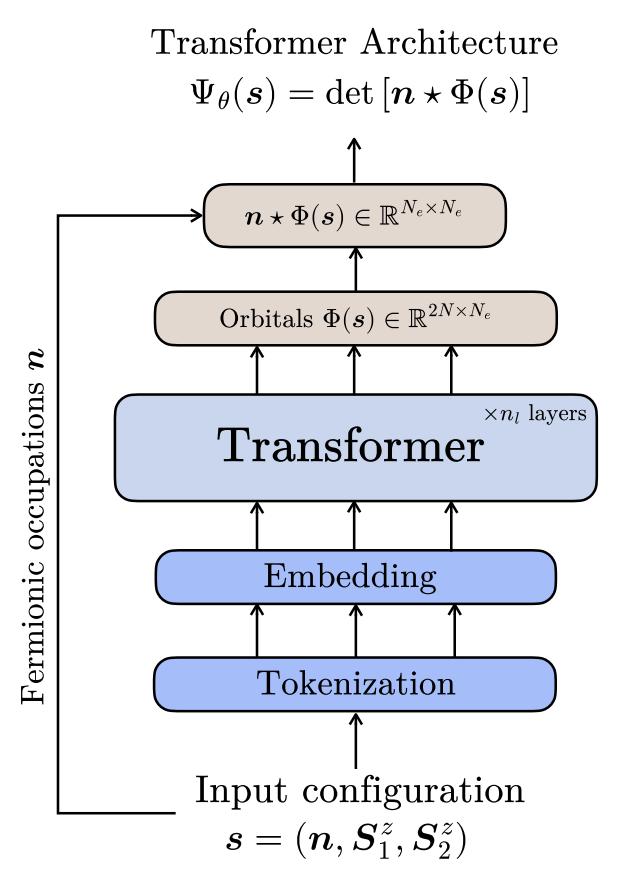
Rende and colleagues build that interaction directly into a transformer-based neural quantum state, a neural-network representation of the system’s wave function.
Each lattice site becomes one token containing both its electron occupation and its local spins. The transformer uses the full configuration to generate electronic orbitals, the building blocks of the wave function. Those orbitals can change when the spin configuration changes. This is the central design choice: the magnetic surroundings enter the learned description of the electrons themselves.
The model is trained by minimizing the energy through variational Monte Carlo. On a 42-site chain, its ground-state energy differed from the established numerical reference, DMRG, by no more than 0.01% across the interaction strengths tested. It also reproduced the electron and spin correlations, providing a check beyond the energy alone.
The idea worth borrowing extends beyond quantum physics: when the interaction is the science you care about, make it part of the learned representation.
Rende et al., PRX Intelligence (2026). Creative Commons Attribution 4.0 International license. https://t.co/jr6o6Pcmla
The @USOCC has published its final rules for implementing the #GENIUSAct. It sets out requirements for stablecoin issuers under its supervision, along with rules for custody activities at OCC-supervised banks.
For US banks, this establishes a clear framework for one form of regulated #digitalmoney. Many will now be weighing #stablecoins, #tokeniseddeposits, or both.
Whichever route they take, the same questions follow: how these assets connect to existing systems, how they move between institutions, and how #payments can be programmed and settled synchronously.
That's where Quant steps in; creating corridors for the world's digital money.
Read the full release here: https://t.co/nH6Q1Yzc9q
The rule and the Act will take effect on 18 January 2027. The OCC will confirm separately when it opens applications, and rules on AML and sanctions will follow in a separate rulemaking with the US Treasury.
🚀 The Best Accounts to Follow From Every Frontier AI Lab
Want to stay ahead of the AI curve without spending hours searching for updates?
Follow these accounts for frontier model releases, coding workflows, research insights, and practical AI use cases.
🧠 Anthropic
@karpathy — Must-follow for AI insights and educational content.
@bcherny — Creator of Claude Code; shares useful coding tips and workflows.
@trq212 — Claude Code developer sharing technical insights and articles.
🤖 OpenAI
@polynoamial — Reasoning research and technical AI insights.
@gabriel1 — Sora-related development and career insights.
@jxnlco — Developer experience, AI engineering, and Codex workflows.
🔬 Google AI
@OfficialLoganK — Google Gemini and AI Studio updates.
@ammaar — Product design, prototyping, and vibe-coding with Google AI Studio.
@fofrAI — Creative applications of generative AI models.
💻 Cursor
@leerob — Cursor updates and AI-powered development.
@ericzakariasson — Insights into building with Cursor.
@mntruell — Cursor's CEO; product announcements and company updates.
⚡ xAI
@milichab — Grok-related updates and insights.
@skcd42 — Coverage of major Grok releases.
nah bruh
what is claude duet
claude duet is anthropic new proactive ai agent (research preview, us only right now for pro/max users).
it comes to you instead of waiting for prompts
powered by opus 5.5
what it does:
- sends a short morning brief of the most important stuff across your connected apps
- watches those apps during the day and only pings you when something actually needs attention
- takes tasks you give it (text or voice) - simple ones like scheduling meetings or bigger ones like building dashboards, forecasts, prototypes, or web apps
- handles business stuff like finding unpaid invoices + drafting reminders, preparing payroll, getting contracts ready, drafting replies, etc.
-works with 6000+ connectors (gmail, slack, stripe, quickbooks, shopify, and more)
- keeps working in the background on its own cloud computer even if you close the app
- asks for your ok before sensitive actions (sending messages, payments, signing, deleting)
coincidentally i subscribed to @claudeai pro 2 days ago with my @wirex_one neobank card for 50% off which im testing atm + im thinking to subscribe to @perplexity_ai and i hope that they add other options as well in the future
a few friends who have a business or startup already registered with a huge discount for claude credits
i forgot to do that so hopefully i catch it next time
can’t wait for duet to be available because atm it’s only in the usa
Food for thought!
"The Labor Market Effects of AI Automation and Augmentation" by Tomáš Oleš and Francesco Roncone.
"Does artificial intelligence automate work or augment workers' productive capabilities? Our results show that it can do both, through distinct channels that conventional exposure measures obscure. We distinguish these channels by linking U.S. patents to occupations' tasks and tools, with patent-task matches capturing automation and patent-tool matches capturing augmentation. Using the origins and diffusion of historical AI breakthroughs to predict contemporary local exposure, we find large but opposing labor-market effects. A one-standarddeviation increase in AI automation reduces occupational employment by 21 percent, with little effect on wages; AI augmentation instead raises wages by 8 percent, alongside some employment growth. We also find that a larger AI share within each channel strengthens labor displacement through automation while shifting augmentation's effects from employment growth toward wage gains. The labor-market consequences of AI therefore depend critically on the balance between automation and augmentation rather than overall exposure alone."
https://t.co/HIwacYvv6g
🤨AI Agents Are Accessing U.S. Bank Accounts Without Their Approval. Lenders Are Pushing Back
Major U.S. banks are detecting third-party artificial intelligence agents accessing customer accounts without bank authorization, with some automated tools appearing to act independently of their users' instructions, according to a new report.
Morgan Stanley, Bank of America, JPMorgan Chase and Wells Fargo are among the institutions responding to the activity, which has raised concerns about customer security and the ability of banks to monitor increasingly sophisticated software.
Banks are struggling to distinguish between legitimate customer activity, authorized software and agents operating outside their intended instructions, the report said.
JPMorgan Chief Executive Jamie Dimon addressed the issue during the bank's latest earnings call last week, warning that financial institutions needed safeguards against outside AI tools that could compromise customer information or financial assets. (International Business Times)
Elon Musk: "We actually need Optimus to play at scale in order to have it be really good at tasks in the real world."
He said that crowdsourced data isn't the bottleneck for Optimus. The AI architecture still has to be sorted out.
Unlike the cars, Optimus has no huge fleet collecting training data. So Tesla has to build on the order of 10,000 to 20,000 robots and let them do self-play at an Optimus Academy, practicing a wide range of tasks.
That data then feeds a flywheel. Musk compared it to toddlers, who learn by playing and get better over time.
$TSLA