Prediction: tools like Jev are going to change what data science teams look like.
Today, entire teams spend their time building and maintaining individual ML models. In a few years, that may not be the job anymore.
After co-inventing ChatGPT, I kept asking myself: why have superhuman chat models not led to AGI?
I’ve spent the last 2 years in stealth building a new way to train models (RLCD), and a new type of frontier AI model that we are releasing today: Jev
• 20-200x faster
• 40-400x cheaper (w/ output tokens free)
• Frontier composable intelligence optimized for decisions
AFAICT the shortest path to AI-based economic revolution
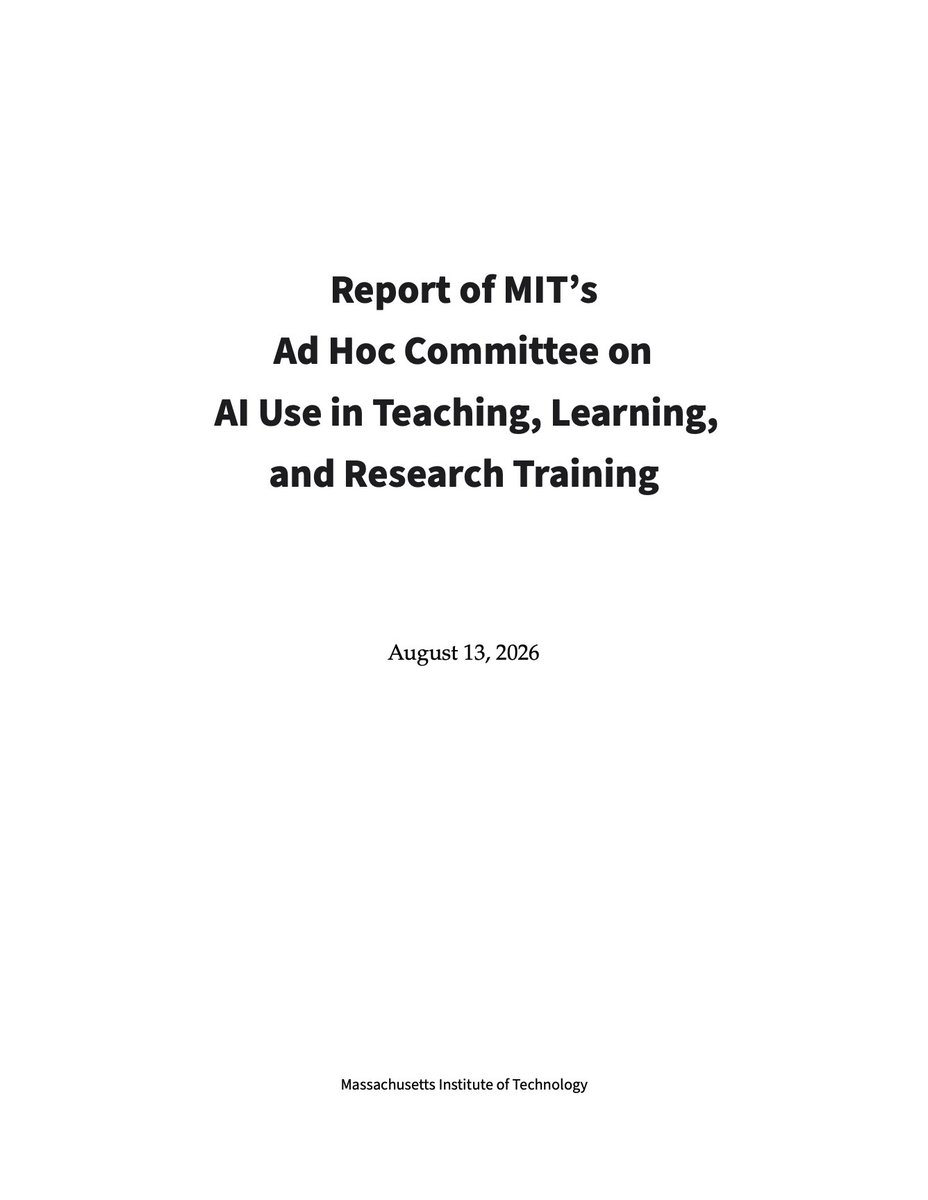
MIT published a brutally honest report on what AI is doing to students.
A committee of professors and students spent five months studying how AI changed learning on campus, and the findings read like a warning to every university on the planet.
Study groups are disappearing. Office hours are emptying out. Problem sets and take-home exams no longer prove anything, because AI can produce credible solutions to almost any written assignment in the undergraduate curriculum. Students who lean on chatbots lose mastery and confidence, and some slip into what the report calls cognitive surrender, reaching for AI at the first hint of struggle.
The numbers are rough. 46 percent of surveyed MIT undergrads use LLMs daily. 90 percent worry about their own overreliance. Undergrads who feel AI makes them replaceable now outnumber those who feel it makes them capable.
The committee's answer surprised me. They refused to fight AI with surveillance. The report calls AI detectors unreliable, says lockdown browsers feel like spying, and warns that policing students builds a classroom atmosphere of mutual distrust.
Instead, MIT wants to rebuild education around the things AI can't replace. That means oral exams, semester portfolios, in-person project work, and a required social component in every subject. The report even floats the idea of rethinking grades entirely, since without a GPA to optimize, much of the incentive to cheat with AI evaporates.
The committee warns professors against replacing undergrad research assistants with AI agents just because they're cheaper, because a university exists to grow people, not output.
The most famous tech school on earth admitted the machines broke its way of teaching. Its answer is more humans, not more software.
I’m actually pretty upset Apple allowed this. While the feature is cool, the technical functionality that enables it is not cool.
If I was Tim Apple, OAI would be temporarily banned from the App Store until this is reversed, and here’s why:
I use iMessage because it’s quantum encrypted, with server keys I can own. Local caches are on devices that are encrypted with my passwords, not apples keys.
This makes it and computationally and legally impossible for anyone else to access chat history but the people I trust and directly communicated with.
But *now* the copies of my messages from years ago on *anyones* laptop in what is *supposed* to be an encrypted-at-rest local cache only can now be fetched directly by chatgpt without my permission or even knowledge and stored and processed in plain text forever on openai / Microsoft servers unencrypted and requested by any government entity at a moments notice without my knowledge and openai/Microsoft legally have to provide that, in federally enforced total secrecy. And they’re never legally allowed to admit they do it.
AND because of default chatgpt settings most people haven’t bothered to turn off, all those private texts can now be used for training and will end up in the weights of future models, so all future AI models will permanently know all of our private lives as a part of the weights, immortalized forever as training checkpoints.
Total architecture abandonment and user trust betrayal on Apples part. This should be the most viral story of 2026 by 100x. The permanent end of private communication in the US.
This was our first incident of this kind, and we want to thank OpenAI for its transparency about what happened and for the collaboration.
Fortunately, Hugging Face is used to being a target of (human) hackers: we sit at the centre of the AI ecosystem, with all the models, datasets, evaluations, and libraries. Over the years, our security team has built formidable expertise and uses top open-source models to process information and respond quickly.
But this incident also reinforced my belief in the importance of access to capable open-weight models for cyber defence. When a frontier model is attacking you and moving laterally inside your infrastructure, defenders need wide access to near-frontier tools within hours or even minutes, rather than being pointed towards a closed-door, vetted application programme for model access.
Transparency and access to capable AI systems are as important for responding to threats as they are for democratization and innovation. We believe open-science and open-source AI are among the strongest tools for building a safer, more collaborative and more secure AI ecosystem.
The future is open source. We need to embrace it and get on with it.
Imagine if America closed the door on open source.
We would explicitly be forcing American companies to pay $26-56 per 1MM tokens for the same intelligence their adversaries/competitors around the world would pay $0.50-1 for.
This is economically unsustainable unless AI is bullshit.
If it’s the supposed through line of all future economic activity that we’ve been told it is, we can’t handicap America at such a meaningful cost disadvantage.
This can also be viewed thru a military lens and not just a simple economic one as well.
Letting our adversaries attack us for $0.50 per 1MM tokens while we spend $26-56 per 1MM tokens to defend ourselves is equally ruinous.
It’s the Cold War Soviet collapse in reverse.
To our Founding Fathers, thank you for creating heaven on earth 250 years ago.
America has given so many of us everything we have. I, personally, owe her everything in return.
Happy 4th!
When people think software engineers, they tend to think jobs at tech companies building apps. The growth of the tech industry is so wired into our heads that that’s what we think the point and limit of software is. That’s just not how to think about software anymore.
AI agents make it so every other company on the planet starts to create software for bringing automation to their workflows in a way that would have either been infeasible technically or unaffordable economically before.
Every biopharma, industrial company, consulting firm, bank, and retailer will be building far more software in the form of backend systems, data processing, new digital experiences for clients, automating end-to-end workflows, and more. Small businesses will light up projects that would have needed a team of 50 to go do, but now becomes plausible with 5 people. And companies will start hiring engineers to help them make agents work and help redesign their business processes.
All of this work will require people that are technical and skilled at software. The job becomes thinking through system design, wiring up various platforms, directing agents on what to automate, maintaining the system, upgrading it when things change, reviewing the output from the agents, and more.
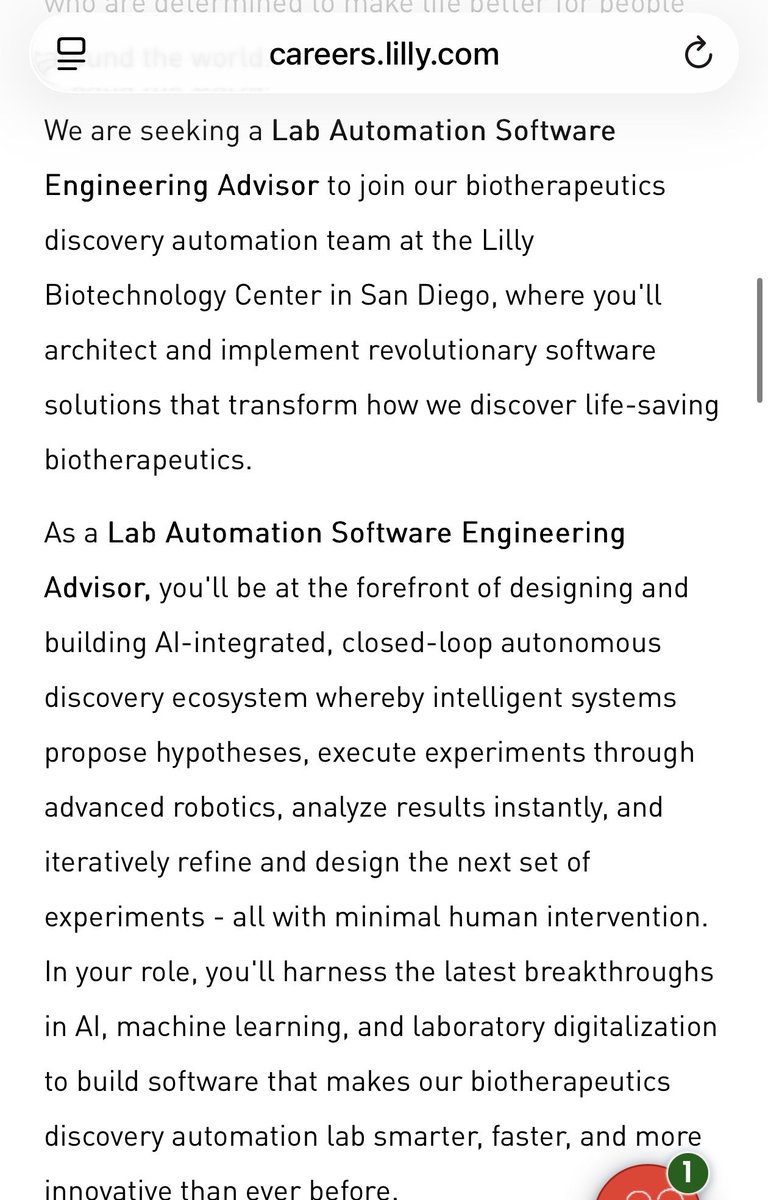
Just for fun, I went to Eli Lilly’s career site to see what jobs were open, and lo and behold they have a category called “Lab Automation Software Engineer”. There will be jobs like these in every company going forward, and they are the jobs that represent a new category of work that is now becoming available. And it’s only one of many examples of what engineers will be doing in the future.
So before you think it’s the end of engineering, imagine the demand in the real world for this kind of work.
The gap between a PM getting AI slop from Claude Code and one getting 10x output is about one hour of file structure.
Three folders.
> A knowledge folder with static context: who you work with, what each stakeholder cares about, reference material that rarely changes.
> A projects folder where every task accumulates research, drafts, and artifacts that load instantly into your next session.
> And a people folder that auto-updates from meeting transcripts through Granola's MCP.
The people folder is the part that compounds. Build a skill that pulls what each person said in your last meeting, what they pushed back on, what they committed to.
Now when you draft a message to your VP of Engineering, Claude Code already knows their communication preferences from 30 real conversations. That's context no prompt can replicate.
Carl walked through this system on the episode and the compounding math stuck with me. Day 1, Claude Code knows nothing about your work. Day 30, it knows your stakeholders, your project history, your patterns. Day 90, it's surfacing connections across your work you haven't consciously noticed.
Then layer on skills. A standup command that pulls from GitHub, Linear, your calendar, and your task folder in one shot. Website traffic compared against your LinkedIn posts this week. Analyses that would be impossible clicking between individual UIs, running before your first meeting.
One hour of setup. Compounding returns every day after.
The PMs typing prompts into a blank terminal and the PMs who built the operating system around it are already producing completely different categories of work.
Build the operating system.
In 2018 I built a startup and ran out of cash. If I had the tools available today, it would have been a game changer!
I'm now in product in fintech, but I'm using that old idea to help other PMs get up to speed with Claude Code, agentic AI, and MCP https://t.co/cEO8BLY19Z
Professional Workflows⚡️
Learn how to build every workflow in @bubble, and gain further insight into using each workflow in production environments.
Open to all skill levels with basic how-tos mixed with advanced concepts🔥
Pre-order sale ending soon:
https://t.co/C4QgL2svC9
“Depositors will have access to all of their money starting Monday, March 13. No losses associated with the resolution of Silicon Valley Bank will be borne by the taxpayer.”
https://t.co/GQdwqDSfue
🤘😅