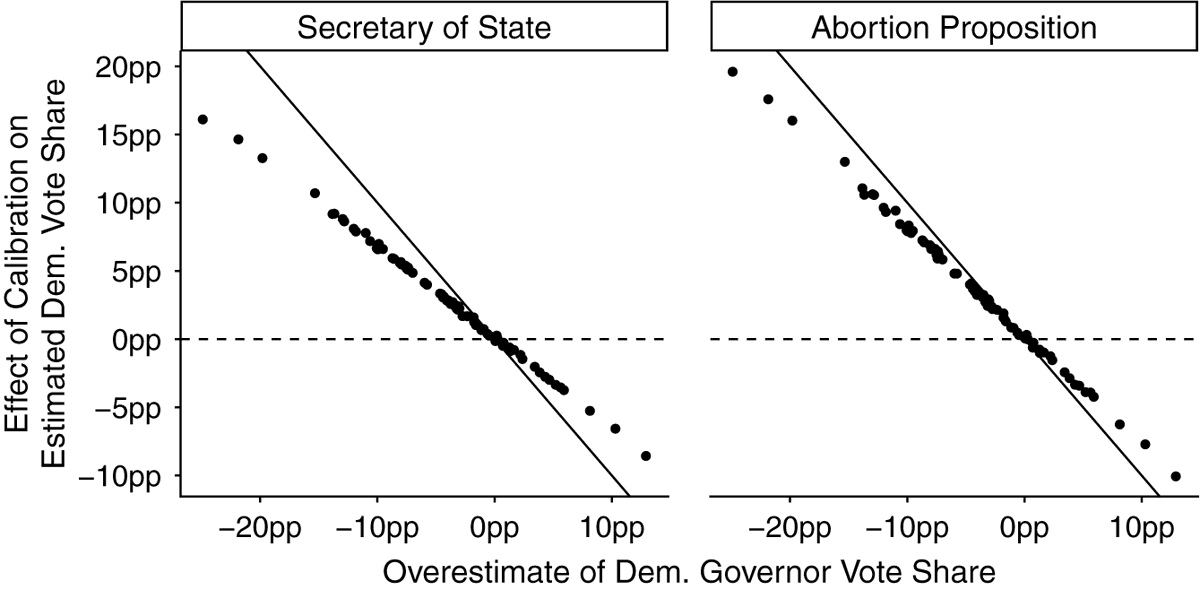
Currently in FirstView: In “Improving Small-Area Estimates of Public Opinion by Calibrating to Known Population Quantities,” @wpmarble and @joshclinton provide a framework for incorporating known population data to improve estimates of small subgroups in MRP models.
@dhopkins1776 Currently very few classes attempt to measure growth in a sincere way (e.g., some kind of pre-class test with same difficulty level as final exam).
A new release of the ANES Cumulative Data File is now available for download. Over 200 variables have been updated to include data from the 2024 Time Series. Visit the study page to download data and documentation:
https://t.co/Ax4Y5YvvfL
ANES Data Release! https://t.co/pyraGPqqyM...
The 3-wave ANES panel is now available. It merges data from 3 election studies (2016-2020-2024), the first time the ANES has collected interviews of the same respondents across 3 presidential elections.
Sharing an event that may be of interest to this community!
Rare traits like support for violence, conspiracy beliefs, and unsafe health behaviors are really hard to measure! On Thursday November 13, learn from experts about the problem and solutions.
https://t.co/QnBBTwDEkz
@jmwooldridge Unfortunately you'll also need to rewrite the slides of many statistics professors! (Please rewrite their discussion of normal errors and binary outcomes while you're at it.)
@NateSilver538 A priori adopting the same weighting method as other pollsters isn't herding 🐑, especially if the pollster has been doing it all season. It's a bad idea, but that's another story.
No defiers is a required assumption for identification of LATE in IV analysis. If that is false, the best thing you can do is to calculate bounds for the LATE.
But what happens if limit the maximum proportion of defiers. For instance, what if I don't believe is > 10%?