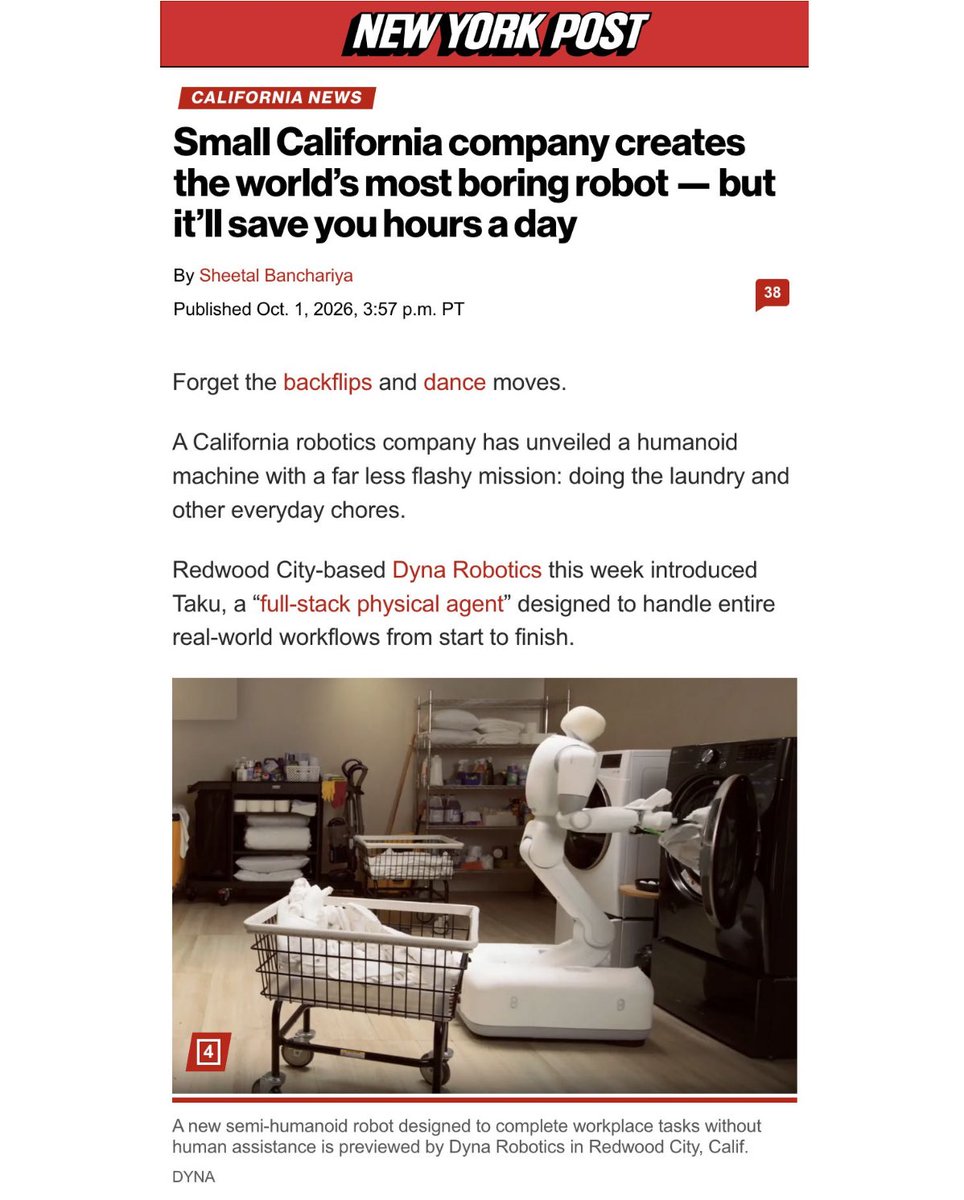
Had a lot of fun briefly visiting @JasonMa2020 at @DynaRobotics on the way back to the airport. Super impressed and got to meet Taku (it works! Its real!)
The best robotics demo is a reorder.
@DynaRobotics says Din Tai Fung signed a bigger contract after deploying napkin-folding robots across locations.
Show me sites live, repeat orders and margins after support.
Pilot count is messaging market fit.
Growing the total number of robots deployed at the individual location level and the total number of locations is product-market-fit.
Good work by Dyna.
When the New York Post calls your robot “the world’s most boring robot”, you know you are doing something right. 😭😂
This is actually the highest praise ever: when robots actually work, they are supposed to be boring, just calmly and reliably getting the job done.
Robots are still in their chatbot era: each does one task, then waits for a person to set up the next.
In LLMs, the big leap was from chatbot to agent.
Robots are next.
Dyna-2.1 is our first physical agent. It doesn't work turn by turn; it runs the whole laundry room.
We are releasing Dyna-2.1, the first Physical Agent that achieves reliable super long-horizon whole-body autonomy. It combines our brand-new semi-humanoid hardware with an agentic system built around Dyna-2 to handle ultra-long real-world workflows.
Here is an uncut footage of Dyna-2.1 completing an entire hour-long laundry room workflow, just like a human does.
OpenAI's Head of Applied Research predicts a shortage of robot parts like the graphics-card crunch as GPT-6 crushes robotics benchmarks and bodies are good enough
"I think with GPT-6, we've seen that the models are now just crushing a bunch of benchmarks in the robotics space, and I think that's only the beginning. I think we've seen that with demos, and I think now we're starting to see some of the benchmarks come out."
"My sense is you might be able to use GPT-6 as a training model and then use whatever efficient architecture you actually want, so that you can serve things super fast. But training data has, for the longest time, been the biggest problem of robotics."
"And also, it seems like robot bodies are good enough. I think we've seen both the Olympics and also kind of human-operated robots are able to do a lot."
"So if brain is truly the only problem, and we see exponential improvement in top-line capabilities, maybe Astra is too slow to solve all those problems, but once we have that, it can be infinitely scaled to all the specialized use cases, and then you can just distill that into a small, tiny model that's going to be served."
"So I would really suspect there to be a huge boom in physical AGI, and we'll probably have a shortage of robot parts, the same thing that happened with the whole supply chain with graphics cards, I would expect to happen with robotics."
_______
Link and for more comments from the Head of Applied Research at OpenAI, Boris Power: https://t.co/sPGnq5U2Uj
@stash_pomichter@dimensionalos@lesh_bla Interesting. Curious what "infinite" mean in "infinite procedural generated scenes". Does it just mean a lot, however many you want, or, do you actually use infinite scenes?
3 weeks in, this blog is the least technically or academically interesting, yet it's the one that matters most: people.
We're building intelligence that's useful to people, and robots that the general public understands and wants.
Read the full blog to see why customers love Dyna robots: https://t.co/t8soOZzG3u
And we are hiring!
After so many demos, models, pilots, robots are still struggling to land real deployments with real customers. Until now.
Today we’re excited to share that our robots have successfully crossed the ROI threshold, and Din Tai Fung, one of the highest revenue per location restaurant chain in the US, is rolling out Dyna robots across its extensive restaurant network.
This brings our rollouts across hotels, logistics, data centers, and many other use cases to a fleet that reaches hundreds of robots by the first half of 2027. And we’re just getting started.
It’s been a wild year, and today we’re double clicking on the battlefield stories and sharing a few learnings about scaling robot deployments. We are just scratching the surface.
Read the full blog post: https://t.co/8QVEoQuzBY
Many Thursdays ago, I got this text:
“Understand u guys r quite tied up with existing deployments, but when can we get our next batch of robots?”
I read it three times.
Anyone who has built something from 0 to 1 knows the feeling. For months, you’re pushing a boulder uphill. You don’t know if there’s a top. Then one day, almost quietly, you feel the boulder start rolling on its own. The question had changed from “does this work?” to “when can we get more?”
We found our fit.
The path there was not obvious. For a long time, the question I got most about Dyna was: are you a model company or a deployment company?
What I rarely admitted was that I wasn’t entirely sure either.
We knew what we were doing, but it felt like we were swimming against the tide because investors kept pushing us to pick a lane. The cleaner path was to just build the brain. It was a story with no revenue pressure, software-like scalability, better multiples, and less messiness. But the real world is brittle, and robots are not LLMs. So we kept coming back to what we were actually here to build.
The answer wasn’t another breakthrough model. And it wasn’t more unscalable deployments. It was a robot people wanted.
It took us a while to realize there was a third path. Frontier research makes the product possible. Deployment teaches us what the research needs to solve next. Each makes the other better. Both are necessary to build a PRODUCT people want. After all, isn’t that why we’re building robots in the first place?
We are Dyna. A product company that turns frontier intelligence into real-world impact.
There’s still more to come.
I'm glad to see that what I helped build in 2025 is now just a tiny starting point for the scale described in this blog. From ingestion and annotations to curation and feeding the GPU, every part of the system has grown by orders of magnitude. Our 🐐 team has built so much while I've been heads-down on robot software. Huge kudos to @YorkYang5050@ZhipengYan7
Read our full technical blog for details: https://t.co/0vsfA0nbyk
Our ingestion pipeline was once capped at 14,000 episode-hours per week — at that rate, a million hours would have taken over a year. We rewrote it around DAG decomposition, staggered starts, and bin-packed batches:
• throughput scaled 14,000 → 440,000 episode-hours/week, a 31x improvement
• one million hours now processes in under three weeks, down from ~16 months
Anyone who’s worked in robotics will agree infrastructure is what enables research and deployment. It’s the true cornerstone. I’m glad that at Dyna, we put infrastructure in the spotlight, and we appreciate the people who build it!!
When people talk about robotics, they usually talk about models, data, or hardware. Few people talk about the infrastructure that lets you iterate on all three quickly. Today we're publishing how we trained Dyna-2 on over 1,000,000 hours of egocentric video, repeatably. At this scale, most of what worked at ten thousand hours did not hold up:
• ingestion throughput was capped at 14,000 episode-hours per week — a million hours would have taken over a year
• building a training manifest took 48 hours before a run could even start
• reading a petabyte from cloud storage during training left GPUs exposed to latency and packet loss
🧵
Jason Ma reveals the first true scaling law in robotics: robots trained on 1 million hours of first-person human video predictably get better without ever seeing robot data
"Yesterday we announced our new flagship robot foundation model called Dyna-2. It's very significant for the entire field for many different reasons. First of all, it's the first robot foundation model trained on at least one million hours of data. That in itself is a very challenging infrastructure challenge."
"What we demonstrated is that even if the one million hours of data is entirely first-person video of humans doing manipulation tasks, we actually see scaling law for transferring to robot embodiments that the model has never seen before."
"By training on more human data, we actually see predictable performance improvement on robots. That's a big deal because the biggest challenge facing robot foundation models is that we don't have enough data."
"Unlike language models, there are just not enough robotics data out there, and it's very difficult to collect these robot data. Only by passively observing humans doing things can we scale this kind of data, and this is the first time we showed there is a lot of improvement that can transfer."
@JasonMa2020@DynaRobotics