Zero-shot antibody design in a 24-well plate @chaidiscovery
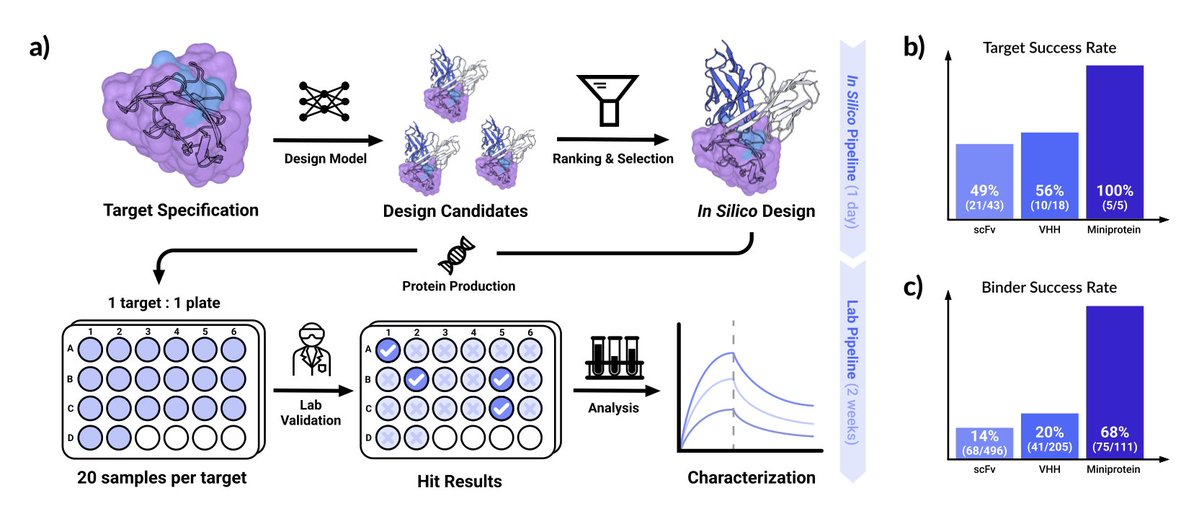
1. Researchers have introduced Chai-2, a multimodal generative model that marks a significant leap in de novo antibody and miniprotein design. This platform achieves an impressive 16% hit rate in de novo antibody design, which represents over a 100-fold improvement compared to previous computational methods.
2. Chai-2 also demonstrates a 68% wet-lab success rate in miniprotein design, consistently yielding picomolar binders. This high success rate enables rapid experimental validation and characterization of novel antibodies within two weeks, accelerating the drug discovery timeline.
3. The model was prompted to design up to 20 antibodies or nanobodies for 52 diverse targets, none of which had pre-existing binders in the Protein Data Bank. Remarkably, at least one successful hit was found for 50% of these targets in just a single round of experimental testing, often with strong affinities and favorable drug-like profiles.
4. Chai-2 facilitates a complete workflow from AI design to wet-lab validation in under two weeks, enabling discovery in a single 24-well plate. This drastically reduces experimental timelines from months or years to just weeks, tightening the design-validation feedback loop.
5. A key innovation of Chai-2 is its ability to perform "zero-shot" design, generating candidate binders for any specified binding site with just a few residues and without requiring a known starting binder. It can also generate sequences in various modalities, including scFv antibodies, VHH domains, or minibinders.
6. The platform successfully designed the first computationally designed hit against TNFα, a challenging target previously considered intractable for computational protein design due to its highly flat and polar binding site.
7. The designed antibodies are novel and diverse, confirmed by structural and sequence analysis, and exhibit favorable developability profiles. Chai-2 also allows for the optimization of designs for specific therapeutic requirements, such as species cross-reactivity.
📜Paper: https://t.co/dzaHOyEtpk
#AntibodyDesign #ProteinDesign #AIDrugDiscovery #ComputationalBiology #Biologics #Chai2 #DeNovoDesign #DrugDiscovery
It's been a privilege work alongside the most uniquely talented group of individuals I've ever encountered on this breakthrough result
@Kevin_E_Wu, @_nathanrollins, @j_boitreaud, @danny_nkjg, @jackdent , @joshim5, @ZhuoranQ and others. You all made this possible!
@PierreGlaser@AlanNawzadAmin@AlissaHummer@deboramarks Cool idea! I wonder, could ACMMD be adapted as a loss function to train an inverse-folding model? What properties would a model with higher ACMMD have, e.g. when designing a sequence for a new 3D fold, or recommending mutations to an existing sequence+3D fold?
Want to catch up with the rapid progress in ML for functional protein design? Not sure where to start?
Check out our review in Nature Biotech! #ProteinDesign#NatureBiotechnology#Cover
New microscopy technology enables nanoscale imaging of centimetre-scale tissues, making it possible to image the entire expanded mouse brain at cellular and subcellular resolution. #ReviewedPreprint https://t.co/7D3JyPGvWo
New preprint out!
Babies are born to breastfeed.
While 50% of lactating persons struggle to make enough milk, there are no FDA-approved drugs to enhance lactation.
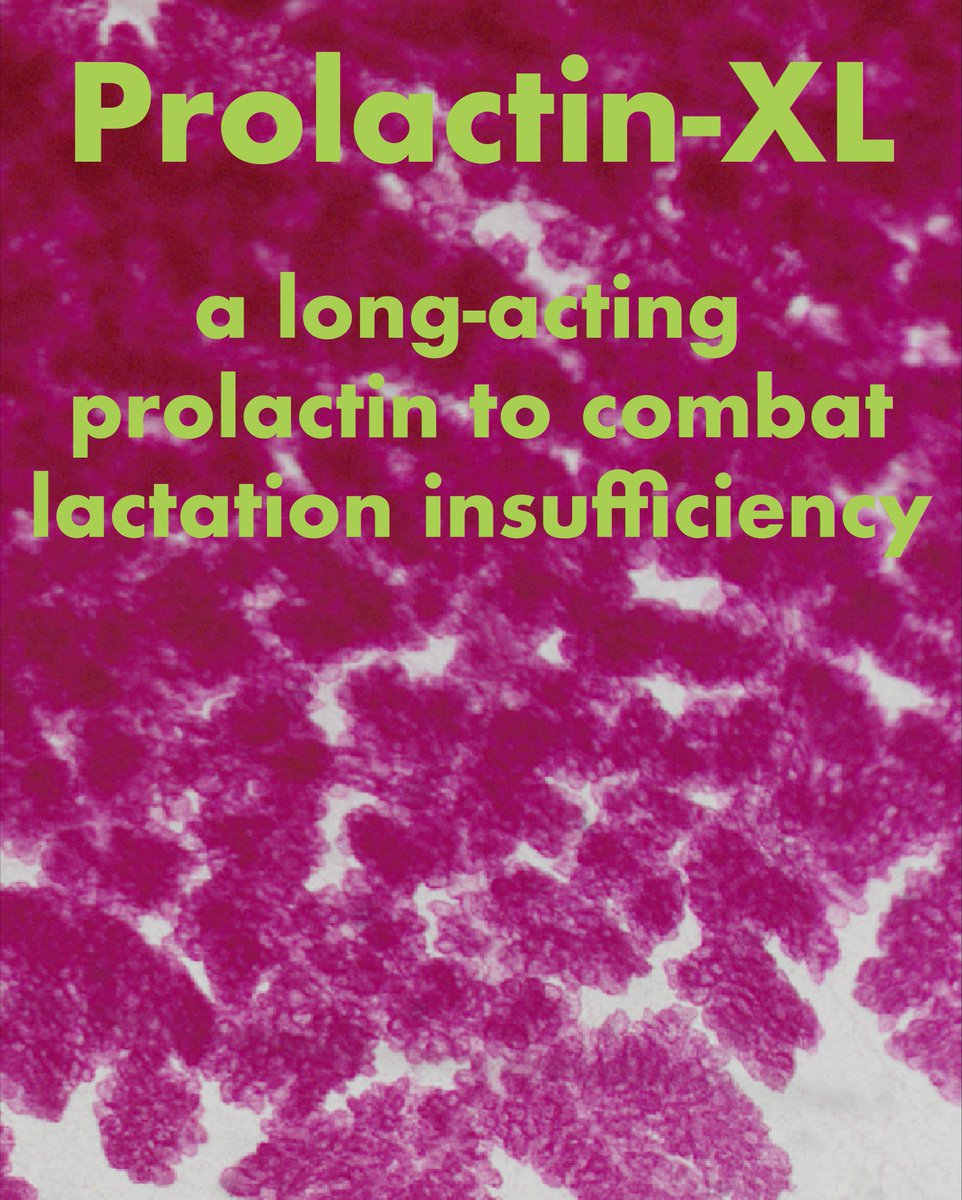
We engineered a long-acting prolactin, Prolactin-XL,
to enhance milk production.
https://t.co/qv2D2NoU6u
1/14
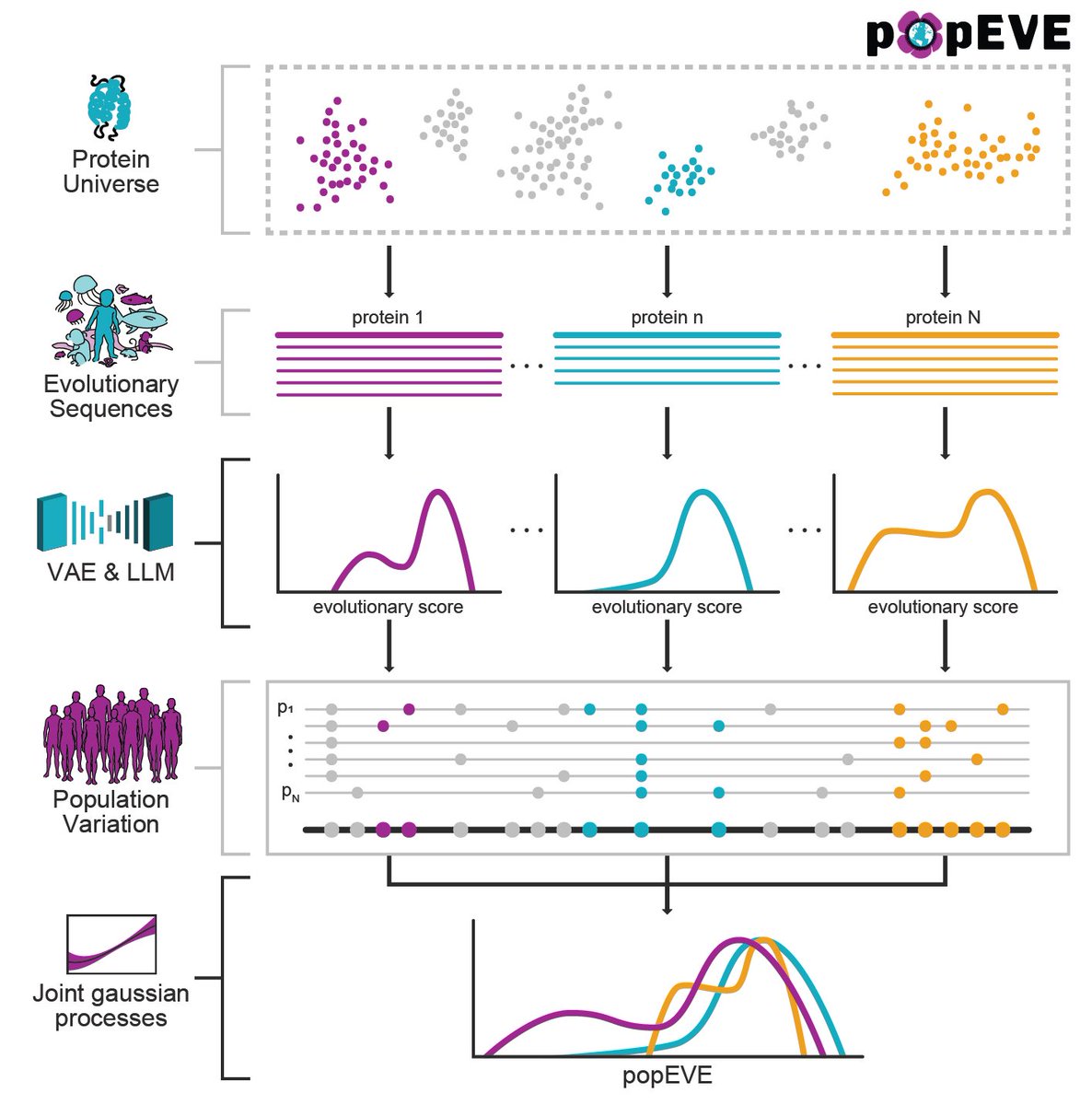
Announcing popEVE - a deep generative model of the human proteome that reveal over a hundred novel genes involved in rare genetic disorders https://t.co/WjtLLbwhle @Jonnygfrazer@aaronkollasch @H__Spinner @c_sheare@MafaldaFigDias@deboramarks
explore at https://t.co/ls3uShlt1a
Excited to debut our work: ML methods that accelerate the development of proteins of interest into full-fledged therapeutics. By making proteins safer, faster, we hope to expand the space of therapies in the clinic!
We're looking forward to presenting preclinical data describing the application of our IMPACT platform at PEGS Boston 2023 #PEGS23 next week, the world’s largest gathering of protein engineering and biotherapeutics experts. #WeAreSesimic
https://t.co/NyQA3C3b4T
@StuntedDwarf I believe if you do this you may invent the ultimate joke, tragedy, fighting words, pickup line, or textual eldritch horror. This has been done for monkeys with images.
https://t.co/XGtXiPZjWT
But if we show all the gene knockouts ordered by genomic position, a curious pattern emerges: CRISPR knockouts look more similar to KOs on the same chrom. arm than to KOs on other arms –producing a striking image of a genome-wide CRISPR map in which genome structure is obvious!
The author recommends some charities with data-supported high impact:
https://t.co/JFYXjNRpVY
..a stand-out to me, just $100 de-WORMS 100 children! removes these things! https://t.co/TuvNxKwbIZ
Until recent history, ~50% of children used to die before 5 years old. With modern understanding of sanitation, nutrition, and vaccination, that number is down to 4%.
(1) What a pitch for studying biology and medicine!
(2) We can and must lower that number!
In wealthy countries with sanitary childbirthing, nutrition, vaccination, child mortality is 1/50th that in poor countries.
Our World in Data shows that low income is massively correlated with high child mortality:
https://t.co/MO9dKPFC9B
Our new paper is out in @nchembio where we describe our journey from a #covalent fragment screen to an in vivo active Pin1 inhibitor. https://t.co/DKdvmjYJ6f
Below is a musical abstract guest-starring @UriAlonWeizmann and a tweetorial 1/n
By sequencing bat viruses, we could have spotted SARS-CoV-2 predecessors decades before the outbreak. Now 500,000+ SARS-CoV-2 genomes have been sequenced, sampled from humans. We also need that thorough sequencing applied to disease vectors like bats!
Analyzing Coronavirus genomes, Boni et al predict that the viruses that became SARS-CoV-2 branched off from those that became SARS-CoV-1 likely in the middle ages.. and SARS-CoV-2 branched from the nearest bat coronavirus likely 50 years ago.
https://t.co/jpNyfhDS3g
Keeping that in mind- SARS-CoV-2 didn't evolve rapidly out of the blue, instead very similar Coronaviruses to SARS-CoV-2 have been gradually evolving for centuries.