Elevated synaptic PKA activity and abnormal striatal dopamine signaling in Akap11 mutant mice, a genetic model of schizophrenia and ... https://t.co/n7CkEZdYZ0 #biorxiv_neursci
Akap11 mutations greatly increase risk for #bipolar disorder and #schizophrenia. Not much was known about this gene when we started. Here’s what we learned!
https://t.co/nCeX4r8ucA
Thanks to Morgan Sheng, @ajgrange, Yang Ge, Borislav Dejanovic & crew @broadinstitute
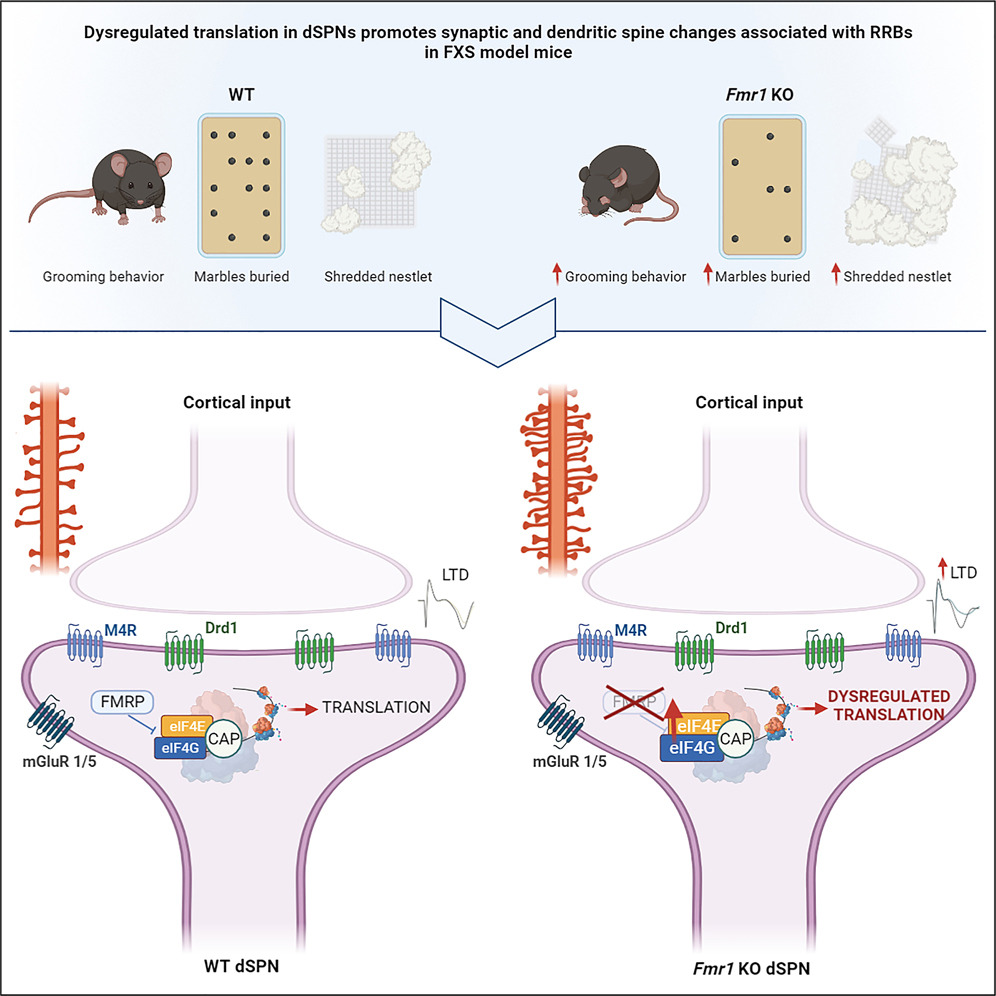
Excited to share that our paper on cell-type specific changes in the striatal medium spiny neurons underlying the expression of RRBs in FXS mice is finally online @CellReports. Thanks to team members from @KlannLab, @CarterAG, @NicTritsch, and @BagniLab for their contribution!1/6
Nat Biotech recently published a provocative study claiming single synapse RNA-seq. Unfortunately, there is no evidence demonstrating droplet-based sequencing of single synaptosomes. They are likely studying random pieces of cellular debris. Our reply:
https://t.co/QyXql1AXt2
🧵4/4
@_sameeraryal shows shared molecular changes in schizophrenia and bipolar disorder, offering new possibilities for understanding and treating these disorders!#MentalHealth#Schizophrenia#BipolarDisorder 🧠💡
👉 https://t.co/MLRzdvUSQU
A deep, unbiased analysis of synapse proteins in brain tissue from individuals with schizophrenia, those with bipolar disorder, and unaffected individuals uncovers molecular evidence that these disorders have more in common than previously thought. https://t.co/xaYVcXsewF
We carried out proteomics of synaptic fractions purified from the DLPFC of humans with schizophrenia and bipolar disorder. We found multiple interesting changes, some of which were also seen in mice lacking Akap11, a shared risk gene for both diseases. Happy to share the work!
Deep proteomics identifies shared molecular pathway alterations in synapses of patients with schizophrenia and bipolar disorder and mouse model https://t.co/4kQI0r375w
@Mauricio_Neuro For biochemical enrichment from brain tissue, the approach described by El Fatimy (2016) and Aschrafi (2005) may be useful. See https://t.co/FDAS1o7ysW
Happy to share two recent studies I contributed to. The first led by @fran_longo17 found that cell-type-specific disruption of cortico-striatal circuitry drives repetitive patterns of behavior in fragile X syndrome model mice.
Excited to share our last work from @KlannLab where we unveiled cell-type specific changes in the striatal medium spiny neurons underlying the expression of RRBs in FXS mice! A great collaboration with @CarterAG, @NicTritsch, and @BagniClaudia labs! 1/5