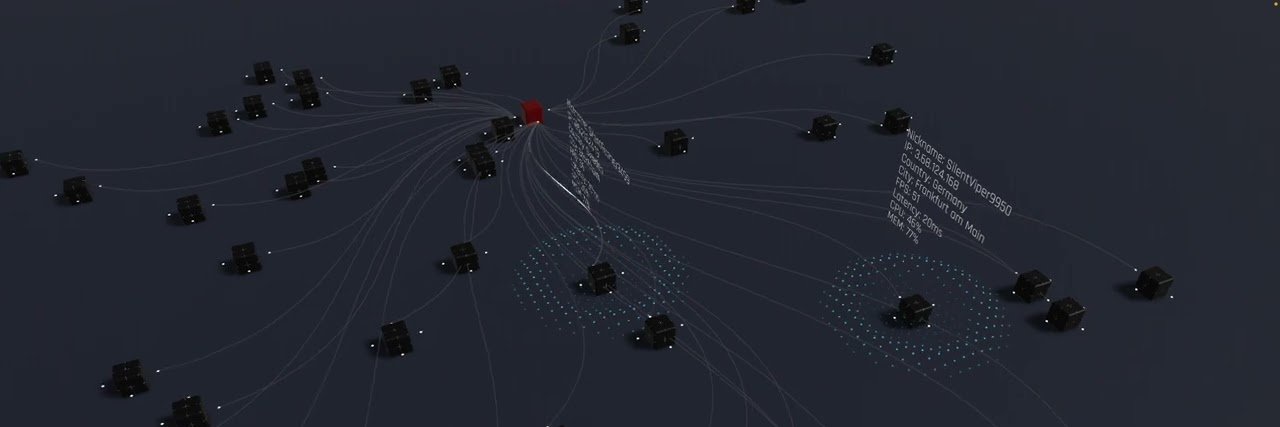
More experiments around Sentinel.
This time connections between servers and clients are straight lines, one per each traffic direction.
When you select a node, all it's network connections get a bandwidth graph.
The graph data specifically if fake for now as i'm not sure I will keep this.
Overall what I'm trying to do with Sentinel is to re-imagine observability/monitoring in an unconventional way.
"1 real PC buys you like 10+ years of cloud gaming..." yea, you can do so much more with 1 real PC compared to a subscription service. you can technically use that 1 PC to make 10x more money (recurrently) than you spent on that PC. you can't do that with a subscription to a gaming service. apples to oranges
@rsms I guess the 8.3 ms from the command buffer is actually 120fps vsync. Right? How would it look like without v-sync? (In a web browser it’s mostly likely not possible to displayable vsync since you don’t control the window)
@dhh In Sweden, school class photos are not a thing due to "privacy" concerns but you can know every single detail of every single person living in the country including income/financial and criminal records.
Moving from C# to a Rust based extension in Godot to crunch data feels almost the same as moving from gdscript to C#. The major inconvenience is having to reload the project to take advantage of new changes on the extension side.
This is a 2048*128*2048 (~0.5 billion voxels) terrain patch generated in ~8 seconds. Generation is split across 8 threads, each thread generates a separate terrain slice along the Z axis, chunk by chunk. There are 3 noise samples: 2d for base heightmap, a 3D sample to generate overhanging terrain structures (you can't really see that in this video since it was toned down) and another 3D sample to generate caves inside the terrain.
#gamedev #rust #godot
I like switching between projects in my spare time so here is a sneak peek into a voxel sandbox I’ve been building in parallel to other things with @godotengine. Currently toying with destruction altough there is 0 purpose to it other than looking cool :)
The terrain is a series of 32^3 voxel chunks, each chunk is 1 greedy mesh. When the projectile collides with any of the chunks a spatial query retrieves affected voxels, re-meshes the affected chunk(s) and extracts the debris as individual meshes with their own colliders.
#gamedev #voxel