May 18, 2026:
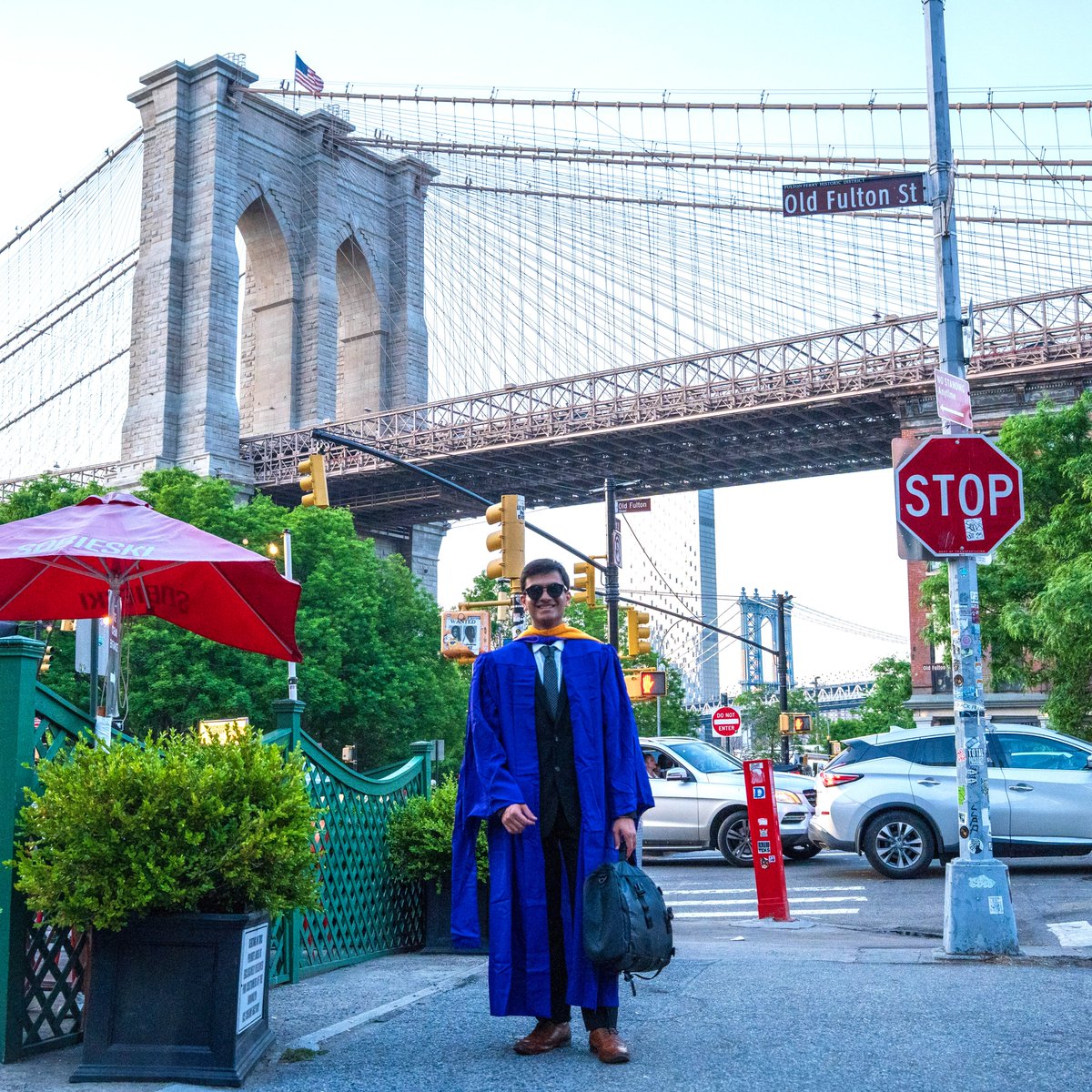
I graduated NYU with a Master's in Management of Technology, and it has been the best two years of my life so far. Here's how I made the most of it in the last 20 months as an international student:
1/ Coursework: Focused all my electives on product management through courses including Design Strategy, Product Design Studio, Design Innovation with AI & ML, and Entrepreneurship across all 4 semesters.
2/ Internship: Built on my undergrad technical understanding and extensive experience in content marketing to break into product marketing as @RiversidedotFM's first-ever intern, a tool I had used for 3 years to create content, going from power user to working on their team, as a stepping stone toward product management.
3/ Product Management Club at NYU (NYUPMC): Became the first grad student in the club, starting as Graduate Representative and working my way up to Vice President. Immersed myself in NYU's undergrad culture, hosted 7 PM panels at NYU Tandon, met some of the smartest people I know, and learned so much about PM. The best part of it all!
4/ Product Management Bootcamp: Co-founded NYU's PM Bootcamp, ran 2 cohorts of 20 students selected from 80+ applicants, hosting 17 sessions with 15+ PMs from Stripe, Goldman Sachs, Meta, Microsoft, and others, teaching PM fundamentals through a project-based approach. Built a PM culture at NYU Tandon from the ground up.
5/ On-Campus Job: Managed my living expenses in New York entirely by myself from day one. Worked with the NYU Tandon CSE department across all 4 semesters to organize 12 large-scale exams for 1,000+ students, coordinating with 20+ professors.
6/ New York: Attended dozens of tech events and conferences, cold emailed and met founders, investors, and PMs, and built genuine relationships across the tech industry in the city. Found invaluable mentors and advisors throughout the process: @SahilBloom, @andruyeung, @pratik_ratadiya, @lennysan, @AmeyaShanbhag, @charlesodeiiii, @shauryaset, and so many others who gave their time generously and helped me grow.
7/ Giving Back: Built a YouTube playlist documenting my grad school application process, scaling it to 55K+ views and 1.4K subscribers. Had coffee chats with 80+ incoming grad students (completely free of cost) to help them navigate their process.
Signing off @nyuniversity! Grateful to my family, friends, mentors, professors, and of course NYU and New York City. Super excited for what's ahead! :)
growing up, our definition of 'intelligence' was very narrow: someone who can grasp and retain concepts well in class and perform well in exams. that's it, they were called intelligent.
as i've progressed in life and met genuinely 'intelligent' people, that definition has become much wider, expanded below:
the ability to be open to change, learning and unlearning new things, is intelligence. adaptability, the ability to recalibrate yourself quickly according to circumstance, is also intelligence. the ability to create a resource from scratch is intelligence. the ability to spot and make use of existing resources around you is also intelligence. the ability to identify and fully lean into your innate talents and unfair advantages is intelligence. the ability of knowing what to want and what to not want, and what to work hard on, is intelligence. the ability to figure out whom to work with, and create access to them by raising your bar of work, is intelligence. the ability to read people, and manage your own emotions, is intelligence. knowing when to act, when to wait, and when to pivot, is intelligence. the ability to take something complex and make it simple and legible to others, is intelligence. knowing how to get to the outcome you desire, in the short and long term, is intelligence.
intelligence isn't just about how theoretically smart you are. it's about how well you navigate the world, people, resources, and yourself, to get to where you want to go.
may to july 2026, the gap between graduation and my full-time start date at goldman sachs. here's how i spent it:
1/ started by meeting every product manager, founder, professor, nyupmc alumni and e-board, and my nyu batchmates in my network 1-1, the ones who've watched my work over the last two years, seeking their perspective on how to approach work and goal-setting in the next phase.
2/ traveled across upstate new york (beacon, albany, wilmington), washington dc, virginia, shenandoah national park, and edison nj, with a full nyc tour to three friends visiting the city for the first time (my favorite thing to do that makes me fall in love with the city all over again!)
3/ activities: hiking, kayaking, indoor rock climbing, and biking across the city.
4/ sat in on some incredible spaces: datadog hq in nyc, capital one hq in mclean, amazon in arlington, and the datadog dash conference.
5/ kept mentoring 3-4 students every week on grad school applications, pm interview prep, and job searches, something i want to keep doing regardless of how busy work gets.
6/ reconnected with friends and family over calls, the people who've been there through all of it.
7/ documented everything: every insight, thought process, and essay across product, gtm, and content, on x and linkedin. cleared my mind completely so new information has room to come in.
a deliberate balance of work, relationships, travel, and rest before the next chapter begins!
Career update:
After graduating NYU in May 2026, I'm joining Goldman Sachs at their global headquarters in New York on their Asset & Wealth Management team as a Product Manager on Monday, Jul 27.
nolan literally teleports you into a completely different world for the 3 hours of the movie, where you literally live as odysseus throughout his journey. insanely beautiful non-linear storytelling as you discover new layers of the character that slowly grows on you.
when the movie ends, you're left with teary eyes but a broad, ear-to-ear smile on your face, biking your way back home in nyc at 5am, while the grandeur of the film and those specific, beautiful scenes that carry it keep flashing before your eyes. you're still in the movie, but you're also back to your normal life.
the theater was packed at 2am on the opening weekend. cinemas are so back, and life is beautiful.
nolan literally teleports you into a completely different world for the 3 hours of the movie, where you literally live as odysseus throughout his journey. insanely beautiful non-linear storytelling as you discover new layers of the character that slowly grows on you.
when the movie ends, you're left with teary eyes but a broad, ear-to-ear smile on your face, biking your way back home in nyc at 5am, while the grandeur of the film and those specific, beautiful scenes that carry it keep flashing before your eyes. you're still in the movie, but you're also back to your normal life.
the theater was packed at 2am on the opening weekend. cinemas are so back, and life is beautiful.
nolan literally teleports you into a completely different world for the 3 hours of the movie, where you literally live as odysseus throughout his journey. insanely beautiful non-linear storytelling as you discover new layers of the character that slowly grows on you.
when the movie ends, you're left with teary eyes but a broad, ear-to-ear smile on your face, biking your way back home in nyc at 5am, while the grandeur of the film and those specific, beautiful scenes that carry it keep flashing before your eyes. you're still in the movie, but you're also back to your normal life.
the theater was packed at 2am on the opening weekend. cinemas are so back, and life is beautiful.
in a recent interview, christopher nolan was asked, "do you know how good you are at making films?" he gave a really interesting answer that made me want to study him more and write about it.
1/ his confidence comes from understanding the process: as he puts it, he enjoys "knowing how to do that process": knowing how to begin, how to solve problems, and trusting that even the hardest challenges are eventually solvable.
2/ experience compounds: every film adds to what he calls a "body of knowledge," and that accumulated experience becomes the foundation for everything that comes next.
3/ real mastery means deliberately creating problems you don't yet know how to solve: "with the odyssey, we certainly wanted to try and challenge ourselves, we set ourselves a lot of problems that we didn't know how to do, but you bring in a base level of knowledge and then you try and push it a bit further." learn, get comfortable, then make yourself uncomfortable again on purpose.
4/ he never describes himself as an individual genius: he keeps coming back to "my collaborators", the people he's made films with for years. together, they've solved enough problems that they trust themselves to solve the next one. their shared experience is the asset.
tl;dr: mastery is the continuous process of accumulating knowledge, solving increasingly difficult problems, and expanding the boundaries of what you know how to do alongside the best people around you.
nolan has been an inspiration to me for so many years, and i cannot wait to watch the odyssey on opening night at 2am at times square.
"@naval said this thing like, 'It's really hard to build a restaurant that's really successful. It's also really hard to build a billion-dollar unicorn.' They're both going to be 80-hour weeks."
@alexhormozi on his advice for young people:
I think there are two types of optimism:
1. Passive Optimism
2. Active Optimism
Passive Optimism is exclusively about belief. The belief that things will work out. Blind faith.
Active Optimism is about belief that begets action. The belief that things will work out, and the action to make sure they do. Earned faith.
Passive Optimism fails for the same reason Pessimism does. Because it doesn’t move. The passive optimist does nothing because he thinks he doesn’t have to.
And the reality is that Passive Optimism can often masquerade as patience, faith, or even wisdom. It’s the career path that will sort itself out. It’s the relationship struggle that will surely disappear with time. It’s the health issue that will eventually go away.
Belief is great. Faith is great. But without appropriate action, they are a recipe for long-term disappointment.
A mentor once told me this:
Always assume things will work out, then do the work to make it true.
That combination creates a quiet confidence that allows you to tolerate uncertainty better than anything else.
It’s a mindset of Active Optimism. Belief and action.
"The ideal life would be one where you had a hobby that as a byproduct made you money, you had a hobby that as a byproduct kept you healthy, you had a hobby that as a byproduct made you smarter and more creative."
@naval
In my early 20s, I wrote a list of ambitious things I wanted to do in life. Go bungee jumping. Create a movie. Start a business. That sort of thing. I did a few of them, but not most.
Looking back, however, that list was incredibly valuable because it taught me the usefulness of chasing bold ideas—even if they never materialize. The dreams that didn't happen changed shape and led me down other interesting paths.
The important thing isn't to achieve all your dreams, but to keep dreaming. Your desires change as you learn and grow. Old dreams will spawn new dreams. And eventually, one of these newer, more refined visions will find its moment and become reality.
Finish something. Anything. Stop researching, planning, and preparing to do the work and just do the work. It doesn’t matter how good or how bad it is. You don’t need to set the world on fire with your first try. You just need to prove to yourself that you have what it takes to produce something.
There are no artists, athletes, entrepreneurs, or scientists who became great by half-finishing their work. Stop debating what you should make and just make something.