Today @GoogleDeepMind and @GoogleResearch are introducing WeatherNext 2, our most advanced and efficient forecasting model. WeatherNext 2 can generate forecasts 8x faster and provide hundreds of possible weather outcomes for more accurate forecasts.
WeatherNext has made the leap from the lab to reality, with technology now powering forecasts in popular Google products like Search, Gemini, Pixel Weather, and Maps Platform. The forecasts are also available across Cloud.
A hearty shout-out to colleagues pushing the frontier.
A sequel better than the original!
@GoogleDeepMind & @GoogleResearch are introducing WeatherNext 2, an advanced AI-based 15-day weather forecast. Our new model novelly produces ensembles to give users a fuller and more accurate picture.
https://t.co/wH6WAEC3Ww
Seeing Earth AI come to life feels 'full circle'. 20 years ago, I received a small NASA grant for EarthTutor, to use AI to bring satellite data to the public. While EarthTutor is kaput, the spirit lives on at incredible scale.
Kudos to my many colleagues & my teams who took part
Google Earth AI, our collection of geospatial AI models and datasets, is expanding globally and adding new capabilities. That includes Geospatial Reasoning, powered by Gemini, which automatically connects different Earth AI models - like weather forecasts, population maps + satellite imagery - to answer complex questions.
We’re also bringing new Earth AI models to Gemini capabilities in Google Earth, which make it easy to instantly find objects and discover patterns from satellite imagery. For example, analysts could spot harmful algae blooms that could impact drinking water supply, and issue warnings.
Google Earth AI, our collection of geospatial AI models and datasets, is expanding globally and adding new capabilities. That includes Geospatial Reasoning, powered by Gemini, which automatically connects different Earth AI models - like weather forecasts, population maps + satellite imagery - to answer complex questions.
We’re also bringing new Earth AI models to Gemini capabilities in Google Earth, which make it easy to instantly find objects and discover patterns from satellite imagery. For example, analysts could spot harmful algae blooms that could impact drinking water supply, and issue warnings.
Read how work by @UChicago, building on the AI-based NeuralGcM weather model developed & open-sourced by @GoogleResearch, is being used to more accurately predict the monsoon season in India and support farmer decision-making for 38M farmers in India. 🌱
https://t.co/NLkLlnQUiG
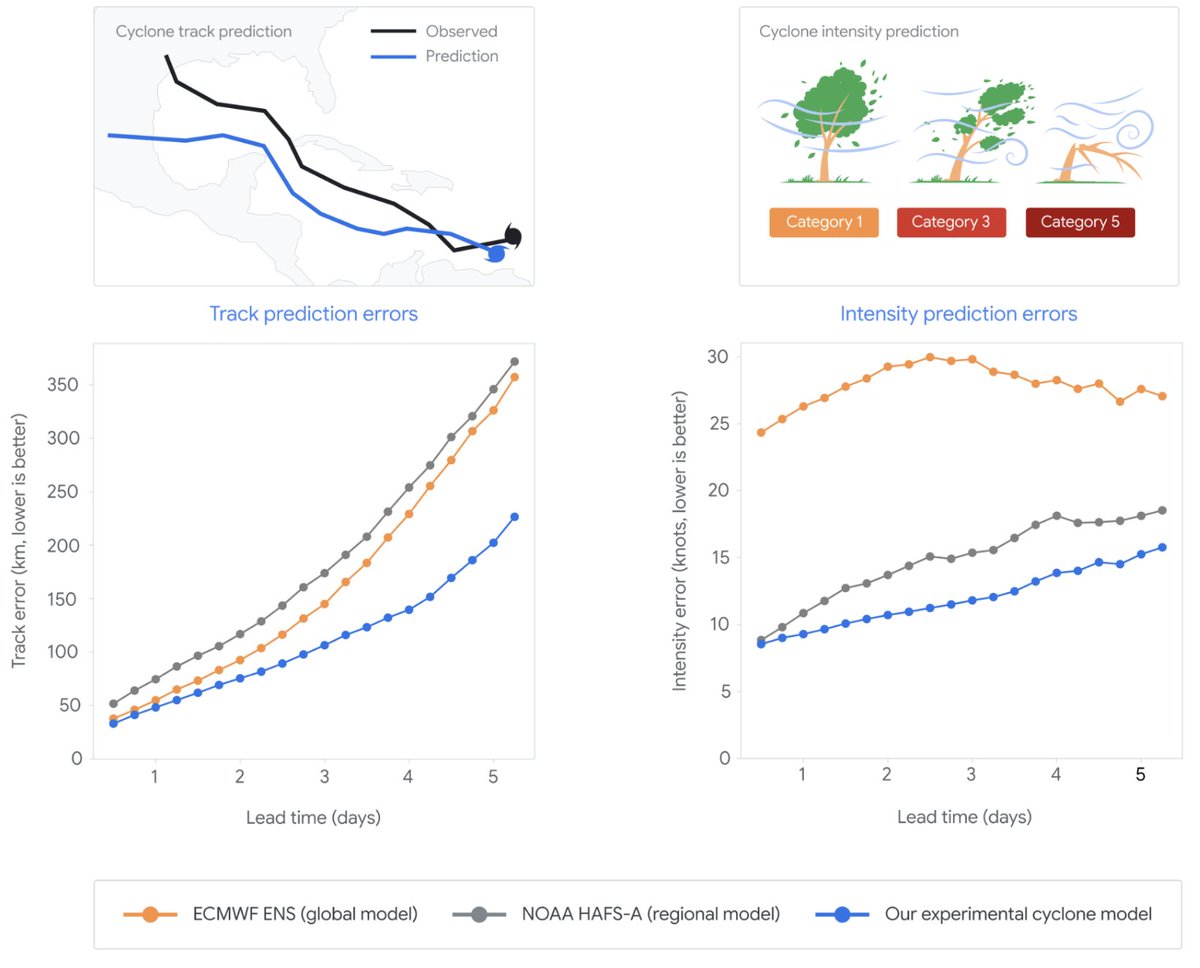
Our work on AI to improve cyclone prediction is likely to be quite impactful & save lives. We've been partnering w/ @NWSNHC, @metoffice & others for testing.
This builds on years of work on improving general weather prediction using AI from @GoogleDeepMind & @GoogleResearch.
We’ve hit a major milestone: a new ML weather model that can predict cyclone tracks & intensity with promising early results!
Our teams at Google DeepMind and Google Research have put in true Cat5 🌀 effort... more to come...
Excited to announce our new experimental cyclone model and a partnership with @NHC_Atlantic!
Traditionally, it's been hard for a model to predict tracks & intensities: one requires a global view, the other very high resolution. Our AI model achieves strong performance on both.
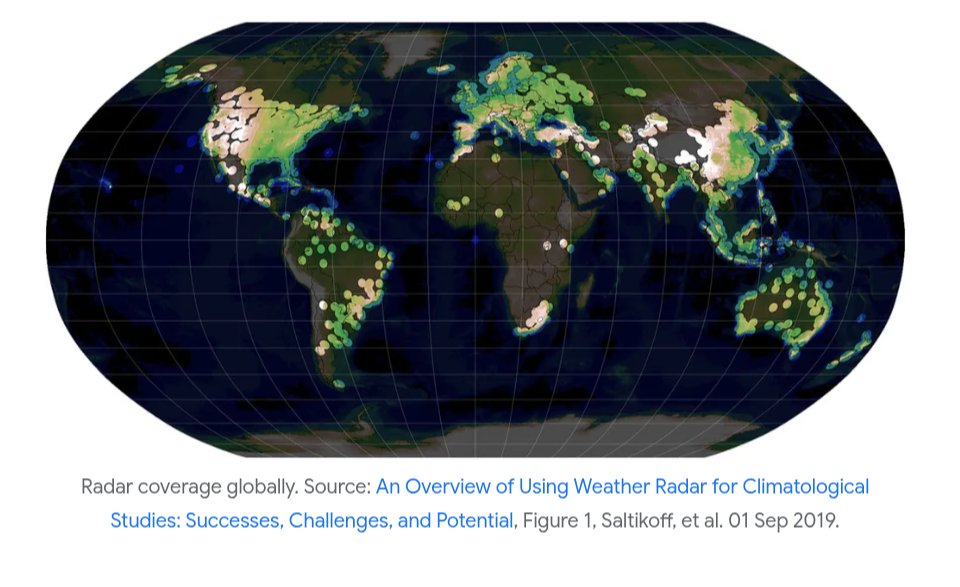
Great to see AI-based weather prediction being rolled out across Africa. This is important because traditional weather forecasts rely much more on ground-based radar, and in Africa, there simply aren't enough to give high quality traditional forecasts.
https://t.co/yonBR65ESU
Nowcasting forecasts for Africa are live on Search! Leveraging new ML work on making the most of sparse observations for high-skill predictions, and unlocking new important applications. Congrats, team!
Great to see AI-based weather prediction being rolled out across Africa. This is important because traditional weather forecasts rely much more on ground-based radar, and in Africa, there simply aren't enough to give high quality traditional forecasts.
https://t.co/yonBR65ESU
We’ve entered a new era of weather understanding through AI.
Today we’re excited to announce that @Google's WeatherNext forecasts are now live on Earth Engine and BigQuery, giving researchers and decision-makers access to real-time and historical data, including global ensembles. Let's advance weather and climate science together!
(And big kudos to my Research/@GoogleAI & @GoogleDeepMind colleagues!)
Explore the AI-powered forecasts here: https://t.co/tZP6UchpFU
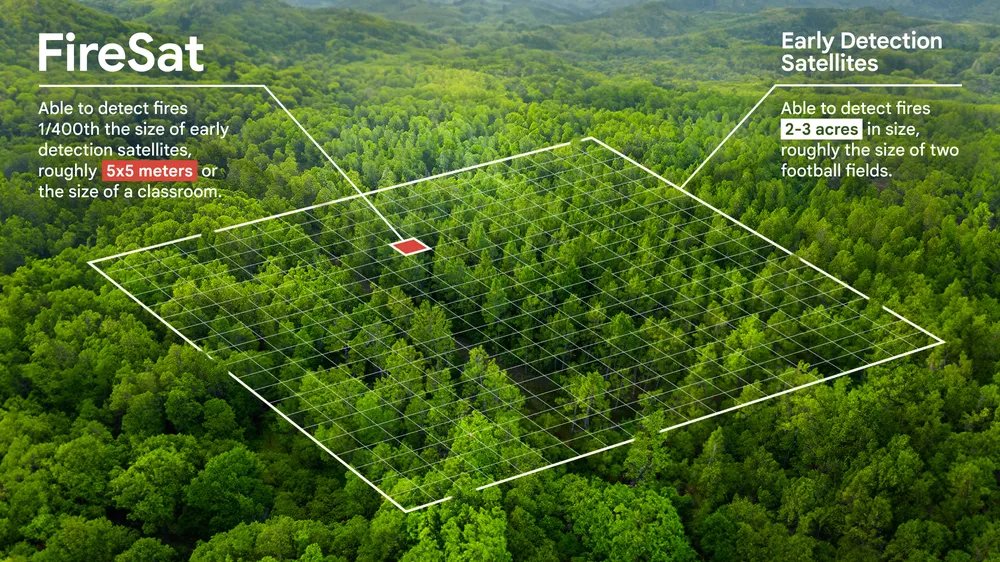
I'm really excited about this work. As the earth warms, wildfires are becoming more common in many places on earth. Early detection, before they burn out of control, is key to dramatically reducing their impact. Current early detection satellites are only able to detect fires that are 2-3 acres in size. With the FireSat constellation of 50 micro satellites for frequent coverage of every spot on Earth, and AI models trained on the sensor data, we'll be able to detect fires 1/400th that size (roughly 5x5 meters), enabling first responders to put out fires quickly.
The first satellite will launch next year, and the whole constellation (critical for detecting fires quickly) will be operational in the following few years.
Kudos to the whole team working on this at @GoogleResearch and to partners at @EarthFireAll, @MuonSpace and @MooreFound, and especially to my Google colleague Chris Van Arsdale, who has been working on this project for many years.
Learn more:
Blog:
https://t.co/rWimOieKNT
Great video:
https://t.co/cU9G4H7Hsx
Earth Fire Alliance website (@EarthFireAll is a 501c3 committed to accessible fire data from and for the entire planet):
https://t.co/8smmBEsMfK
I'm incredibly proud to share NeuralGCM, our new AI and physics based approach to weather and climate modeling with state-of-the-art accuracy, published today in @Nature:
https://t.co/rtQa0Lq0fT
#Graphcast named a top 10 science breakthrough! The pace of ML innovation in weather & climate modeling is staggering, and it's still very early days. 2024 will bring better predictions, deeper insights, and new approaches, across the globe.
Trained on four decades of historical data, #GraphCast from @GoogleDeepMind is an #AI model that predicts global weather with greater speed and accuracy compared with traditional approaches.
Learn more in Science's last issue of 2023: https://t.co/kGtyTfWfuu
The first major WeatherBench 2 update is now live, including:
➕ New models: (pseudo-)operational Pangu and GraphCast, FuXi, SphericalCNN and NeuralGCM
➕ Improved scorecards (incl. a probabilistic one)
➕ More comprehensive ERA5 and IFS ENS data
https://t.co/f50rGD3GcK
New research from @GoogleDeepMind in Science: our latest AI model GraphCast can predict weather conditions up to 10 days in advance more accurately + much faster than current systems, with potential for earlier warnings of extreme weather events.
https://t.co/JW8GX3JvgX
Presenting GraphCast: our state-of-the-art AI model delivering 10-day weather forecasts with unprecedented accuracy in under one minute. 🌦️
It can even help predict the potential paths of cyclones further into the future.
Here's how it works. 🧵 https://t.co/ygughpkdeP