Biochemist and Genome Editor. Former postdoc in the @ESontheimerlab, former scientist and manager @InscriptaInc and @TesseraTx. Currently at @CRISPRTX.
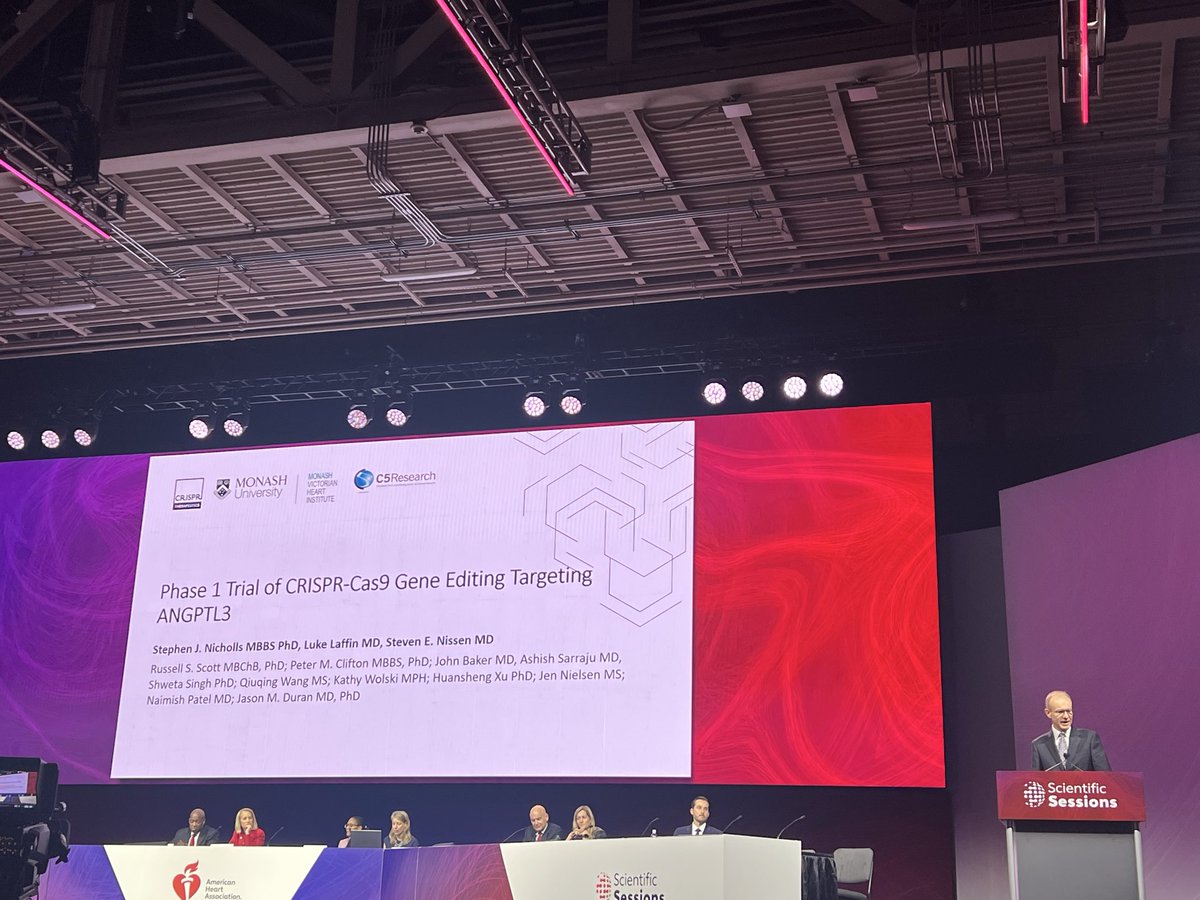
#AHA25 and @NEJM data for CTX310 by @ProfSNicholls . A single in vivo administration safely and durably lowered ANGPTL3, reducing triglycerides and LDL, progress toward applying gene editing to more common diseases. @CRISPRTX
Researchers from @UCBerkeley describe an RNA-guided system for transgene insertion at a safe harbor locus in the human genome, which offers considerable therapeutic potential.
Read the Views & News from @anarkalim_ and @ESontheimerLab:
https://t.co/BjFCn79q8h
Just out: our new genome editing fluorescent reporter mouse is compatible with multiple Cas nucleases and PAM sequences, and reports on both nuclease and prime editing. With @ESontheimerLab and @xue_lab.
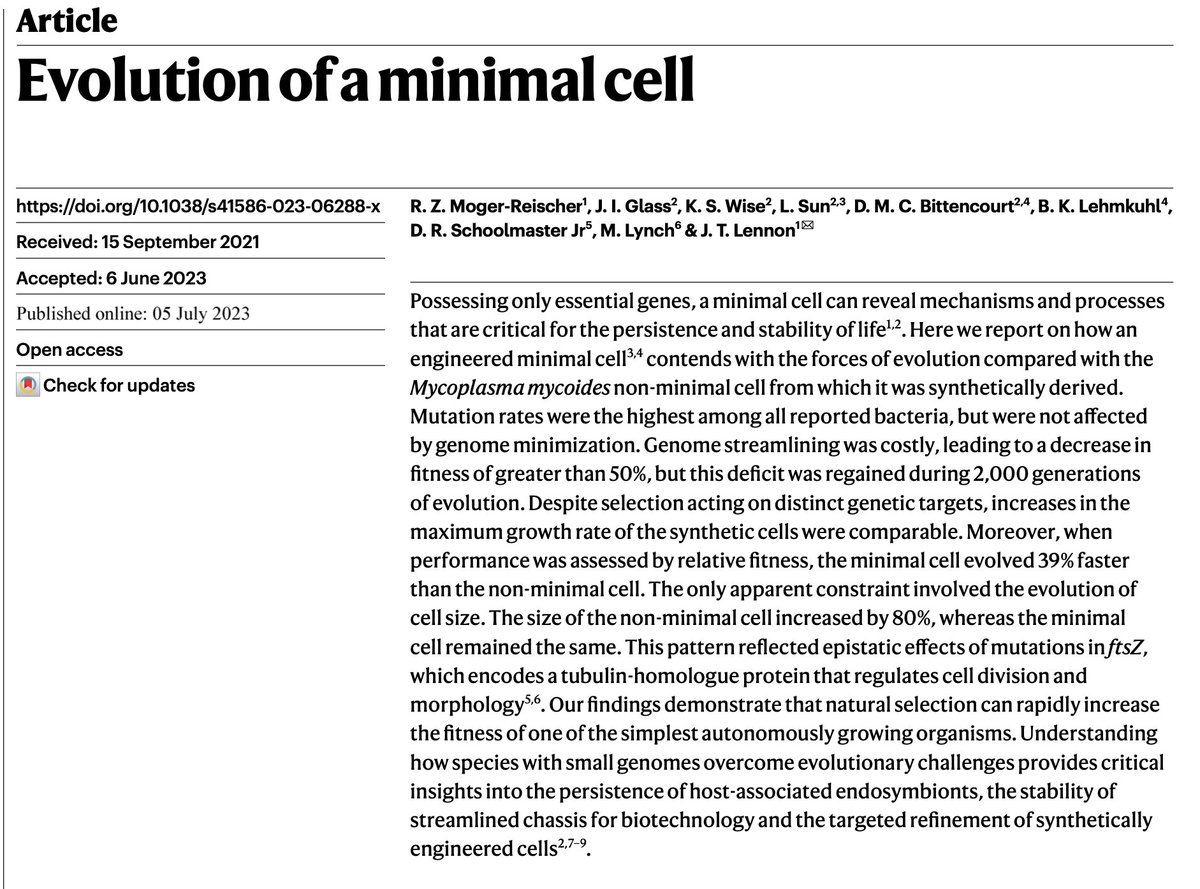
A mind-blowing paper has come out today in @Nature
In 2016, JC Venter Institute scientists trimmed a bacterial genome to its barest minimum required for life to synthesize what they called a "minimal genome" (https://t.co/Rk8oZJ0bUj).
Today, a group of scientists from Indiana University reports how that minimal genome evolved over 2000 generations in comparison to the non-minimal genome.
The authors found that even when you reduce a bacterial genome to its absolute minimum where every nucleotide matters, the genome undergoes mutational events generation after generation as much as the non-minimal genome. One simply cannot stop the evolution.
Just over 300 days of evolution (equivalent to 40,000 years in humans) the minimal cell has gained everything it lacked in fitness on day one in comparison to the non-minimal cell.
When comparing the evolved traits between the minimal and non-minimal cells, the scientists found something striking. The evolutionary process increased the cell size of non-minimal cells but not that of the minimal cell. But that is not the striking part.
The scientists were able to identify the key mutation that resulted in cell size evolution. And it turned out that the mutation that helped the non-minimal cells to grow bigger is the same that helped the minimal cells to stay smaller. Growing bigger had a survival advantage for non-minimal cells and not growing bigger had a survival advantage for minimal cells. So, the mutation had a context-dependent effect. This just demonstrates that the evolutionary effects on traits have no absolute direction. All that matter is what is beneficial for the organism's survival.
The conclusion of the paper is metaphorically a quote from the Jurassic Park movie:
“Listen, if there’s one thing the history of evolution has taught us is that life will not be contained. Life breaks free. It expands to new territories, and it crashes through barriers painfully, maybe even dangerously, but . . . life finds a way". (https://t.co/UlxRlb86CT)
https://t.co/zA9OAqSoAu
A computational pipeline identifies more than 10000 viroid-like covalently closed circular RNAs from metatranscriptomics. The collection contains putative viroids, satellite RNAs, retrozymes, and ribozy-like viruses. #NBTHighlight https://t.co/0y2mq8xxbG
Excited to see our study "Predicting prime editing efficiency and product purity by deep learning" published in @NatureBiotech today! @schwanklab@krauthammerlab https://t.co/JGAVSYJhfe 1/14
Today we announced Anne-Virginie Eggimann as our new Chief Regulatory Officer and welcomed Derica Rice to our Board of Directors. Their appointments are a testament to Tessera's continued and impressive growth.
At @FASEBorg's #GECSRC22, @mcholmes_holmes showed that our RNA rewriters can correct disease-causing mutations in vivo in mice with high efficiency via all-RNA delivery. This is an exciting day for our team and a milestone in our journey to create new therapies for patients.
The next chapter of the PhD work is published in @NatureComms. Base editing can rescue the function and survival of cone photoreceptors in an inherited retinal degeneration model. This story was not possible without @susiesuh529@SethBlackshaw@davidrliu https://t.co/weQhajVxmn
New ePub drop today:
Prime editors and petRNAs* unleashed
*prime editor template RNAs
And I describe our split PE (sPE) system as “unleashed” for a very specific reason…see the paper’s title for a great big clue as to why! Tweetorial follows. 1/13
https://t.co/j0mOOaGxFU
Towards safer AAV #CRISPR delivery:
A recent study from @SontheimerLab@UMassChan uses all-in-one, self-inactivating #AAV vectors with compact #Cas9 to excise or correct pathogenic variants in animal disease models.
Read more here: https://t.co/2AIQUIBEPH
#crisprmedicinenews
A team of researchers led by Harvard and Broad Institute scientists has developed twin prime editing, a new gene-editing strategy https://t.co/C3Y2coSwGQ
Paper is finally online! Being very fortunate to work in
@liugroup@davidrliu with a group of fantastic scientists everyday, particularly Andrew, Chris @CPodracky, and Drew @LilGLeprechaun in this project! Hope twinPE could be a new and safer approach to gene therapy.