@bchesky@bchesky 2 mins is still a very long wait time and missing 6% at your volume is a staggering number. You need both AI and human to solve this. We (@smithdotai) have taken this approach and I was inspired by the very same problem when I was CTO at @thehomedepot
For my first post, I’m sharing a letter @NVIDIA signed on why open models matter.
AI will transform every industry, power every company, and be built by every country.
Open models strengthen safety and cybersecurity, accelerate innovation and diffusion, and enable sovereignty.
The world needs both frontier closed models and frontier open models.
https://t.co/AUKzoQ5Ikb
A few thoughts about PayPal, nearly 12 years after I left.
I woke up this morning to dozens of messages from former PayPal colleagues. It pushed me to finally speak up.
I never spoke publicly about the company after I left. Part of that was loyalty to John Donahoe, who gave me an unlikely opportunity, handing the reins of PayPal to a startup guy who, on paper, had no business running a then 15,000-person organization. But part of it was something else: I had left. I chose not to stay and fight for the changes I believed in. Speaking from the sidelines felt like armchair commentary. Easy opinions without the burden of execution. So I stayed quiet.
But twelve years of silence is long enough. And today's news makes it clear the pattern I've watched unfold isn't self-correcting.
I left PayPal in 2014 because I was deeply frustrated. We had executed a silent turnaround of a company that had lost its soul. We brought back engineering talent, shipped good products quickly, and acquired Braintree and Venmo. The company was on a tear. So much so that Carl Icahn felt compelled to accumulate a position in eBay and push for a PayPal spinoff. At the time, eBay decided to fight Icahn.
It was a difficult period for me, caught between what I felt was right for PayPal and my loyalty to the eBay team.
This is when Mark Zuckerberg approached me to join Facebook. The combination of his conviction that messaging would become foundational, the appeal of going back to building products at scale, and my growing exhaustion with the internal politics at PayPal and eBay eventually convinced me to leave and join one of the best teams in the world, one I had admired for a long time.
In the summer of 2014, I met John in a café in Portola Valley and told him I had decided to leave. During that conversation, he told me that Icahn had effectively won the fight, that PayPal was going to become an independent company, and he tried to convince me to stay on as CEO, but I had already said yes to Mark, and my word is my bond. There was no turning back.
After my departure, the board scrambled to find a replacement, and it took a few months for them to land on Dan Schulman. The leadership style shifted from product-led to financially-led. Over time, product conviction gave way to financial optimization.
Much of the momentum we had created still persisted and carried the company forward, mainly driven by Bill Ready, who came over in the Braintree acquisition and rose to COO. Under his leadership, Venmo grew exponentially, and total payment volume (TPV) accelerated quickly. But the shift under Schulman became more pronounced after Bill's departure at the end of 2019. With him went the product conviction that had defined the post-spinoff momentum. Then, for a period, COVID-fueled online shopping hid a lot of the company's new weaknesses.
During that period, the company made a fundamental miscalculation: it optimized for payment volume instead of margin and differentiation. It leaned into unbranded checkout, where PayPal had the least leverage, instead of branded checkout, where the margin, data, and customer relationship actually lived.
Visa masterfully structured a deal that effectively ended PayPal's ability to steer customers toward bank-funded transactions, which had been a core driver of PayPal's economics. Not long after, PayPal lost a significant portion of eBay's volume. Over time, it saw its share of checkout among its most profitable customers steadily erode as Apple Pay and others continued to execute well.
The same pattern repeated itself across lending, buy-now-pay-later (BNPL), and new rails.
On lending, PayPal missed the opportunity to turn it into a platform weapon. Products like Working Capital were conservative, short-duration, and optimized for loss minimization. Lending never became programmable, never became identity-driven, and never became a reason for merchants or consumers to choose PayPal over something else.
The missed opportunity in BNPL was even more striking. Klarna, Affirm, and Afterpay didn't just offer installment payments, they built consumer finance brands, persistent credit identities, and new shopping behaviors. PayPal saw the BNPL turn, entered the market, and had every advantage: distribution, trust, and merchant relationships. But BNPL was treated as a defensive checkout feature rather than an offensive category. There was no attempt to turn it into a core consumer relationship, no super-app behavior, and no meaningful differentiation for merchants. Others built platforms, PayPal added a feature.
The failure to lean into building and owning new rails followed the same logic. After the spinoff, PayPal had a once-in-a-generation opportunity to build a global, at scale payment network. Instead, the company focused on building on top of existing networks and third-party rails.
More recently, that mindset carried over to PYUSD. Technically, the product was sound. Strategically, it launched without a compelling transactional reason to exist. PYUSD had distribution, but no organic demand. It was not embedded deeply enough into flows to become a true settlement layer, a cross-border merchant rail, or a programmable money primitive. It sat adjacent to the product instead of inside the core of it.
Acquisitions during this period followed a similar pattern. Honey was not a strategic acquisition for PayPal. It added activity, but not leverage. It lived outside the transaction, monetized affiliate economics rather than payment economics, and never meaningfully strengthened PayPal's control of the customer or the checkout moment. Xoom solved a real problem in remittances, but it never compounded PayPal's advantage. It scaled volume without changing the underlying rails, identity graph, or settlement model, and as importantly, it didn’t cater to a high-value, high-margin customer archetype.
None of these were bad companies. They were just a wrong fit for PayPal and became unnecessary distractions.
The board eventually recognized the problem. In 2023, they brought in Alex Chriss, an Intuit veteran with a strong product background, explicitly to restore product conviction. It was the right instinct.
But Alex came from software, not payments. He understood SMB product development. He didn't have the muscle memory for transaction economics, network effects, or settlement infrastructure.
In hindsight, he also made an error: clearing out much of the leadership team that understood payments deeply. Executives with years of institutional knowledge departed within his first year.
This morning, Alex was removed as CEO. Branded checkout grew 1% last quarter. The board tapped another operator, Enrique Lores, the former HP CEO who's been on the PayPal board for five years.
I don’t know Enrique. And he might be a great leader, but on paper at least, he’s a hardware executive. For a payments company.
The common thread through all of this is incentive design. Once PayPal became independent, short/medium-term predictability beat long-term vision and ambition. Stock performance mattered more than platform risk and network opportunity. Financial optimization replaced product conviction.
I'm not claiming I would have made every call differently. Running a public company at scale involves tradeoffs I didn't have to make after I left. But the pattern, choosing predictability over platform risk, again and again, was a choice, not an inevitability.
Over time, the company that had every advantage and could’ve become the most consequential and relevant payments company of our time, lost its mojo, its product edge, and its ability to compete in a market that’s being rewired and reinvented in front of our eyes.
That's the part that's hardest to watch for a company I care so deeply about.
@garrytan Yes, we have https://t.co/uhMb7Sd6kt that can answer and qualify calls, added your friend & family to direct transfer and bypass the AI and block spam calls. @garrytan in your mind, how would you define urgent authenticated phone calls?
25 years ago today I officially started at a small search engine company, wedged into a tiny office space above what's now a T-Mobile store in downtown Palo Alto. Since then, I have had the incredible pleasure of working with awesome colleagues on software used by billions of people all over the world.
To all of my current and former colleagues, thank you for the collaborations, and I delight in what we have helped build together! 🙏
My first office:
Current office, my 16th different desk location at Google (more desk moves than 98.88% of Googlers):
There's a fun internal site that lets you see what percent of employees are newer than you at the company. I'm almost at five 9s overall, but infinite 9s within our engineering group. 😅
Thank you for indulging me in my moment of reflection!
I am very impressed with the FSD that just launched. Kudos to the @Tesla team and @elonmusk It feels like AI driving like a human and have common sense. I think you will see 10X adoption if you changed from paying $15k or $200/mo to pay-per-mile. It's really addictive.
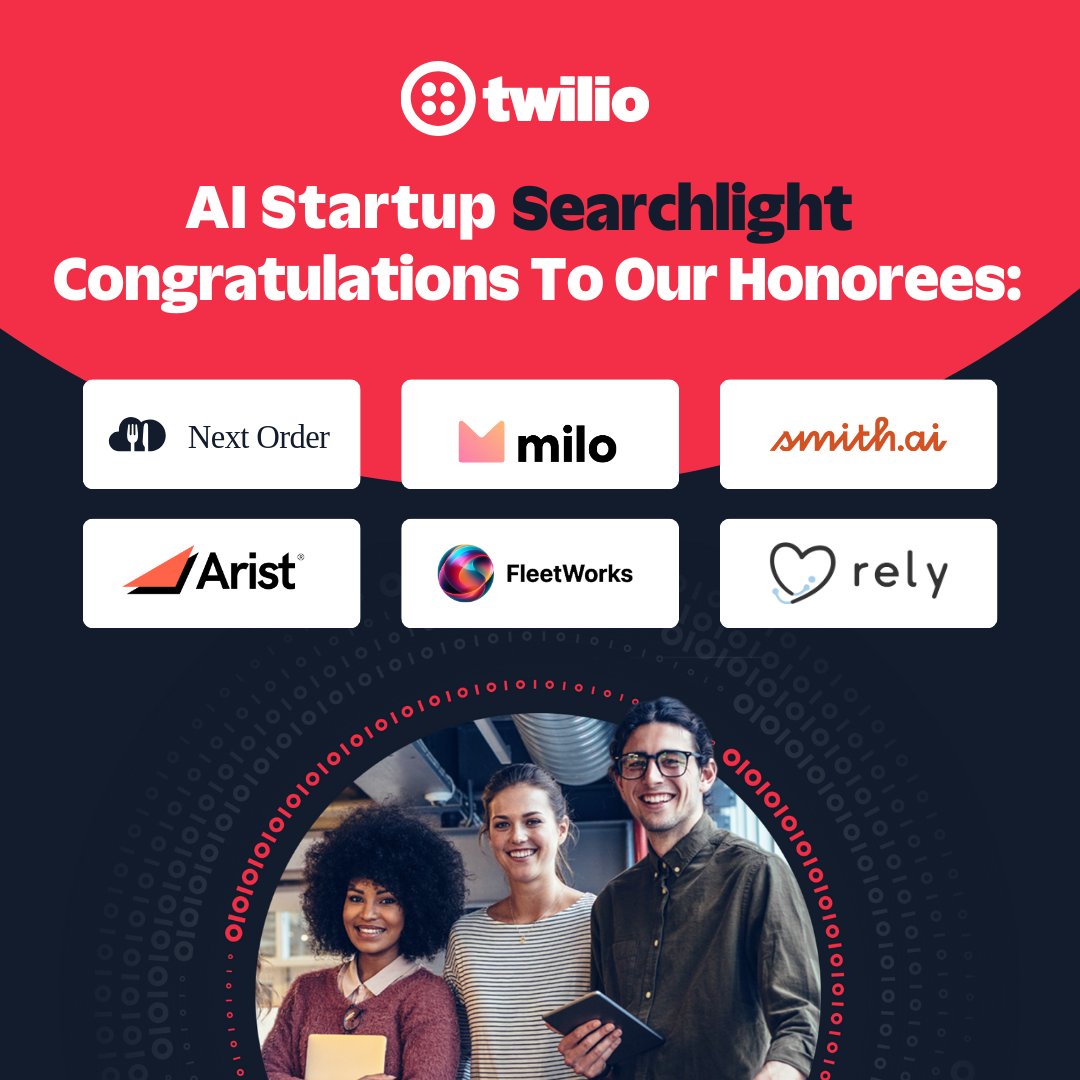
@smithdotai is thrilled to announce that @twilio recognized us as one of their AI Startup Searchlight Award Winners! Read the full article on Business Insider: https://t.co/01LhaBiQD8
Congratulations @smithdotai for winning in @twilio's 2024 AI Startup Searchlight Awards.
Smithai's AI-powered customer engagement platform merges human and AI agents to provide best in class customer service 24/7.
Read more here: https://t.co/t1FofCckL8
📣 Introducing Twilio’s AI Startup Searchlight Honorees!
Congratulations FleetWorks, @Arist, Next Order, @join_milo, Rely Healthcare, and @smithdotai who have created cutting-edge customer engagement solutions using generative AI and Twilio.
https://t.co/FAAf0xVPym
As an adult, I don't play 20q very often, but I had lots of fun chatting with Heather Langone from @hvacrbusiness about the role of tech in customer service, my thoughts on running a business, and how AI is HVACR business owners. Thanks for having me!
https://t.co/dE1Gi9FKYu
Thanks @SignalFire and @brexHQ for the amazing billboard for @smithdotai at #NYTechWeek Times Square
When opportunity calls, we answer.
#GrowWithBrex and start leveraging AI call & chat answering for your business!
Excited to share my recent chat on The Zero Prime podcast https://t.co/BYXEp3JHn5 with @petesoder. We explored:
⦿ The origins & journey of @smithdotai
⦿ Harnessing AI to elevate productivity
⦿ AI's evolving role in CX
⦿ Balancing AI's potential with its limitations in EQ
CEOs: one best practice to get advice ("how do I do X?") is to reach out to other founders CEOs whose company is 1-2 stages ahead of you, in a similar space, but non-competitive. You'll be pleasantly surprised about how open they are to helping you.
As @martin_c_mao from @chronosphereio puts it in @GergelyOrosz's newsletter: "I never realized how most founders and CEOs give a lot more time than you would expect. For example, one CEO in particular, from a publicly traded infrastructure company, has helped me out no end. If I text this CEO about something, he’ll make time to help and offer support, even though I know how busy he is. I notice that most such CEOs are really protective of their time, yet they’re still willing to carve out time for other founders. This makes me want to pay it forward as well, and help earlier-stage founders too."
@bchesky@bchesky 2 mins is still a very long wait time and missing 6% at your volume is a staggering number. You need both AI and human to solve this. We (@smithdotai) have taken this approach and I was inspired by the very same problem when I was CTO at @thehomedepot
Everything you need to know and more about Blending AI and Human Touch and how we do it at https://t.co/00GETKe4wB
Listen to today's episode on the Startup Hustle Podcast, where I sat down to talk shop with @decourseymatt It was a blast!
https://t.co/WCNTfvBDWN
As founders ourselves, we understand the struggles of scaling a startup.
For the last 5 years, we've worked tirelessly to build free software tools that help founders do just that.
@meliarobin shares the story for @BusinessInsider:
https://t.co/PmiIMEs3lk