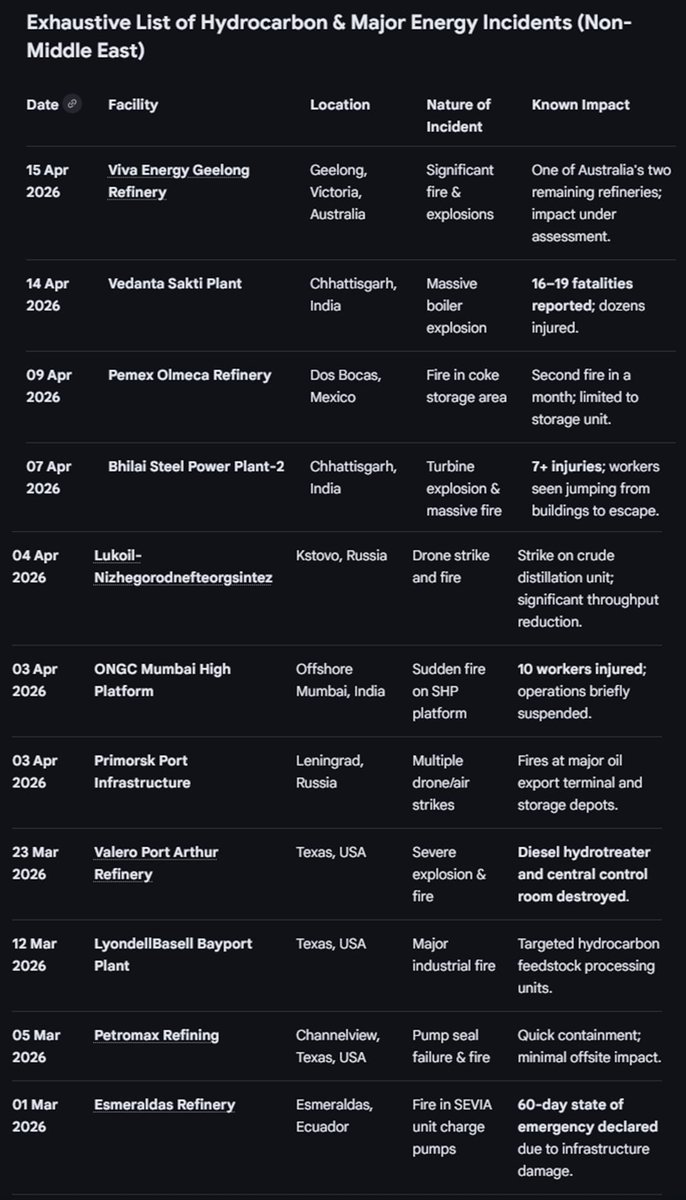
Here's potentially what they are hoping to achieve with the #IranWar and the fires, sabotage and destruction of over 45+ oil refineries around the world in the past few months.
Quick takeaway:
Refining capacity destruction → Supply destruction → Money printing → Excess liquidity → Massive inflation → Debt debasement (that USA/EU + others desperately need)
Longer explanation:
1. Destroy refineries/petrochemical plants
Crude oil is useless without refining into petrol/gasoline, diesel, jet fuel, LPG, petrochemical feedstock, etc. These plants take years to rebuild.
2. Fuel shortages hit transport first
Within days/weeks, trucking slows, shipping delays increase, airlines cut routes, public transport reduces service, fuel rationing and initial WFH (e.g. civil service) is imposed
3. Supply chains start failing
Fuel shortages spread to food distribution disruptions, medical supply delays, factory shutdowns, supermarket shortages, farming disruptions (tractors, fertilizers, transport). Government may start to impose emergency controls to safeguard food supply, medical and emergency services.
4. Government imposes rationing
Lockdown lite - fuel rationing for households, limits on private/non-essential driving, reduced public transport services, curfews to reduce movement.
5. Full mobility restrictions become likely
Full lockdown - If shortages persist, governments may impose WFH mandates, closure or non-essential businesses, restrictions on travel between regions, limits on operating hours, shutdown of energy intensive industries.
6. Industrial output contracts sharply
Factories, construction sites, mining, chemicals and manufacturing slow or stop due to lack of fuel and raw materials. Global production of goods drops significantly.
7. Global supply of goods shrinks
With transport restricted and factories offline, fewer goods are produced and delivered — from food and fuel to electronics, building materials and consumer products.
8. Governments roll out massive stimulus
To prevent unemployment and social instability, governments inject stimulus — wage subsidies, cash transfers, business bailouts, subsidies for food and energy.
9. Central banks print aggressively
To fund deficits and stabilize financial markets, central banks expand money supply, buy government bonds, and inject liquidity into the banking system.
10. More money enters the system while supply of goods shrink
Supply has fallen due to shutdowns and fuel shortages, but money supply increases due to stimulus and printing.
11. Too much money chasing too few goods
Demand is artificially supported by stimulus, while production remains constrained — pushing prices upward across essentials.
12. Broad-based inflation accelerates
Fuel, food, transport, housing, and manufactured goods rise in price due to persistent shortages and excess liquidity.
13. Nominal GDP rises due to inflation
Even if real production is weak, prices rise — increasing nominal wages, revenues and tax collections.
14. Government debt becomes easier to carry
Most government debt is fixed in nominal terms. Inflation reduces its real value over time.
15. Government Debt-to-GDP ratios improve through currency debasement
Rising nominal GDP and eroded real debt values reduce debt burdens — not through productivity, but through inflation.
16. Wealth destruction
Anyone holding large amounts of cash, savings accounts, fixed deposits, pension funds, or low-yield government bonds risks silent wealth destruction, as inflation steadily erodes the real value of their savings.
17. Wealth protection in inflationary cycles has traditionally started with #gold as the primary store of value, followed by #silver, resource assets, energy, and property that rise with scarcity - real assets that cannot be printed.
$TLT $SPX $SILJ $GDX $GDXJ $URA #USOIL $XLE $XME $GLD
Australia’s wheat acreage for the 2026/27 crop is expected to fall to a seven-year low as weak prices and shortages of fertilizer and fuel weigh on harvest prospects https://t.co/WWdfsun9FM
@ElCidRudy@jynpang@nntaleb Interesting, thanks for the response. Something I have felt, although I can't say I have embraced religion fully. Makes perfect sense though
I've been tracking breadth indicators for years, and they remain some of the most reliable tools for identifying major market bottoms and turns.
This was my post from April 8th, 2025, breaking down exactly why I thought a low was forming. The market bottomed on April 7th.
When many readings all align at the same time, it's an extremely powerful signal.
Kobe Bryant: "Failure doesn't exist, it's a figment of your imagination"
An interviewer asks: "Are you someone who loves to win or hates to lose?"
Kobe responds:
"I'm neither. I play to figure things out. I play to learn something. Because if you play with a fear of failure or you play with the will to win that supersedes fear, I think it's a weakness either way. If you play with fear of failing, you'll capitulate to that fear. If you play with the sense of 'I want to win, I want to win,' then you have the fear of what happens if you don't. But if you find common ground in the center, you're unfazed by either. That enables you to stay in the moment and not feel anything other than what's in front of you."
The interviewer asks: "How did you become someone who doesn't seem afraid of failing?"
Kobe responds:
"What does failure mean? It doesn't exist. It's a figment of your imagination."
He explains with an analogy:
"Let's use happy endings. Everybody wants a happy ending, right? Snow White finds her prince and lives happily ever after. Well, I call BS on that because two months later, they had an argument and he's sleeping on the couch. The point is: the story continues. So if you fail on Monday, the only way it's a failure is if you decide to not progress from that. If I fail today, I'm going to learn something from that failure and try again on Tuesday. That's why failure doesn't exist."
The interviewer asks: "If you finished your career without a championship, would you have looked at that as a failure?"
Kobe:
"No. I would look at it as being extremely disappointed, because I had a dream and goals I wanted to accomplish. If I didn't accomplish those goals, I'd have to ask myself why. Poor leadership? Failure to communicate with my teammates? Lack of preparation? Those would be reasons why I didn't win. So I'd have to analyze that. And as I evolved post-basketball into business, those same weaknesses would reveal themselves there too. If I don't learn from that, I'm going to struggle again."
He concludes:
"I can take those situations and learn from them and have them make me a better person later in life. But if I don't take that stuff and apply it someplace else, that's failing. The worst possible thing you can ever do is to stop. It's to not learn."
This is a great point, and I agree that for China, gold is too small to replace dollar reserve assets at current prices. So the legacy stock of reserves is largely stuck in Western financial assets. Gold is more an outlet for incremental flow than a substitute for the existing stock.
But that’s also a big part of the bull case. Gold is a relatively small asset class, so even a modest marginal reallocation from USG bonds to gold has a very large effect on price. And there is a gold price that can absorb more of China’s and the RoW’s surpluses. It’s just much, much higher.
But what I think this episode highlights more than anything else is the weakness of using commodities as reserve assets. Their prices will fall at exactly the point reserves are most needed. That’s certainly true for energy and industrial commodities. And while gold used to be more counter-cyclical, in the new reserve paradigm, it becomes pro-cyclical too.
The reason gov bonds work so well as reserves is that their price is anchored by the expected path of future policy rates, and less by flows. And in a growth slowdown, when you might need to liquidate reserves, rate expectations typically fall and bond prices rise. Gold doesn’t have that anchor.
Importantly, when gold played the reserve asset role under the Gold Standard and Bretton Woods, the gold price was fixed. The adjustment happened through the money supply and domestic economic conditions. Today gold floats, so the adjustment happens in the gold price itself. And that’s what makes it much more volatile and much more pro-cyclical now.
But until a new reserve architecture exists, gold will increasingly be pushed into that role anyway bc there aren’t any better alternatives, aside from countries actually reversing the domestic policies that create their surpluses in the first place. They won’t do that willingly.
Eventually the world will come together and create a new trading system with something like Keynes’ Bancor idea at the center. But that’s a long way off. There were 20 years and two world wars between the initial collapse of the gold standard and Bretton Woods. Until a new system is built, gold is going to play a major role as a reserve asset.