I was wrong about the Midjourney ultra-sound scanner.
Well, maybe not wrong, but at a minimum I missed something obvious because I was thinking like a doctor who's been practicing for 25 years.
And I didn't explain my point well.
First, where I was wrong:
All historical precendent that showed that widespread screening imaging is net neutral or harmful was imaging that was expensive, inconvenient, gated by physicians and couldn't practically be repeated frequently short term.
If the Midjourney ultrasound is high resolution, harmless, inexpensive and convenient, people can get an initial scan, then if there are abnormalities concerning for cancer, they can get weekly follow up scans to see if it's growing/changing, and if it's not, they can leave it alone.
In retrospect, that is obvious but it never occurred to me.
Now, you'd assume that that approach would have to lead to it being useful and saving lives, and it probably will. But we won't really know it does until we have a couple years of data. Lots of things that seem obvious in medicine end up being wrong once we collect data.
Second, what I didn't explain well:
It's not that I think non-doctors are 'too dumb' to use the results effectively.
Its that historically it was literally impossible to use the results effectively, and that is super, super counterintuitive. It seems obvious that finding stuff early is beneficial, but experience has shown that it isn't.
Here's why:
The vast majority of abnormalities (i.e. possible cancer) isn't cancer - like over 90% of them, ends up being harmless - something thay your body could have handled on it's own.
But the only way to find out was to have invasive, risky procedures to biopsy or remove what was found.
And overall, the side effects from all the risky, invasive procedures to track down the over 90% of stuff that was harmless equal or outweigh the benefit from removing the less than 10% of stuff that wasn't harmless.
If the MIdjourney device can be repeated frequently, like weekly, at a low cost and is harmless, it could negate the need for the risky, invasive procedures.
Not saying it will, but it seems like it could and I confidently posted yesterday that it was a bad idea.
I was wrong to confidently post that.
Step-By-Step LLM Engineering Projects Roadmap
- Build a tokenizer
- Learn embeddings
- Implement RoPE / ALiBi
- Hand-wire attention
- Build MHA
- Build a Transformer block
- Train a mini-former
- Compare objectives
- Build sampling
- Speculative decoding
- KV cache
- MQA / GQA / MLA
- Long context
- FlashAttention
- Hardware budgets
- Toy MoE
- Sparse model trade-offs
- State-space / linear attention
- Diffusion language models
- Data pipelines
- Synthetic data
- Scaling laws
- SFT / DPO / RLHF / GRPO
- Quantization
- Serving stacks
- Eval harnesses
- RAG
- Tool use / agents
- Vision-language adapters
- Interpretability
- Red-team suite
- Full capstone model system
One request:
Choose an Opensource AI lab when you make it
Opensource is where humanity gets to keep the tools
DM me when you've made it ;)
Was just going through anthropic engineering blogs on harness and here cursor has just open sourced many projects to build on.
Weekend is going to be interesting building those local agents.
We’re introducing the Cursor SDK so you can build agents with the same runtime, harness, and models that power Cursor.
Run agents from CI/CD pipelines, create automations for end-to-end workflows, or embed agents directly inside your products.
I personally feel that the breaking news these days “that how you prompt Claude translates to how much tokens<->cost you are going to pay is a evil marketing strategy to justify costly plans by these big companies.
#ai#llm#opus
How do I explain to my girlfriend that the reason we can't go watch a movie tonight is because I have already pencilled in watching some guy build an agent harness for forty minutes?
This is a serious problem. Anyone else experience this?
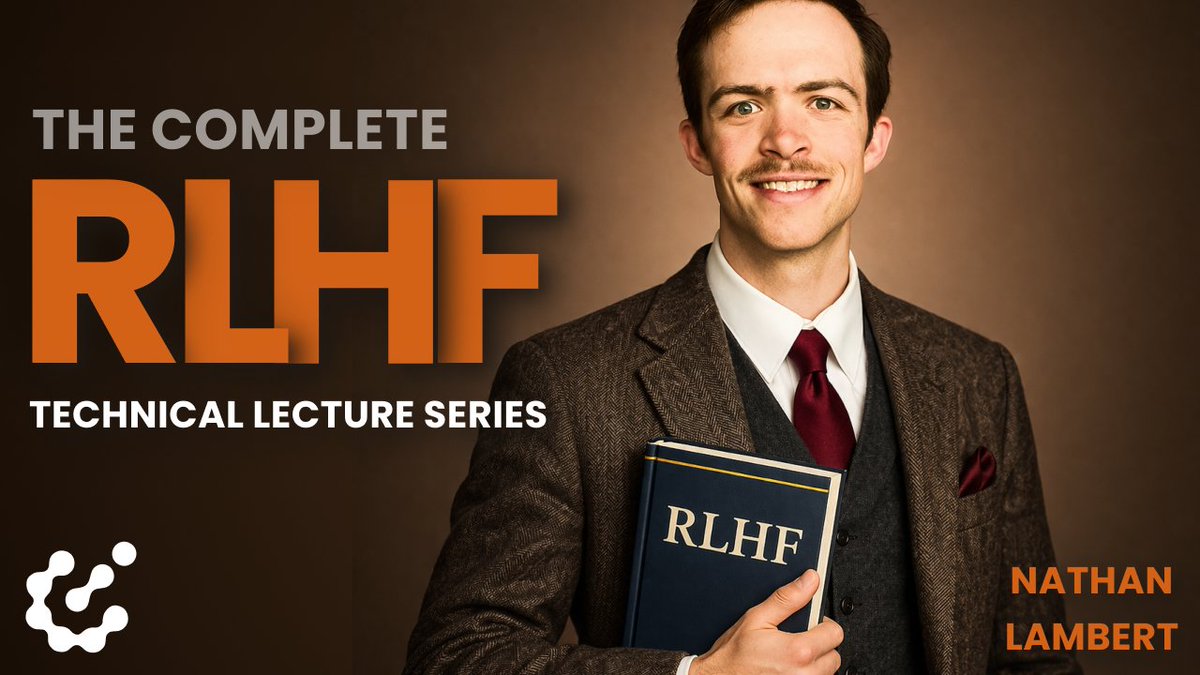
Excited to launch the accompanying free RLHF Course for my book. To kick it off, I've released:
- Welcome video
- Lecture 1: Overview of RLHF & Post-training
- Lecture 2: IFT, Reward Models, Rejection Sampling
- Lecture 3: RL Math
- Lecture 4: RL Implementation
I'm going to add question & answer videos throughout the lecture to go deeper on topics that need it, and potentially cover some topics that are too recent and in flux to go in print. I expect 10-15 videos in total over the next few months.
At the same time, development around the code for the book is picking up. It's a great time to build the foundation for post-training methods.
YT playlist and course landing page below.
Announcing Amazon S3 Files.
The first and only cloud object store with fully-featured, high-performance file system access.
Learn more here. https://t.co/rNuWa5Rsi2
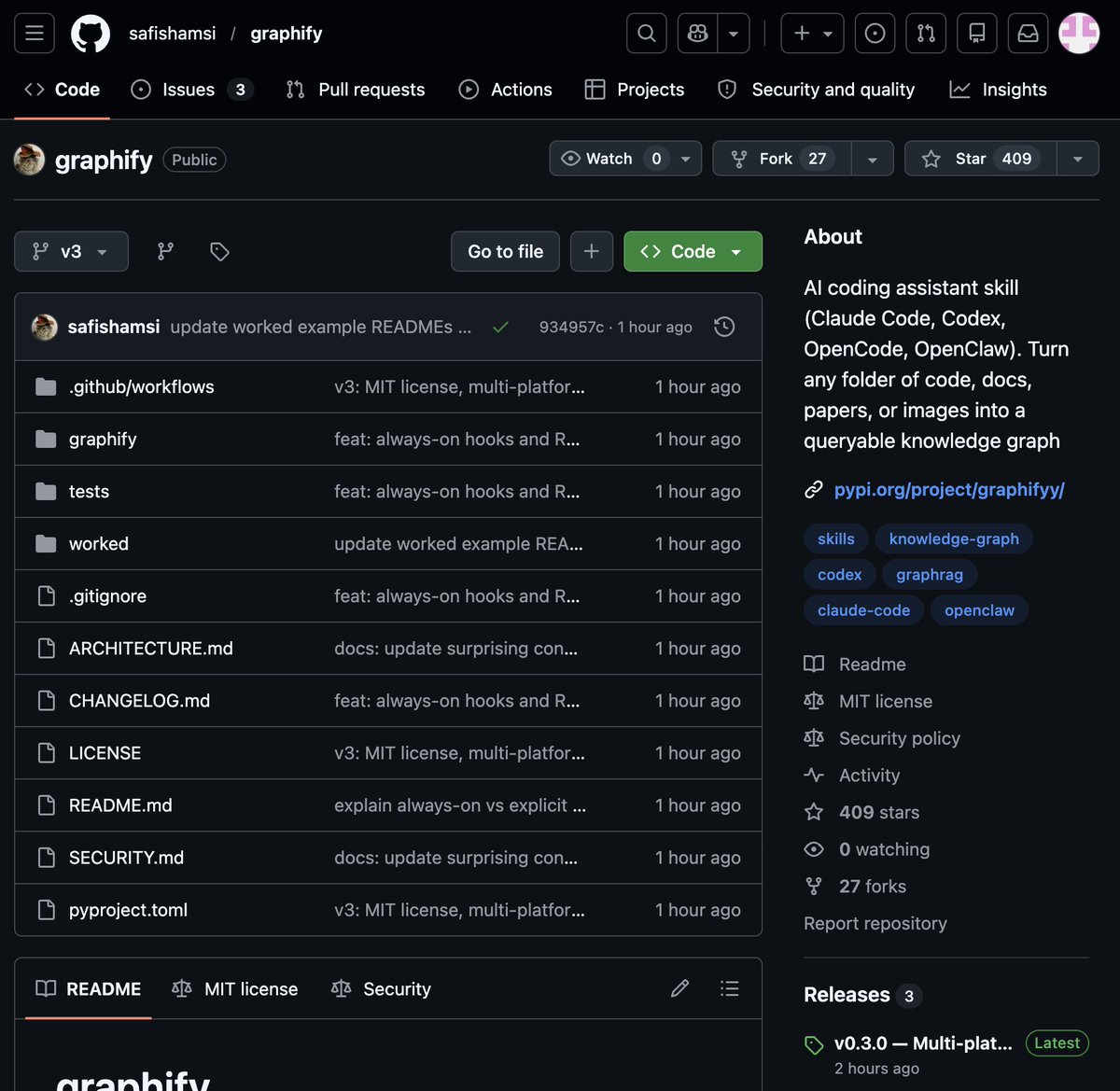
🚨 BREAKING: Someone just built the exact tool Andrej Karpathy said someone should build.
48 hours after Karpathy posted his LLM Knowledge Bases workflow, this showed up on GitHub.
It's called Graphify. One command. Any folder. Full knowledge graph.
Point it at any folder. Run /graphify inside Claude Code. Walk away.
Here is what comes out the other side:
-> A navigable knowledge graph of everything in that folder
-> An Obsidian vault with backlinked articles
-> A wiki that starts at index. md and maps every concept cluster
-> Plain English Q&A over your entire codebase or research folder
You can ask it things like:
"What calls this function?"
"What connects these two concepts?"
"What are the most important nodes in this project?"
No vector database. No setup. No config files.
The token efficiency number is what got me:
71.5x fewer tokens per query compared to reading raw files.
That is not a small improvement. That is a completely different paradigm for how AI agents reason over large codebases.
What it supports:
-> Code in 13 programming languages
-> PDFs
-> Images via Claude Vision
-> Markdown files
Install in one line:
pip install graphify && graphify install
Then type /graphify in Claude Code and point it at anything.
Karpathy asked. Someone delivered in 48 hours.
That is the pace of 2026.
Open Source. Free.
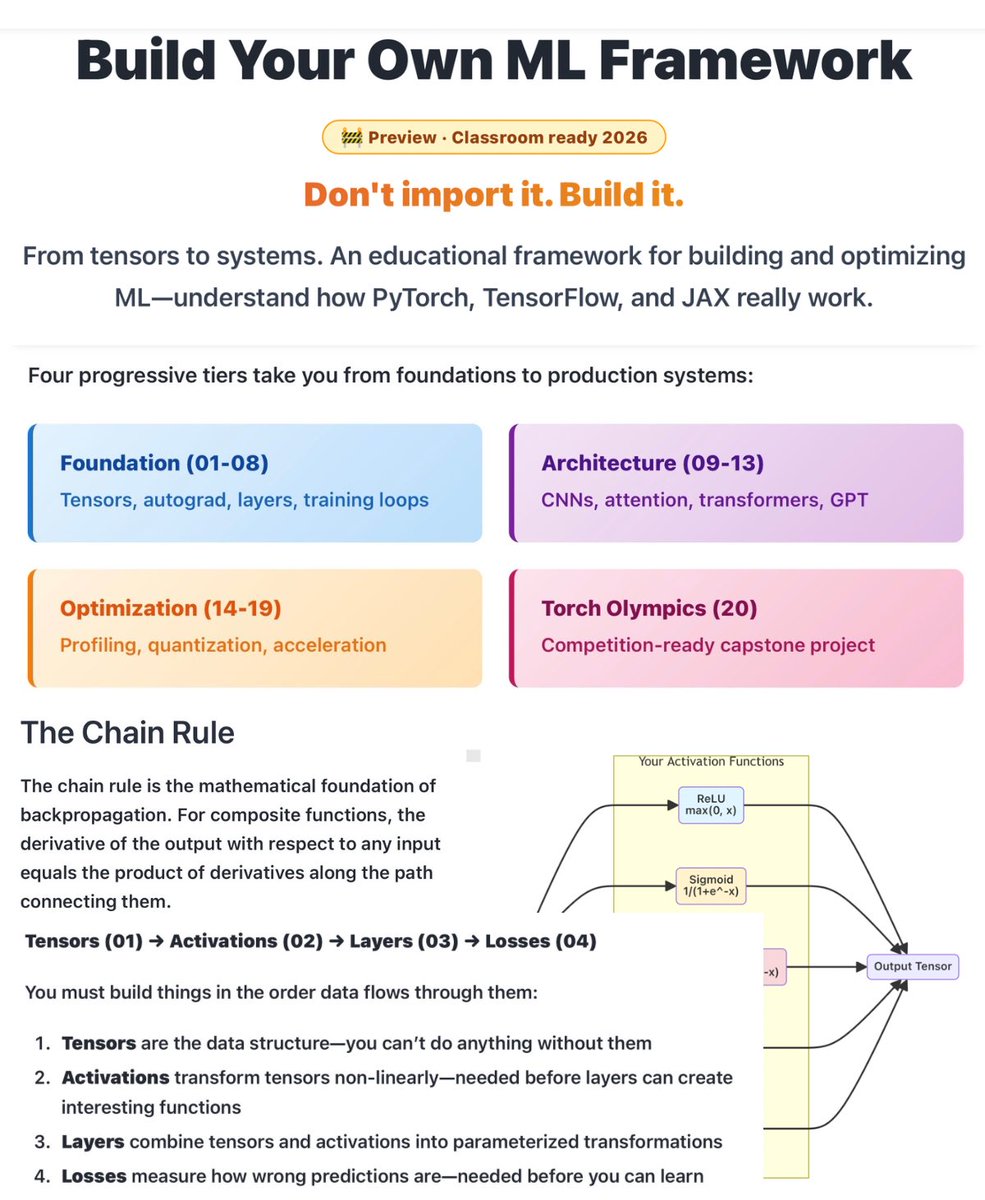
don’t just import pytorch, build it. Harvard’s tinytorch is exactly designed to help you implement a simple ML framework from scratch.
tensors, autograd, training scripts, transformers, profiling, quantization, built by you.
ngl this will open a new level of mastery over DL.
link: https://t.co/NdCLXNV0iX