8 years of work. Finally published.
Our paper in @CircRes shows that arterial resident—but not monocyte-derived—macrophages require endothelial CSF1.
Grateful to everyone who made this journey possible. @UHN@UofT_LMP
🔗 https://t.co/63AVaht78l
#atherosclerosis
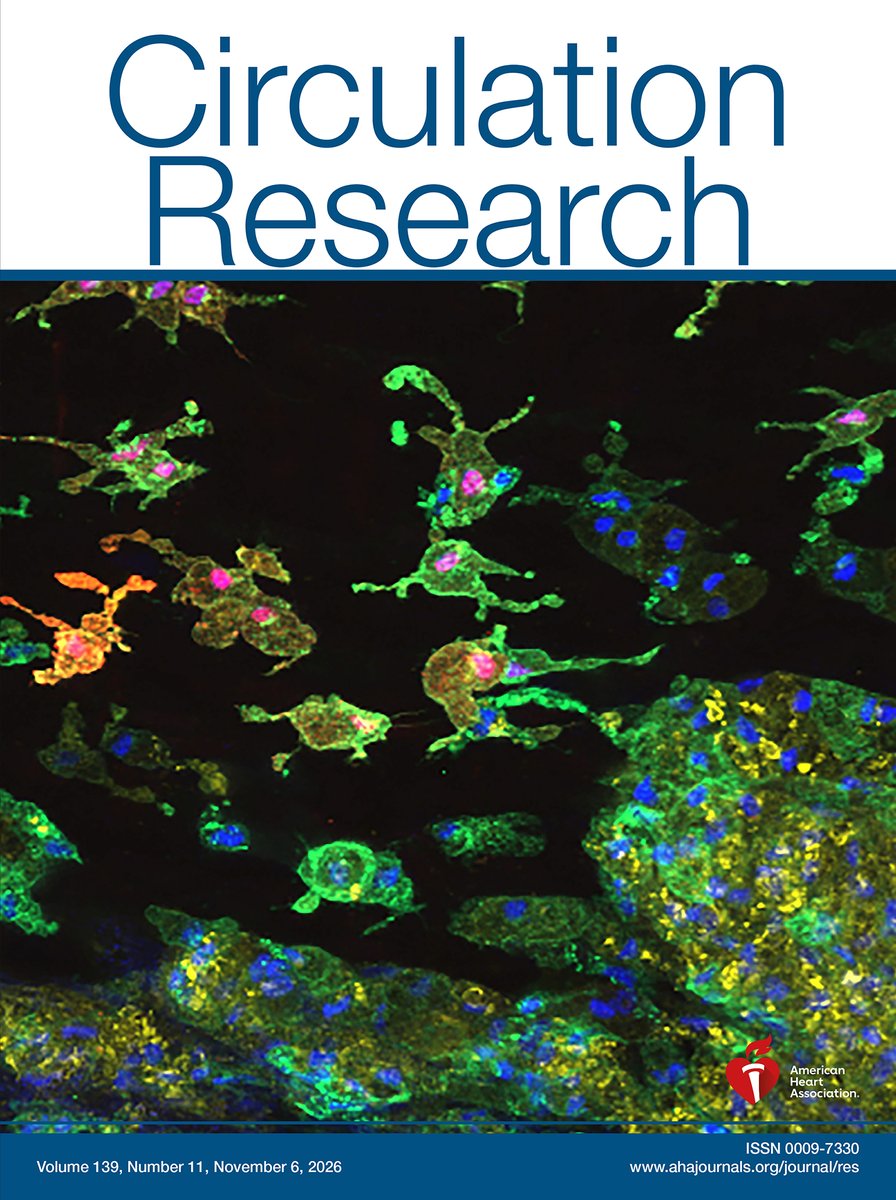
@CircRes Nov 6th Issue is Out! https://t.co/IiX6g6rOKd
Cover: IHC of tissue-resident macrophages with dendritic morphology & minimal lipid content at periphery of an atherosclerotic AA, while monocyte-derived macrophages clustered in the lesion are lipid-loaded; nuclei-blue.
4/4 — Perhaps the most interesting finding:
During early atherosclerosis, tissue resident (TR) & monocyte-derived macrophages behave differently.
TRM depend strongly on CSF1.
Monocyte-derived macrophages do not.
Same lesion & broad cell type. Different biological dependencies
8 years of work. Finally published.
Our paper in @CircRes shows that arterial resident—but not monocyte-derived—macrophages require endothelial CSF1.
Grateful to everyone who made this journey possible. @UHN@UofT_LMP
🔗 https://t.co/63AVaht78l
#atherosclerosis
3/4 — What is CSF1 actually doing?
Our experiments suggest CSF1 helps maintain intimal resident macrophages primarily through proliferation and retention, rather than simply preventing cell death.
A niche does more than keep cells alive—it helps keep them where they belong.
2/4 — Same artery. Different neighborhoods.
Intimal and adventitial macrophages rely on different sources of CSF1:
→ Intima: endothelial cells
→ Adventitia: PDGFRβ+ mesenchymal cells
The local microenvironment matters.
1/4 — Location matters.
In the mouse artery, tissue-resident macrophages in the intima depend on CSF1 produced by endothelial cells to maintain their population.
The endothelium is not simply a barrier—it helps create the macrophage niche.
@AhwalKSA@AhwalCare سلام عليكم، هل هذه قائمة الأسماء الممنوعه، لأنى لم اجد اى قائمه في الموقع الرسمي للأحوال المدنيه.
السؤال هل يمكن ان أسمى بنتي بإسم "مَلَك"؟. أرجو الإفاده وشكرا
When Adil joined the lab, little did we know his project would take us on a wild ride that would teach us that spleen ECs are so *so* important for lipid-induced atherosclerotic progression. Check out his study in @NatureCVR 🤩🤩 Can’t wait to see what he does next in Augusta!
Plasma S1P orchestrates reverse transendothelial migration of aortic intimal myeloid cells: further insights into how
circulating mediators impact intimal cell dynamics in health & inflammation @CoreyScipione@abid_marwan@chanelekpolenz
https://t.co/nx3K8DZm0R