Your breakfast is either medicine or poison.
Most people start their day with sugar: cereal, pastries, juice, oatmeal with dried fruit. Within an hour, their blood sugar crashes, they’re hungry again, and they’re locked into cravings for the rest of the day.
Protein changes everything.
When you eat protein first thing, you stabilize blood sugar, reduce ghrelin (your hunger hormone), and activate satiety signals. You’re literally reprogramming your metabolism. About 30% of protein calories are burned just digesting it, that’s the thermic effect of food working in your favor.
Plus, you’re giving your brain the amino acids it needs to make serotonaaand dopamine. Better mood. Better focus. Better energy.
What I eat:
-Eggs with greens and avocado
-Protein smoothie with almond butter
-Full-fat Greek yogurt with nuts (no sugar)
-Leftover salmon or chicken
Stop eating dessert for breakfast. Start with ~30 grams of protein and watch what happens to your energy, your cravings, and your waistline!
What are you eating tomorrow morning? 👇
7. This thread showed up in your feed.
The algorithm only pushes health content to people it thinks actually care about getting healthier.
That's the strongest sign of all. You're already paying attention.
If you found this useful, follow @coachdango for more.
At midnight on February 6th, earlier this year, the doorbell to our apartment rang. The doorbell was followed by a pounding on the door. I answered the door and a security person in our building handed me his phone. It was my oldest daughter Eloise. She had found my 26-year-old daughter unconscious on the floor of her apartment and had called 911. The EMT team was already there, but they did not know what was wrong with Lucy or to which hospital they would take her.
I threw on some clothes and jumped in an Uber heading east toward Brooklyn. (Lucy lived alone in Williamsburg.) On the way, I learned that they were taking her to Elmhurst, a City trauma hospital in Queens. I arrived about five minutes after the ambulance to join Eloise, Lucy’s mom, and a friend, and waited to learn what was wrong.
After about 15 minutes, I asked a nurse where she was. I looked over his shoulder to his computer. Next to her name, it said “non-responsive.” I walked into the emergency room and wandered around looking for her until I found her unconscious on a gurney surrounded by several doctors and nurses.
By about 2:30am with the results from a CAT scan, Lucy’s doctors had determined that she had a massive brain hemorrhage and would need an emergency hemicraniectomy to release the pressure on her brain and remove the blood from the hemorrhage. I called our wonderful friend and family doctor Eddie Fisher and explained what was going on. He woke up Josh Bederson, Chairman of Neurosurgery at Mount Sinai, to find out more about Zach Hickman, the neurosurgeon on call that night. Dr. Bederson said Hickman was an excellent surgeon, which was comforting as we had no choice.
The surgery to save Lucy’s life began around 3:15am and finished around 5:30am. It was successful.
The following day, I joined Lucy in an ambulance while she was being transferred to Mount Sinai on Madison Avenue. Later that day, we determined from Lucy’s Oura ring that her hemorrhage had occurred around 9am, which meant that more than 19 hours had passed from the time of the hemorrhage to the completion of the surgery to release the pressure on her brain (I only wish @ouraring had an alert for this kind of a medical event. Imagine it could call a family member if the wearer doesn’t cancel the alert).
I later learned that the standard of care is not to do surgery to save a patient with a large brain bleed if more than five hours have passed since the hemorrhage. Even when the surgery is done, I was told that the likely outcome for the patient is a few months in a nursing home and death from pneumonia.
When I met Lucy’s doctors, I did my best to inspire them: “Let’s see what can be accomplished if we give her the best care possible and we invest unlimited resources to restore her to life.” And I promised that whatever we learned we would make available to everyone.
Dr. Chris Kellner, her neurosurgeon, and Dr. David Putrino, Director of Rehabilitation Innovation for the Mount Sinai Health System have led Lucy’s care team since that day. Words cannot describe the remarkable and compassionate care that she has received beginning with the EMT team and then from nurses, doctors, therapists, and the army of people who have worked to save her and return her to life. To this day, we have a daily Zoom where we discuss her progress and make adjustments to her care. While her care and oversight have been incredible, the learnings for the Mount Sinai team have also been elucidating and will assist in the care of many others.
Lucy began in a bad place. She was in a coma for several weeks and then awoke not being able to breathe on her own, unable to walk, see or speak.
Over the last six months, she has recovered her cognition – she understands everything including her circumstance – is able to walk a hundred or more steps at a time with assistance, is making progress with sounds, vowels and consonants and the beginnings of speech, but she remains unable to see.
Each day, she makes a little progress, and daily progress compounds. Every day I tell her that she just needs to make a little progress and it won’t be long before she is back.
We remain optimistic that Lucy will return to normal function. It will likely take years, but I believe it is only a matter of time, hard work, and technological progress, along with some, and perhaps a lot, of divine intervention.
Many people have been praying for Lucy and we are incredibly grateful for the prayers and remarkable support she has received. Lucy’s friends have been with her every day since the beginning, and their presence and friendship have saved her life and helped to rebuild and maintain her spirit. And on a very positive note, Lucy’s challenge has brought together our entire modern family who have all been incredibly devoted to her care and recovery.
Lucy's vision and other faculties may require some form of brain computer interface, work that is underway at Neuralink, Precision Neuroscience, Science, Synchron, Nudge, and other companies in the space.
If you are going to have a devastating brain injury, now is the best time in history for that to happen. We are living in a world when you can be confident that the blind will soon see again. We are going to do everything we can to help make that happen, including by assisting existing companies in the space.
With respect to our promise to make Lucy’s care available to others, we have made good progress. In May, a real estate colleague made me aware of a 93% vacant, brand new, 400,000 square foot Class A+ purpose-built biotech facility on West End Avenue between 65th and 66th Streets that missed the market and was available for sale. The Pershing Square Foundation acquired the building 60 days later.
We also put under contract an adjoining 130,000 square foot building at 320 West 66th Street that is currently being used by Saturday Night Live for studio space. The building has 35-foot ceilings with massive column-free spaces that can be converted into superb rehabilitation facilities. We will close on the SNL building in December.
We are also acquiring an adjoining vacant lot with additional air rights. With just the existing zoning rights, we can add a 150,000 square feet for a total of 680,000 square feet, a lab footprint larger than Rockefeller University, and that’s without including the potential for an upzoning that would allow for substantially more buildable area on the site’s 3.4 acres with spectacular views of the Hudson.
Our goal is to build the world’s greatest brain research, rehabilitation, recovery, human optimization, and longevity institute. We have named it The Ackman Oxman Institute or the AOI for lack of a better name, but also to reinforce the point that Neri and I and our family are all-in on the mission.
The AOI will be patient-centric. It will not be an academic research institute that produces lots of papers, a Nobel Prize winner or two, but little if any results for patients. We will be laser-focused on cures, treatments, devices, rehabilitation and exercise equipment, and targeted and basic research with a goal of massively accelerating the time from idea to innovation to production to helping a patient.
While the AOI will be a non-profit, it will have highly commercial instincts. The AOI will have its own venture funding and will work to develop innovations to create companies that we will seed, assist, and spinout to ensure technologies, treatments, techniques, and drugs get to patients as promptly as possible.
On one 3.4 acre campus in what is still the greatest city in the world, we will do neurosurgery, neuroscience, rehabilitation, nutrition, BCI and device development, human trials, hyperbaric oxygen treatments, and life extension programs, and we will mandate and incentivize collaboration among the teams with no silos, politics, bureaucracy, or any other constraint that is inconsistent with the mission.
Mount Sinai will be an important partner and deservedly so, but it won’t be our only hospital or medical school partner as we don’t believe any institution has a monopoly on the best ideas or the best talent. We don’t believe in exclusive relationships because that is not in the best interest of patients.
Five years ago, we considered launching a brain institute inspired by Neri’s mom who sadly died from Alzheimer’s. We couldn’t make the math work as the real estate was too expensive and we believed it would be too difficult to recruit the best talent from universities to our effort.
Since then, the real estate became available at a 70% discount, universities became a much less attractive place to work due to politics outweighing meritocracy, protests that disrupt learning, the curse of antisemitism, and a decline in funding. Fortunately, during the same time, I made sufficient personal economic progress to make the AOI possible.
The advance of AI in the last few years will also enable us to greatly accelerate our mission. AI still has a lot to learn about human intelligence and the brain, and the AOI should be at the forefront of the interplay between the brain and AI.
Today, I am making a public filing disclosing a gift from Neri and me of ~$400 million or 10,000,000 shares of Pershing Square Inc. (PS) to the AOI. It is very early days for Pershing Square so these shares are intended to anchor the long-term work of the AOI as the shares compound over time while generating what we expect will be a growing stream of quarterly dividends to fund the Institute.
We will also be announcing an additional gift of similar and potentially greater size which won’t be in the form of Pershing Square stock to provide the AOI with the short- and intermediate-term runway necessary to enable it to achieve its goal of becoming a self-sustaining institute, which reinvests all of its revenues, royalties, and the economic rewards of company formation to advance the fields of brain health and human longevity.
Neri and I have chosen to anchor the funding of the AOI to maintain vision alignment and limit the need for the organization to focus on fundraising. We expect the AOI to be the best-resourced brain, rehab, recovery, and longevity institute in the world.
We are grateful to have been able to form a board which includes Dean Kamen (our generation’s Thomas Edison), George Yancopoulus (CEO of Regeneron), James Rothman (Nobel Laureate), Bernardo Sabatini (neuroscientist), Chris Kellner (neurosurgeon), Olivia Flatto (CEO Pershing Square Foundation), Neri Oxman, and myself.
We have recently identified a CEO who we expect to announce by October along with other key hires, and are beginning searches for a Chief Scientific Officer, a Chief AI/Technology Officer, a Chief Operating Officer, a Chief Financial Officer, and other key leadership roles.
If you find what we are building compelling and want to be part of the leadership team that creates and builds the AOI from a standing start, please send an email to: [email protected] with a short note as to why you believe you can help. Please include your best three ideas for the AOI along with a summary of your background and your most important accomplishments.
We promise strict confidentiality to those expressing interest in working with us.
We have learned from Lucy that the brain can recover from even catastrophic injury. There is so much more work to be done as the mind is a terrible thing to waste.
For details from my Pershing Square SEC filing see:
https://t.co/gZKafCw6Ia
The measure of a life is not what you consume, but what you contribute.
Spend less time owning, consuming, taking. Spend more time giving, creating, making.
Nashville - we are hiring!
Hiring Event: Friday, August 28
Two TBMs are currently tunneling, with a 3rd arriving soon.
If you can wrench, weld, wire, engineer, or manage construction sites - we want you on the Music City Loop Team.
Apply here: https://t.co/9u1qxBF1gk
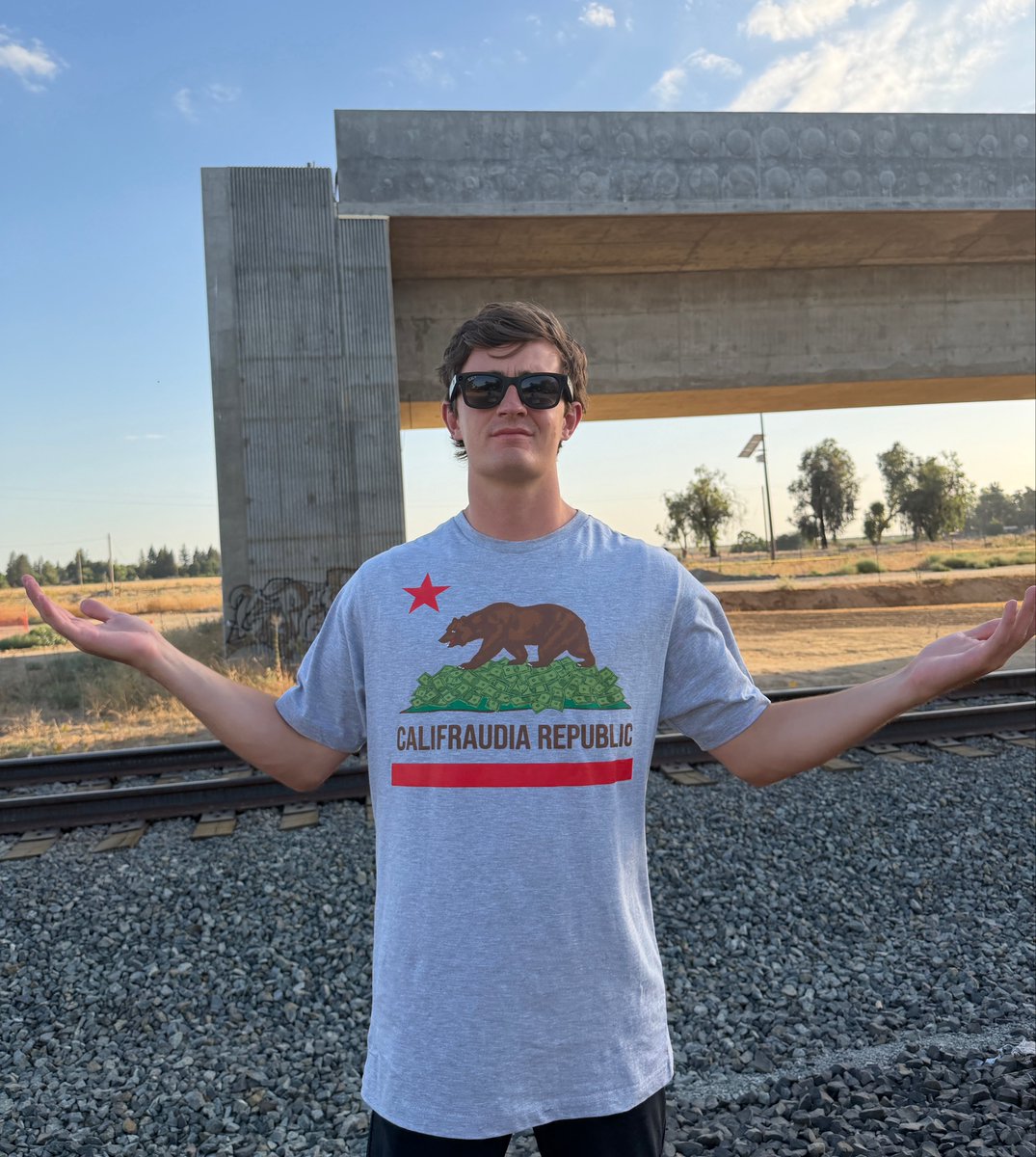
So much fraud and waste in one state that you could spend a lifetime and never find it all. Expose it and they will create laws against you.
Welcome to the Califraudia Republic
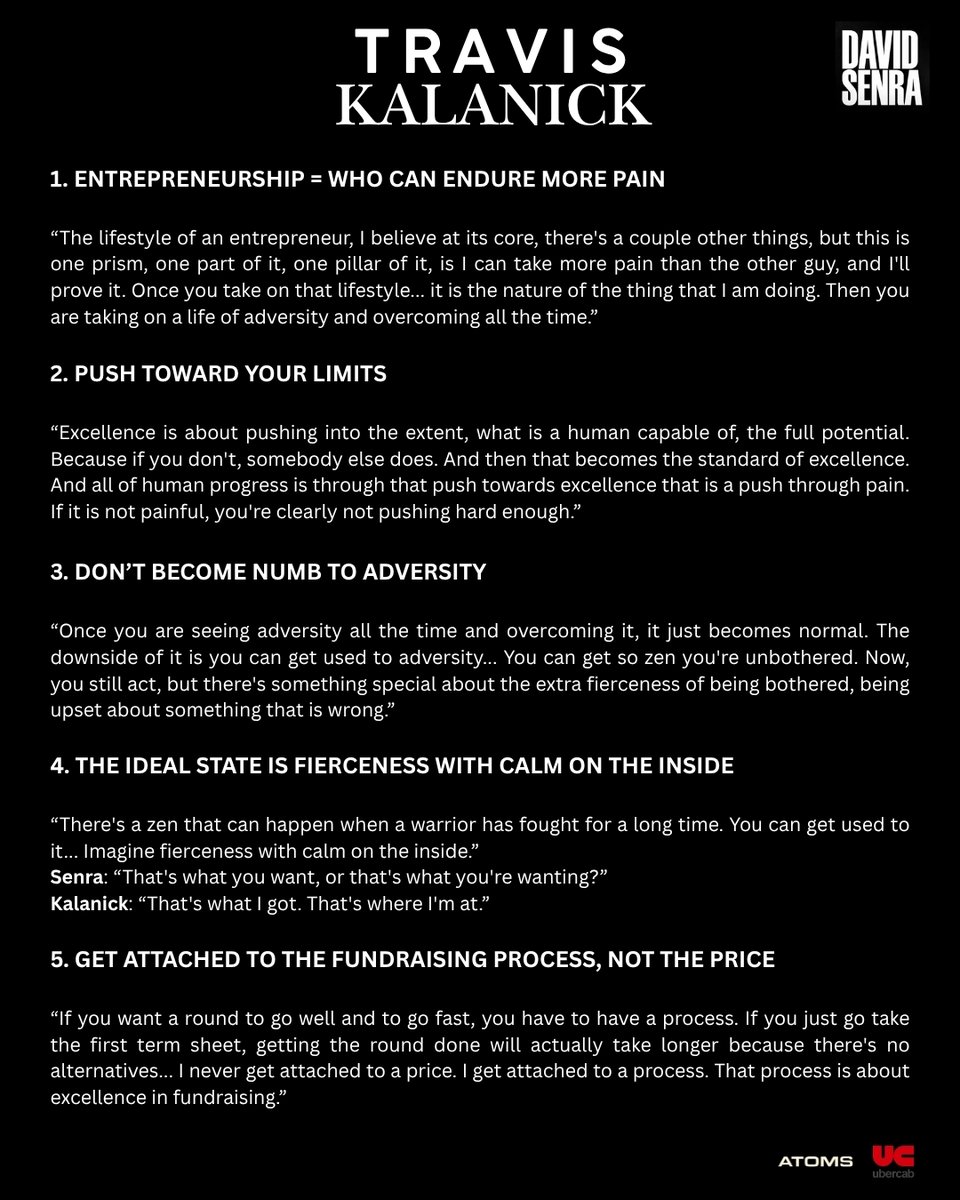
18 lessons from Travis Kalanick (@travisk) on building companies, adversity, raising capital, competing at scale, & pushing toward the edge of what’s possible.
My conversation with @travisk, founder of Atoms and Uber.
0:00 Building Atoms & the Meta Problem of Management
3:51 The Appeal of Impossible Problems: Starting Over in China
12:19 Uber vs. Didi: Copycats, Hypergrowth & China's Rules
21:02 How Network Effects Become an Efficiency Fortress
31:48 Capitalism vs. the Taxi Cartel
44:05 The China War Goes Global & the Entrepreneur's Capacity for Pain
54:04 Life After Uber: Lawfare, Media Narratives & Reputation
58:21 What Founders Get Wrong About Venture Capital
1:08:35 The Fundraising Playbook: QED Storytelling & a Five-Room Auction
1:18:38 The Uber Coup, Radical Accountability & Outgrowing Fear
1:26:42 Why Specialized Robots Beat Humanoids at Industrial Scale
1:31:30 Finding Your Sport: Food, Mining & the Physical AI Stack
1:40:14 How to Build Many Companies Inside One Company
1:46:33 Entropy, Civilization & the Meaning of Progress
Includes paid partnerships.
Cursor is now part of @SpaceX.
Today, we have officially closed our acquisition. We will join the @SpaceXAI team to help make Grok the world's most useful AI and improve Grok Build, Grok Bot, Grok API, Cursor, and more.
SpaceX has built some of the most inspiring and impressive technology in the world, and we’re grateful for the opportunity to become part of such a special company. Onwards.
Being curious and excited can take you far, especially over the long arc of a life. The person who is a voracious lifelong learner will figure it out eventually. A strong reader with a healthy dose of curiosity and a willingness to try things is hard to stop.
We made rockets reusable and are rebuilding the internet in space. The next challenge: making life multiplanetary and understanding the true nature of the universe
Watch @ElonMusk deliver a company update to @SpaceX employees
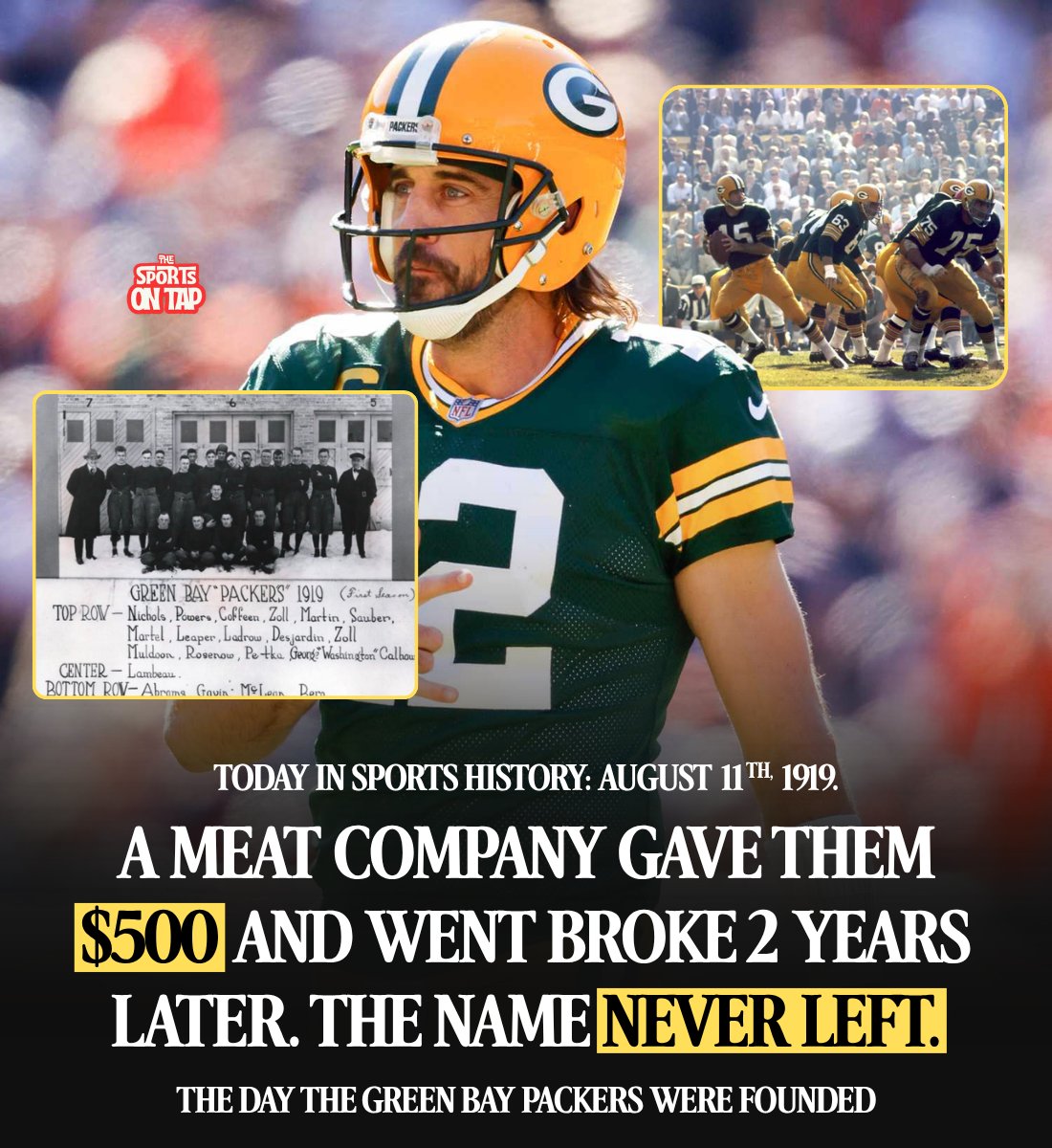
TODAY IN SPORTS HISTORY: 107 years ago today, a 21 year old shipping clerk talked his boss into giving him $500 for football uniforms.
That meat company went out of business two years later.
Its name is still on the field every Sunday.
August 11, 1919. Green Bay, Wisconsin. Population around 15,000.
A group of local athletes crowd into the editorial room of the Green Bay Press-Gazette. Most of them are former high school players from Green Bay East and West.
Two men called the meeting.
Earl "Curly" Lambeau was 21. He'd been a standout at Green Bay East, then went to Notre Dame and made Knute Rockne's varsity team as a freshman, before a brutal case of tonsillitis ended it and sent him home.
He needed a job, so he took one as a shipping clerk at the Indian Packing Company, a canned meat outfit.
But he still wanted to play football.
The other man was George Whitney Calhoun, the city editor at the Press-Gazette. A newspaperman who could put anything he wanted in front of the entire town.
They'd been talking about it all summer. Calhoun started running ads in his own paper inviting players to show up.
Then Lambeau went to his boss and asked for money.
The Indian Packing Company gave him $500 for uniforms and equipment, plus use of the company athletic field. There was one condition.
The team had to carry the company's name.
Two days later, the Press-Gazette referred to them in print as the Packers for the first time.
That's it. That's the whole origin. A canned meat sponsorship agreement.
They played home games at Hagemeister Park, which had no real seating. Fans stood along the sidelines and passed a hat around to pay the players.
They went 10-1 that first season.
In 1921 they joined the league that would become the NFL. They immediately went broke and forfeited the franchise, and Lambeau had to scramble to find new backers to get it back.
Meanwhile the Indian Packing Company was already gone. Sold to Acme Packing, and out of existence by 1921.
The sponsor lasted about two years. The name has lasted 107.
And the rest of it is the most improbable story in American sports.
Green Bay is the smallest market in the entire NFL, by an enormous margin, in a league where every other small market team folded or moved decades ago. The Duluth Eskimos. The Pottsville Maroons. The Canton Bulldogs. All gone.
The Packers survived because in 1923 they did something no other team has ever done. They sold shares to the public and became a community owned, non profit corporation.
No billionaire owner. No threat to relocate. The fans literally own the team.
That's why they're still there.
Thirteen NFL championships, more than any franchise in history. Four Super Bowls. Curly Lambeau won six titles as coach before he resigned in 1949, and the stadium carries his name. Vince Lombardi won five in seven years, and the Super Bowl trophy carries his.
Don Hutson. Bart Starr. Reggie White. Brett Favre. Aaron Rodgers.
All of it traces back to a 21 year old with tonsillitis asking a meatpacking plant for uniform money on this day in 1919.
The oldest team name still in use in the NFL belongs to a company that has not existed since Woodrow Wilson was president.
For more stories like this, follow us on any platform @thesportsontap
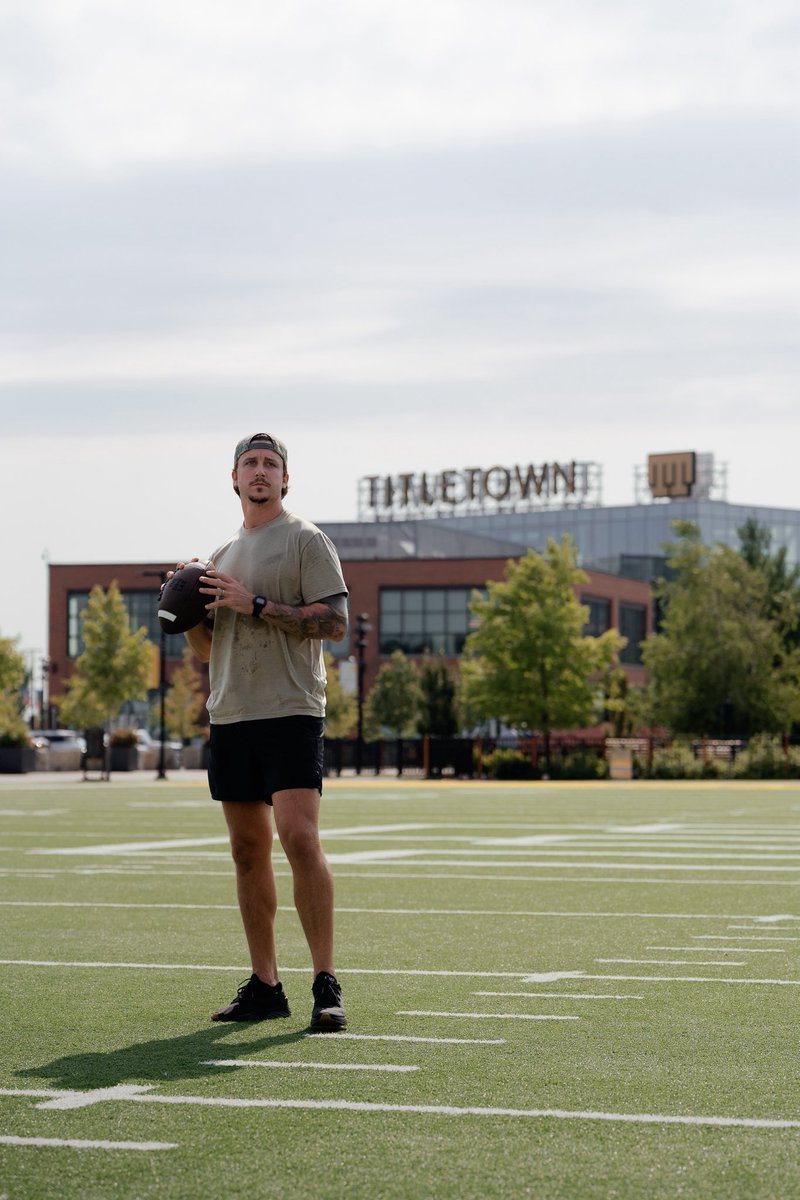
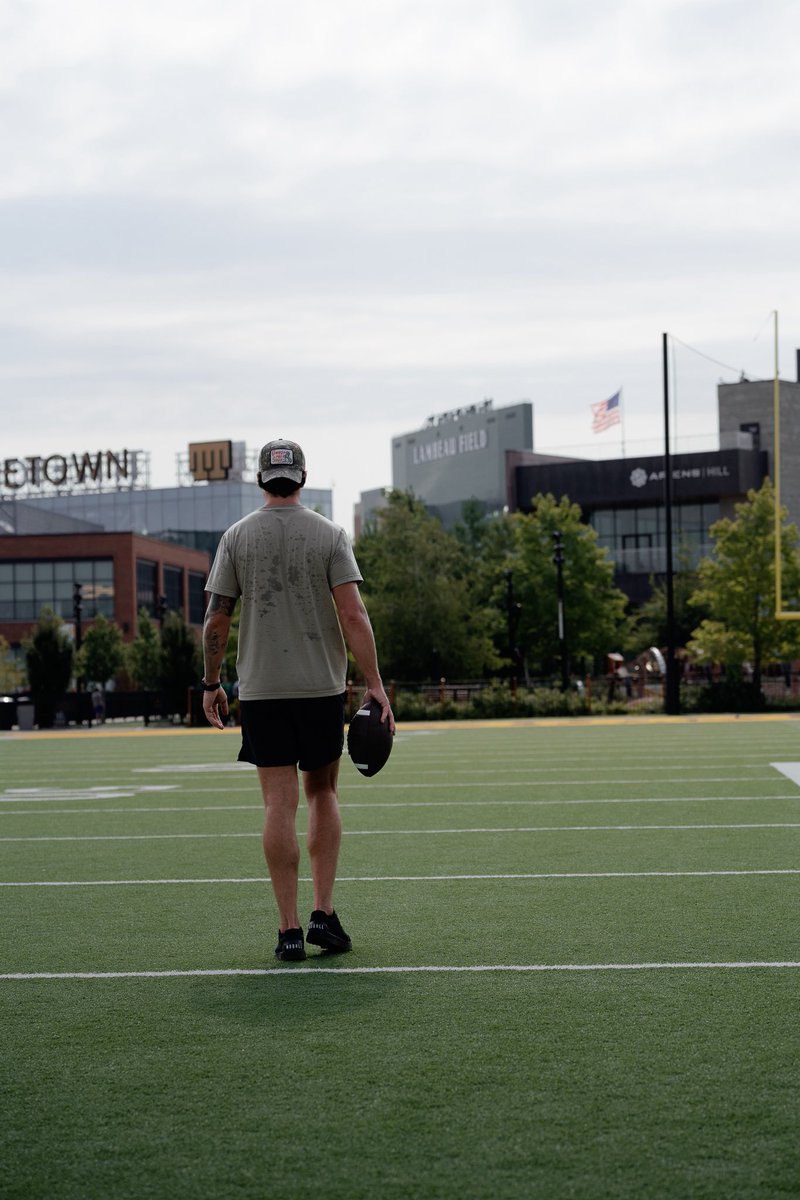
A lot has changed since they asked me to turn in my iPad in ‘22. I’m thankful that I got to come back and experience some Wisconsin summer.
The food, the lakes, the people… it’s a special place.❤️