Luis Tumialan, MD Knocks it out of the park.
Why did the federal government ban physician ownership in hospitals?
Physician owned hospitals are the highest quality hospitals either the lowest prices.
Imagine banning Apple, Google, Amazon, Nvidia, and Tesla from growing?
This is the insanity of the moratorium on physician ownership in hospitals.
You see…. This is everything wrong with public figures and public press commenting on healthcare
The NYT was unafraid to use the word doctor in the title of this article… where it mattered. Then read the article. Every reference is not Senator Marshall. It’s not Dr Marshall. It’s Mr Marshall.
The same NYT spent the last month or so blasting the No Surprises Act, which reduces the out of pocket costs for patients and protects them from surprise bills, even in emergencies like obstetrics. That’s a bill that Sen Marshall was extremely involved in and voted for.
Now the NYT and apparently other public officials (or those that seek public office) want to blast doctors for trying to collect on the dollars they are rightfully owed by their patients. I guess the answer is that all physicians should just become charities. It is unethical and immoral to seek payment or sell your receivables to a collection agency to try to get paid, particularly in emergent situations where you took call and had no choice but to provide the care.
I don’t know where this ends, but a policy where doctors are unethical for collecting the money they are due and owed and also unethical and “gaming the system” for using a government authorized process where a third party determines their value is leading to massive consolidation. Physicians are small business owners. They aren’t nonprofits with donations to keep them afloat.
This mentality is the one leading to our healthcare crisis. It’s driving doctors to consolidation so hospitals can become their payer and they no longer have to deal with the difficult decisions of keeping lights on or asking their patients to pay the bills for services doctors rendered.
We didn’t set the copay or deductible amounts. We didn’t set the rules that doctors now have to make those collections instead of insurers or others as the numbers continue to get bigger year over year.
Let’s stop casting the stones at doctors. They aren’t the problem in this system and that’s clear to essentially everyone in health policy.
I spy, with my little eye, America’s newest physician-owned hospital - will go live next fall.
Delivering babies - note that there are a whole lot of health systems that said this couldn’t be done.
Congrats @DrLGarl@NicholeMyersDMD
Chefs can own restaurants. Lawyers can own law firms. But for 16 years, federal law has stood in the way of doctors opening or expanding hospitals.
It’s time to lift the ACA’s restrictions on physician-owned hospitals and let them compete on the same footing as traditional hospitals.
https://t.co/y76CDWUaUB
Every major payer in America has filed a position on whether physicians can own hospitals.
The physicians themselves have not.
That’s how Section 6001 has survived fifteen years.
Now is your opportunity…
https://t.co/5eI8opN7Ni
🔎 For the first time in 14 years, Medicare is ready to end the status quo.
CMS just included a request for information on allowing physician-led hospitals to expand to make the TEAM model excel, and PHA President Carlos Cardenas, MD, is calling it what it is: a landmark moment.
Physicians hold the highest level of training in the healthcare system, and it’s time they’re allowed to put that expertise to work in operating hospitals. Our nation’s seniors deserve the best care possible, and that comes from physician-led healthcare.
Stay tuned for more from PHA and dozens of other healthcare stakeholders who are ready to enhance our nation’s healthcare system.
When @RepMGriffith asked insurance executives earlier this year if they opposed lifting the ban on physician-led hospitals, not a single hand went up.
This week, he asked physicians and hospital leaders the same question. Only ONE hand was raised — the CEO of the American Hospital Association.
‼️Let that sink in.
Communities in healthcare deserts are being denied care — not because physicians can’t help, but because special interest doesn’t want them to lead.
The same physicians trusted to treat patients every day are blocked from owning and operating hospitals — while large systems consolidate power, drive up costs and limit options.
Since the ban took effect in 2010:
• Hospital consolidation has increased.
• Prices have risen.
• Patient outcomes have declined.
✅ This policy hasn’t worked. It’s protected special interests — not patients.
✅ Physicians should be empowered, not controlled.
When physicians lead, patients succeed.
✅ It’s time for Congress to change course
✅ Time is up on the arbitrary ban on physician-led hospitals.
📺Watch the exchange:
https://t.co/peoNXdJuTQ
Oh come on…
On self-referral “conflict of interest”: The Stark Law already governs physician self-referral. POH physicians must publicly disclose their ownership interest to every referred patient.
Now… what do hospital controlled doctors disclose?? Nothing. They have zero disclosure obligation when they refer patients to the same corporate system that signs their paycheck. They are systematically incentivized to use higher-cost outpatient hospital settings rather than independent facilities. A 2020 Journal of General Internal Medicine analysis of Texas BCBS claims found hospital-owned physician practices generated 5.8% higher annual spending, 13% higher imaging costs, and 21.7% higher outpatient facility costs than independent practices, driven entirely by utilization and site-of-service billing. If the concern is financial conflicts driving utilization, the data points to hospital consolidation, not physician ownership.
On the “data is clear” claim about cherry-picking: The data is actually clear in the opposite direction. The 2015 BMJ study examined 219 POHs and 1,967 non-POHs across 95 hospital referral regions and found Medicare patient proportions were statistically identical with 47.1% at POHs versus 47.2% at non-POHs. Medicaid proportions were 14.9% versus 15.4%. Minority patient proportions were similarly equivalent. The 2024 Physicians Advocacy Institute analysis of 20 high-cost DRGs found no evidence of cherry-picking after controlling for patient age, race, and health status. At the same time they found POHs delivered care at 8-15% lower Medicare cost per episode. The 2023 JAMA Network Open study found POHs had 17.5% lower commercial negotiated prices and 46.7% lower cash prices in the same geographic markets. The “cherry-picking” narrative collapses under peer-reviewed scrutiny.
On rural hospital harm: The FAH report this argument relies on was commissioned by the Federation of American Hospitals and the American Hospital Association. It is a modeled simulation based on hypothetical scenarios, not observed real-world outcomes. The legislation in question (H.R. 2191) specifically requires a 35-mile separation between a new POH and any existing rural hospital, which is a provision designed precisely to avoid the competitive overlap this model assumes. More importantly, 152 rural hospitals have closed since 2010 (when the POH ban took effect). The ban did not protect rural access. It accelerated consolidation, reduced competition, and drove up costs. Markets with POHs have 16.7% lower concentration scores than markets without them. The real threat to rural hospitals is a Medicare reimbursement structure that already produces -11.8% Medicare margins for sole community hospitals. Fixing that requires payment reform, not protecting incumbent hospital systems from physician-led competition.
What’s perhaps not discussed enough is that nearly every procedure performed in hospitals today is subject to utilization review (prior authorization). If someone is looking over the claim to make sure it is indicated and medically necessary, all of these arguments go away anyway. It doesn’t matter if the physician takes the procedures to their own facility, particularly if the physician hospital provides the same or better quality and the same or lower price.
The ACA Section 6001 ban on physician ownership was legislative horse-trading, so let’s not pretend to take some high road that this is about protecting patients. Fifteen years later, consolidation has accelerated, patient choices have narrowed, and the organizations lobbying hardest to keep the ban are the ones profiting most from it.
Amazing work today by @DrDiGiorgio - member of @CNS_Update and @AANSNeuro - advocating for patients today in Congress.
It’s time to end the arbitrary ban on physician-led hospitals put in place by special interest lobbyists.
@neurosurgery@AmerMedicalAssn
We look forward to hearing Washington Committee member @DrDiGiorgio highlight some key priorities in our legislative and regulatory agenda in his testimony, including unleashing physician-led hospitals to increase competition and improve quality of care, reducing administrative burden to put patients over paperwork, and stabilizing Medicare payments to sustain private practices across America. #fixmedicarenow #fixpriorauth
@CNS_Update@AANSNeuro@spinesection@councilsns@SpecialtyDocs@physicianhosp
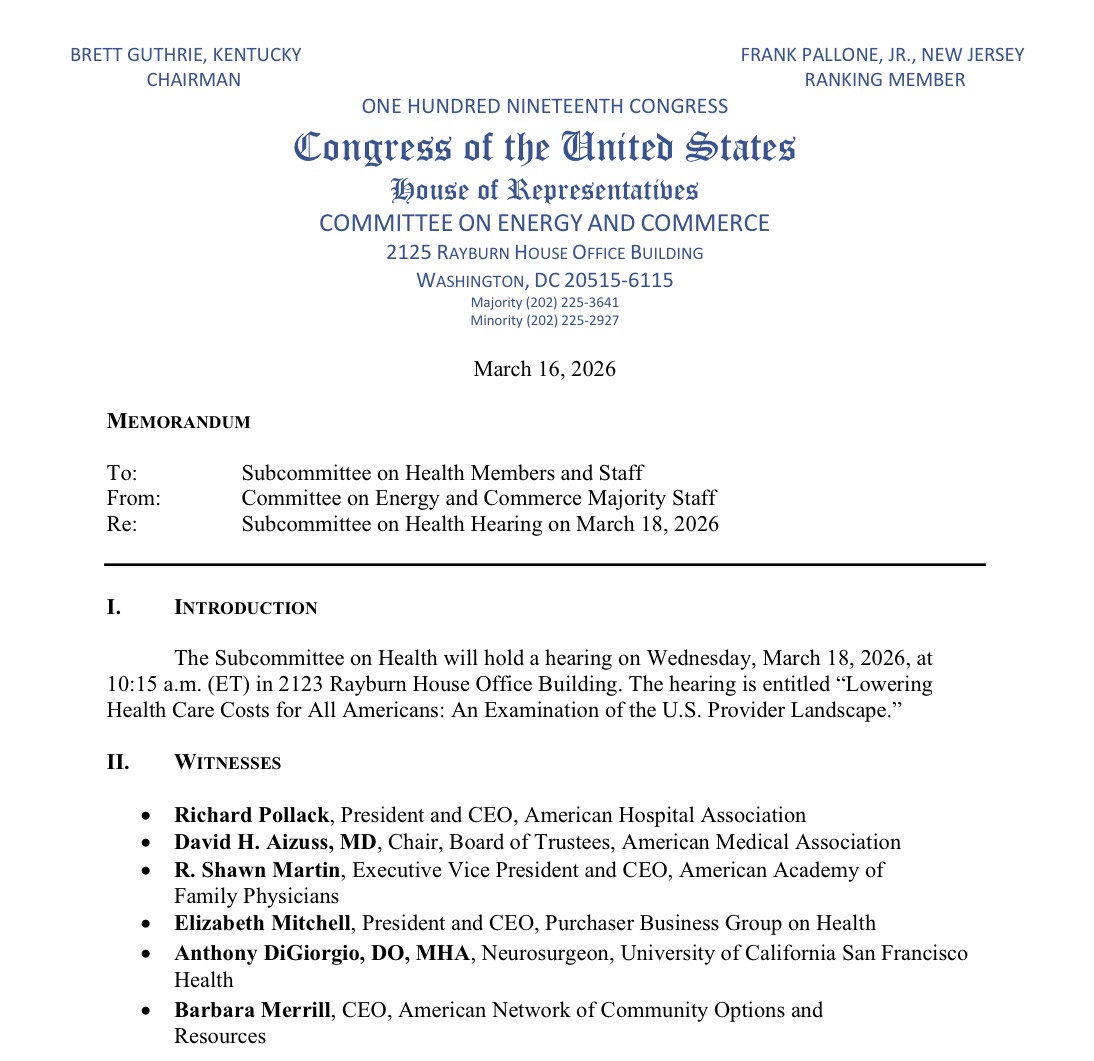
I’m honored to testify before the @HouseCommerce Health Subcommittee on March 18 as Congress examines the background, scale, and consequences of rising health care costs.
Health care affordability is one of the defining policy failures of our time.
@brian_blase is exactly right. Medicare prices are set by politics, not markets, which means hospitals win, insurers win, and physicians lose. And that distortion is driving the healthcare cost crisis, not solving it.
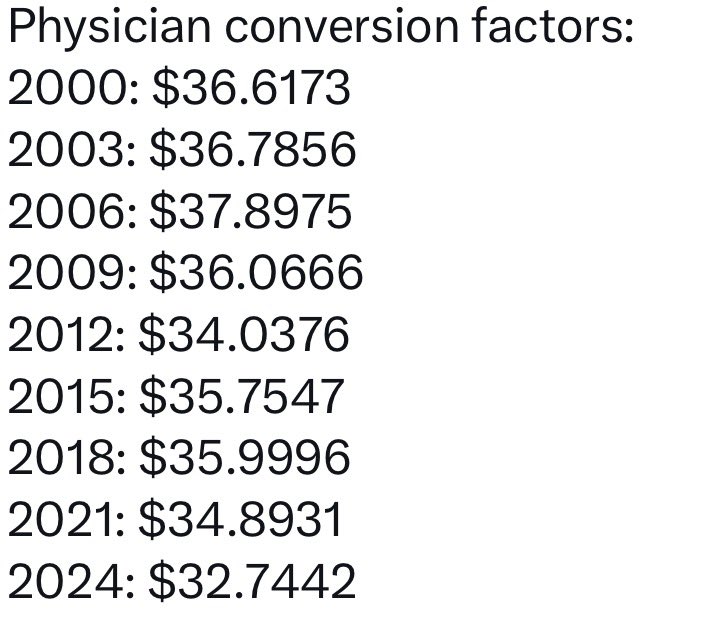
Since 2000, the physician conversion factor has gone from $36.62 → $32.74 — a nominal cut of ~10% while inflation ran 86% over the same period. Meanwhile hospital inpatient rates rose 30% since 2016 alone. We’re not underpaying hospitals. We’re systematically defunding physician care.
When you can’t sustain a practice on Medicare rates, you sell. In 2019, 62% of physicians were employed by hospitals or corporate entities. By Jan 2024 it was 77.6%. Cutting physician pay doesn’t reduce costs. It eliminates independent practice and hands leverage to the most expensive site of care.
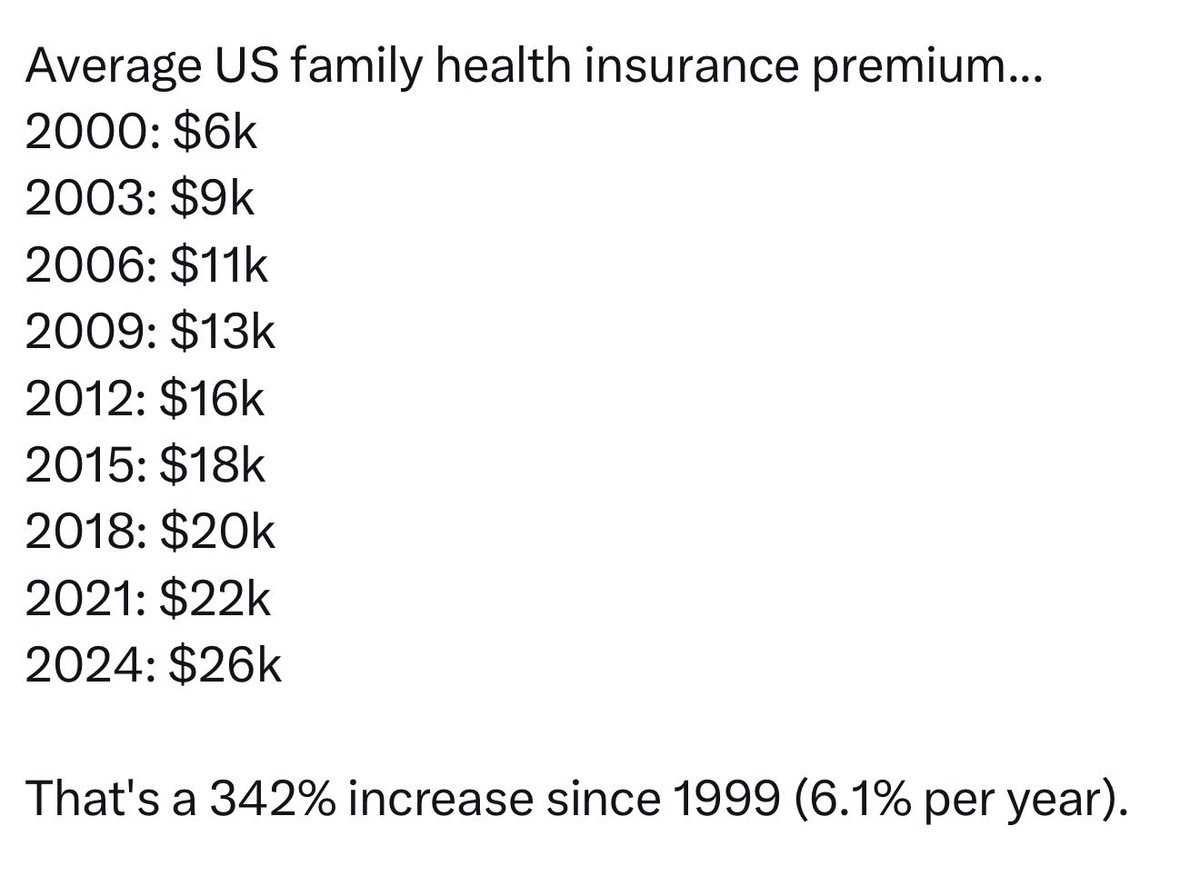
Here’s what nobody wants to say out loud: the average family health insurance premium went from $6k (2000) → $26k (2024), a 342% increase, while physician pay fell 10% over the same period. If physician pay were driving premiums, the lines would move together. They don’t. In fact, they’re inversely related. Every reduction in physician pay leads to a simultaneous increase in patient premiums.
The money didn’t disappear. It moved away from the physician-patient relationship and toward administrative overhead and insurer profit. UHC stock: up 8,556% before its massive downfall. Insurance premiums: up 342%. Inflation: up 86%. Physician pay: down 10%.
The fix isn’t complicated: index physician payment to inflation, equalize site-of-service payments, and stop rewarding consolidation through facility fees.
Pay physicians fairly → more stay independent → less consolidation → lower system costs. The data is clear. The politics just haven’t caught up.
Congress outlawed physician-owned hospitals in 2010.
The American Hospital Association and the Federation of American Hospitals lobbied for it.
CMS data shows 9 of the top 10 hospitals for quality, access, and cost are physician-owned.
Charges are one-third lower than traditional hospitals for the same procedures.
Congress banned the best model and now wonders why healthcare is expensive.
And you’re wondering why your premiums are high? Kennedy and OZ could fix it tomorrow…
This simple principle can be applied to US healthcare
US chose to move towards socialized healthcare with the ACA and look at the inefficient, expensive dumpster fire healthcare system we have today
Bring back private practice
Bring back physician ownership hospitals
Bring back competition, free market and capitalist principles in healthcare
In one of the most medically underserved regions in the country, physician ownership made all the difference - allowing physicians to build what our community actually needed.
Carlos Cardenas, MD, of @DHRhealth takes a look at the importance of physician-led hospitals.
URGENT:
The Republican healthcare plan includes “provider owned hospitals”! Today is a massive breakthrough for everyone who has been fighting to reverse the injustice. As quickly as I am typing this, members of the AHA and FAH will be working to protect their monopoly on hospitals ownership.
Remember that this policy will reduce costs and improve quality. Call your Congressman today and let them know that the “provider owned hospitals” cannot be stripped out of the plan. They cannot back down to pressure from hospitals. We have let large corporations put in their monopoly granting regulations for far too long. Let’s take back our healthcare system!
Breaking News: Independent doctors get a new advocacy group as skepticism of health giants grows
Today we launch a new group focused on the issues that matter to patients and the independent physician community.
We’re fighting for
• Physician Autonomy
• Fair Reimbursement
• Fixing the No Surprises Act
• Protecting practices against consolidation
Independent doctors deserve a voice. Now we have one. If you believe in independent medicine and the ways it will help to fix our healthcare system, join us today. It’s time to take back our healthcare system.
Read our @statnews exclusive story at
https://t.co/TEvZUFaco3
@IndeMedAction