If JavaScript can get rewritten into rust in days to weeks …
How soon can the entire hardware stack be translated into lean for the self verifying hardware Olympics to begin ?
@type1ayy@i2cjak I’ve been trying to dig deeper into this rabbit hole.
Every aspect of design from RTL, to EDA tools have to be defined in one common domain then translated into lean.
After that the self verification loop speed run begins to start designing crazy shit
@Reagent_Systems like for the vibe or for the practicality?
on device STT is actually great here.
but then the tying itself ?? why or how other than just if you like the sound and vibe of type
As we inch closer to the final frontier,
I wonder how Synopsys /Cadence will put up a fight in regards to Vendored IP, and Standard Cells
Soon as any frontier model gets their own spec for DDR, PCIE and critical Standard Cells.. or even reverse engineers it..
What happens next?
@MiaAI_lab Founder shared benchmarks to prove they don’t quant their models to serve them like this. 🤔
Are you using just their API or the full opencode harness?
Opencode harness has some the worst agentic performance compared to most others like Pi, Codex, etc.
If something isn't working, anything. Don't ask yourself why it isn't. Ask yourself how could you fix it. There is nothing you can't fix, if you only think. Think! Think, don't give up. There is always something you can do. There always is another option
@poteto@bot Mainly telling @bot to remote to my machine on tailnet thanks to the new tailscale connector !!
it Helped observe and gather results from the experiment to write my report !
Was inspired by some your posts about Software being able to self verify to reduce adversarial audit and time spent on human review.
Gave @bot and experiment to run on exploring how we can set out to benchmark this and build on this for designing hardware
https://t.co/jRFXvQTVDd
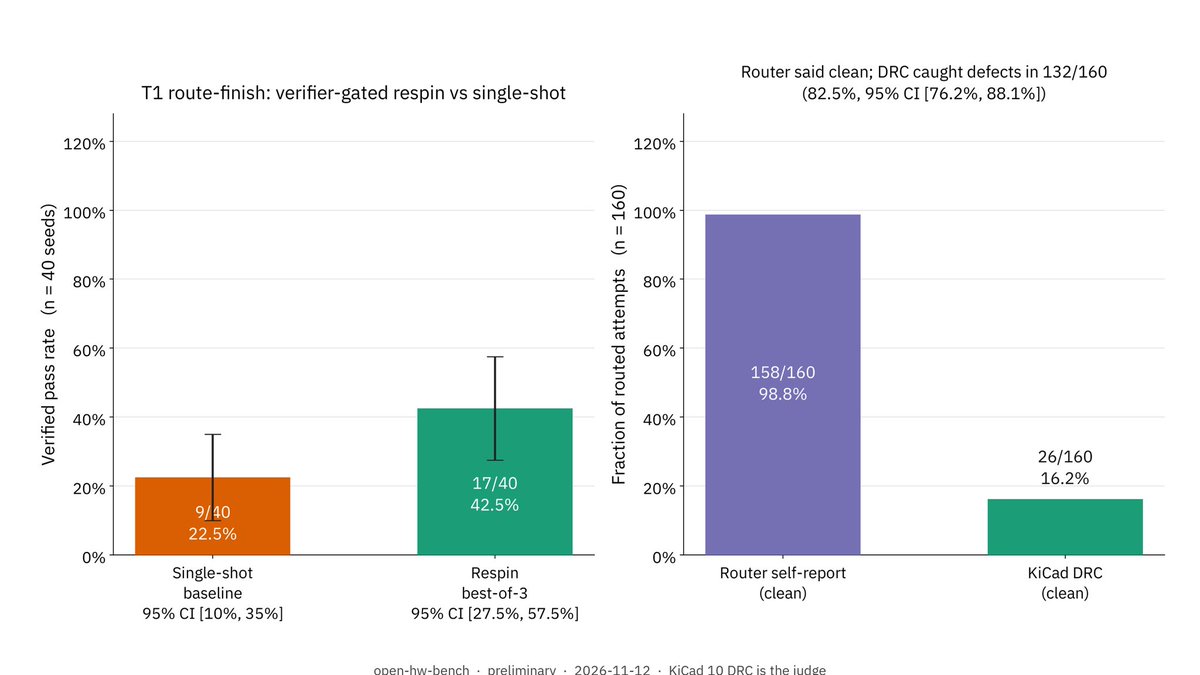
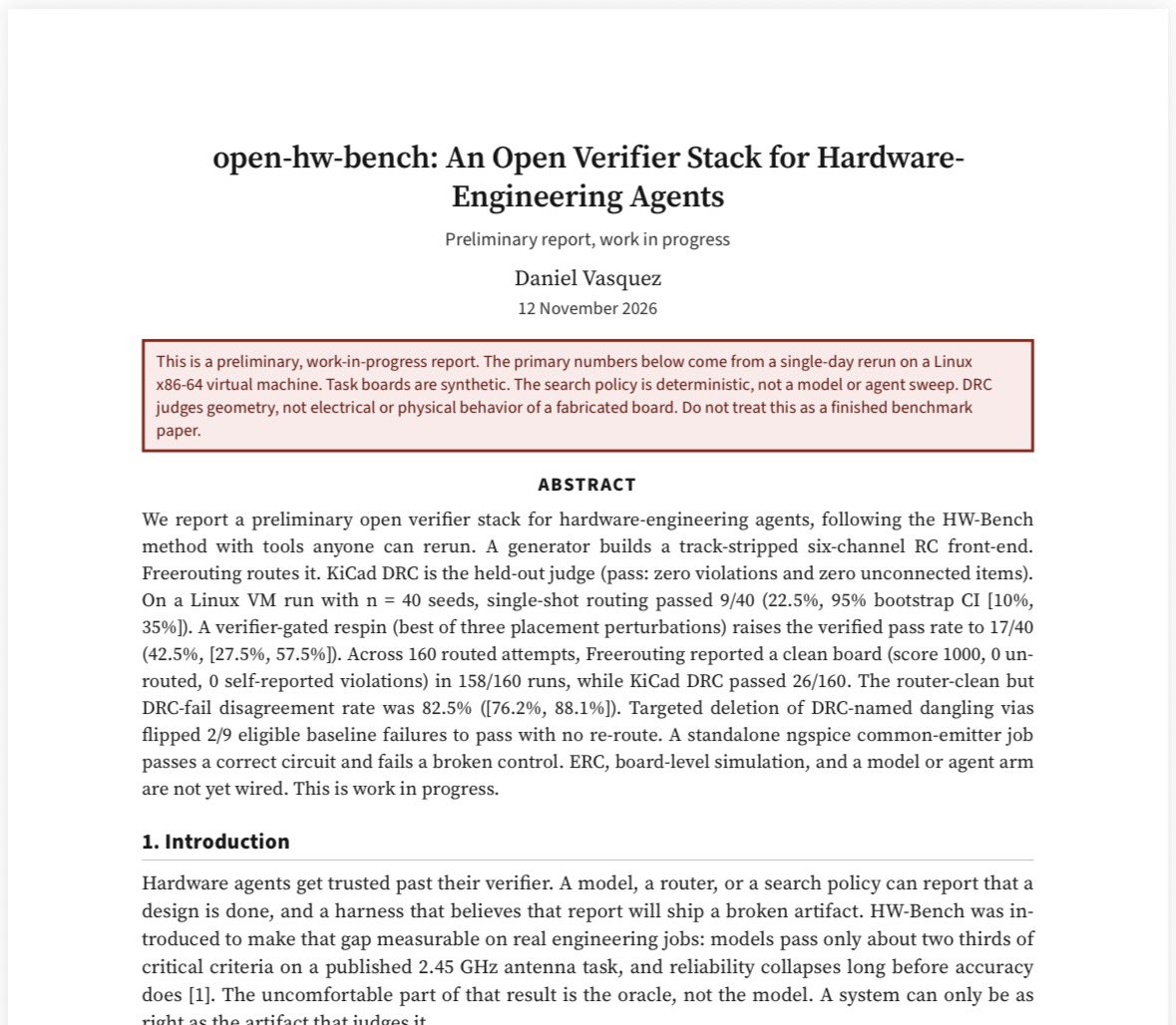
We applied The Bitter Lesson to hardware verification. Same open PCB router, same boards, plus a deterministic verifier in the loop: verified pass rate up 89% (22.5% to 42.5%, n=40). The router alone called 158/160 boards clean. KiCad DRC caught real defects in 132. 🧵
5
Thanks to @thinkymachines for the AI credits that power this research. Early results, more data coming. Code lands in the repo in a few days after review.
Inspired by @arenaphysica@hardwarebench
We applied The Bitter Lesson to hardware verification. Same open PCB router, same boards, plus a deterministic verifier in the loop: verified pass rate up 89% (22.5% to 42.5%, n=40). The router alone called 158/160 boards clean. KiCad DRC caught real defects in 132. 🧵
4
Next: the same loop for semiconductor design and EDA. Timing with OpenROAD and OpenSTA, LVS, RF with openEMS, ERC and SPICE on routed boards, then model and agent runs scored on repeat reliability. Preliminary paper and data: https://t.co/rTffvPTSlJ