Excited to share our paper published in @CommsPsychol 🥳
Using VR, EEG, real-time affect rating, and deep representation learning, we show that subjective awe is better predicted by ambivalence-related behavior and neurogeometry than univalent ones (1/n)
https://t.co/PBn8dSUvdE
Excited to share our new findings on how internal states dynamically modulate the population dynamics!
This was only possible due to the amazing mentorship of @SurLabMIT and @timbuschman!
Check it out here!
https://t.co/iugzNYMSFD
Explainable AI may be pointing at the wrong features, systematically.
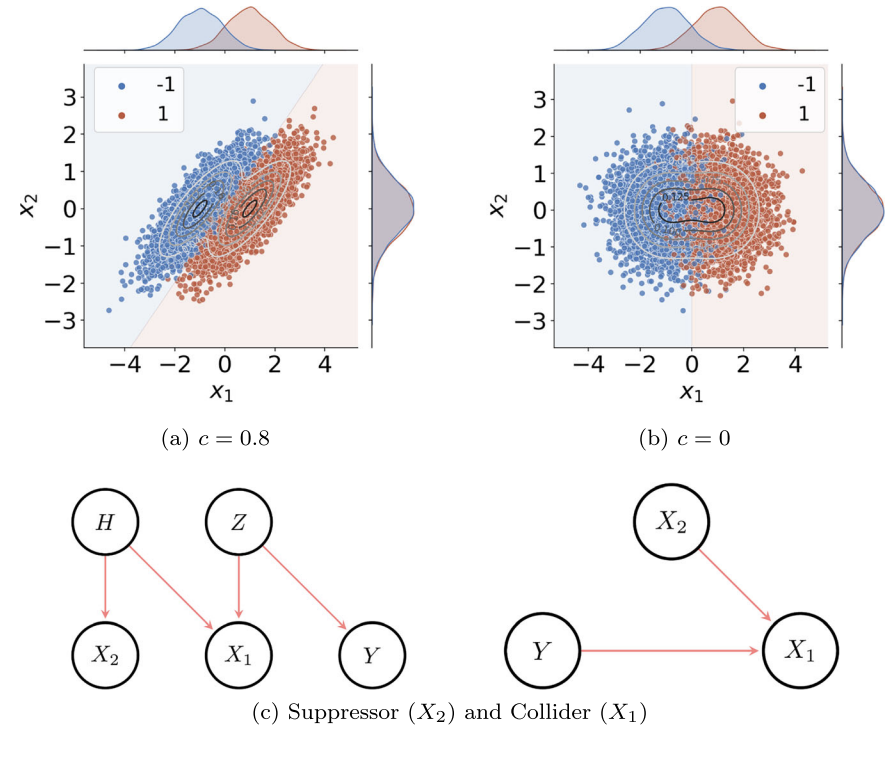
When a machine learning model predicts that a patient is at high risk of a clinical event, and an explainability tool highlights "age" as a key driver, most practitioners will nod and move on. But what if age is not actually informative about the outcome — and the model is using it only to cancel out noise in a correlated variable that is informative? You would be reading a coherent, plausible explanation that is fundamentally wrong.
This is not an edge case. Stefan Haufe and coauthors show why it is the expected behavior of most popular explainable AI (XAI) methods — including SHAP, LIME, integrated gradients, LRP, counterfactual explanations, and permutation feature importance.
The core problem is what statisticians call suppressor variables: features that have no statistical association with the prediction target, yet improve model performance by removing irrelevant variance from features that are informative. A classic example — blood pressure depends on age, but age itself may not predict the disease. An optimal model may assign non-zero weight to age precisely to denoise the blood pressure signal. When XAI methods reduce to model weights, as the authors show analytically for linear models and empirically for non-linear ones, they will highlight the suppressor — not the informative feature.
The authors introduce the Statistical Association Property (SAP) as a necessary condition for any XAI method to be fit for purpose: if a method flags a feature as important, that feature must have a genuine statistical association with the target. Testing a broad range of popular methods against this criterion, they find that nearly all fail it in the presence of correlated features — true of virtually every real-world dataset.
The path forward is a shift from algorithm-first to problem-first development: formally define what an explanation should answer, derive correctness criteria, validate against synthetic ground-truth data, and only then assess robustness and usability.
This has direct consequences for applied R&D teams. Explainability tools are increasingly used to shortlist candidate molecules, flag confounded biomarkers, or justify regulatory submissions. If those tools are suppressor attributors, the features they highlight may carry no real biological or physical signal — meaning that follow-up experiments, costly and time-consuming, could be chasing artifacts. Demanding formal SAP compliance from XAI tools used in applied pipelines is not academic caution; it is a prerequisite for reproducible, trustworthy science-in-the-loop workflows.
Paper: Haufe et al., npj Artificial Intelligence (2026) — CC BY 4.0 | https://t.co/AUdfWCz4cA
Thrilled to share that my first PhD project was nominated for both an oral presentation and a travel award at the upcoming @SANS_news!
I’m looking forward to discussing new ideas and analytic considerations. Feel free to reach out if you're interested! See you in San Diego 👋
How do you know how someone is feeling? We don't just use facial expressions, we combine expressions with "context", like body language and scenes, to truly understand emotions. Our study investigated the brain's computational mechanisms for integrating these cues in real-time.
Clarifying the conceptual dimensions of representation in neuroscience — a Perspective by Stephan Pohl, Edgar Y. Walker, David L. Barack, Jennifer Lee, Rachel N. Denison, Ned Block, Florent Meyniel & Wei Ji Ma
https://t.co/6Tap2kIZgZ
A new preprint titled Lost in Emotional Space introduces the concept of emotional bandwidth as a metric for navigating daily emotional landscapes.
https://t.co/TekDe7z04c
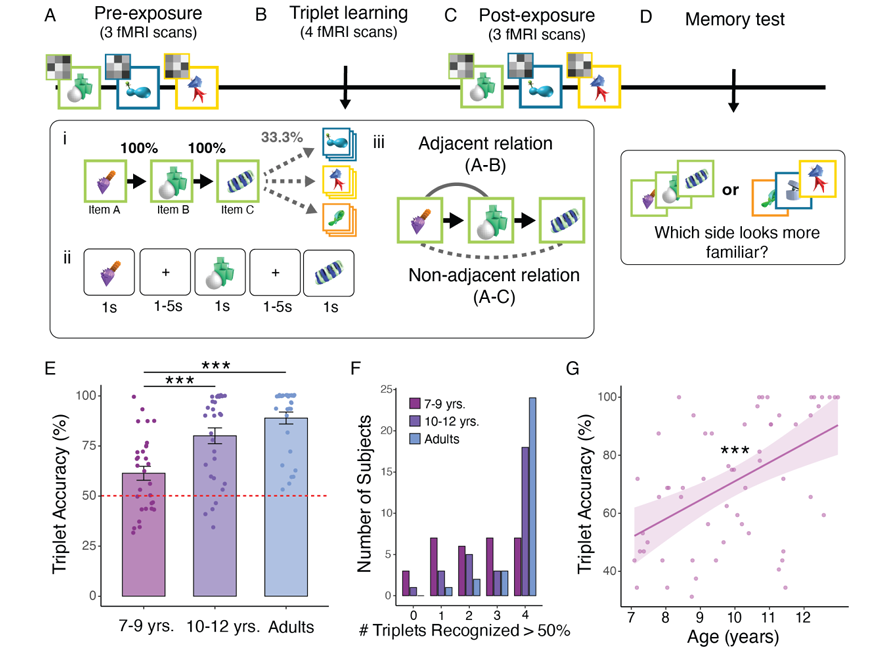
How the developing brain (mostly the hippocampus) constructs increasingly flexible representations of predictive temporal structure
https://t.co/eBcu5q9sWZ
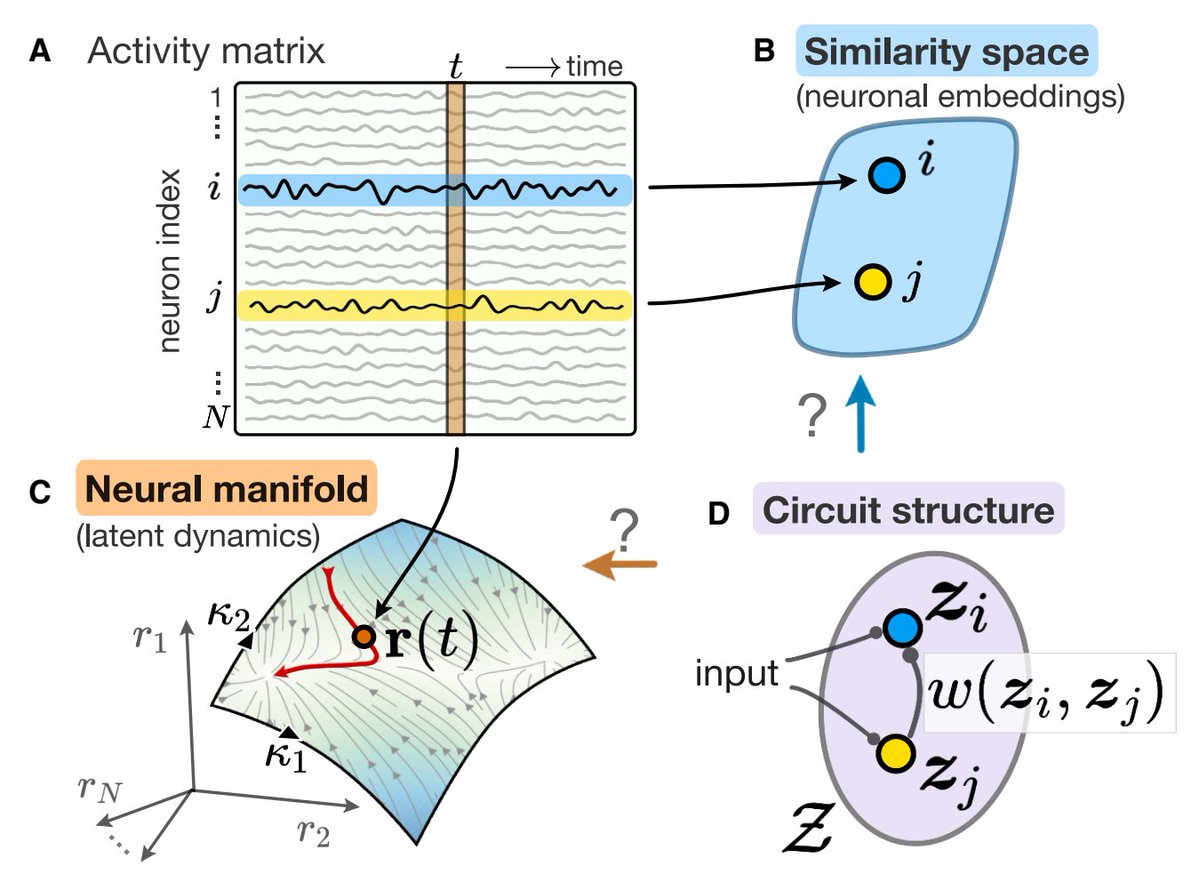
𝗪𝗵𝗮𝘁'𝘀 𝘁𝗵𝗲 𝗿𝗲𝗹𝗮𝘁𝗶𝗼𝗻𝘀𝗵𝗶𝗽 𝗯𝗲𝘁𝘄𝗲𝗲𝗻 𝗺𝗮𝗻𝗶𝗳𝗼𝗹𝗱𝘀 𝗮𝗻𝗱 𝗿𝗲𝗰𝘂𝗿𝗿𝗲𝗻𝘁 𝗻𝗲𝘁𝘄𝗼𝗿𝗸𝘀 𝗶𝗻 𝘁𝗵𝗲 𝗯𝗿𝗮𝗶𝗻?
This looks like a must read (suppl material bursting with goodies).
https://t.co/aMNOr9ReQV
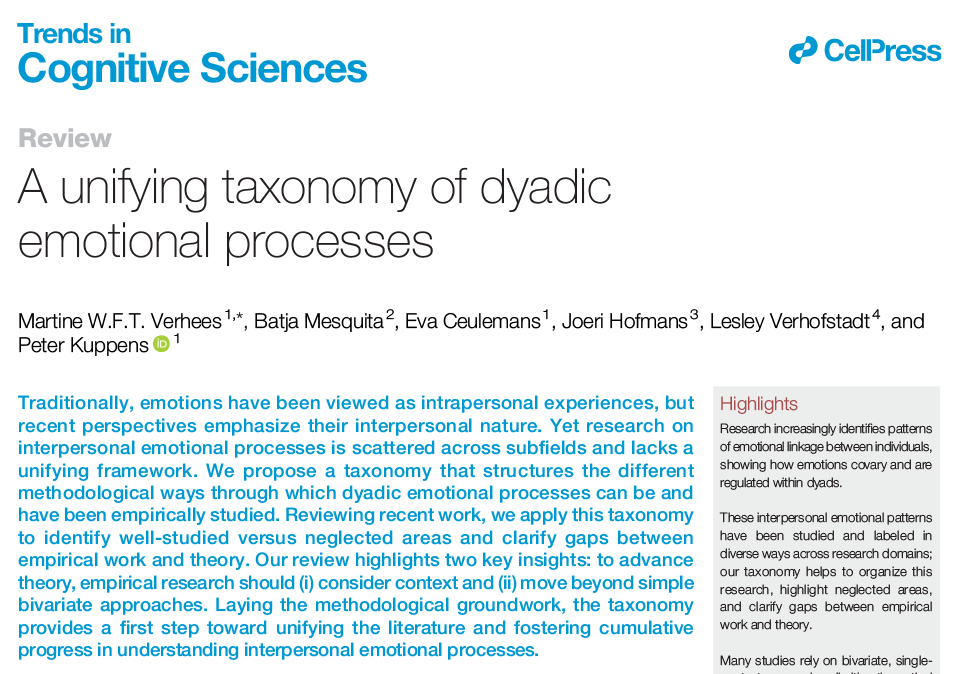
A unifying taxonomy of dyadic emotional processes
Review by Martine W.F.T. Verhees, Batja Mesquita (@BatjaMesquita), Eva Ceulemans, Joeri Hofmans, Lesley Verhofstadt, & Peter Kuppens
https://t.co/N81tDtqTQY
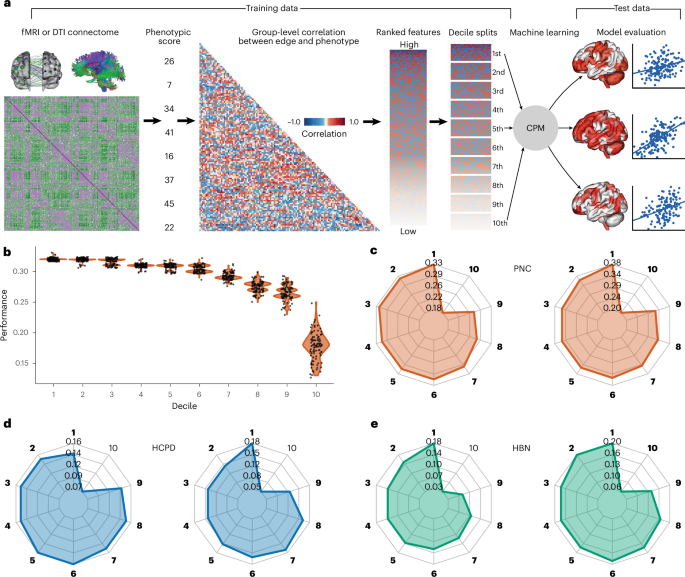
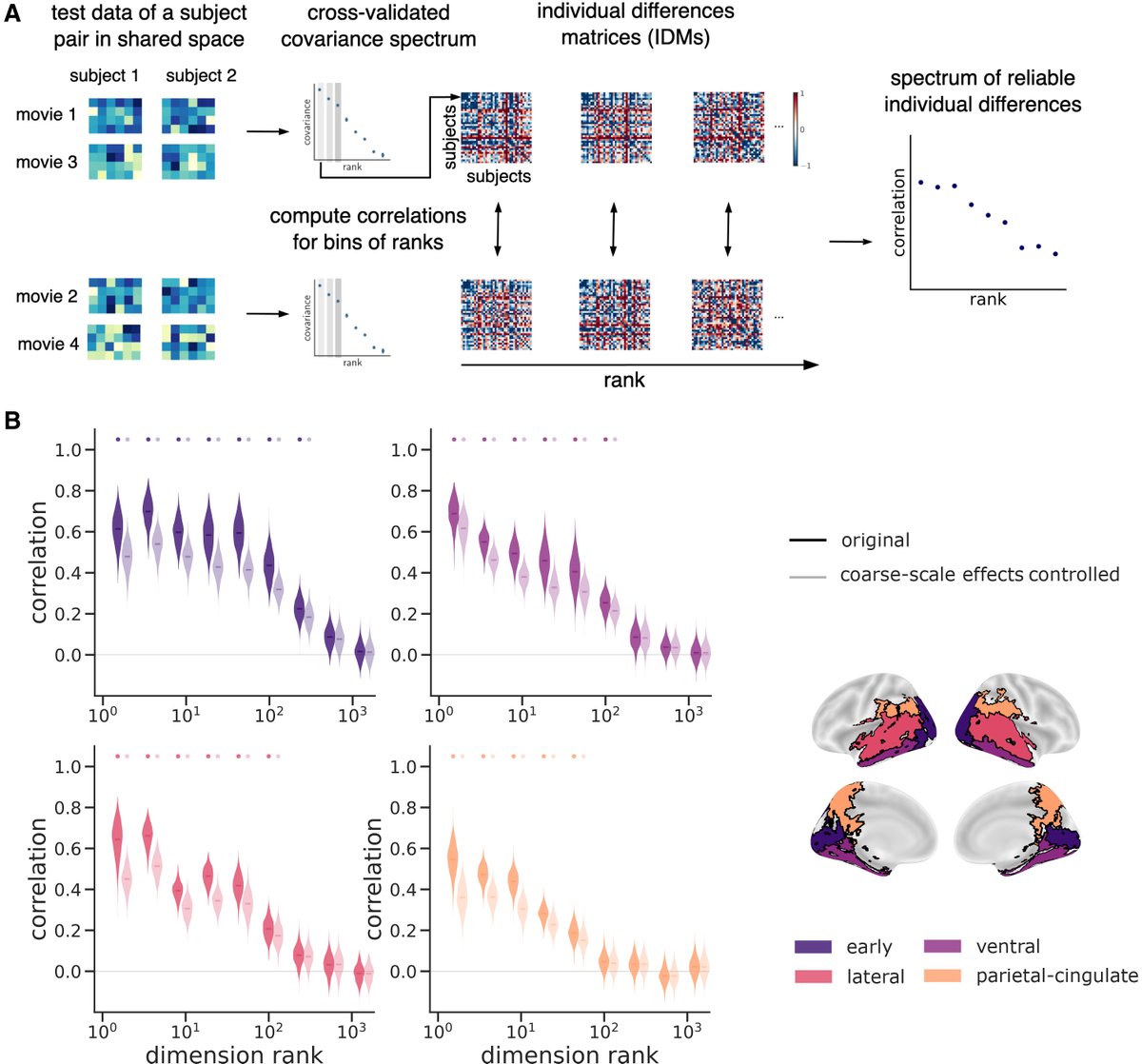
In our new work, we find that the ways individual brains differ are *not* constrained to a few dominant patterns. We find distinct patterns in how individual brains process natural movies along many latent dimensions, and these differences are reliable across different movies.
New Substack post: When neural networks learn to speak the language of science
Modern AI excels at prediction—forecasting weather, folding proteins, winning games—but ask it why and you get silence. The knowledge that must be encoded somewhere in those billions of parameters remains locked away, inaccessible to human understanding.
Ziming Liu and coauthors present a framework to change that. Their paper develops Kolmogorov-Arnold Networks into tools for curiosity-driven science—not just prediction, but discovery.
I wrote a deep dive on Substack covering the key ideas, the new tools introduced in the paper, and applications ranging from conservation laws to hidden symmetries in black hole physics.
Link to the post: https://t.co/cFvmVXIOQu
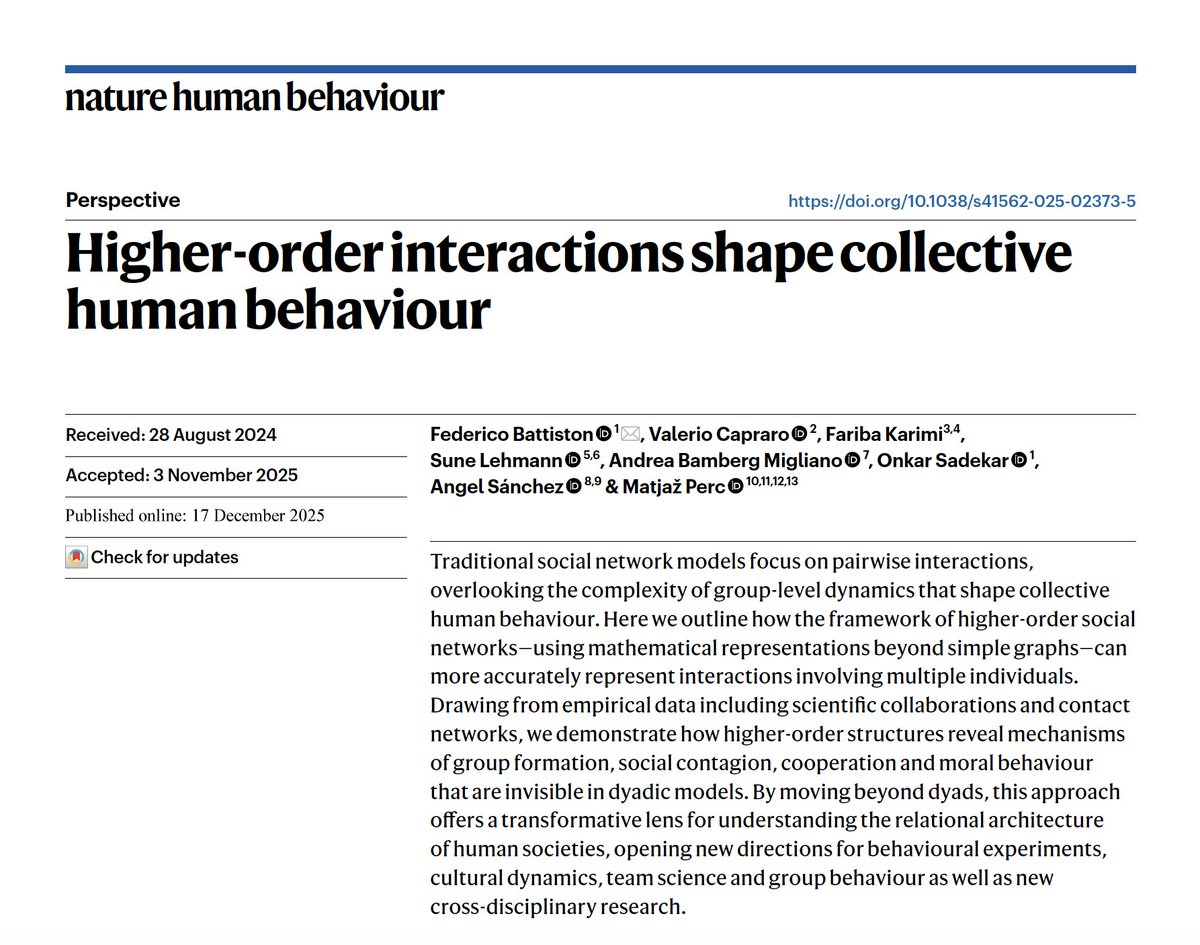
Now out in Nature Human Behaviour! 🚀🚀
Over the past decades, research on collective human behaviour has relied heavily on networks. This is intuitive: people interact with other people.
However, we argue that this dominant framework misses a crucial ingredient.
Traditional networks represent agents as nodes and pairwise relations as edges. As a result, they fundamentally assume that social interactions can be decomposed into pairs.
Yet many social processes are irreducibly group-based.
A simple example: a group of three coauthors writing a paper cannot be reduced to three independent pairs of coauthors. The group itself matters.
In this article, we review a wide range of empirical and theoretical cases where group interactions cannot be decomposed into pairwise ones, and show that higher-order interactions shape collective behaviour above and beyond dyadic ties.
We advocate studying collective behaviour on hypergraphs, where interactions can involve multiple agents simultaneously.
We review how hypergraphs provide new insights across domains, including affiliation and collaboration networks, high-frequency contact settings (families, friends), and key social processes such as social contagion, cooperation, truth-telling, and moral behaviour.
Finally, we outline promising directions for future research: addressing computational challenges of higher-order models; studying bias and inequality in group dynamics; combining hypergraphs and large language models to investigate the coevolution of language and behaviour; and using higher-order networks to simulate the impact of policies before implementation; and others.
We are very excited about this work and hope it will inspire further research in a rapidly growing and fundamental area with broad real-world implications.
Link to the paper in the first reply
This work was brilliantly led by Federico Battiston (@fede7j), with an outstanding team of co-authors: Fariba Karimi (@fariba_k), Sune Lehmann, Andrea Bamberg Migliano, Onkar Sadekar (@OnkarSadekar), Angel Sanchez, & Matjaz Perc (@matjazperc)
Just out in Nature Reviews Neuroscience! We've been studying information synergy within the brain for a few years now: here we explore how we can take this approach to the level of synergy *between* brains! 🧠🔄🧠
Thanks to Edoardo Chidichimo for leading this inter-brain synergy!
Another new paper from Feldman Barrett and colleagues connecting allostasis and interoception. Many new insights!
Cortical and subcortical mapping of the human allostatic–interoceptive system using 7 Tesla fMRI
https://t.co/yzaqguHtW7